
Eleuthero (Siberian ginseng): for immunity and endurance (FAQ)
Eleuthero, or Siberian ginseng: what clinical studies have really shown about endurance and fatigue, and what medications the plant interacts with.
Eleuthero, sold in Poland as Siberian ginseng, has one of the longest research programs in the history of herbal medicine and at the same time one of the most difficult-to-access evidence bases. Over a thousand papers have been published on it in the USSR, which have never been translated into English, and most of the promotional promises surrounding this plant refer to them. When Western researchers began to verify these reports using their own methods, the results were much more modest than the plant’s reputation suggested: the most frequently cited sports trial showed no difference compared to placebo. This article shows what can be defended today about eleuthero with controlled studies, what remains an unfulfilled promise, and where the real risk lies when taking medications simultaneously.
KEY INFORMATION
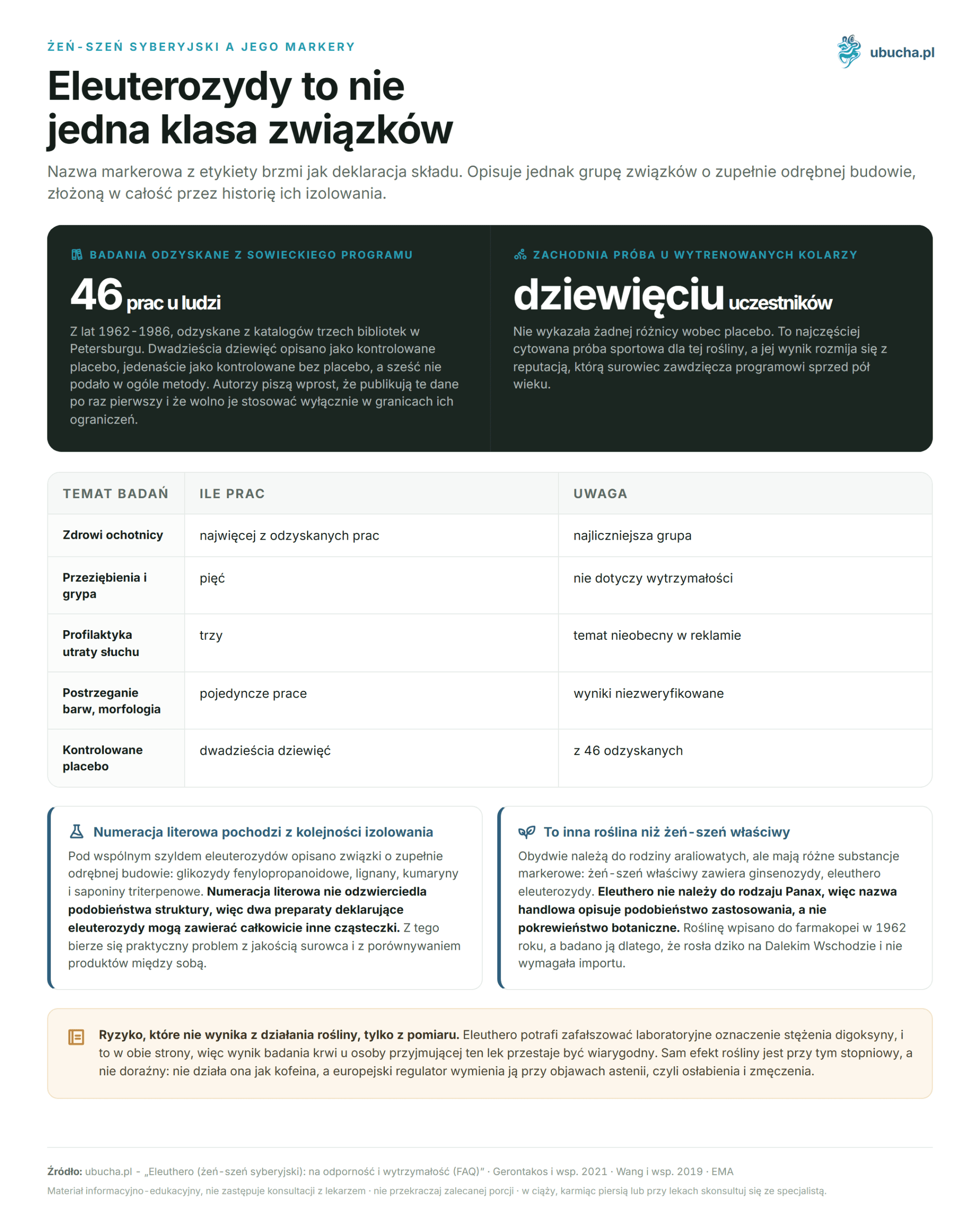
• 46 clinical studies from the Soviet research program from 1962-1986 were recovered, of which 29 were described as placebo-controlled (Gerontakos et al., Journal of Ethnopharmacology, 2021).
• The European Medicines Agency lists eleuthero for symptoms of asthenia, i.e., weakness and fatigue.
• A Western trial in nine trained cyclists showed no difference compared to placebo.
• Eleuthero can adulterate laboratory measurements of digoxin concentration, in both directions.
• The effect is gradual, not immediate: eleuthero does not act like caffeine.
Why was eleuthero studied in the USSR?
Because it was a native plant, growing wild in the Far East, and did not require import from Korea. Eleuthero (Eleutherococcus senticosus, also known as prickly eleutherococcus) was officially included in the USSR pharmacopoeia in 1962 and became the subject of a separate research direction on substances improving endurance. Today, the European Medicines Agency lists it for symptoms of asthenia, i.e., weakness and fatigue.
The scale of this program is difficult to compare with anything in Western phytotherapy. The team of Gerontakos (Journal of Ethnopharmacology, 2021) counted over a thousand publications, none of which have been translated into English, as for safety reasons they were not made available outside the USSR. The authors visited three libraries in St. Petersburg and recovered 46 studies involving humans, published in Russian from 1962-1986. Twenty-nine were described as placebo-controlled, eleven as controlled without placebo, and six did not provide a method at all.
It is worth seeing what these studies were about, as the distribution of topics does not match today’s advertising of the supplement. Twenty-one studies were conducted on healthy volunteers, five concerned the prevention of colds and flu, three the prevention of hearing loss, and single studies on color perception, blood morphology, and cognitive functions. The authors state directly that they are publishing this data for the first time and that it should only be used within its limitations: no one has verified the raw results from half a century ago today.
How does eleuthero differ from Korean ginseng?
They are two different plants from the same family of Araliaceae, with different marker substances. True ginseng (Panax ginseng) contains ginsenosides. Eleuthero contains eleutherosides and does not belong to the genus Panax, so the commercial name “Siberian ginseng” describes similarity in use, not botanical kinship.
The name “eleutherosides” can be misleading, as it does not denote a single chemical class. Under this common label, compounds with completely different structures have been described: phenylpropanoid glycosides, lignans, coumarins, and triterpene saponins. The letter numbering from A upwards comes from the order of isolation, not from structural similarity, so two preparations declaring “eleutherosides” may contain completely different molecules.
This leads to a practical problem with the quality of the raw material. The team of Wang (International Journal of Molecular Sciences, 2019) examined 24 samples of plant material and commercial products with eleuthero using UHPLC with mass detection. In three of the eleven products studied, green tea (Camellia sinensis) was detected, which was not on the label, and which the authors considered adulteration of the raw material. This same problem also applies to declarations on the packaging: the content of triterpene saponins in the leaves is low and difficult to determine with ordinary UV detection, so the number on the label may not correspond to the method by which it was obtained.
Does eleuthero improve physical endurance?
In the only Western sports study with a controlled method, it did not improve. This finding directly contradicts how eleuthero is marketed, so it is worth describing it in detail, along with what exactly was measured.
Eschbach et al. (International Journal of Sport Nutrition and Exercise Metabolism, 2000) used a crossover design with double blinding in nine highly trained men. Each of them rode for 120 minutes at about 60 percent of their oxygen uptake, and then underwent a simulated time trial over a distance of 10 kilometers. The diet was controlled, and eleuthero or placebo was administered for seven days before each of the two trials. Oxygen consumption, respiratory exchange ratio, heart rate, perceived exertion, and plasma lactate and glucose concentrations were measured.
No significant differences were found: neither at any stage of steady-state riding nor in the time trial. More importantly for the popular narrative about eleuthero, the study was designed to verify reports of increased fat utilization as fuel, and this mechanism was not confirmed. The authors conclude the summary with the statement that their result contradicts previous reports.
| Study | Participants | Design | Result |
|---|---|---|---|
| Eschbach et al., 2000, International Journal of Sport Nutrition and Exercise Metabolism | 9 highly trained men | 7 days, crossover with placebo | No significant differences in substrate utilization and in the time trial for 10 km |
| Hartz et al., 2004, Psychological Medicine | 96 people with chronic fatigue, 76 on control after 2 months | 2 months, randomization to placebo or eleuthero | No advantage over placebo in the entire trial; signal only in subgroups |
| Gerontakos et al., 2021, Journal of Ethnopharmacology | 46 studies from the USSR from 1962-1986 | Archival recovery, without re-analysis of raw data | 29 studies described as placebo-controlled; results not verified contemporarily |
Does eleuthero help with chronic fatigue?
The best study on this topic yielded a negative result in the entire group. Hartz et al. (Psychological Medicine, 2004) recruited individuals with persistent fatigue lasting at least six months without an established cause, mostly from advertisements in Iowa, and to a lesser extent from support groups for chronic fatigue syndrome patients.
96 individuals were randomly assigned to groups, and after two months, data was provided by 76. Fatigue decreased significantly in both arms, including placebo, and the difference between them did not reach statistical significance in the full trial. The authors summarize this in one sentence: efficacy was not demonstrated.
However, an interaction was found between the response to eleuthero and the severity and duration of fatigue. In a subgroup of 45 individuals with milder fatigue, the effect after two months was significant, but the authors themselves note that this value was not adjusted for multiple comparisons. In a subgroup of 41 individuals with fatigue lasting at least five years, the result did not reach the threshold of significance. The conclusion drawn from this is cautious: possible efficacy in some patients justifies further research, not recommendation.
A negative result does not mean that the plant does not work for anyone. It means that with such a number of participants and such a duration of observation, the effect, if it exists, is smaller than the ability of this study to detect it. More on how to read similar results with other adaptogens can be found in the post about cordyceps and what randomized studies really show.
What does it really mean that eleuthero is an adaptogen?
An adaptogen is a pharmacological category describing a mode of action, not an indication. Panossian et al. (Medicinal Research Reviews, 2021) define it by its multifaceted impact on the neuroendocrine-immune system and by a characteristic dose-response curve that is not linear.
This curve is the most interesting here. Adaptogens have a biphasic response: in small doses, they act as a mild stressor that triggers the signaling pathways of the adaptive response, preparing the body for heavier stress. This is the opposite of the action of a stimulant, which raises arousal immediately and proportionally to the dose. Hence the practical difference described by most users: eleuthero does not provide a noticeable kick after the first dose.
From the same property arises a second conclusion, which is less often discussed. Since the effect depends on the dose non-monotonically, increasing the portion does not have to enhance the action and may weaken it. The authors of the review note that the potential of adaptogens remains poorly studied, and the most interesting effects may come from combinations of several plants, which a single ingredient does not replicate. We described how this concept looks in practice with other plants in the post about adaptogens for stress and the HPA axis.
What medications can eleuthero interact with?
The best-documented problem concerns digoxin and has two layers that can easily be confused. The first is a case report published in CMAJ in 1996: a 74-year-old man, who had been taking a constant dose of digoxin for years, had elevated serum drug levels without symptoms of toxicity. After discontinuing eleuthero, the concentration returned to normal, after reintroducing it, it rose again, and after a second discontinuation, it fell again, with the drug dose unchanged. The author of the report notes that it is unclear whether there was a real change in concentration or a measurement artifact.
The second layer is explained by laboratory work by Dasgupta et al. (American Journal of Clinical Pathology, 2003), who tested six preparations of Asian and Siberian ginseng in five different immunological tests for digoxin. The results diverged in both directions: in one method, the digoxin concentration was falsely elevated, in another falsely lowered, and in the remaining three tests, there was no interference at all. A falsely low reading is more dangerous than a high one, as it may lead to an increase in the dose of a drug with a narrow therapeutic window.
Besides digoxin, caution is advised with anticoagulants and sedatives, as well as with uncontrolled hypertension, although these recommendations are based on pharmacological premises, not on studies involving humans. During pregnancy and breastfeeding, eleuthero is not recommended. If you are taking medications regularly, inform your doctor or pharmacist about eleuthero, providing specific names, before you start using it.
Frequently Asked Questions
What is eleuthero and why is it called Siberian ginseng?
Eleuthero (Eleutherococcus senticosus) is a shrub from the Araliaceae family, growing in the Far East. The name “Siberian ginseng” is commercial and describes similar use, not kinship: eleuthero does not belong to the genus Panax, and its marker substances are eleutherosides, not ginsenosides.
Does eleuthero really improve sports performance?
In Eschbach’s study with a crossover and placebo design, nine highly trained cyclists showed no significant improvement: neither in the use of energy substrates nor in the time trial for 10 kilometers. The study aimed to verify reports of increased fat burning and did not confirm them.
Does eleuthero help with chronic fatigue?
In Hartz’s randomized study, 96 people with fatigue lasting at least six months participated, and data after two months was provided by 76. Fatigue decreased in both groups, including placebo, and the difference was not statistically significant. The authors concluded that efficacy was not demonstrated.
How long does it take to see the effects of eleuthero?
Adaptogens work by triggering the adaptive response, not by immediate stimulation, so the effect does not appear after the first dose. Panossian describes a biphasic response, where small doses act as a mild stressor. Practical conclusion: the lack of an immediate kick does not mean the product is inactive.
Does eleuthero interact with medications?
A case was described where the concentration of digoxin rose and fell with the intake of eleuthero, with the drug dose unchanged. Dasgupta’s study additionally showed that eleuthero interferes with some digoxin tests, yielding a high result in one method and a low result in another. Consult the use with a doctor.
Does every product with eleuthero contain the same?
No. In Wang’s analysis, three of the eleven commercial products studied contained green tea not disclosed on the label, which the authors considered adulteration of the raw material. Additionally, “eleutherosides” is a collective term for compounds with different structures, so two declarations with the same content may mean different things.
Can eleuthero be combined with other adaptogens?
Combining is common practice, and Panossian notes that some combinations of adaptogenic plants yield effects unattainable by a single ingredient. However, there are no human studies comparing specific combinations with a single preparation, so this is a theoretical premise, not a finding.
We have gathered plants and mushrooms as adaptogens in the supplement category adaptogens. We also separately described tulsi, or holy basil.
This article is for informational and educational purposes and does not constitute medical advice. Before starting supplementation, consult your doctor, especially if you are taking medications regularly, are pregnant or breastfeeding, or have a chronic illness.
Author: Michał Waluk · Published: 2026-08-09 · Updated: 2026-08-16