
Chocolate Muffins with Hemp Flour: Fluffy and Moist
Recipe for moist chocolate muffins with hemp and rice flour. Gluten-free, ready in 35 minutes. Proportions of flours, the principle of short mixing, and five variations.
Chocolate muffins with hemp flour require one change in habit: do not overmix them. Hemp flour does not contain gluten, so the dough lacks its own structural support, and all rising relies on the air introduced by the soda and baking powder. Every unnecessary movement with the spatula knocks air out of the batter. Other than that, the recipe is straightforward: two bowls, ten minutes of work, and twenty minutes of baking. Below you will find the proportions of flours based on measurements from baking studies, an explanation of where the dark color of the finished muffins comes from, and five variations that do not require changing the rest of the recipe. You will also find the answer to a question that most recipes usually avoid: why it is impossible to provide a single reliable nutritional table for baked goods made with hemp flour.
KEY INFORMATION
• Hemp flour does not contain gluten, so in muffin dough, it serves as a flavor and nutritional filler, not a structural builder.
• In gluten-free cookies, replacing 20-60 percent of corn flour with hemp flour increased the protein content by 40-122 percent, but the volume of the baked goods decreased, and hardness increased (Korus et al., 2017).
• The browning index of the crumb increased from 29.7 for wheat bread to 46.3 with 50 percent hemp flour, and for industrial production, it was recommended not to exceed 30 percent (Mikulec et al., LWT, 2019).
• The main storage protein in hemp seeds is edestin, rich in arginine, making up 11-12 percent of the amino acid composition (Docimo et al., 2014).
Why does hemp flour pair well with cocoa?
Because both have the same flavor direction. Hemp flour is nutty, slightly earthy, with a distinct green note that can be overwhelming on its own. Cocoa has a bitter and also earthy profile, so instead of competing with the flour, it covers its most characteristic part. Therefore, recipes with hemp flour work best in chocolate and spiced versions, and worst in delicate, light cakes, where there is nothing to balance that aftertaste.
The second thing cocoa does along the way is color. A baked good with hemp flour will be darker than one made with wheat flour anyway. Mikulec and colleagues measured this in bread: the browning index of the crumb increased from 29.7 with wheat flour to 46.3 with a fifty percent addition of hemp flour (LWT, 2019). In a light cake, such a change looks like a mistake, but in a cocoa muffin, no one will notice it.
Then there is the issue of structure. Hemp flour does not create a gluten network and cannot replace the base flour. The dough holds together with rice flour, eggs, and fat, while hemp flour acts as a flavor and nutritional addition. This distinction determines all proportions in this recipe.
How much hemp flour to use in muffins?
In this recipe, 100 g of hemp flour corresponds to 80 g of rice flour, which is roughly 55 to 45. This is already the upper limit of a sensible range, and you can see it in the dough: the mixture is thick, absorbs liquid, and requires exactly as much milk as the recipe states. Above this proportion, the muffins come out dense and distinctly bitter.
The direction is confirmed by measurements. Korus and colleagues replaced 20 to 60 percent of corn flour in gluten-free cookies with hemp flour. The protein content of the baked goods increased by 40-122 percent, fiber content too, but the cookies came out smaller and harder than the controls (European Food Research and Technology, 2017). Mikulec and colleagues reached a similar conclusion with bread and recommended not exceeding 30 percent for industrial production.
A muffin can handle more than bread because it does not need to be light or springy, and a moist center is an advantage here. However, do not expect it to be as fluffy as wheat dough. If you want a higher rise, shift the proportion towards 40 to 60 in favor of rice flour and increase the milk by a tablespoon. For the same reason, we do not provide a nutritional table per piece here. Hemp flour is ground cake after oil pressing, and its composition depends on how much fat the press left and how much husk the mill left. House, Neufeld, and Leson measured an average of 40.7 percent protein in commercial hemp cakes, but with a standard deviation of 8.8 points, meaning a wider spread than the difference between some pairs of grain flours. The number for a muffin would thus be calculated from data that no one measured for your package. The label on a specific package will tell you more than any general table.
What do you need for twelve muffins?
The list is short and contains nothing hard to find. Use dark, unsweetened cocoa, as the sweetness of the batter comes from honey. Coconut oil must be melted and warm before adding, as hot oil would cook the eggs in the wet mixture.
- 100 g hemp flour
- 80 g rice or buckwheat flour
- 3 tablespoons unsweetened dark cocoa
- 2 eggs size M
- 80 ml melted coconut or rapeseed oil
- 100 ml cow’s milk or plant-based drink
- 4 tablespoons honey or maple syrup
- 1 teaspoon baking powder
- half a teaspoon baking soda
- 1 teaspoon vanilla extract
- pinch of salt
- optional 50 g chopped chocolate with at least 70 percent cocoa
- optional 2 tablespoons shelled hemp seeds for sprinkling
Baking soda and baking powder work together here and are not interchangeable. Baking soda reacts with honey and cocoa, while baking powder adds a second wave of leavening already in the oven. Omitting either one results in flat muffins regardless of the flour proportions. Store hemp flour in the refrigerator in a sealed container, as the residual fat from the seeds goes rancid faster than the fat in wheat flour, and rancid flour imparts bitterness to the entire bake.
How to bake muffins step by step?
Preheat the oven before reaching for the bowls. Gluten-free dough does not tolerate waiting in the mold: the soda starts working immediately upon contact with moisture, and batter left to sit for fifteen minutes rises noticeably weaker afterward.
- Preheat the oven to 185 degrees and line a muffin tin with paper liners. If baking without liners, grease the cavities with fat and dust with rice flour.
- Mix the dry ingredients. In a large bowl, combine hemp flour, rice flour, cocoa, baking powder, baking soda, and salt. Stir with a spoon until the color is uniform, without lighter streaks.
- Whisk the wet ingredients. In a second bowl, combine eggs, warm oil, milk, honey, and vanilla. Whisk for a minute until the mixture is smooth and slightly frothy on top.
- Combine both mixtures briefly. Pour the wet into the dry and mix with a spatula until no dry flour spots remain, about ten to fifteen strokes. The mixture should remain slightly lumpy. In gluten-free dough, there is nothing to develop with longer mixing, and every additional stroke knocks out the air introduced by the soda.
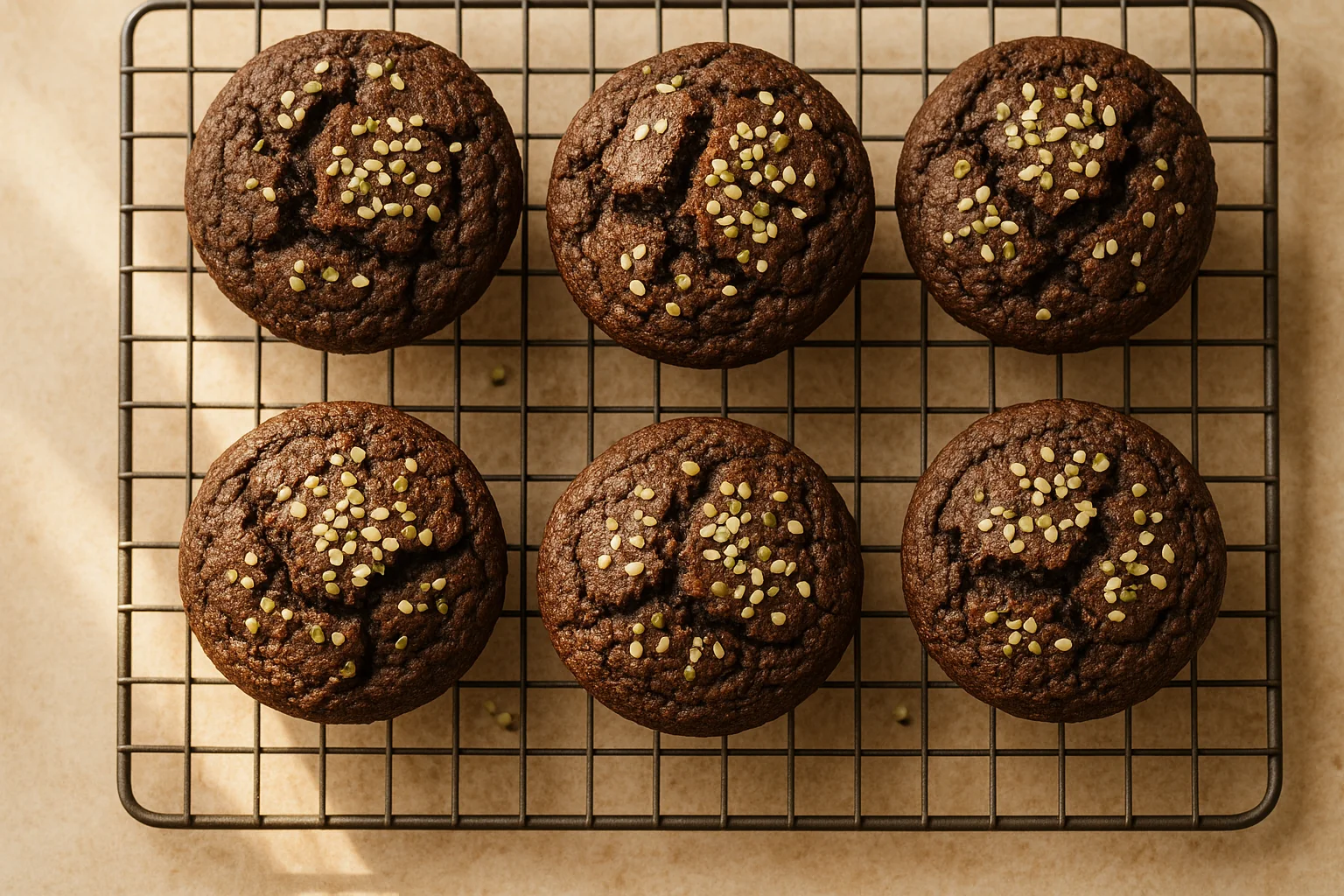
- Fill the molds two-thirds full. Sprinkle the top with hemp seeds or chocolate pieces. Overfilled liners will spill over the edge, as the mixture rises up and has no way to spread out.
- Bake for 18-22 minutes and do not open the oven for the first fifteen. The muffins are ready when the top is dry and springy, and a toothpick comes out dry or with dry crumbs. Cool on a rack for at least ten minutes.
How to modify this recipe to your taste?
Each variation below works without recalculating the rest of the recipe. Instead of milk, you can pour in cold, strong coffee, which deepens the cocoa flavor without adding ingredients. Two or three raspberries pressed into the center of each muffin just before baking provide acidity that balances bitterness, and frozen ones do not need to be thawed beforehand. In a vegan version, eggs are replaced with ground flaxseed soaked in water at a ratio of one tablespoon to three tablespoons, set aside for ten minutes, and honey is replaced with maple syrup.
Oil can be replaced in three ways: avocado puree in the same mass, three tablespoons of peanut butter, or 80 ml of natural yogurt. Avocado and peanut butter retain moisture, yogurt lowers calorie content but makes the muffins noticeably denser. If you want to increase the protein content, add two tablespoons of hemp protein powder and increase the milk by two tablespoons, as the powder absorbs more moisture than the flour itself. The main protein in hemp seeds is edestin, a storage globulin rich in arginine, which Docimo and colleagues determined to be 11-12 percent of the amino acid composition of both studied types (Plant Physiology and Biochemistry, 2014).
The same flour in a different format behaves differently, and it is worth seeing this in two examples: brownies with hemp flour are dense by design, so they can handle a higher proportion of hemp flour than muffins, while chocolate tart with hemp flour utilizes its crumbly structure instead of fighting against it. A version without cocoa, for breakfast, is described in the recipe for breakfast muffins with hemp flour.
Frequently Asked Questions
Why do muffins with hemp flour come out flat?
Most often for three reasons: too much hemp flour relative to the base flour, omitted baking soda or baking powder, or too long mixing of the batter. Hemp flour does not form a gluten network, so rising depends solely on leaveners and the air that remains in the batter.
Are muffins with hemp flour gluten-free?
Yes, as long as all ingredients are gluten-free. Hemp and rice flour do not contain gluten. If you have celiac disease, check the certifications on the packaging of both flours, cocoa, and baking powder, as the risk lies in cross-contamination at the packing facility, not in the raw material itself.
How much hemp flour can be added to muffins?
About half the total mass of all flours. Above this, the dough becomes dense and bitter. In a study on gluten-free cookies, the addition of hemp flour increased the hardness of the baked goods and decreased their volume, while simultaneously increasing protein and fiber content.
How long can muffins with hemp flour be stored?
In an airtight container for up to three days at room temperature or up to six days in the refrigerator, where they become moister. They can also be frozen for several months and reheated after thawing. Hemp flour contains unsaturated fats, so in warmth, muffins quickly acquire a bitter aftertaste.
What can replace oil in hemp muffins?
Avocado puree in the same mass, three tablespoons of peanut butter, or 80 ml of natural yogurt. Avocado and peanut butter retain the moisture of the dough, yogurt lowers the calorie content but makes the muffins denser. Peanut butter additionally enhances the nutty profile of hemp flour.
Ready hemp snacks and infusions have been gathered in the food category.
This article is for informational and educational purposes and does not replace consultation with a doctor. If you are pregnant, breastfeeding, taking medications, or have chronic conditions, consult the use of supplements or herbs with a specialist.
Author: Michał Waluk · Published: 2026-06-22 · Updated: 2026-08-15