
How to Store CBD Oil? Shelf Life, Temperature and Mistakes to Avoid
Not the fridge, but darkness determines the shelf life of CBD oil. What do studies say about light, oxidation, temperature, and whether CBN or THC is formed from it.
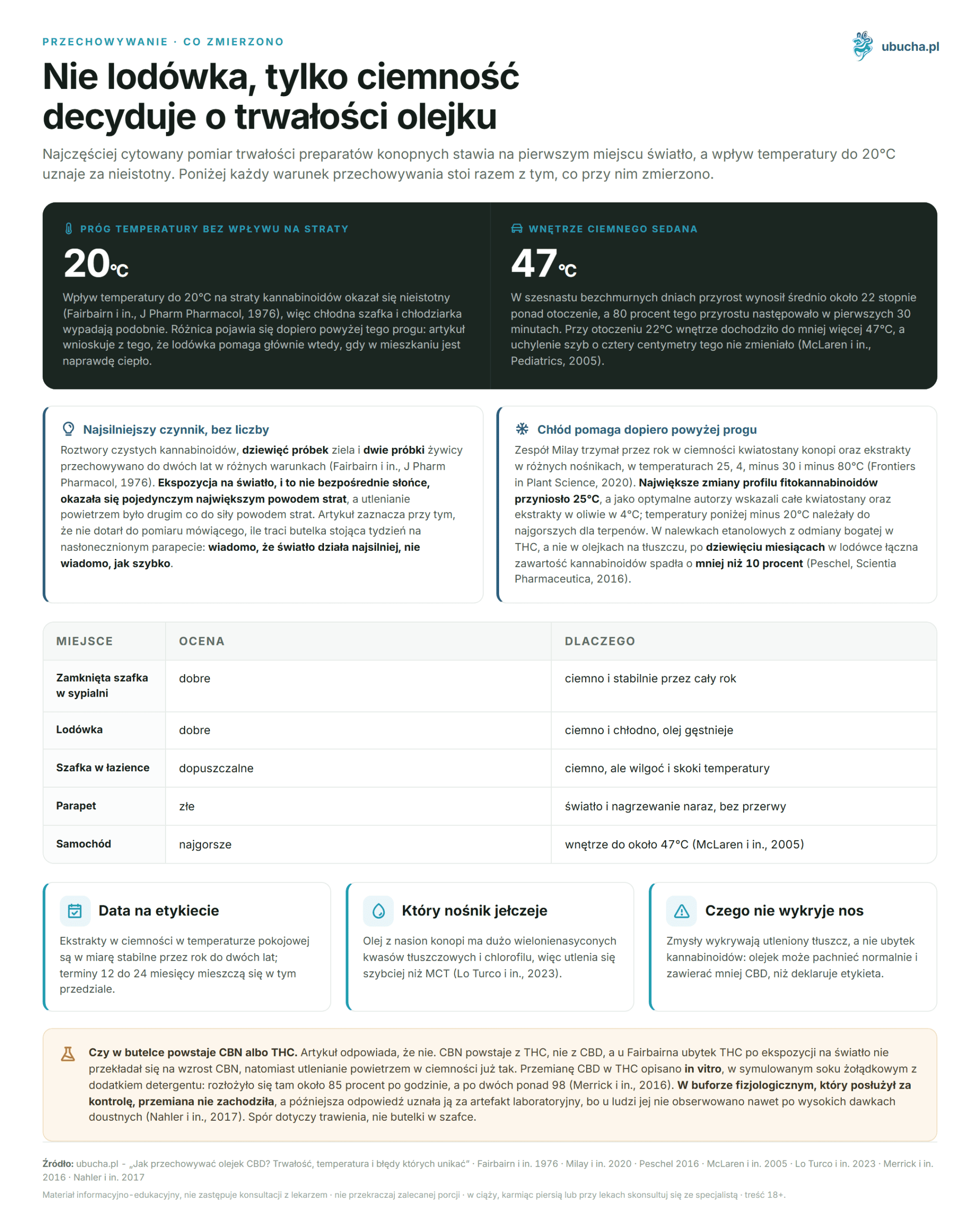
The advice you will find in most guides is: keep CBD oil in the fridge. The oldest and still most frequently cited study on the stability of hemp preparations says otherwise. Fairbairn and colleagues stored cannabinoid solutions for two years under various conditions and found that light was the primary factor in losses, while the effect of temperatures up to 20°C was insignificant. Cooling does no harm, but it will not save a bottle that is kept in a bright place and opened several times a day. Below you will find what is really known from published measurements: which factor degrades cannabinoids the fastest, why carrier oil usually spoils before CBD itself, and whether CBN or THC is formed during storage.
KEY INFORMATION
• Exposure to light is the single largest factor in cannabinoid loss, and the effect of temperatures up to 20°C was found to be insignificant (Fairbairn et al., J Pharm Pharmacol, 1976).
• Extracts kept in darkness at room temperature remain relatively stable for one to two years.
• CBN is formed from THC during oxidation in darkness, not from CBD and not under the influence of light.
• Hemp seed oil goes rancid faster than MCT because it has a lot of polyunsaturated fatty acids.
What Most Shortens the Shelf Life of CBD Oil?
Light. In the study by Fairbairn and colleagues (J Pharm Pharmacol, 1976), pure cannabinoid solutions, nine samples of herb, and two samples of resin were stored for up to two years under various conditions. Exposure to light, and not direct sunlight, turned out to be the single largest cause of losses, especially in solutions.
The second factor was oxygen. Air oxidation caused noticeable losses, although less than light. The third factor performed surprisingly poorly: the effect of temperatures up to 20°C was insignificant. This reverses the typical advice found online, where cooling is prioritized, and darkness is mentioned in passing. The authors also noted something that today sounds like a warning for tincture producers: earlier reports on the stability of ethanol solutions were not confirmed.
For you, this results in a simple hierarchy. First, ensure that the bottle is kept in darkness. Then, make sure it is tightly closed. Only at the end should you consider temperature. Diffused light from a window is enough for the process to proceed, so simply “not standing in the sun” is not enough.
This is why most oils are sold in amber glass. The dark bottle blocks some radiation before it reaches the contents, and glass does not allow oxygen to pass through as plastic does. If your oil is in a clear container, a dark cupboard is no longer a recommendation but a requirement.
Does CBD Oil Need to Be Kept in the Fridge?
No, it does not, although the fridge does no harm. In Fairbairn’s study, the effect of temperatures up to 20°C was insignificant, so a cool cupboard and refrigerator perform similarly. The difference only appears above this threshold. This means that the fridge mainly helps when it is really warm in the apartment.
Newer measurements confirm and clarify this. A team from Milay (Frontiers in Plant Science, 2020) kept hemp flowers and extracts dissolved in various carriers in darkness for a year at temperatures of 25, 4, minus 30, and minus 80°C. The most significant changes in the phytocannabinoid profile occurred at 25°C, which the authors call the least favorable variant. They indicate whole flowers and extracts in oil stored at 4°C as optimal conditions.
A similar picture was given by traditional hemp tinctures studied by Peschel (Scientia Pharmaceutica, 2016), with one caveat: these were ethanol extracts from a THC-rich strain, not oils in fat. After nine months in the fridge, the total cannabinoid content dropped by less than 10 percent. The main change during storage turned out to be the decarboxylation of THCA to THC, and its extent after 15 months in the cold corresponded to about three months on the shelf.
The freezer is already excessive. In Milay’s study, temperatures below minus 20°C were among the worst conditions for terpenes, which were already quickly diminishing in every variant. Cooling also has a practical cost: the oil thickens, and the dropper takes less than you think. Hold the bottle in your hand for a minute before dosing.
Where to Store CBD Oil at Home?
In a dark, closed place with a relatively stable temperature: a cupboard in the bedroom, a desk drawer, a home medicine cabinet away from the heater. The criterion comes directly from measurements and is singular, which is the lack of light access. Temperature and humidity are of secondary importance.
The worst place is the car, and not because of the sun shining directly on the bottle. Measurements in a dark sedan, repeated over sixteen cloudless days, showed an average increase of about 22 degrees above the ambient temperature, with 80 percent of this increase occurring in the first 30 minutes. Even at the lowest studied ambient temperature of 22°C, the interior reached about 47°C (McLaren et al., Pediatrics, 2005). Cracking the windows by four centimeters did not change either the heating rate or the final temperature.
The windowsill combines two factors at once: light and heating. The bathroom performs worse than the bedroom due to humidity and temperature fluctuations during showers, but still better than a window, as long as the bottle is kept in a closed cupboard. The same rules apply to dried herbs and cannabis teas, although there relative humidity also comes into play, which we broke down in the text how to properly store dried cannabis.
| Location | Rating | Why |
|---|---|---|
| Closed cupboard in the bedroom | good | dark and stable all year round |
| Fridge | good | dark and cool, oil thickens |
| Bathroom cupboard | acceptable | dark, but humidity and temperature fluctuations |
| Counter next to the stove | poor | daylight plus heat from cooking |
| Windowsill | bad | the strongest of the described factors acts continuously |
| Car | worst | interior up to about 47°C (McLaren et al., 2005) |
How Long Does CBD Oil Retain Potency?
From one to two years, provided it is stored in darkness at room temperature. This conclusion was drawn by Fairbairn and colleagues for carefully prepared hemp raw material and extracts. The expiration dates indicated on oil packaging, usually from 12 to 24 months, fall exactly within this range.
The date on the label is a commitment from the manufacturer, not a moment of product shutdown. It indicates until when the content corresponds to the declaration under proper storage. After this date, the oil usually still contains cannabinoids, but no one guarantees how much.
We have not been able to find a measurement that indicated how much a bottle standing for a week on a sunny windowsill loses. Numbers circulating in guides, such as “30 percent in a year” or “two weeks in the sun,” have no source and therefore you will not find them here. It is known that light acts the strongest. It is unknown how quickly.
The practical conclusion concerns the size of the packaging rather than the date itself. Buy as much as you will use in two or three months. It is about the number of openings: each lets a portion of air inside, and oxidation was the second strongest cause of losses according to Fairbairn. The same arithmetic can be misleading in the other direction: a stronger oil lasts longer at the same dose in milligrams, so along with a higher concentration, you also buy a longer time for the bottle to sit in the cupboard.
Which Carrier Oil Spoils Faster?
Hemp seed oil. It has a lot of polyunsaturated fatty acids and chlorophyll, both of which accelerate oxidation, especially in the presence of light (Lo Turco et al., Antioxidants, 2023). MCT from coconut oil is made up of saturated medium-chain fatty acids, without double bonds, which are the sites of oxygen attack.
In this study, cold-pressed hemp oil was observed for 12 weeks in clear bottles. Filtration, which removes some chlorophyll, significantly improved resistance to photo-oxidation and slowed the breakdown of tocopherols, polyphenols, and carotenoids. One caveat: this work compared filtered oil with unfiltered, not different storage temperatures, so nothing can be concluded about the effect of cooling on the carrier itself.
Milay and colleagues, on the other hand, checked which carrier best protects the phytocannabinoid profile in the extract. Olive oil won. However, MCT dominates the market, and it is a reasonable compromise, as the carrier is then resistant to rancidity, and the taste remains neutral. The differences between these two fats beyond durability are outlined in the text MCT vs olive oil as a CBD carrier.
This leads to something that confuses the most people. The smell of spoiled oil is most often a signal from the carrier, not from the cannabinoids. The fat goes rancid. CBD may still be largely intact during this time, and the opposite situation can also occur: MCT oil can smell completely normal after six months by the window.
Does CBD Convert to CBN or THC During Storage?
No, it does not convert to either. CBN is formed from THC, not from CBD. Fairbairn and colleagues additionally showed that after exposure to light, the loss of THC did not translate into an increase in CBN, whereas air oxidation in darkness did.
This distinction has practical significance, as CBN is sometimes presented as a measure of product age. Peschel tested this on tinctures: a slight increase in CBN did not correlate with a decrease in THCA and THC, and the sum of cannabinoids or the ratio of acidic to neutral forms proved to be a better indicator of durability. The level of CBN will tell you little about how long the bottle has been sitting.
The story of CBD converting to THC comes from one in vitro experiment. Merrick and colleagues (Cannabis and Cannabinoid Research, 2016) immersed CBD in simulated gastric juice with detergent added. After an hour, about 85 percent broke down, and after two, over 98, producing among others delta-9-THC and delta-8-THC. In the physiological buffer, which served as a control, the transformation did not occur. The authors themselves drew a far-reaching conclusion: that the acidic environment of the digestive tract may expose a person taking CBD orally to amounts of THC that elicit a physiological response.
A year later, Nahler and colleagues (Cannabis and Cannabinoid Research, 2017) responded that such a model deviates from the conditions in the stomach, and transformations were not observed in humans even after high oral doses. They deemed it a laboratory artifact and pointed to an additional argument: in blinded studies with CBD, the typical set of THC side effects did not appear. Regardless of the resolution of this dispute, it concerns digestion, not the bottle in the cupboard.
How to Tell if CBD Oil Has Gone Bad?
By smell and taste, but only if the carrier oil has gone bad. A rancid, fishy, or musty smell indicates oxidized fats. Darkening and sediment that does not disappear after warming the bottle in your hand are also warning signs.
Cloudiness after being taken out of the fridge is not a sign of spoilage. The oil thickens in the cold and returns to clarity at room temperature. Color differences between products also say nothing about quality: isolate in MCT is light yellow, while full-spectrum oil can be dark green from chlorophyll.
The limitation of this assessment is more serious than most guides suggest. Our observations from conversations with customers boil down to one thing: the senses detect rancid fat, not a loss of cannabinoids. A bottle that has been sitting for months by the window may smell and taste normal, even though it contains significantly less CBD than on the day of purchase. Only a laboratory can check this, meaning a current certificate of analysis for that batch.
For this reason, it is more beneficial to monitor conditions than to smell the contents. Dark, sealed, without temperature fluctuations. These three conditions close the topic of durability better than any home test.
Frequently Asked Questions
How long can CBD oil be stored?
Carefully prepared hemp extracts remain relatively stable for one to two years if kept in darkness at room temperature (Fairbairn et al., 1976). The shelf life of 12 to 24 months indicated on the packaging falls within this range. After this date, the oil usually still contains cannabinoids, but no one guarantees how much.
Does CBD oil need to be kept in the fridge?
No, it does not. The effect of temperatures up to 20°C on cannabinoid loss was insignificant (Fairbairn et al., 1976), so a dark cupboard is sufficient. The fridge only provides an advantage over a warmer room: in a year-long comparison, 4°C performed better than 25°C (Milay et al., 2020).
Can CBD oil be frozen?
There is no need. In a year-long comparison of storage conditions, temperatures below minus 20°C were among the worst for terpenes, and the authors indicated 4°C as optimal, not the freezer (Milay et al., 2020). The issue of oil density remains.
Does light really destroy CBD?
Yes, and it is the most significant factor. In Fairbairn’s study, exposure to light, not direct sunlight, was the single largest cause of cannabinoid loss, especially in solutions. That is why oils are packaged in amber glass, and the bottle is kept in a closed cupboard instead of on a windowsill.
Can THC be formed from CBD oil?
Not in the bottle. The transformation was described in simulated gastric juice with detergent (Merrick et al., 2016), but it did not occur in physiological buffer, and a later review deemed it a laboratory artifact, as it was not observed in humans even after high oral doses (Nahler et al., 2017). The dispute concerns digestion, not storage.
How to tell if CBD oil has gone bad?
By a rancid or musty smell, darkening, and sediment that does not disappear after warming the bottle. Cloudiness after being in the fridge is normal. The senses detect oxidized carrier oil, not a loss of cannabinoids, so the oil may smell good and contain less CBD than the label states.
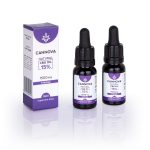
If you want to choose a smaller package for two or three months, check out the hemp oils section, and for containers and accessories, go to the storage category. We described how to read the label and the certificate of analysis in the text how to choose CBD oil.
This article is for informational and educational purposes and does not constitute medical advice. Before starting to use cannabis or CBD for therapeutic purposes, consult your doctor, especially if you are taking other medications, are pregnant, or breastfeeding.
Author: Michał Waluk · Published: 2026-05-29 · Updated: 2026-08-15