
Edibles: what are they and how do edible products work
Edibles are edible cannabis products. How long do they take to work, why do they hit differently than inhaled, and how does Polish law divide those with THC from those with CBD.
Edibles are edible and drinkable cannabis products, where cannabinoids enter the body through the digestive tract rather than the lungs. This one difference changes everything else, as the ingested cannabinoid first goes to the liver. Therefore, the first effects appear after 30 to 90 minutes, the peak occurs at 2 to 4 hours, and the overall duration is longer than after inhalation. This text serves as an introduction to the topic, not a recipe or dosage guide. It explains what edibles are as a product category, where the delay comes from, what in Polish law divides THC products from CBD products, and which mistake most often ends with a visit to the doctor. For details, such as converting milligrams and ready recipes, links are provided within.
KEY INFORMATION
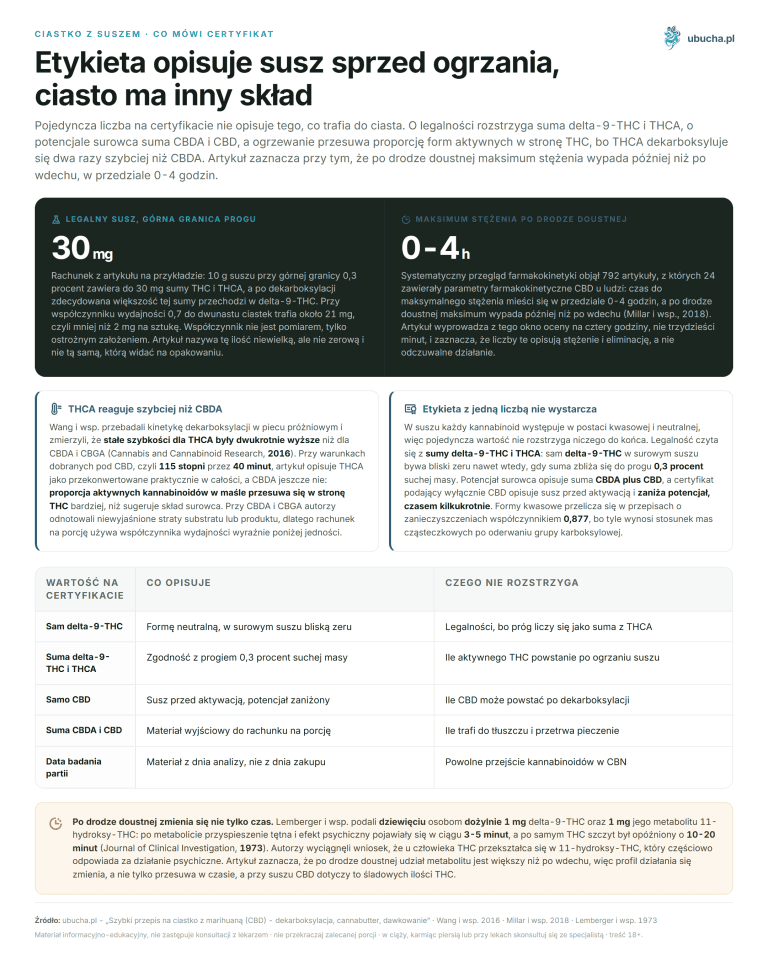
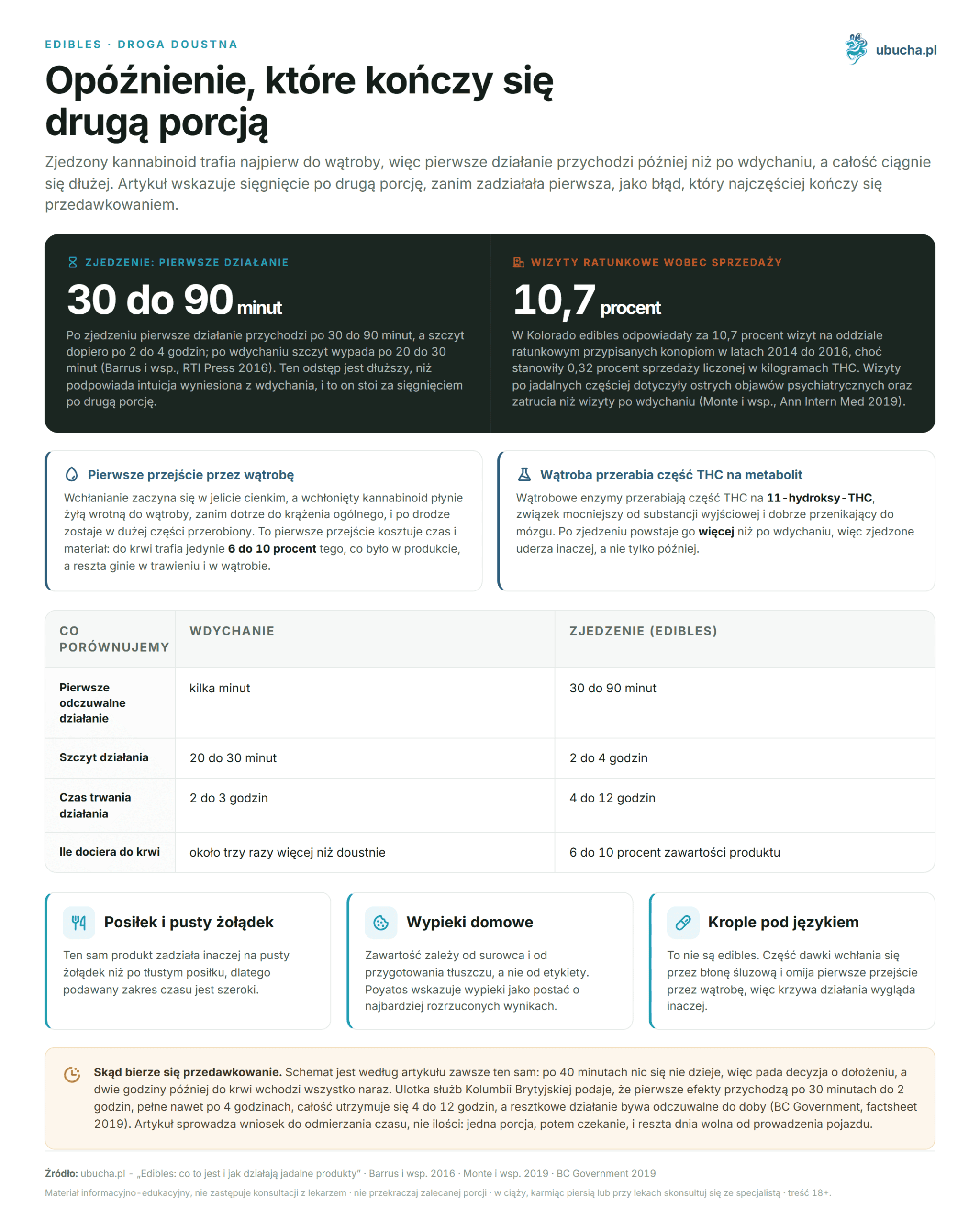
• The first effect after ingestion comes after 30 to 90 minutes, with a peak at 2 to 4 hours; after inhalation, the peak occurs after 20 to 30 minutes (Barrus et al., RTI Press 2016).
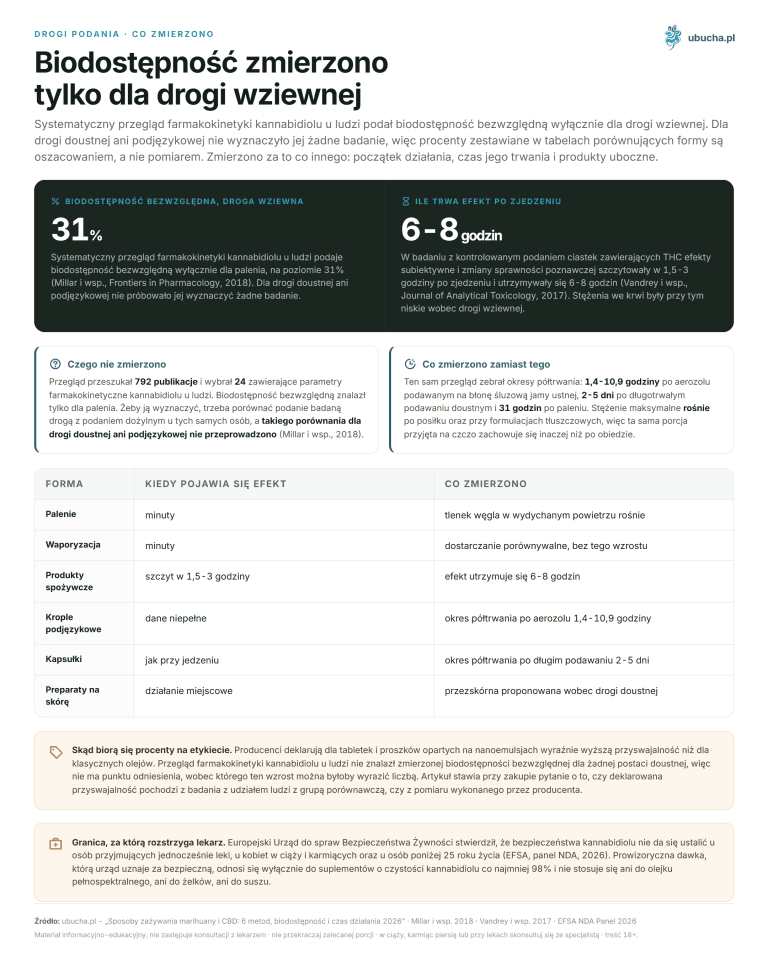
• About 6 to 10 percent of the THC in the ingested product reaches the bloodstream, the rest is lost in digestion and in the liver (Barrus et al. 2016).
• The liver converts some THC into 11-hydroxy-THC, a metabolite stronger than THC itself, which is produced in greater amounts after ingestion than after inhalation (Barrus et al. 2016).
• In Colorado, edibles accounted for 10.7 percent of emergency room visits attributed to cannabis, although they represented 0.32 percent of sales measured in kilograms of THC (Monte et al., Ann Intern Med 2019).
• No oral CBD product has EU authorization as new food, and EFSA calculated a temporary safe dose of 0.0275 mg per kilogram of body weight per day, which is about 2 mg for an adult weighing 70 kg (EFSA NDA Panel 2026).
What are edibles and how do they differ from other forms of cannabis?
Edibles is a collective term for edible and drinkable products in which cannabinoids are absorbed in the digestive tract. This includes gummies, cookies, chocolates, bars, capsules, oils added to dishes, and beverages. The criterion is not taste or form of the product, but the route of administration: you swallow, and absorption begins in the small intestine.
This definition immediately rules out two things that are often confused with edibles. The first is sublingual administration, which means drops held under the tongue for several seconds. Part of the dose is absorbed through the mucous membrane of the mouth and bypasses the first pass through the liver, so the action curve looks different. The second is vaporization and smoking, where the substance goes from the lungs directly into the bloodstream.
The word itself came from markets where edible products primarily referred to those with THC. In Polish stores, the same name usually describes products made from hemp, where THC is trace, and the carrier may be CBD or simply seed oil. The distinction is not cosmetic, as both groups are subject to completely different regulations in Poland.
A separate case is homemade baked goods. The cannabinoid content depends on the raw material and how the fat was prepared, not on any label. How this process looks step by step is shown in the post about CBD cookies.
Why do edibles take longer and last longer than inhaled cannabis?
Because the oral route goes through the liver. The cannabinoid absorbed in the intestine flows through the portal vein to the liver before reaching the general circulation, and along the way, it is largely processed. This first pass costs time and material: only 6 to 10 percent of what was in the product reaches the bloodstream.
The numbers are measured. Barrus and colleagues in a review for RTI Press in 2016 state that after ingestion, the first effect comes after 30 to 90 minutes, with a peak at 2 to 4 hours, while after inhalation, the peak occurs after 20 to 30 minutes (Barrus et al. 2016). The review by Poyatos and colleagues from 2020 collects raw data: after a brownie with 50.6 mg of THC, the median time to peak concentration in the blood was 2.5 hours, while for the same dose smoked it was 0.13 hours (Poyatos et al., Medicina 2020).
The second element is the metabolite. Liver enzymes convert some THC into 11-hydroxy-THC, a compound stronger than the original substance and well-penetrating the brain, which is produced in greater amounts after ingestion than after inhalation. This is where the impression comes from that ingested hits differently, not just later. The mechanism is detailed in a separate post about the 11-hydroxy metabolite.
| What we compare | Inhalation | Ingestion (edibles) | Source |
|---|---|---|---|
| First noticeable effect | a few minutes | 30 to 90 minutes | Barrus 2016 |
| Peak effect | 20 to 30 minutes | 2 to 4 hours | Barrus 2016 |
| Peak THC concentration in blood after brownie with 50.6 mg THC | median 0.13 hours (joint) | median 2.5 hours | Newmeyer 2016 in Poyatos 2020 |
| Duration of effect | 2 to 3 hours | 4 to 12 hours | Barrus 2016, BC Gov 2019 |
| How much substance reaches the blood | about three times more than orally | 6 to 10 percent of the product’s content | Barrus 2016, Poyatos 2020 |
The third element is variability. The same product will work differently on an empty stomach than after a fatty meal, and Poyatos indicates baked goods as the form with the most scattered results.
How do THC edibles differ from CBD edibles in Polish law?
They differ in everything that has legal significance. An edible product with THC comes from material that the drug prevention law refers to as cannabis other than hemp, meaning the above-ground part of the plant, excluding seeds, containing more than 0.3 percent of the sum of delta-9-THC and THCA. Such material is a narcotic and is outside legal retail circulation.
The 0.3 percent threshold is set in Article 4 points 5 and 37 of this law (Journal of Laws 2005 No. 179 item 1485, consolidated text). Below the threshold, the plant is hemp and can be cultivated and processed after registration, and its derivatives reach stores. Above the threshold, criminal regulations apply: Article 62 provides for a penalty for possession of a narcotic, and Article 63 for cultivation.
Edible products with CBD are not narcotics, but food, and here different regulations apply. Oral cannabidiol is treated as new food in the EU, so it requires authorization before being placed on the market. The EFSA panel in the February 2026 update states directly that CBD products intended for oral consumption remain in this mode unauthorized, and there are four conclusions regarding synthetic CBD and sixteen regarding CBD from cannabis in the risk assessment (EFSA NDA Panel 2026).
The practical conclusion is that two products looking identical on the shelf stand on two completely different regulatory sides. The category of hemp gummies is food from hemp, not edibles with THC.
How to calculate the dose in a CBD product and what cannot be calculated?
Start with the label and one piece, not the package. The manufacturer usually states the cannabidiol content in milligrams per piece or per 100 grams; the latter form requires conversion to the weight of a single gummy. Only the number of milligrams per piece allows for comparison of two products and relating them to anything.
The reference point today is the EFSA value. The panel calculated a temporary safe dose of CBD at 0.0275 mg per kilogram of body weight per day, which for an adult weighing 70 kg gives about 2 mg per day, and noted that this applies only to products with a purity of at least 98 percent. The same document states that the safety of CBD cannot be established for individuals under 25 years of age, pregnant or breastfeeding women, and those taking medications (EFSA NDA Panel 2026). A conversion table for gummies is provided in a separate post about dosing CBD gummies.
What cannot be calculated: discrepancies between the label and the content. In an analysis of 84 CBD products purchased online, 30.95 percent of samples had a content consistent with the declaration, 42.85 percent were underestimated, and THC was detected in 18 out of 84 (Bonn-Miller et al., JAMA 2017). The study concerned the American market from years ago, so it does not directly transfer to the Polish shelf, but it shows what every such calculation is based on: trust in the batch analysis certificate.
This text does not provide THC doses. Edible products with THC are outside circulation in Poland, and numbers for controlled substances do not belong to informational content.
What mistake most often leads to overdosing on edibles?
Reaching for a second dose before the first one has taken effect. The pattern is always the same: after 40 minutes nothing happens, so the decision is made to add more, and two hours later everything enters the bloodstream at once. The interval between eating and peak is simply longer than intuition from inhalation suggests.
Data from the health protection system confirms this. In a five-year review of charts from a large hospital in Colorado, edibles accounted for 10.7 percent of visits attributed to cannabis from 2014 to 2016, although they represented 0.32 percent of sales measured in kilograms of THC. Visits after edibles were more often related to acute psychiatric symptoms and poisoning than visits after inhalation (Monte et al., Ann Intern Med 2019).
Public health recommendations boil down to measuring time, not quantity. The leaflet from British Columbia states directly that the first effects come after 30 minutes to 2 hours, full effects even after 4 hours, the total lasts 4 to 12 hours, and residual effects can be felt for up to a day (BC Government, factsheet 2019). The practical conclusion is simple: one dose, then wait with a watch in hand, and no driving that day.
If the dose turns out to be too strong, time and calm matter. What to do in such a situation and what to avoid is described in the post about too strong edible CBD.
Frequently Asked Questions
How long does it take for edibles to take effect?
The first effects usually appear after 30 to 90 minutes, with a peak occurring 2 to 4 hours after consumption. A fatty meal and an empty stomach shift these values in opposite directions, which is why the range is wide. This data comes from a review by Barrus and colleagues from 2016.
How long do the effects of edibles last?
From 4 to 12 hours, and some residual effects can be felt even up to a day after consumption. This is stated in the public health leaflet from British Columbia from 2019. After inhalation, the same effect usually diminishes within 2 to 3 hours.
Why do ingested cannabis work differently than inhaled?
Because the oral route goes through the liver, which converts some THC into 11-hydroxy-THC. This metabolite is stronger than the original substance, penetrates the brain well, and more of it is produced after ingestion than after inhalation. Only 6 to 10 percent of the product’s content reaches the bloodstream.
Are edibles legal in Poland?
It depends on what is inside. THC products come from material that the drug prevention law refers to as cannabis other than hemp, and are outside legal circulation. Hemp products are food, and oral cannabidiol is subject to new food regulations and does not yet have EU authorization.
Can you overdose on CBD edibles?
You can take more than you intended, most often by adding a second dose before the first one has taken effect. EFSA calculated a temporary safe dose in 2026 at about 2 mg per day for an adult weighing 70 kg and noted that safety cannot be established for individuals under 25 years of age, pregnant or breastfeeding women, and those on medication.
How long should you wait before eating another dose?
Until the first dose has reached its peak, which is at least two hours, and safer four. Shortening this interval is the most common cause of too strong an effect. Also plan that the rest of the day will be free from driving and operating machinery.
This article is for informational and educational purposes and does not constitute medical advice. Before starting to use cannabis or CBD for therapeutic purposes, consult a doctor, especially if you are taking other medications, are pregnant, or breastfeeding.
Author: Michał Waluk · Published: 2026-08-24 · Updated: 2026-08-24