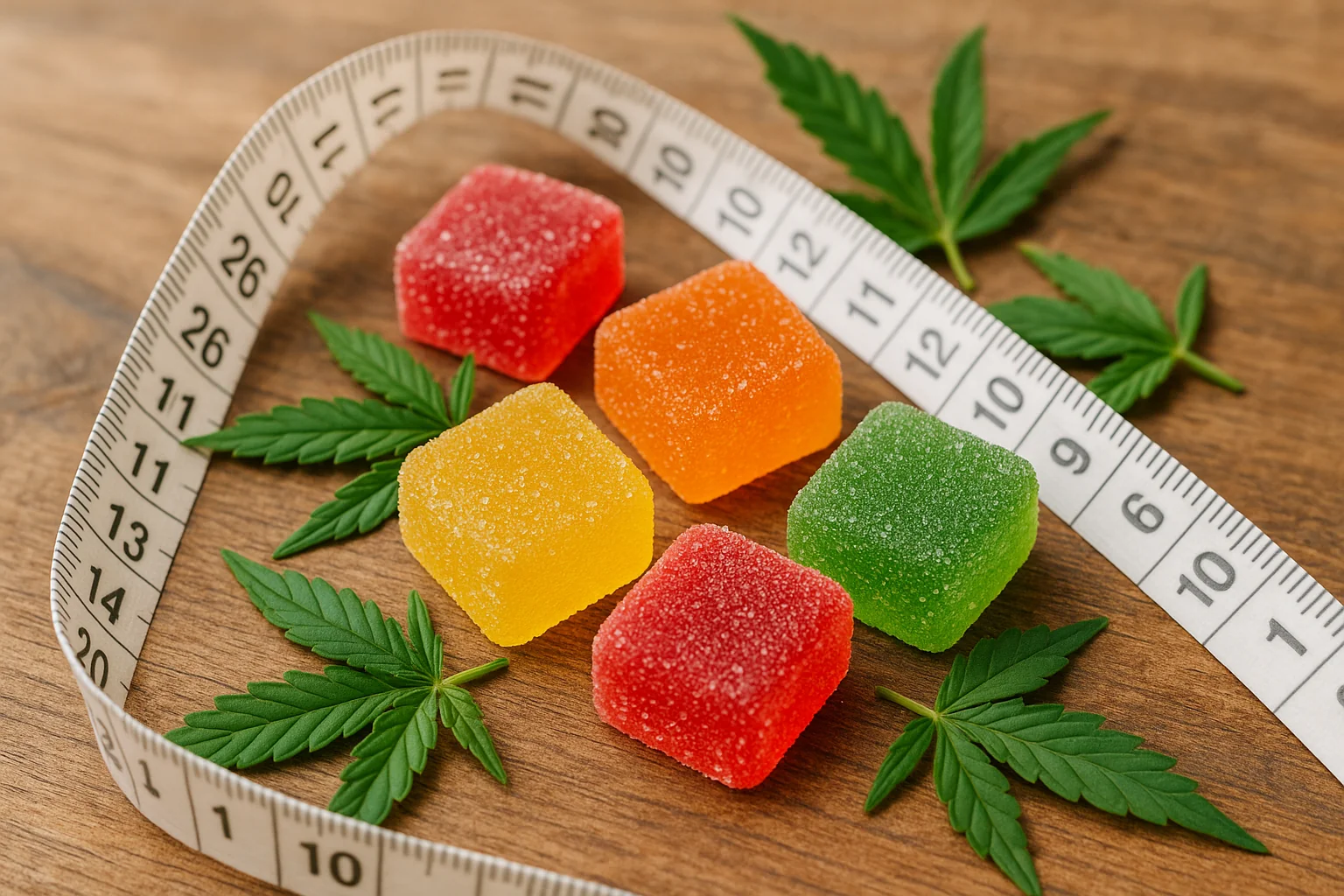

CBD Gummies: how many milligrams do they contain and what do studies say
How much cannabidiol is in one gummy, what has really been measured about the oral route, and why the dosage table by body weight has no basis in studies.
This article has a title that cannot be honestly fulfilled, and we start right from that. The dosage table by body weight stood here for many months: four weight ranges, starting dose, maintenance, and higher dose, along with a protocol for increasing every two weeks. It has been completely removed because no study in humans has established a dosage of cannabidiol per kilogram of body weight for a healthy adult. Instead, you get what can be verified: how many milligrams the packages declare, what has really been measured for the oral route in humans, and where the European agency has set the safety limit. Three citations leading to works other than those declared and the market growth number, which cannot be verified, have also been removed. The rest is a conversation with a doctor, not with a table, and this text cannot replace that.
KEY INFORMATION
• The dosage table by body weight has been removed from this article. It had no basis in any study, and the basis attributed to it in the form of the WHO report from 2018 does not contain the numbers given there.
• The only value related to body weight that exists is the safety ceiling: 0.0275 mg per kilogram per day, about 2 mg for a person weighing 70 kg (EFSA NDA Panel, EFSA Journal, 2026).
• The safety of cannabidiol cannot be established for individuals under 25 years of age, pregnant or breastfeeding women, and those taking medications. This is the conclusion of the same document.
• The absolute bioavailability of CBD in humans has only been measured after smoking and is 31 percent. No study has done this for the oral route (Millar et al., Frontiers in Pharmacology, 2018).
• In the European Union, cannabidiol remains a novel food ingredient without authorization, and the sanitary notification does not change this.
Why won’t you find a dosage table by body weight here?
Because there is nothing to build it on. The table that stood here attributed to the World Health Organization a statement about a starting dose of 10-25 mg per day. The WHO report from 2018 does not provide such a number (WHO Expert Committee on Drug Dependence, Cannabidiol Critical Review Report, 2018). It does provide a range of oral doses studied in the literature, mostly from 100 to 800 mg per day, and this describes clinical trials, not a guideline for buying gummies.
There is also no study that has established a dosage of cannabidiol per kilogram for a healthy adult. Conversions of milligrams to kilograms exist in the pharmacology of cannabidiol, but they come from trials on drug-resistant epilepsy, where doses are two orders of magnitude higher than the content of a gummy and administered under medical supervision. Transferring such mathematics to a supplement is the same maneuver as transferring a dose of an antiepileptic drug to a candy.
The only number related to body weight that has a basis today goes in the opposite direction. The European Food Safety Authority derived a provisional safe dose of 0.0275 mg per kilogram of body weight per day using the benchmark dose method, with an uncertainty factor of 400, which is about 2 mg daily for a person weighing 70 kg. This is a ceiling, above which the agency cannot guarantee safety, not a threshold at which something starts to work. The value applies only to supplements with a purity of cannabidiol of at least 98 percent, without nanoparticles.
How much cannabidiol is in one gummy?
This is a question that can be answered without guessing, as the content is declared by the manufacturer on the packaging. The following summary describes only the content of products available in the store ubucha.pl, as of August 16, 2026. This is not a recommendation or suggestion of how much to eat, just the arithmetic of what goes into the mouth with one piece.
| Declaration method on the packaging | Content of one piece | How does it compare to the EFSA ceiling for 70 kg |
|---|---|---|
| 300 mg for 30 pieces | 10 mg | about five times |
| 25 mg per piece | 25 mg | about twelve times |
| 750 mg per package, without the number of pieces in the name | cannot be calculated from the name | cannot be calculated |
The third row is as important here as the first two. If the packaging only states the total milligrams and not the number of pieces, you cannot calculate the content of one piece from the label, and no one else will calculate it for you. This is the first thing to check before purchasing, and the first thing to ask if it is not on the packaging.
The comparison from the last column is neither an encouragement nor a warning against a specific product. It shows the scale: a single piece from a popular shelf carries a multiple of the value that the European agency has provisionally called safe. The panel notes that for individuals taking medications, pregnant, breastfeeding, and under 25 years of age, safety cannot be established at all, so for them, no conversion makes sense. You can find products in this form in the gummies category, and the declared content is the only number that can be verified before purchase.
Do gummies work worse than oil under the tongue?
It is unknown, as no one has measured this in humans. Millar and colleagues reviewed 792 works and selected 24 that provided pharmacokinetic parameters of cannabidiol in humans. Absolute bioavailability was established only for smoking and was 31 percent. No study has conducted such a measurement for the oral, sublingual, or any other route, despite the availability of intravenous forms.
Values of 6-19 percent for the oral route and 13-19 percent for the sublingual route, which stood in this article in five places, do not appear even once in the full text of this review. We checked the entire document, over 50,000 characters. It must be added honestly that the number 6 percent does exist: the WHO report from 2018 provides it for the oral route, but calls it an estimate and refers to a textbook chapter, not to a measurement in humans. No one has measured the ranges stretched around it. The statement that gummy dosing starts higher than oil to compensate for the difference in bioavailability was based precisely on those ranges and disappeared along with them.
However, the review provides parameters that have been measured. The half-life of cannabidiol ranged from 1.4 to 10.9 hours after aerosol on the oral mucosa and 2-5 days after chronic oral administration. The time to peak concentration ranged from zero to four hours. The area under the curve and peak concentration increased with the dose, and the peak concentration was higher after meals and with fatty preparations. The authors call the state of knowledge insufficient and point out discrepancies between studies. One of the co-authors worked at Artelo Biosciences at the time, and the study was funded by the UK BBSRC council.
What does food do to the absorption of cannabidiol?
It clearly changes it, and this is the only practical hint that has solid support in this text. Birnbaum and colleagues administered a single dose of capsules with 99 percent purity to eight adult patients with drug-resistant epilepsy, once fasting and once after a high-fat breakfast of 840-860 kilocalories, in an alternating design (Birnbaum et al., Epilepsia, 2019). The peak concentration was on average 14 times higher after the meal, and total exposure was 4 times higher, with ninety percent confidence intervals of 7.47-31.86 and 3.42-7.82, respectively.
These two multipliers differ from each other, and that matters. In this article, there was previously one number, a 4-5 fold increase in bioavailability, attributed, by the way, to the wrong work. The reality is less round: the parameter that increased the most increased fourteenfold, while the one describing total exposure increased fourfold. Eight patients with drug-resistant epilepsy is a very small and specific trial, so the numbers should not be read as a multiplier for oneself.
An independent signal in the same direction was given by the work of Abbotts and colleagues, who administered five different cannabidiol preparations in standardized doses of 30 mg to fourteen men with a body mass index of at least 25 (Abbotts et al., Nutrients, 2022). Eating noticeably changed the pharmacokinetics and increased systemic availability. The authors noted significant differences between the commercial preparations themselves, which is another reason not to transfer experiences from one product to another.
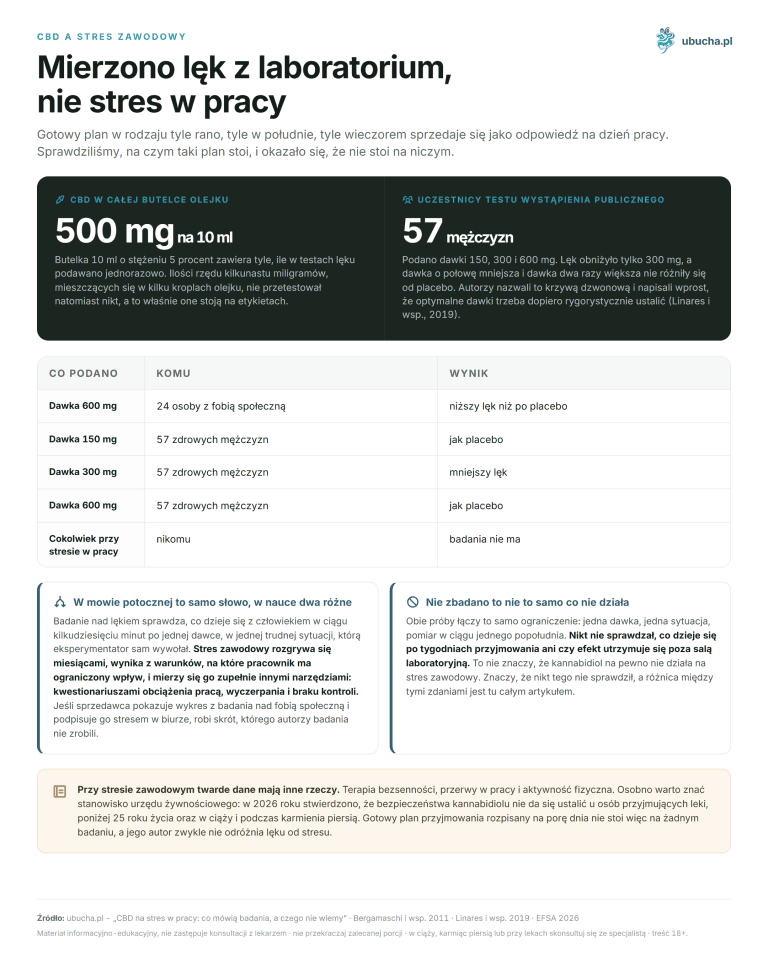
What did the study on cannabidiol and sleep really show?
The study that this article referred to exists, but it is something different than what is written here. Shannon and colleagues retrospectively reviewed the documentation of a psychiatric clinic where cannabidiol was used as an adjunct to standard treatment for complaints of anxiety and sleep (Shannon et al., The Permanente Journal, 2019). This is a retrospective case series, not a clinical trial with a control group.
The final sample consisted of 72 adults: 47 reported primarily anxiety, and 25 reported poor sleep. Anxiety scores decreased in the first month in 57 patients, or 79.2 percent, and remained reduced. Sleep scores improved in the first month in 48 individuals, or 66.7 percent, but fluctuated in subsequent months. Cannabidiol was well tolerated in all but three patients. The authors conclude that controlled clinical trials are needed.
This article previously stated that doses of 25-75 mg taken in the evening shortened sleep latency. However, the endpoints were anxiety and sleep scores in validated questionnaires, not sleep latency, and the summary of the work does not provide any dose range, so such a narrow range cannot be derived from it. The statement about the fluctuation of sleep scores is more important here than the percentage of improvement, as it distinguishes a case series from evidence of efficacy.
Can gummies with cannabidiol be combined with other supplements?
With prescription medications, the answer is: not without a doctor. The EFSA panel noted the potential hepatotoxicity of cannabidiol in humans, especially when used concurrently with medications, and directly stated that safety cannot be established for individuals taking medications. This is not a precautionary statement, but a conclusion from a review of data in which animal studies provided a consistent picture of liver toxicity.
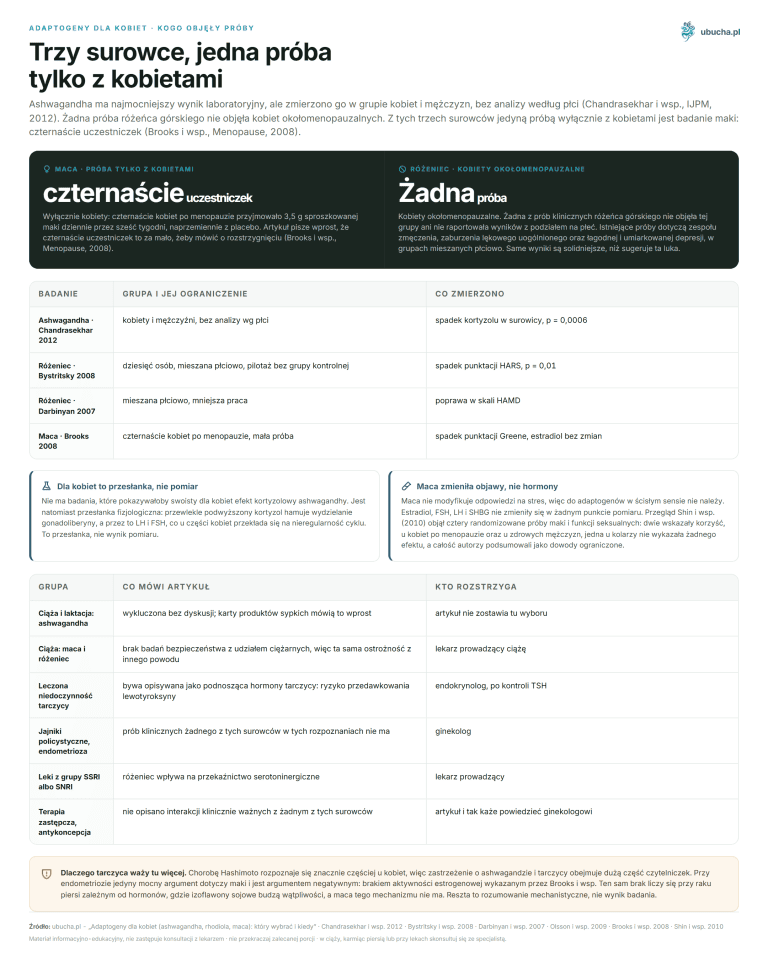
With ashwagandha, it is worth knowing what has actually been shown. A meta-analysis by Cheah and colleagues included five randomized studies with a total of 400 participants, and its endpoint was sleep (Cheah et al., PLoS One, 2021). The extract had a small but significant effect on sleep, more pronounced in individuals with diagnosed insomnia, at doses of at least 600 mg per day and treatment lasting at least eight weeks. Alertness after waking and anxiety levels also improved. The work was unfunded, and the authors reported no conflicts of interest.
This article attributed to this meta-analysis a reduction in cortisol levels, twelve studies, and completely different authors. The word cortisol does not appear in its full text even once, there were five studies, and the given name and journal do not belong to this work. The statement about over 60 percent of adults in Poland not meeting magnesium requirements has also disappeared: under the given number lies a review by other authors, in a different journal and from a different year. It is also worth remembering that in the European Union, cannabidiol remains a novel food ingredient without authorization, and the manufacturer’s sanitary notification does not change anything about this status.
Frequently Asked Questions
Why did you remove the dosage table by body weight?
Because it had no basis. No study has established a dosage of cannabidiol per kilogram for a healthy adult, and the WHO report, which was attributed a range of 10-25 mg, does not contain such a number. The only value related to body weight is the EFSA safety ceiling, which is a limit, not a recommendation.
How many milligrams does one gummy contain?
It depends on the product and is declared by the manufacturer. A package with a total of 300 mg for 30 pieces means 10 mg per piece, and some products state the content directly, for example, 25 mg per piece. If the label only states the total milligrams without the number of pieces, the content of one piece cannot be calculated from it.
What dose of cannabidiol has EFSA deemed safe?
The provisional safe dose is 0.0275 mg per kilogram of body weight per day, which is about 2 mg for a person weighing 70 kg, and applies only to supplements with a purity of at least 98 percent, without nanoparticles. Safety cannot be established for individuals under 25 years of age, pregnant or breastfeeding women, and those taking medications.
Do gummies absorb worse than oil under the tongue?
It is unknown. The absolute bioavailability of cannabidiol in humans has only been measured after smoking and was 31 percent. There is no such measurement for the oral or sublingual route. Values of 6-19 percent and 13-19 percent, repeated in guides, do not appear in the review to which they are attributed.
Is it worth eating a gummy with a meal?
Eating noticeably changes the pharmacokinetics of cannabidiol. In a trial of eight patients with drug-resistant epilepsy, the peak concentration after a high-fat breakfast was on average 14 times higher than fasting, and total exposure was 4 times higher. The trial is very small, so multipliers should not be extrapolated to each other.
Is it permissible to combine cannabidiol with medications?
Not without consultation. EFSA noted the potential hepatotoxicity of cannabidiol in humans, especially when used concurrently with medications, and stated that safety cannot be established for individuals taking medications. If you are taking anything by prescription, make the decision about cannabidiol together with your attending physician.
Differences between both forms have been collected separately in the comparison of gummies and oil, and the time after which the effect appears is described in the entry about the first effects of oil and gummies. If the portion you ate turned out to be stronger than you expected, read what to do then and when to seek medical help.
This article is for informational and educational purposes and does not constitute medical advice. Before starting to use cannabis or CBD for therapeutic purposes, consult your doctor, especially if you are taking other medications, are pregnant, or breastfeeding.
Author: Michał Waluk · Published: 2026-08-09 · Updated: 2026-08-16