
Paranoia and Anxiety After THC: Where They Come From and How to Prevent Them (FAQ)
Where does anxiety and paranoia after THC come from, on whom it was measured, whether CBD really protects, and when an unpleasant episode requires contact with a doctor.
Anxiety and paranoid thinking are among the most commonly reported unpleasant consequences of contact with THC. This phenomenon is not a myth: it has been studied in controlled conditions, with randomization and placebo, so more is known about it than about most effects attributed to cannabis. The problem is that popular texts, including an earlier version of this post, describe them with numbers and mechanisms that are not present in the cited works. Below, we separate what has been demonstrated, on whom, and by what route of administration, from what has been added along the way. We also discuss what is usually missing in such guides, namely when a transient episode ceases to be transient and requires medical assistance rather than just waiting it out.
KEY INFORMATION
• In a randomized placebo-controlled trial involving 121 individuals, intravenous administration of 1.5 mg of THC intensified paranoia, and the effect was entirely explained by negative mood and unusual experiences (Freeman et al., Schizophrenia Bulletin, 2015).
• In 14 healthy men, increased anxiety after oral THC was associated with the availability of CB1 receptors in the right amygdala (Bhattacharyya et al., Scientific Reports, 2017).
• Randomized studies in which CBD was administered together with THC did not show protection against psychotic symptoms.
• Edible THC products more frequently than inhalation lead to emergency room visits due to acute psychiatric symptoms (Monte et al., Annals of Internal Medicine, 2019).
• Plant material containing THC above the legal threshold is considered a narcotic in Poland.
Why does THC cause anxiety and paranoia?
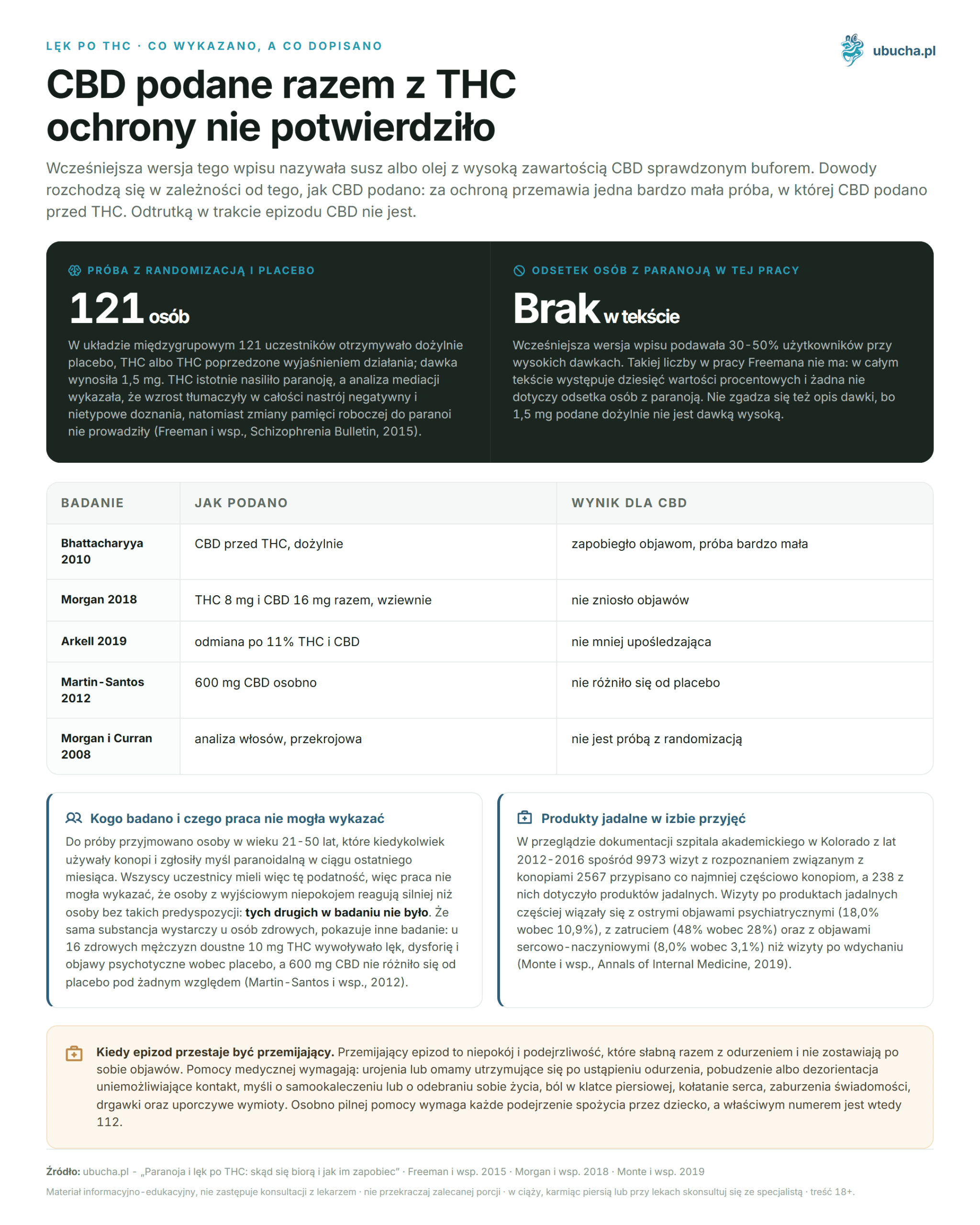
The strongest evidence comes from a study by Freeman and colleagues published in 2015 in Schizophrenia Bulletin. It was a randomized placebo-controlled trial in a between-groups design, where 121 participants received intravenous placebo, THC, or THC preceded by an explanation of possible effects of the substance. A dose of 1.5 mg of THC was used, and paranoia was assessed using several tools simultaneously: in a real social situation, in immersive virtual reality, and in an interview. THC significantly intensified paranoia, unusual experiences, anxiety, and negative self-thoughts, and impaired working memory.
However, the way it works is important. Mediation analysis showed that the increase in paranoia was entirely explained by negative mood and unusual experiences, while changes in working memory did not lead to paranoia. A separate study, by Bhattacharyya and colleagues in Scientific Reports in 2017, added a receptor layer: fourteen healthy men were tested twice, a month apart, after oral administration of 10 mg of THC or placebo, combining functional imaging with positron emission tomography. THC induced anxiety and altered the response of the right amygdala to anxiety-provoking stimuli, and the intensity of both effects correlated with the local availability of CB1 receptors in this structure.
Who is at risk and what did the studies not measure?
An earlier version of this post stated that THC induces paranoid thinking in 30-50% of users at high doses. Such a number is not present in Freeman’s work: throughout the text, there are ten percentage values, and none pertains to the percentage of individuals with paranoia. The description of the dose is also incorrect, as 1.5 mg administered intravenously is not a high dose.
The second correction concerns who was studied. The trial included individuals aged 21-50 who had ever used cannabis and reported paranoid thoughts in the past month. All participants had this susceptibility, so the study could not demonstrate that individuals with pre-existing anxiety react more strongly than those without such predispositions: the latter were not present in the study. The authors cautiously state that THC induces paranoia in susceptible individuals. That the substance alone is sufficient in healthy individuals is shown by another study: in a randomized double-blind trial involving 16 healthy men, oral 10 mg of THC induced anxiety, dysphoria, and psychotic symptoms compared to placebo, while 600 mg of CBD did not differ from placebo in any respect (Martin-Santos et al., Current Pharmaceutical Design, 2012).
| Factor | What is known from research |
|---|---|
| Previous paranoid thoughts | Inclusion criterion in Freeman’s study: the entire trial had this feature, so the study describes just this group |
| Availability of CB1 receptors in the amygdala | Correlates with increased anxiety after THC in 14 men |
| CBD content in the product | In randomized trials, it did not reduce psychotic symptoms after THC |
| Route of administration | Edible products have a higher share of acute psychiatric symptoms in the emergency room |
| Accompanying alcohol | Prolongs the duration of effects; when driving, effects add up, not multiply |
Does CBD protect against anxiety induced by THC?
This claim requires the most serious correction, as an earlier version of the post referred to high-CBD flower or oil as a proven buffer. Evidence diverges depending on how CBD was administered. Support for protection comes from a study by Bhattacharyya et al. in Neuropsychopharmacology from 2010: six healthy volunteers received THC intravenously after prior administration of CBD or placebo, and the preliminary administration of CBD prevented acute psychotic symptoms. The trial is very small, and CBD was given before THC, not after it.
Studies in which both substances were administered together did not confirm protection. In a randomized, double-blind, crossover trial involving 48 cannabis users, placebo, 8 mg THC, 16 mg CBD, and both substances combined were compared, administered via vaporizer. THC intensified psychotomimetic symptoms and impaired memory, and the addition of CBD did not alleviate this (Morgan et al., Translational Psychiatry, 2018). In a crossover study involving 14 individuals, vaporization of cannabis containing 11% THC and CBD was not less impairing than a strain rich in just THC, and the peak concentration of THC in plasma was higher (Arkell et al., Psychopharmacology, 2019).
Separately, there is the work by Morgan and Curran from 2008, which an earlier version attributed to the journal Psychological Medicine. It was published in the British Journal of Psychiatry, is a cross-sectional study based on hair analysis of 140 individuals, and contains nothing about recognizing faces expressing fear. The group with only THC in their hair had more positive symptoms than the group with THC and CBD, but cross-sectional comparisons cannot be read like the results of a randomized trial. CBD is not an antidote during an episode.
When does an unpleasant episode require contact with a doctor?
Popular guides often conclude with the assurance that anxiety after THC will pass on its own and does not pose a health risk. The first part is usually true, the second can be careless, and an earlier version of this post repeated it without any caveat. In a review of documentation from an academic hospital in Colorado from 2012-2016, out of 9973 visits with cannabis-related diagnoses, 2567 were attributed at least partially to cannabis, and 238 of them concerned edible products. Visits after edible products were more frequently associated with acute psychiatric symptoms (18.0% vs 10.9%), intoxication (48% vs 28%), and cardiovascular symptoms (8.0% vs 3.1%) than visits after inhalation.
A transient episode is anxiety and suspicion that diminish along with intoxication and leave no symptoms behind. Signals that require medical assistance are different: delusions or hallucinations persisting after intoxication has subsided, agitation or disorientation preventing contact, thoughts of self-harm or suicide, chest pain, palpitations, altered consciousness, seizures, and persistent vomiting that cannot be controlled. Urgent help is also required for any suspicion of ingestion by a child. In such situations, the appropriate number is 112, not waiting for it to pass on its own.
What realistically reduces the risk of anxiety after THC?
This section must be more modest than in the previous version, as half of the advice given there had no basis. Hydration with orange juice does not speed up THC metabolism, and there is no study behind the breathing pattern counted in seconds for this symptom. What remains is what has been measured.
First, the route of administration. After edible products, the effect appears with a delay, making it easy to re-dose under the impression that nothing is happening. Second, alcohol. In a crossover study involving 19 individuals who were given cannabis with or without alcohol, the perceived effects lasted for 3.3-4.3 hours, and concurrent alcohol consumption prolonged their duration (Hartman et al., Drug Testing and Analysis, 2016). It is worth correcting another sentence from the previous version: in a driving simulator study involving 18 individuals, the effects of cannabis and alcohol were found to be additive, not synergistic (Hartman et al., Drug and Alcohol Dependence, 2015). Third, the environment and baseline state, as the mechanism established by Freeman leads through negative mood, which depends on the situation. Studies on paranoia are discussed more broadly in the post about self-medication with cannabis and levels of paranoia.
What is the legal status of THC in Poland?
The answer depends on the THC content in the plant material. According to Article 4 point 5 of the Act of July 29, 2005 on Counteracting Drug Addiction (Journal of Laws 2023, item 1939, as amended by the Act of March 24, 2022, Journal of Laws 2022, item 763), hemp plants are those in which the sum of delta-9-THC and tetrahydrocannabinolic acid in flowering or fruiting tops, from which resin has not been removed, does not exceed 0.3% when calculated on a dry mass basis, rounded to one decimal place.
The threshold is calculated as the sum of delta-9-THC and THCA, not just delta-9-THC alone, which changes the result of laboratory testing. Material above the threshold is cannabis other than fiber hemp, which is a narcotic, and its possession outside of medical use is prohibited in Poland. The value of 0.2% was in effect until May 6, 2022, and is now outdated. This article is therefore a description of a phenomenon measured in studies and information about the risks, not a guide to use. Other consequences of contact with cannabis are described in relation to wolf appetite after cannabis and dry mouth after cannabis.
Frequently Asked Questions
Why does THC cause paranoia?
In a randomized placebo-controlled trial involving 121 individuals, intravenous administration of 1.5 mg of THC intensified paranoia, and mediation analysis indicated that this was due to negative mood and unusual experiences. Changes in working memory did not lead to paranoia. A separate study linked increased anxiety to the availability of CB1 receptors in the right amygdala.
Does paranoia after THC affect 30-50% of users?
This number does not come from any of the studies referenced in this post. In Freeman’s study, the percentage of individuals who experienced paranoia was not provided, and all participants were selected based on previous paranoid thoughts. Therefore, it cannot be calculated for the general user population based on this study.
Does CBD help with paranoia after THC?
In randomized trials where CBD was administered together with THC via inhalation, the addition of CBD did not reduce psychotomimetic symptoms or cognitive impairment. The only result suggesting protection comes from a very small trial where CBD was given before THC. CBD is not an antidote during an episode.
How long do the effects of inhaling THC last?
In a crossover study involving 19 individuals who were given cannabis via a vaporizer, the perceived effects lasted for 3.3-4.3 hours, and concurrent alcohol consumption prolonged their duration. After edible products, the onset of effects is delayed, increasing the risk of re-dosing.
When should help be sought after THC?
When delusions or hallucinations persist after the intoxication has subsided, when disorientation prevents contact, thoughts of self-harm, chest pain, altered consciousness, seizures, or uncontrollable vomiting occur. Urgent help is also required if there is suspicion of ingestion by a child. The emergency number is 112.
Are edible products safer than inhalation?
Not in this regard. In an analysis of emergency room visits in Colorado, visits after edible products were more frequently associated with acute psychiatric symptoms, intoxication, and cardiovascular symptoms than those after inhalation, and their share was higher than would be expected from sales.
This article is for informational and educational purposes and does not constitute medical advice. Before starting to use cannabis or CBD for therapeutic purposes, consult with a doctor, especially if you are taking other medications, are pregnant, or breastfeeding.
Author: Michał Waluk · Published: 2026-08-09 · Updated: 2026-08-16