
Munchies: why we get a ravenous appetite after cannabis (FAQ)
Gastrofaza is a colloquial term for appetite after THC. We check on which species the mechanism was measured, what was shown in humans, and what Polish law says.
After contact with cannabis containing THC, the fridge suddenly seems empty, and ordinary crackers taste better than usual. The English slang calls this \”munchies\”, while the Polish internet has adopted the term \”gastrofaza\”. The phenomenon itself is real and described in the literature, but the way it is discussed online diverges from what has actually been measured and on whom. Most of the mechanisms cited in popular texts come from studies on mice, and some claims about taste have been tested on humans and have not been confirmed. The version of this post before editing referred to four works, three of which did not concern appetite at all. This article separates the layers that have merged there: what has been shown, on which species, by what route of administration, and what is still unknown about the wolf appetite after cannabis.
KEY INFORMATION
• \”Gastrofaza\” is a colloquial term, not a scientific term: the literature speaks of the stimulation of appetite by cannabinoids.
• The mechanism with POMC neurons was described in mice after pharmacological stimulation of the CB1 receptor (Koch et al., Nature, 2015).
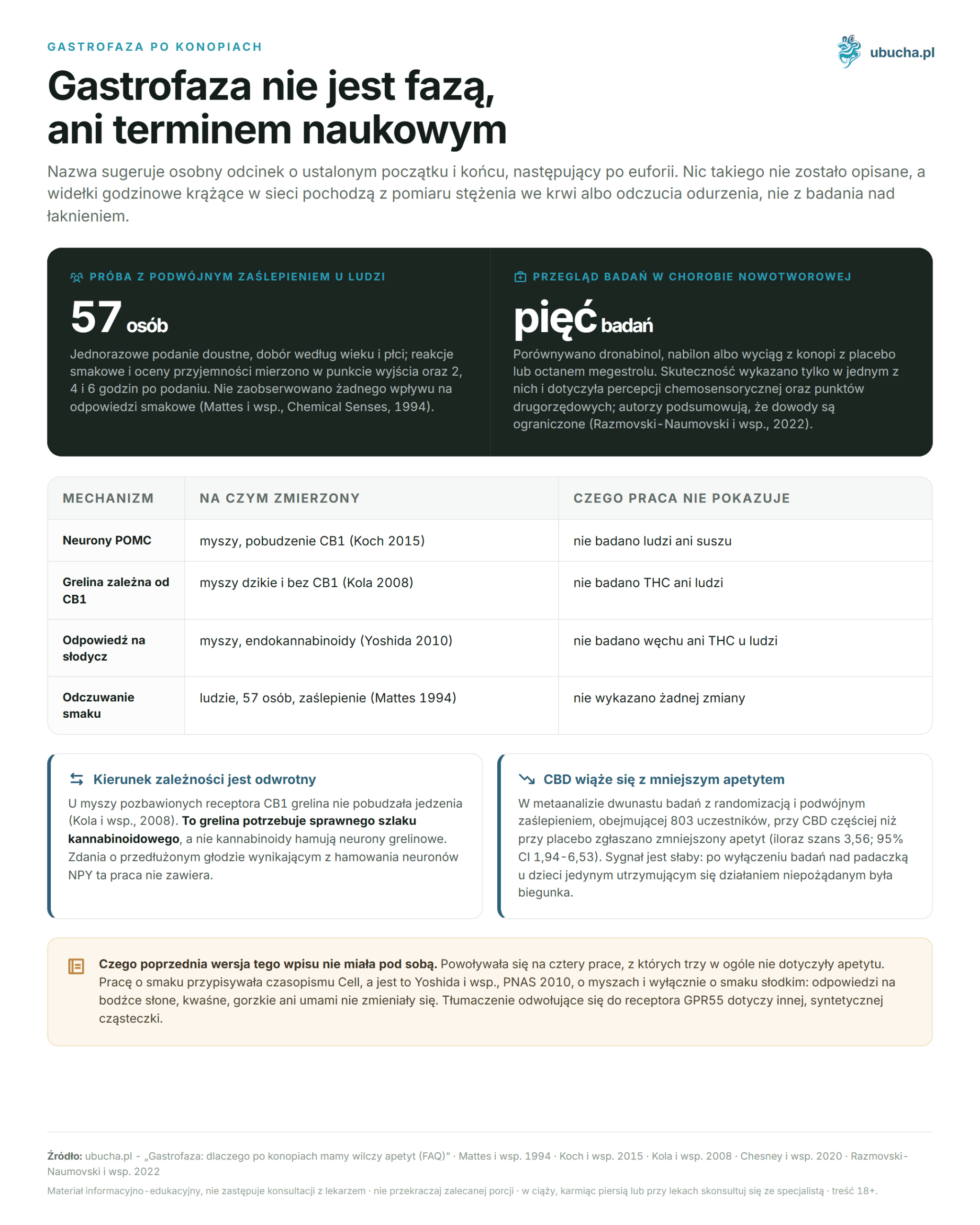
• In a double-blind trial of 57 people, THC did not change taste perception or food pleasure ratings (Mattes et al., Chemical Senses, 1994).
• A systematic review of five randomized studies did not confirm that medical cannabis improves appetite in cancer patients (Razmovski-Naumovski et al., Palliative Medicine, 2022).
• Plant material with THC content above the legal threshold is a narcotic in Poland.
Is \”gastrofaza\” a scientific term?
No. It is a colloquial adaptation of the English slang \”munchies\”, which in Polish internet has started to function as if it named a unit described in textbooks. There is no such term in the literature. The works speak of appetite stimulation, orexigenic action, or hyperphagia induced by cannabinoids, and each time describe a specific measurement, not a colloquial phenomenon. The distinction is not nitpicking: the colloquial word travels between texts along with claims that no one has measured.
The name itself also suggests something that is not visible in the data: that it is a separate \”phase\” with a defined beginning and end, following euphoria. Nothing like that has been described. The intensity of appetite can vary greatly among different people, and studies measuring the duration of the effect usually measured the concentration of substances in the blood or the feeling of intoxication, not appetite itself. The time frames provided online for inhalation and for edible products are therefore a transfer from another measurement, not a reading from a study on appetite. More about how the phenomenon looks from the user’s experience is discussed in our post about increased appetite after marijuana.
On what was the appetite mechanism after THC measured?
The most frequently cited work is by Koch and colleagues from 2015, published in Nature. They studied well-fed mice. Pharmacological stimulation of the CB1 receptor increased food intake and, contrary to expectations, raised the activity of POMC neurons, which are associated with satiety. The Pomc gene encodes two different molecules, and stimulation of CB1 increased the release of beta-endorphin, not alpha-melanocyte-stimulating hormone. Administration of naloxone, an opioid receptor blocker, abolished this effect.
The second work, Kola et al. from 2008 in PLoS ONE, also concerns mice: wild and those lacking the CB1 receptor. In animals without CB1, ghrelin did not stimulate eating. The direction of the relationship is therefore opposite to what was stated in the previous version of this post: it is ghrelin that needs a functional cannabinoid pathway, not cannabinoids that inhibit \”ghrelin neurons\”. The statements about prolonged hunger resulting from the inhibition of NPY neurons are not included in this work.
| Mechanism | On what and how measured | What the work does not show |
|---|---|---|
| Stimulation of POMC neurons and release of beta-endorphins | Mice, pharmacological stimulation of CB1 (Koch 2015) | Not studied in humans, flower or inhalation |
| Dependency of ghrelin action on the CB1 receptor | Wild mice and those without CB1, administration of ghrelin (Kola 2008) | Not studied THC or humans |
| Enhancement of response to sweetness | Mice, endocannabinoids administered to the animal (Yoshida 2010) | Not studied smell or THC in humans |
| Taste perception and pleasure of eating | Humans, 57 people, double-blind (Mattes 1994) | No change in taste responses was observed |
Does THC really improve the taste of food?
This is the most frequently repeated statement about gastrofaza, and it has actually been tested on humans. Mattes and colleagues described in Chemical Senses in 1994 a series of studies on occasional marijuana users. The main part was a double-blind placebo-controlled trial, with a single oral dose, on a sample of 57 adults matched by age and sex. Additionally, eleven people compared the route of administration, and six received doses twice a day for three days. Taste reactions and pleasure ratings were measured at baseline and 2, 4, and 6 hours after administration.
The result: no effect of the substance on taste responses was observed. The authors stated directly that the changes in tastiness reported by users may result from changes in memory and cognitive processes, rather than from the function of the sense of taste. In the same work, the rate of saliva secretion was significantly negatively correlated with the concentration of the substance in plasma, which we discuss separately in relation to dry mouth after cannabis.
The work that the previous version of this post attributed to the journal Cell and receptors in the nasal epithelium actually refers to Yoshida et al., PNAS 2010. It concerns mice, endocannabinoids administered to the animal, and only sweet taste: responses to salty, sour, bitter, or umami stimuli did not change. The work says nothing about smell. Meanwhile, the review by Bloomfield et al. in Nature from 2016 emphasizes that data on the effect of THC on the dopaminergic system are contradictory between studies: acute administration increases dopamine release, while long-term use is associated with dulling of this system.
Does CBD also induce gastrofaza?
There are no studies showing this. CBD does not stimulate the CB1 receptor like THC. In measurements on cell cultures, in HEK 293A lines and in model striatal neuron cells, cannabidiol reduced the potency and efficacy of THC and the endocannabinoid 2-AG on CB1 and acted as a non-competitive negative allosteric modulator (Laprairie et al., British Journal of Pharmacology, 2015). This is a test-tube measurement, so it describes receptor behavior, not what happens in the human body.
In humans, the direction is rather the opposite. A systematic review with a meta-analysis of twelve randomized double-blind studies involving 803 participants found that with CBD, adverse events in the form of decreased appetite were reported more frequently than with placebo (odds ratio 3.56; 95% CI 1.94-6.53) (Chesney et al., Neuropsychopharmacology, 2020). However, the signal is weak: after excluding studies on childhood epilepsy, where interactions with other medications were involved, the only persistent adverse effect of CBD was diarrhea. The translation from the previous version, referring to the stimulation of the GPR55 receptor, has no support: studies on GPR55 stimulation concern a compound called abnormal cannabidiol, which is a different synthetic molecule.
Do cannabinoids stimulate appetite in disease?
Here, the data are older and less clear than popular texts suggest. In the study by Beal et al. from 1995, published in Journal of Pain and Symptom Management, 139 people with anorexia in the course of AIDS and a weight loss of at least 2.3 kg participated. Participants were randomly assigned to dronabinol at a dose of 2.5 mg twice daily or to placebo; efficacy assessment was conducted in 88 people. Appetite increased above baseline values by 38% compared to 8% with placebo (p = 0.015).
A newer systematic review included five randomized studies in cancer patients, comparing dronabinol, nabilone, or cannabis extract with placebo or megestrol acetate. Effectiveness was demonstrated in only one of them and concerned chemosensory perception and secondary endpoints. The authors’ conclusion is that evidence from randomized studies that medical cannabis increases appetite in cancer patients is limited. The previous version of this post stated that THC reliably produces this effect, and in the structural data of the site, there was a statement about WHO confirming the effectiveness of cannabinoids in oncology patients, which was not present in the visible content at all. Dronabinol is synthetic delta-9-THC, a controlled substance: its use is determined by a doctor.
Is reaching for THC for appetite legal in Poland?
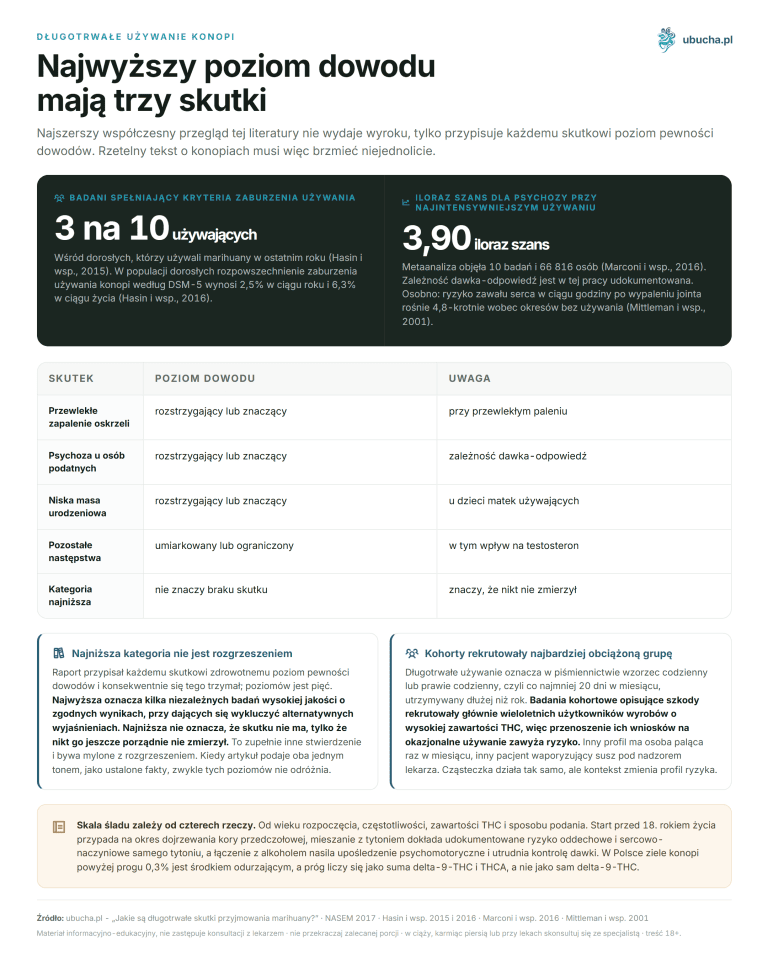
The answer depends on the THC content in the plant material and does not boil down to a single number. According to Article 4 point 5 of the Act of July 29, 2005 on counteracting drug addiction (Journal of Laws 2023 item 1939, as amended by the Act of March 24, 2022, Journal of Laws 2022 item 763), industrial hemp is defined as plants in which the sum of delta-9-THC and tetrahydrocannabinolic acid in flowering or fruiting tops, from which resin has not been removed, does not exceed 0.3% when calculated on a dry mass basis, rounded to one decimal place.
Two details of this definition are often overlooked. First, the threshold is calculated as the sum of delta-9-THC and THCA, not just delta-9-THC, which changes the result of laboratory testing. Certificates stating \”Total THC\” convert THCA with a factor of 0.877, while the law sums without a factor, so the legal value for the same sample comes out higher. Second, material above the threshold is cannabis other than industrial hemp, which is a narcotic, and its possession outside of medical use is prohibited. The value of 0.2% was valid until May 6, 2022, and is now outdated. Other acute consequences of contact with THC are described in relation to paranoia and anxiety after THC.
Frequently Asked Questions
What is gastrofaza?
It is a colloquial Polish term for increased appetite after contact with cannabis containing THC, a Polish adaptation of the English slang term \”munchies\”. It is not a scientific term or a unit described in textbooks. The literature refers to the stimulation of appetite by cannabinoids and always refers to a specific measurement.
On which species was the appetite mechanism after THC described?
On mice. The work of Koch and colleagues from Nature in 2015 showed that in well-fed mice, stimulation of the CB1 receptor increases food intake and simultaneously activates POMC neurons, with beta-endorphin being released. There is no equivalent measurement in humans, so directly transferring it to humans is an overinterpretation.
Does THC improve the taste of food?
In a double-blind placebo-controlled study of 57 people, no effect was found on taste responses or food pleasure ratings. The authors concluded that the changes reported by users may result from changes in memory and cognitive processes, rather than from the function of the sense of taste.
Does CBD induce gastrofaza?
There are no studies showing this. In a meta-analysis of twelve randomized trials involving 803 participants, CBD was associated with more frequent reports of decreased appetite than placebo, indicating the opposite direction. Cannabidiol does not stimulate the CB1 receptor like THC, as shown in measurements on cell cultures.
Do cannabinoids stimulate appetite in cancer disease?
A systematic review of five randomized studies found confirmation of effectiveness in only one of them, and that was for chemosensory perception and secondary endpoints. The authors summarize that the evidence is limited. Older data concern anorexia in the course of AIDS and come from a study of 139 people.
Does low-THC cannabis induce a wolf appetite?
There is no basis to attribute this effect to it. Material below the legal threshold, calculated as the sum of delta-9-THC and THCA, does not provide the amount of THC at which the phenomena described above were measured. The effect of gastrofaza in studies is associated with THC, not simply with the fact that the plant belongs to the cannabis species.
If you are interested in plant material below the legal THC threshold, you can find it in the category hemp flower.
This article is for informational and educational purposes and does not constitute medical advice. Before starting to use cannabis or CBD for therapeutic purposes, consult a doctor, especially if you are taking other medications, are pregnant, or breastfeeding.
Author: Michał Waluk · Published: 2026-08-09 · Updated: 2026-08-16