
Millet Risotto with Pumpkin and Hemp Seeds: Autumn Dish
Millet risotto with hokkaido pumpkin and hulled hemp seeds. Proportions, risotto technique step by step, and the composition of both grains according to USDA records.
Kaszotto is risotto made with millet instead of arborio rice and it is not a worse version of the original, just different. Millet added in batches to hot broth releases starch and thickens exactly like arborio. Hokkaido pumpkin brings color and natural sweetness, while hulled hemp seeds, added at the very end, provide fat that transforms this starch into creaminess without a hint of cream. The whole process takes 45 minutes. Below you will find the proportions, the order of actions at the pot, and what the food composition records say about millet and hemp seeds. There are more repeated statements about both than measured numbers, so we clarify a few of them along the way with the recipe.
KEY INFORMATION
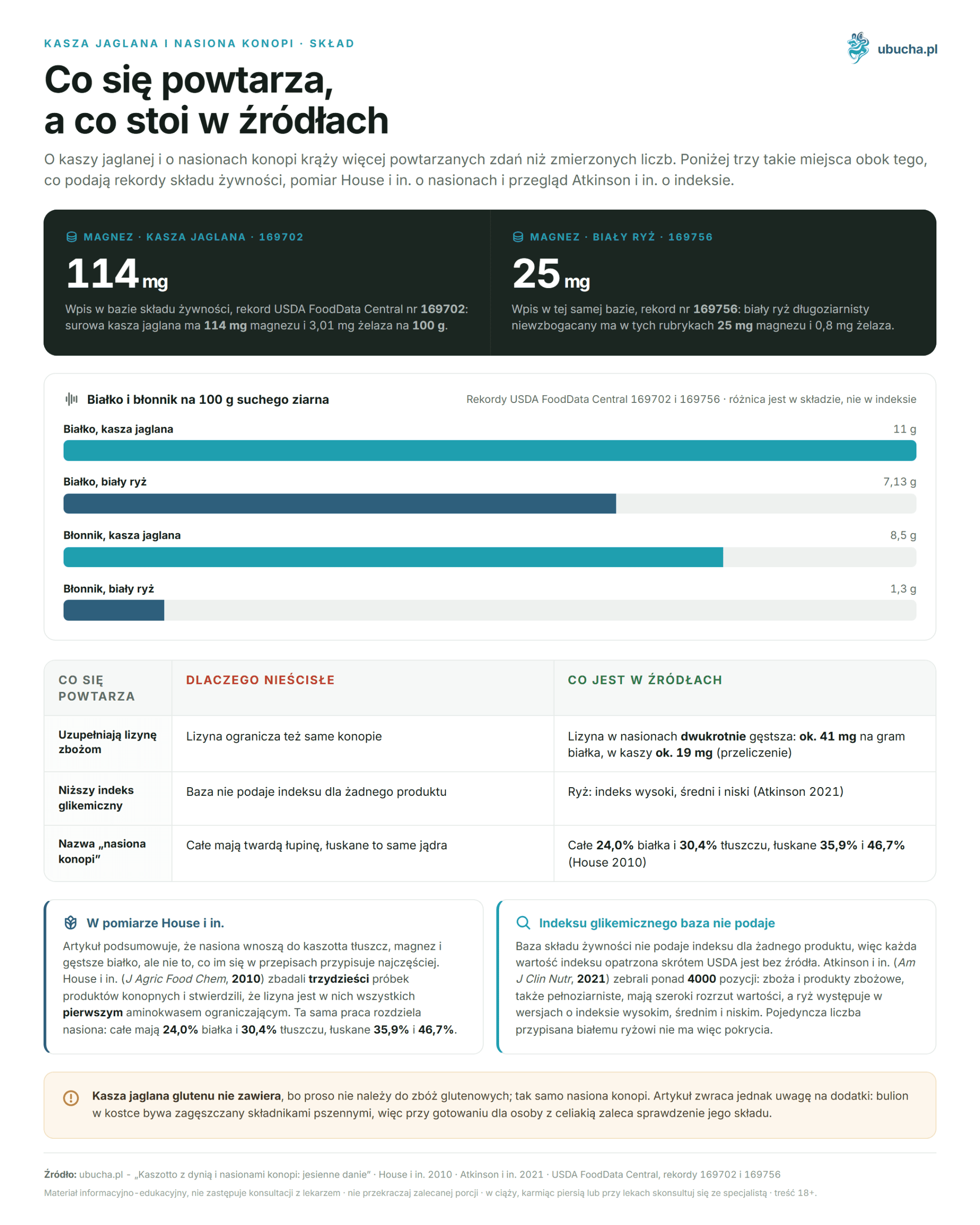
• Raw millet has 11 g of protein and 8.5 g of fiber per 100 g compared to 7.13 g and 1.3 g in white rice (USDA, records 169702 and 169756).
• Hulled hemp seeds contain 31.6 g of protein, 48.8 g of fat, and 700 mg of magnesium per 100 g (USDA, record 170148).
• Lysine is the first limiting amino acid in all studied hemp products (House et al., 2010).
• Add seeds after removing the pot from the heat.
What do hemp seeds bring to kaszotto?
Fat, magnesium, and denser protein. However, they do not provide what is most often attributed to them in recipes, which we will discuss shortly. USDA FoodData Central record number 170148 states for hulled seeds 31.6 g of protein, 48.8 g of fat, and 700 mg of magnesium per 100 g. Four tablespoons, or about 40 g, contribute about 20 g of fat to the pot.
This fat is responsible for the consistency. When added to hot millet after removing from heat, it spreads between the grains and emulsifies with the released starch, just as cold butter does in traditional risotto. It also improves something invisible: the absorption of pigments from the pumpkin. Unlu et al., J Nutr, 2005 provided eleven volunteers with a salad with and without 150 g of avocado, and then measured carotenoids in the lipoprotein fraction of plasma for 9.5 hours. The area under the curve for beta-carotene was 15.3 times greater with fat. Avocado oil worked the same as the flesh, so it is the fat, not the fruit, that works.
It is worth clarifying a statement that often recurs in recipes with hemp seeds: that they complement the lysine missing from grains. House et al., J Agric Food Chem, 2010 examined thirty samples of hemp products and stated directly that lysine is the first limiting amino acid in all of them. PDCAAS was 63-66% for hulled seeds and 46-51% for the cake after oil pressing. Hemp itself has a problem with lysine, so it is hard for it to patch it for grains.
However, this does not mean that the addition is insignificant, as the numbers go the other way here. Hemp seeds have 1.28 g of lysine per 31.6 g of protein, which is about 41 mg per gram of protein; millet has 0.212 g per 11 g of protein, which is about 19 mg. Thus, the seeds carry lysine that is twice as dense and, when added, increase its density in the entire dish. This is the true version of that statement. Callaway, Euphytica, 2004 also mentions an exceptionally high level of arginine; USDA record states it at 4.55 g per 100 g.
How does millet differ from rice for risotto?
In composition, not glycemic index. USDA record number 169702 states for raw millet 11 g of protein, 8.5 g of fiber, 114 mg of magnesium, and 3.01 mg of iron per 100 g. Long-grain white rice that is not enriched has in the same categories 7.13 g, 1.3 g, 25 mg, and 0.8 mg (record 169756).
The glycemic index numbers that usually come up in such comparisons are better left alone. The food composition database does not provide an index for any product, so any value marked with the USDA abbreviation is simply without a source. Atkinson et al., Am J Clin Nutr, 2021 collected over 4000 items and concluded, which explains a lot here: grains and grain products, including whole grains, show a wide range of values, and rice comes in versions with high, medium, and low index. A single number assigned to white rice has no backing.
The practical difference is only visible at the pot. We have noticed in our trials that millet absorbs liquid faster than arborio and can be ready in just 20 minutes, which is earlier than most risotto recipes state. Follow the consistency, not the clock: when the grain offers slight resistance but no longer has a hard center, it is time for the hemp seeds.
What do you need for millet risotto with pumpkin?
Proportions for three to four servings. Preparation takes 15 minutes, cooking 30. The broth must be hot at all times, as cold broth stops the cooking with each addition. A wide pot is more convenient than a tall one, as a shallower layer of millet releases starch more evenly when stirred.
- 200 g dry millet
- 500 g hokkaido pumpkin, about half a small piece
- 4 tablespoons hulled hemp seeds plus a teaspoon for sprinkling
- 1 large onion
- 2 cloves of garlic
- 700-800 ml hot vegetable broth
- 2 tablespoons butter or olive oil
- pinch of nutmeg, salt, and white pepper
- 1 tablespoon oil for roasting part of the pumpkin
- optional: sage leaves, 2 tablespoons grated parmesan or nutritional yeast
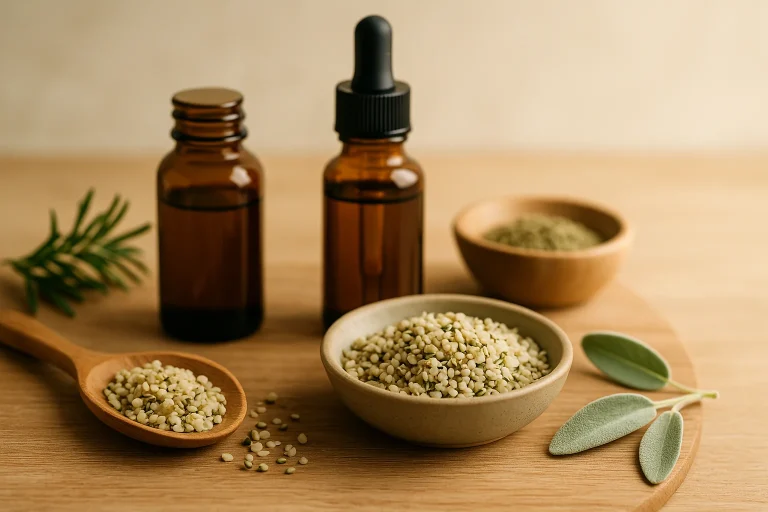
When it comes to seeds, pay attention to the name: hulled means just the kernels, whole ones have a hard shell. Only hulled seeds are suitable for kaszotto. The difference is also in composition, as in the measurement by House et al. whole seeds have 24.0% protein and 30.4% fat, while hulled ones have 35.9% and 46.7%.
How to cook millet risotto with pumpkin step by step?
The whole work is done by stirring. It grinds the grains against each other and releases the starch, which then binds the sauce. Without this, you will end up with millet and pumpkin in broth, not kaszotto. Roast the pumpkin concurrently.
- Prepare the pumpkin and preheat the oven. Preheat the oven to 200 degrees. Wash the hokkaido pumpkin, about 500 g, and cut it into 2 cm cubes; do not peel the skin as it is edible. Place half of the cubes on a baking sheet with a tablespoon of oil and bake for 20-25 minutes until golden.
- Rinse the millet and heat the broth. Rinse the millet, 200 g, under cold water for a minute until the cloudy water runs clear; this removes the bitterness from the outer layer of the grain. Keep vegetable broth, 700-800 ml, hot in a separate pot throughout the cooking process.
- Sauté the onion and millet. In a wide pot, heat 2 tablespoons of butter or oil. Add chopped onion and sauté for 5 minutes, then add garlic for one minute. Add the rinsed millet and sauté for 2 minutes, stirring constantly until the grains turn golden.
- Add raw pumpkin and gradually add broth. Add the raw pumpkin cubes, about 250 g, and pour in the first ladle of hot broth. Stir every 30 seconds, adding the next portion only after the previous one has been absorbed. Continue this for 20-22 minutes until the millet becomes creamy and the pumpkin partially breaks down.
- Add hemp seeds and season. Remove the pot from the heat and only then add 4 tablespoons of hulled hemp seeds, stirring vigorously for a minute. Season with salt, white pepper, and nutmeg. If the mixture is too thick, thin it with 2-3 tablespoons of broth and serve with roasted pumpkin.
How to modify this recipe for the season?
The base allows for several substitutions without losing character, as long as the technique remains the same. All variants below replace additives, never the millet or broth. Always add hemp seeds at the end, after removing the pot from the heat, regardless of which variant you choose.
Eight sage leaves sautéed in a tablespoon of butter and drizzled on top provide the simplest flavor enhancement, as sage and pumpkin are a pair from Italian cuisine. One hundred grams of soaked dried forest mushrooms, added along with the raw pumpkin, deepens the umami; use the soaking broth as part of the broth. A sour apple diced breaks down during cooking and balances the sweetness of the pumpkin with fruity acidity.
If you prefer the original with rice, the same technique is described in our risotto with hemp seeds and mushrooms. Smooth pumpkin can be found in the recipe for pumpkin cream with roasted hemp seeds, and outside the pumpkin season check cauliflower cream with hemp seeds and curry.
Frequently Asked Questions
What is the difference between kaszotto and risotto?
The grain, not the technique. Millet added in batches to hot broth releases starch and thickens just like arborio. The difference is in the composition: raw millet has 11 g of protein and 8.5 g of fiber per 100 g, while white rice has 7.13 g and 1.3 g (USDA, records 169702 and 169756).
Is millet gluten-free?
Yes, millet is not a gluten grain, so the millet made from it contains no gluten, just like hemp seeds. Note regarding additives: broth cubes can be thickened with wheat ingredients, so if cooking for someone with celiac disease, check the ingredients.
How much protein is in a serving of this kaszotto?
About 9 g when divided into four servings and about 12 g when divided into three. This comes directly from the composition records: 200 g of millet contains 22 g of protein, and 40 g of hulled hemp seeds adds another 12.6 g (USDA, record 170148). Broth and vegetables add little.
Do hemp seeds complement the missing lysine in millet?
Not in the sense that recipes often describe. House et al., J Agric Food Chem, 2010 state that lysine is the first limiting amino acid in all studied hemp products. However, they do increase its density in the dish: they have about 41 mg of lysine per gram of protein compared to 19 mg in millet.
What pumpkin is best for kaszotto?
Hokkaido, because its skin does not need to be peeled, and the flesh breaks down on its own when cooked, thickening the sauce. Butternut also works, but it requires peeling. Raw pumpkin provides 3.1 mg of beta-carotene per 100 g at 26 kcal (USDA, record 168448).
This article is for informational and educational purposes and does not replace consultation with a doctor. If you are pregnant, breastfeeding, taking medications, or have chronic conditions, consult a specialist before using supplements or herbs.
Author: Michał Waluk · Published: 2026-06-22 · Updated: 2026-08-16