
Does marijuana affect creativity? What do scientific studies say
Low doses of THC do not change creativity test results, while high doses lower them. Check what controlled studies on cannabis really showed.
The myth of the stoned genius has lived in popular culture for decades. Louis Armstrong, Carl Sagan, Bob Marley: all publicly associated cannabis with their creative process. However, the laboratory tells a different story than anecdote. Since 1978, researchers have been giving volunteers THC and counting how many ideas they can generate, how unusual they are, and whether anything can be built from them. The picture that emerges is surprisingly consistent. The belief in one’s own creativity increases, but not the creativity itself measured by tests. Here we compare six controlled experiments, show the dose at which the result turns negative, and explain why the evaluation of one’s own ideas diverges so much from the assessment of independent judges.
KEY INFORMATION
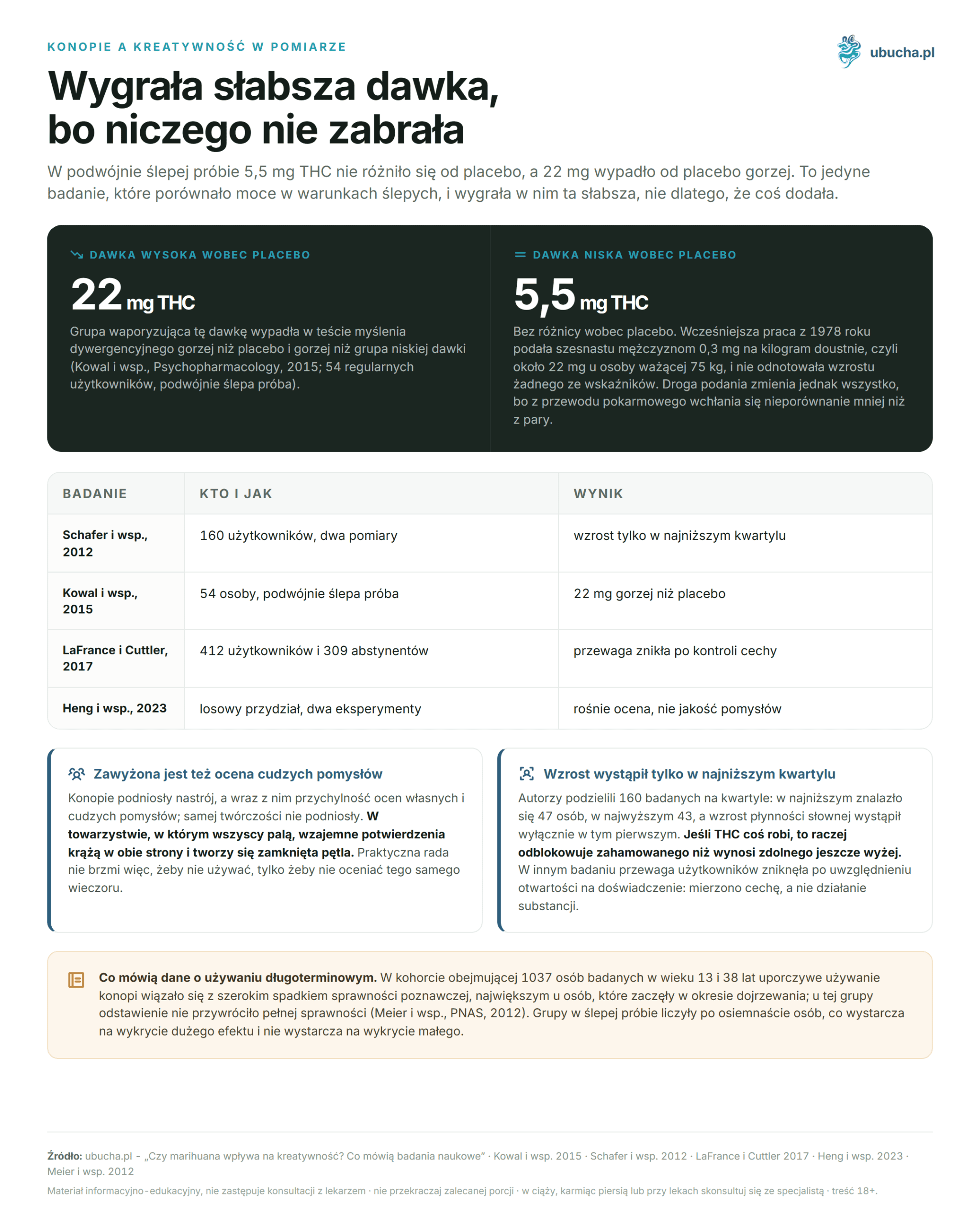
• A dose of 22 mg of THC worsened divergent thinking compared to placebo, while 5.5 mg changed nothing (Kowal et al., Psychopharmacology 2015).
• Cannabis increased verbal fluency only among individuals with the lowest baseline creativity (Schafer et al., 2012).
• After cannabis, the evaluation of one’s own and others’ ideas increases, not their measured quality (Heng et al., 2023).
• The advantage of cannabis users disappears after accounting for the trait of openness to experience (LaFrance and Cuttler, 2017).
Does marijuana really increase creativity?
In psychometric tests, usually not. Controlled experiments do not show that THC raises the measured quality of ideas in the average user, and high doses lower the result. In a study by a Dutch team, the group that received 22 mg of THC performed worse in the divergent thinking test than the placebo group (Kowal et al., Psychopharmacology, 2015).
The literature diverges exactly in one place: between what a person thinks of themselves and what measurement shows. This distinction is the crux of the entire discussion. User declarations have been consistent and enthusiastic for half a century. Test results are cool. When both types of data are collected in one experiment, the divergence is glaring: the evaluation increases, not the product.
However, there is an exception worth noting. Cannabis was able to raise the score for individuals who performed the worst before the experiment. The authors divided 160 participants into quartiles: the lowest contained 47 individuals, the highest 43, and the increase in verbal fluency occurred only in the first group. Not for everyone, not for skilled creators, only for those at the bottom of the distribution. So if THC does something, it rather unlocks the blocked than elevates the capable even higher.
It must also be said honestly what these studies do not measure. The number and unusualness of associations in a few-minute task are scored, not an album, a novel, or a functioning product. A test filled out in the laboratory describes one brick of the creative process. Transferring its result directly to studio work would be an abuse on both sides, both for supporters and skeptics.
So where does the strength of the myth come from? From very strong evidence of one kind: the accounts of people who have actually created outstanding things. The problem is that such testimony cannot separate two possibilities. Cannabis may have helped or may have accompanied work that would have happened anyway. Surveys will never resolve this, as they ask about impressions, and impressions after cannabis are systematically shifted upward. Only a blind trial with an independent judge can resolve this, and there are only a few such trials in the entire literature.
How is creativity measured in the laboratory?
Cognitive psychology breaks creativity down into two modes of thinking, described by J.P. Guilford back in the 1960s. Divergent thinking generates many different answers to an open question. Convergent thinking seeks one correct answer. Almost every study on the pharmacology of creativity measures these two modes.
The classic divergent task, the Alternate Uses Task, asks for as many uses of a brick or newspaper as possible. The judge scores fluency, i.e., the number of answers, flexibility, i.e., the number of different categories, and originality measured by the rarity of answers in the entire sample. On the convergent side is the Remote Associates Task, where one must find one word connecting three seemingly unrelated prompts.
| What is measured | Tool | What the judge scores | Equivalent in work |
|---|---|---|---|
| Divergent thinking | Alternate Uses Task | fluency, flexibility, originality | brainstorming, sketching, first draft |
| Convergent thinking | Remote Associates Task | hitting one connecting word | editing, debugging, mixing |
| Declared creativity | self-assessment questionnaire | the subject’s belief about themselves | feeling that things are going well |
The third row of this table is the reason for most misunderstandings surrounding cannabis. Self-assessment and test results are two separate variables that can go in opposite directions in THC studies. The ecological validity of the tests themselves also has limits: they predict creative achievements outside the laboratory only moderately, so no AUT result determines anyone’s career.
Also note how originality is scored. An answer is original when it rarely appears in the entire sample, not when it sounds clever. This leads to a simple methodological conclusion: it is enough to answer strangely to raise the score, even if none of the ideas are usable. Well-designed studies try to circumvent this by adding an assessment of usability or independent judges who do not know who took what. Without this safeguard, loosening filters can easily be mistaken for creativity.
Also see what a single convergent task looks like, as it often surprises. The participant receives three prompts, for example juice, sour, peel, and searches for a word that fits all at once. The answer usually comes suddenly, in the form of a well-known feeling of insight. This type of task performed better among cannabis users tested sober, before accounting for their personality traits.
What did the first experiments from the 70s and 80s show?
The first rigorous trial came out negative. Tinklenberg and colleagues gave sixteen educated men cookies with cannabis extract at a dose of 0.3 mg THC per kilogram of body weight, which falls within typical social use. The task of describing an object was scored for fluency, flexibility, elaboration, and uniqueness. None of these indicators increased (Tinklenberg et al., J Nerv Ment Dis, 1978).
Seven years later, Block and Wittenborn tested a narrower hypothesis: do cannabis actually bring out rarer associations. Participants listed examples of a given category, such as clothing, for two minutes. Marijuana changed the structure of responses, partially in line with user reports of unusual associations. However, reaction times did not change as the theory predicted, which the authors considered a problem for contemporary explanations of the mechanism (Block and Wittenborn, Psychopharmacology, 1985).
Both works have obvious limitations today. The trials were small, almost exclusively male, and dosing is difficult to compare with today’s products. An extract eaten in a cookie acts differently than vaporized flower, and the potency of materials from the 70s was many times lower than what is available today. Nevertheless, the conclusion from that decade has survived surprisingly well: at a social dose, there is no increase, only a shift towards rarer associations.
However, the way such studies are conducted has changed. An extract in a cookie provided a dose that no one could replicate in the next participant, as absorption from the digestive tract is slow and highly variable. A vaporizer with a standardized strain allowed, only after 2010, to administer measured milligrams in a blind trial. An assessment by unaware judges and measurement of personality traits before the experiment were also added. Only this set of tools allowed the question to be asked differently: not whether cannabis helps, but who and at what dose.
Also convert Tinklenberg’s dose into specifics. A value of 0.3 mg per kilogram for a man weighing 75 kg gives about 22 mg of THC taken orally, which nominally is the same amount received by the high-dose group in Kowal’s study. However, the route of administration changes everything, as much less is absorbed from the digestive tract than from vapor. Comparing milligrams between studies without this correction leads to misleading conclusions.
Which three studies are the basis of the discussion today?
The modern picture is based on three works from 2012-2017. Each answers a different question: do cannabis help everyone, does the dose change the direction of the effect, and are users as a group really more creative. Together they form a coherent answer, although each is often cited selectively.
| Study | Who and how | Result |
|---|---|---|
| Schafer et al., 2012 | 160 users, each tested once sober and once after their own cannabis | verbal fluency increased only in the lowest creativity quartile, to the level of the highest group |
| Kowal et al., 2015 | 54 regular users, vaporization, double-blind trial: placebo, 5.5 mg, 22 mg THC | the 22 mg group worse than placebo and 5.5 mg, low dose no difference |
| LaFrance and Cuttler, 2017 | 412 users and 309 abstainers, all tested sober | the advantage of users in convergent thinking disappeared after controlling for openness to experience |
Schafer’s work showed an equalizing effect (Schafer et al., Consciousness and Cognition, 2012). Kowal added the dose dependency measured in a blind trial, which naturalistic studies cannot ensure. LaFrance and Cuttler closed the matter from the correlational side: cannabis users indeed performed better and rated themselves higher, but the difference dissolved after accounting for personality traits (LaFrance and Cuttler, Consciousness and Cognition, 2017).
Note the direction of reasoning in this last work. It is not cannabis that makes people creative. It is individuals open to new experiences who more often reach for both unusual ideas and cannabis. Correlation without causation, a textbook example.
It is also worth knowing the limits of this trio. All studied individuals already using cannabis, so they say nothing about someone who reaches for it for the first time. Groups in the blind trial numbered eighteen individuals, which is enough to detect a large effect and not enough to detect a small one. None of these studies also checked a real artistic product, only test tasks lasting a few minutes. The gap between the laboratory and the recording studio still awaits filling.
Why does everything seem genius under the influence?
Because the evaluation changes, not the product. Heng, Barnes, and Yam conducted two experiments with random assignment to cannabis or abstinence and checked separately the quality of ideas and their evaluation. Cannabis elevated mood, and with it, the favorability of evaluations of one’s own and others’ ideas. It did not elevate creativity itself (Heng et al., Journal of Applied Psychology, 2023).
This mechanism has a consequence that is easy to overlook. Not only is the evaluation of one’s own works inflated, but also others’. In a company where everyone smokes, mutual confirmations circulate both ways, creating a closed loop. This is where the phenomenon comes from, well known to anyone who, at three in the morning, wrote a brilliant idea on their phone, only to find three nonsensical words there in the morning.
We have noticed in conversations with customers of the store that the most practical advice does not sound like “don’t use”. It sounds: don’t evaluate it the same evening. People who work creatively professionally often come to the separation of the two activities themselves. Generation can occur in any state, as the number and diversity of records matter here. Selection requires a clear head and is best done the next day when the mood stops voting for the idea.
It is also worth remembering where the effect itself comes from. The mood after cannabis acts as information: the brain interprets pleasant arousal as a signal that what it is working on is good. This model is called affect as information and does not apply only to cannabis. We behave similarly after good news or after two glasses of wine.
A practical safeguard is trivially simple and boils down to one rule: write everything down, delete nothing, and do not select the same evening. A notebook with twenty ideas will survive the night without damage, and in the morning, it will show how many of them stand up without the mood that gave rise to them. If after a good night’s sleep only one item remains on the list, it is still one item more than with a blank page. It is not generation that fails, but the choice made at a moment when everything seems equally good.
How does THC affect the brain and why does the dose reverse the result?
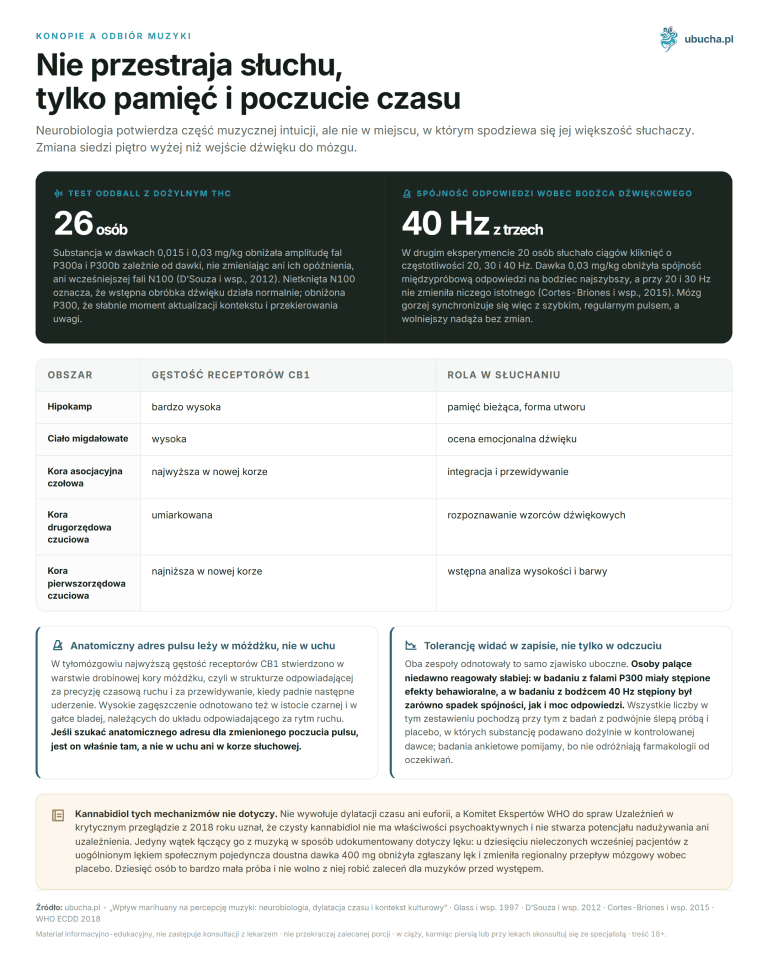
CB1 receptors of the endocannabinoid system are densely distributed in the cortex and striatum, which are structures that handle memory, response control, and reward evaluation. THC stimulates them directly, while CBD does not. In an fMRI study involving fifteen healthy men, both substances produced opposite activation patterns, including in the striatum, hippocampus, and amygdala (Bhattacharyya et al., Neuropsychopharmacology, 2010).
This translates to creativity mainly through dopamine, but not linearly. A review by Boot and colleagues describes a U-shaped relationship and separates two circuits. Moderate levels of dopamine in the striatum promote flexible jumping between associations. Moderate levels in the prefrontal cortex maintain persistent drilling of one thread. Both too little and too much spoil the result (Boot et al., Neurosci Biobehav Rev, 2017).
| Dose in the study | What was measured | Effect |
|---|---|---|
| 0.3 mg/kg orally (Tinklenberg, 1978) | fluency, flexibility, elaboration, uniqueness | no increase in any indicator |
| 5.5 mg vaporized (Kowal, 2015) | divergent thinking | no difference compared to placebo |
| 22 mg vaporized (Kowal, 2015) | divergent thinking | result worse than in placebo |
This table explains why two adjacent studies can sound like a contradiction. They are not contradictory; they measure different points of the same curve. It also undermines the popular belief that stronger herb means stronger inspiration. In the only trial that compared potencies in blind conditions, the weaker one won, not because it added something, but because it took nothing away.
To the picture, working memory is added, which is the ability to hold several elements at once. It allows one to keep the structure of a piece in mind during arrangement or the context of a function during debugging. THC burdens it, regardless of whether you feel high. This is why an experienced user, convinced that a given dose does not affect them, is often surprised by the number of corrections the next day. Subjective habituation to the psychoactive effect does not mean habituation of the entire cognitive system.
Why do some gain while others lose?
Four variables are responsible for this, and THC is only one of them. The baseline level has the strongest effect: cannabis increased verbal fluency only among individuals in the lowest creativity quartile, and did not change anything in the highest (Schafer et al., 2012). The rest of the variance comes from personality, tolerance, and expectations.
- Openness to experience is the strongest predictor on the personality side. After accounting for it, the entire advantage of cannabis users in LaFrance and Cuttler’s study ceased to be visible, suggesting that we were measuring a trait, not the action of the substance.
- Baseline level determines the direction of change. Those who have blocked access to associations may gain from loosening. Those who do not have it have nothing to unlock.
- Tolerance masks the subjective effect, not the cognitive one. An experienced user feels normal at a given dose, which does not mean their working memory is functioning normally.
- Expectations fill in the rest. The mood after smoking shifts the evaluation of one’s own ideas upward, regardless of their quality (Heng et al., 2023).
Additionally, there is a factor rarely mentioned in guides. In Schafer’s study, cannabis intensified transient symptoms similar to psychosis in both compared groups, even among more creative individuals. For some users, the practical effect is not broader access to associations, but anxiety that effectively shuts down work for the rest of the evening.
The situation in which this happens also matters. The same person, the same dose, and a different environment can yield opposite experiences, as the direction is determined by the sense of safety and lack of time pressure. A deadline for the next morning rarely aligns with loosening cognitive filters. If you want to see how it works for you, do it your way: for two weeks, record the number of ideas generated in the evening, and in the morning, note how many of them still hold up. Two columns in a notebook will tell you more than any meta-analysis, as they concern one case that interests you.
What does this mean for artists, programmers, and copywriters?
The practical conclusion is one: professional creativity has two phases, and no substance can handle both at once. Generation rewards loose associations and tolerance for nonsense. Finishing rewards working memory and ruthless evaluation. THC burdens the second phase, and did not improve the first in studies.
| Occupation and phase | What prevails | What the data say |
|---|---|---|
| Programmer: writing and debugging | convergent thinking, working memory | the worst possible moment, THC burdens both resources |
| Musician, sketch session | divergent thinking | no evidence of improvement, real risk of overestimating recordings |
| Musician, mixing and mastering | precision and evaluation | phase requiring sober evaluation, evaluation after cannabis is inflated |
| Copywriter: first draft and editing | both modes alternately | separate them in time, edit the next day |
The popular strategy of “write under the influence, edit sober” has partial support in the data, but not in the way its name suggests. The data do not say that the first part works better. They say that the second part is necessary, because without it, you are left with material evaluated by your own mood. If you have to choose just one rule, choose delayed selection.
A separate issue is long-term use. In the Dunedin cohort, which included 1037 participants aged 13 to 38, persistent cannabis use was associated with a broad decline in cognitive functioning, greatest among those who started during adolescence. In this group, cessation did not restore full functioning (Meier et al., PNAS, 2012). It is hard to imagine worse news for someone who lives by thinking.
How to arrange this in a work week? The simplest way is to assign the state to the stage, not the day. The preparatory stage, in which you gather references and note directions, tolerates looser conditions without much harm, as nothing is yet decided there. The decision-making stage, i.e., choosing versions and submitting files, requires full sobriety and performs best in the morning. Professionals who use cannabis usually come to this division themselves after a few costly mistakes.
Can CBD support creative work?
Not in the way most questioners imagine. CBD does not have intoxicating effects and there is no data to suggest it raises scores in divergent thinking tests. The WHO review report from 2018 states that it is well tolerated and does not show addictive potential or intoxicating effects (WHO ECDD, Cannabidiol Critical Review, 2018).
The real pathway of influence goes through anxiety. Creative blocks rarely result from a lack of ideas, more often from tension and fear of evaluation. In a study involving 24 untreated patients with social phobia, a single dose of 600 mg of CBD given before a simulated public speaking event significantly reduced anxiety and discomfort while speaking (Bergamaschi et al., Neuropsychopharmacology, 2011). This is a clinical dose, significantly higher than a typical serving from oil.
From our observations in the store, a pattern emerges. Graphic designers and copywriters buying oil for work almost never mention boosting creativity. They talk about removing blocks and stopping the endless correction of the same paragraph. This description fits the literature better than the promise of inspiration: it concerns removing obstacles, not adding abilities.
However, there is a difference between the dose from the study and the serving from drops. Six hundred milligrams given once in clinical conditions is a multiple of what lands under the tongue with typical use, so transferring that result directly to an evening serving of oil would be an overinterpretation. Cannabidiol also interacts with liver enzymes that metabolize many medications, which requires a conversation with a doctor or pharmacist when taken regularly.
It is also worth knowing where the regulator’s knowledge ends. In a 2026 position, the EFSA panel derived a provisional safe dose of cannabidiol: 0.0275 mg per kilogram of body weight per day, or about 2 mg for a person weighing 70 kg. The safety of CBD cannot be established today for individuals under 25, pregnant or breastfeeding women, and those taking medications regularly.
If you want to try, start with low concentrations and observe the reaction over several days, keeping a short note on work quality. You can find a full selection in the hemp oil category, and if you are curious about how it differs from cannabigerol, we described it in the text about the differences between CBG and CBD. There is also a separate post about CBD and social phobia that works on the anxiety before a performance.
Frequently Asked Questions
Does smoking marijuana increase my creativity?
In psychometric tests, usually not. Schafer et al. (2012) noted an increase in verbal fluency only among individuals with the lowest baseline creativity. For the other participants, the result did not change. However, the belief in one’s own creativity increases, as shown by the experiments of Heng et al. in 2023.
Does regular smoking permanently lower creativity?
Long-term, persistent cannabis use was associated in the Dunedin cohort (1037 participants aged 13 to 38) with a broad decline in cognitive functions. The greatest impact was on those who started during adolescence, and cessation did not restore full functioning (Meier et al., PNAS 2012).
Do microdoses of THC work better than regular doses?
Neither the literature indexed in Europe PMC nor the clinical trial registry contains a controlled trial on microdoses of THC and creativity. It is only known that 5.5 mg did not change the test result compared to placebo, while 22 mg worsened it (Kowal et al., 2015). In Poland, THC remains illegal, and we develop the topic of dosing in our post about microdosing.
Do indica and sativa differ in their impact on creativity?
The division into indica and sativa poorly describes the composition of the plant. The cannabinoid and terpene profiles matter, as they are responsible for the aroma and part of the perceived effects. Queries in Europe PMC do not return a controlled trial comparing terpenes in terms of divergent thinking.
Can CBD help before a performance or presentation?
Possible, if the problem is anxiety. In a study by Bergamaschi et al. (2011), 24 untreated patients with social phobia received 600 mg of CBD or placebo before a simulated public speaking event. The group with CBD reported significantly less anxiety and discomfort while speaking.
Is an idea conceived under the influence really mine?
From a neurobiological perspective, yes. The material from which the idea is formed is your memory, knowledge, and experience. The substance changes the initial conditions, i.e., the threshold of associations and the level of self-criticism. The problem is different: under the influence, you evaluate which of these ideas is actually viable worse.
What legal methods support divergent thinking?
The best-documented method is open monitoring meditation: Colzato et al. found that it induced a state conducive to divergent thinking, while focused attention meditation did not support convergent thinking (Frontiers in Psychology, 2012). A break from the task and a good night’s sleep also help, as they create conditions favorable for free association.
If you are looking for a milder support for evening conceptual work, browse hemp oils and hemp flower available at Bucha.
This article is for informational and educational purposes and does not constitute medical advice. Before starting to use cannabis or CBD for therapeutic purposes, consult a doctor, especially if you are taking other medications, are pregnant, or breastfeeding.
Author: Michał Waluk · Published: 2026-05-06 · Updated: 2026-08-15