
Microdosing CBD and THC 2026: Trend or Effective Method? Dosages, Protocols, Evidence
Microdosing CBD and THC without marketing: the only clinical study close to microdose, safe dose according to EFSA, and legal status of THC in Poland.
Microdosing promises an effect without the effect: just enough substance to cause a change, and so little that no one notices. The largest placebo-controlled trial involved 191 people self-blinding capsules and showed no difference between psychedelic microdose and placebo (Szigeti et al., eLife, 2021). For cannabis, there is not even such a study. This text separates what has been measured from what product descriptions repeat: what the only clinical study with doses close to THC microdose really showed, how much cannabidiol is actually absorbed, what dose EFSA currently considers safe, and what risks THC outside prescription entails in Poland.
KEY INFORMATION
• The largest blinded trial showed no difference between microdose and placebo (Szigeti, eLife, 2021).
• For cannabis, there is one study with doses close to micro: 16 patients, inhaled (Wallace, The Journal of Pain, 2015).
• EFSA gives a provisional safe CBD dose of 0.0275 mg per kilogram body weight per day, about 2 mg for a 70 kg person (EFSA, 2026).
• CBD safety cannot be established for people under 25, pregnant and breastfeeding women, and those taking medications.
• THC outside Rpw prescription is punishable in Poland.
What is microdosing and where does the term come from?
Microdosing is the regular intake of doses low enough not to cause consciously noticeable effects. The term originated around psychedelics, not cannabis. A systematic review of all available literature on low doses of psychedelics covered 44 studies from 1955-2021 (Polito and Liknaitzky, Neuroscience and Biobehavioral Reviews, 2022).
The same review points out something marketing ignores: there is no consensus on the definition of dose in microdosing literature. The authors had to propose ranges for each substance themselves because different studies understood “micro” differently. If this is the best-described field, transferring this framework to cannabis starts from a worse position, not a better one.
The transfer has two weak points. The first concerns substances. Psilocybin and LSD act on the serotonin 5-HT2A receptor and have a short duration, so days off in the schedule have physiological justification. Cannabinoids act differently and have different pharmacokinetics, so a schedule copied from psychedelics has no data equivalent.
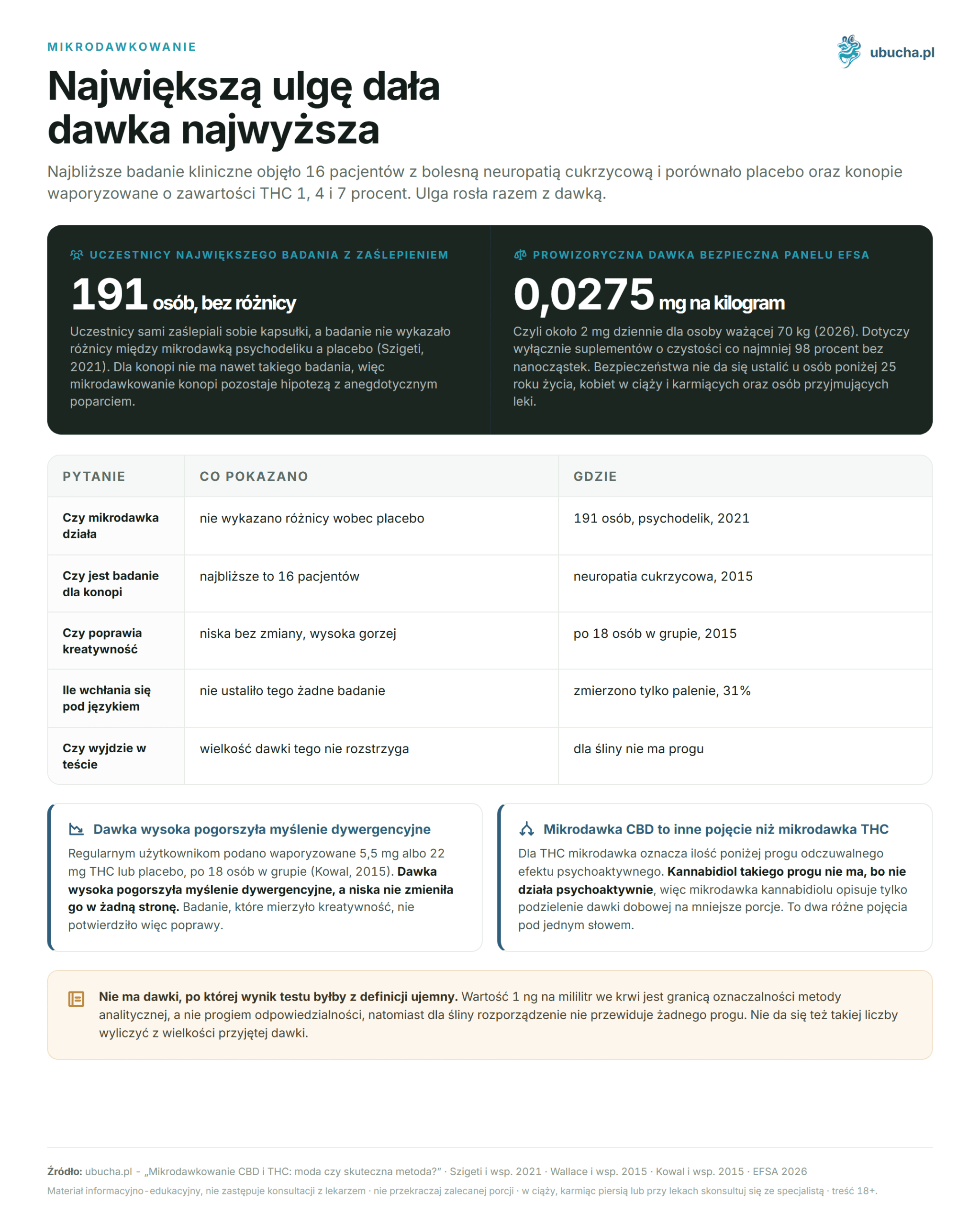
The second weak point concerns CBD. Cannabidiol does not cause psychoactive effects, so there is no perception threshold below which it could be reduced. “CBD microdose” is therefore not a sub-perceptual dose in the sense that LSD microdose is. These are two different concepts under one word, and blurring this boundary causes most misunderstandings in cannabis microdosing texts. A broader introduction to the concept itself can be found in the post about what microdosing is and which substances can be microdosed.
Does microdosing work or is it a placebo effect?
We have data only for psychedelics, and they are inconclusive. In a self-blinding study, 191 participants alternated microdoses and placebo for four weeks following an online-prepared protocol. All measured psychological parameters improved in the microdose group but also in the placebo group, with no differences between groups (Szigeti et al., eLife, 2021).
The authors noted some participants guessed what they were taking, which may explain small differences seen in some scales. They cautiously concluded that reported microdosing benefits can be explained by placebo effect.
Three years later, the same authors who compiled the entire microdosing research corpus reviewed 19 placebo-controlled studies and reached the opposite conclusion to the popular summary. They argued that claiming microdosing is entirely placebo is premature because studies are few, samples small, doses sometimes too low, and only non-clinical populations were studied (Polito and Liknaitzky, Journal of Psychopharmacology, 2024).
For readers, this means suspension rather than resolution. Today, one cannot say either “it works” or “it’s placebo.” Separately, both findings concern LSD and psilocybin. For cannabis, no such study has been conducted at all, so even this cautious uncertainty is borrowed from a neighboring field. The topic is expanded in the post on microdosing versus placebo in controlled studies.
Do low THC doses really act differently than high doses?
Partly yes, but not as most guides say. A systematic review of anxiety studies with cannabinoids states that a biphasic dose-response is well documented in animal studies. In humans, available clinical studies show an anxiogenic reaction to THC, stronger at higher doses (Sharpe et al., Journal of Translational Medicine, 2020).
This distinction changes the whole concept’s meaning. The popular version says low THC calms and high THC causes anxiety, and one just needs to hit the valley of the curve. Sharpe et al. locate this curve in animal models and describe mainly anxiogenic direction in humans.
The same review also resolves which component is responsible for anxiolytic action. Acute CBD doses reduced anxiety in animals and humans and did not cause anxiogenic effects at higher doses. The authors conclude that cannabidiol-based preparations are more suitable for people with pre-existing anxiety than THC-based ones.
Separately, there is a hypothesis that full cannabis extract acts milder than isolated THC because terpenes and other cannabinoids modify its action. The hypothesis author formulates it conditionally and proposes ways to test it, not claiming it proven (Russo, British Journal of Pharmacology, 2011). The statement “entourage effect means low dose suffices” has no support in human studies today.
Does combining CBD with THC act milder than THC alone?
Such a hypothesis exists but has not been tested for low doses. The entourage effect concept author describes that terpenes and other plant components may modify THC action and presents evidence that non-cannabinoid components can counteract its intoxicating effects. However, this is conditional and proposes testing methods, not proven facts (Russo, British Journal of Pharmacology, 2011).
Preparations combining both cannabinoids are well represented in pain studies. In a Cochrane review, ten of sixteen included studies concerned a mucosal spray containing plant THC with cannabidiol. These were therapeutic doses, not microdoses, and their benefit-risk balance was as described in the chronic pain section.
A systematic review of anxiety studies concludes differently than 1:1 marketing. It states that cannabidiol-based preparations are more suitable for people with pre-existing anxiety (Sharpe et al., Journal of Translational Medicine, 2020). This argues for CBD alone, not the mixture.
For Polish readers, the matter ends with legal status. Any composition containing THC, regardless of proportion and dose size, requires a prescription, and outside this path remains a controlled substance.
What did the only clinical study close to THC microdose show?
One randomized, double-blind study involved 16 patients with painful diabetic neuropathy resistant to treatment. Each participant underwent four sessions: placebo and vaporized cannabis with THC content of 1, 4, and 7 percent (Wallace et al., The Journal of Pain, 2015).
The result depended on dose. Spontaneous pain differed significantly between doses, and each of the three doses was better than placebo. However, the friendly microdosing version ends here: the highest dose was significantly better than low and medium, so the strongest relief came from 7 percent, not 1 percent.
The price of this relief is in the same abstract. The highest dose worsened results of two of three neuropsychological tests. This is exactly the compromise microdosing aimed to avoid, and the study shows it in numbers rather than solving it.
Three limitations must be mentioned with the result. The sample was 16 people, sessions were single, and patients had treatment-resistant pain, so they were not typical wellness audience. The authors call their work a small, short-term study providing preliminary grounds for further research, not a basis for use. The paper appeared in The Journal of Pain in 2015, though many Polish texts cite a different journal and date.
How much cannabidiol is really absorbed?
Less is known than tables in dosing articles state. A systematic review of CBD pharmacokinetics in humans collected 24 studies and found absolute bioavailability measured only for inhalation, where it was 31 percent. No study established it for other administration routes (Millar et al., Frontiers in Pharmacology, 2018).
This settles the fate of the most repeated table in Polish CBD texts, listing “oral 6-8 percent, sublingual 13-19 percent, inhaled 30-35 percent.” These values do not come from human measurement. The table below summarizes what the review actually reports.
| Parameter | What Millar et al. 2018 review reports |
|---|---|
| absolute bioavailability | measured only after smoking: 31 percent; not established for other routes |
| half-life | 1.4-10.9 hours after mucosal spray, 2-5 days after chronic oral dosing, 24 hours after intravenous, 31 hours after smoking |
| time to max concentration | 0-4 hours |
| food effect | max concentration increases after food and in fat formulations |
The practical conclusion is inconvenient for the microdosing CBD idea itself. Since we do not know what fraction of oral dose reaches bloodstream, we also do not know how much cannabidiol corresponds to a “microdose” given sublingually. The milligram number on the label describes bottle content, not body exposure.
What CBD dose is considered safe today?
The latest European Food Safety Authority position derives a provisional safe dose of 0.0275 mg per kilogram body weight per day, about 2 mg daily for a 70 kg person. The value was obtained by benchmark dose method with uncertainty factor 400 (EFSA, NDA panel, 2026).
This number has a narrow scope. It applies only to supplements with cannabidiol purity at least 98 percent, without nanoparticles, produced safely and with excluded genotoxicity. It does not apply to other forms or full-spectrum preparations.
The panel also lists what cannot be established. CBD safety cannot be determined for people under 25, pregnant and breastfeeding women, and those taking medications simultaneously. This sentence has more practical significance than the dose itself, as it covers a large part of readers seeking supplementation information.
Other findings go the same way. Animal studies showed consistent liver toxicity, human studies indicated hepatotoxic potential, especially with concurrent drug use. CBD crosses the placenta and accumulates systemically, and prenatal exposure showed long-term sex-dependent neurodevelopmental effects. No study addressed immunotoxicity.
It is worth stating clearly what this number replaces. Polish CBD texts have long circulated a statement about safety of doses up to 1500 mg daily, attributed to a WHO report. The safety review summary, to which this statement is often linked, does not provide such a dose (Iffland and Grotenhermen, Cannabis and Cannabinoid Research, 2017). The discrepancy between 1500 mg and 2 mg is five hundredfold and concerns the number the reader measures with a pipette.
What adverse effects have been reported with CBD?
A clinical data review lists fatigue, diarrhea, and changes in appetite and weight as most common. The authors emphasize that compared to drugs used in epilepsy and psychotic disorders, CBD’s adverse effect profile is more favorable, which may improve patient cooperation (Iffland and Grotenhermen, Cannabis and Cannabinoid Research, 2017).
The same review highlights unstudied areas very clearly. More research is needed on CBD’s effects on liver enzymes, drug transporters, and interactions with other drugs. It is also unknown whether cannabidiol affects hormonal balance, and studies with larger participants and longer administration are still lacking.
Most data come from epilepsy and psychotic disorder studies, i.e., doses many times higher than sold as supplements. Extrapolating findings from such studies to low doses works both ways and is often abused. That a high dose was tolerated in a study does not mean a low dose has effect, nor vice versa.
Practically, this means one thing. If you take prescription drugs, talking to your doctor before adding cannabidiol is not a formality but the only way to assess risk, which data do not resolve. This especially concerns drugs metabolized in the liver.
Do low THC doses improve creativity?
They do not improve it, and high doses impair it. In a randomized, double-blind, between-groups study, regular cannabis users received low 5.5 mg THC, high 22 mg THC, or placebo, all vaporized. Each group had 18 people (Kowal et al., Psychopharmacology, 2015).
The result was clear in one direction. The high dose group performed significantly worse on divergent thinking tasks than the low dose and placebo groups. The authors concluded low potency cannabis does not affect creativity, while high potency impairs divergent thinking.
This study should be considered alongside survey declarations where users describe increased creativity after low doses. Subjective feeling of creative flow and measured creative task performance are two different things, and this work measured the latter.
For the microdosing idea itself, the result is rather neutral than supportive. The 5.5 mg dose did no harm but also did not improve anything. If someone expects a better project idea from a low THC dose, the only study measuring this expectation does not confirm it in any way.
What do studies say about CBD for anxiety and sleep?
The strongest data come from doses many times higher than microdose. In a randomized study, 24 people with untreated social phobia received a single 600 mg CBD dose or placebo before a simulated public speaking test, plus a healthy control group of 12. Cannabidiol significantly reduced anxiety and discomfort during the test (Bergamaschi et al., Neuropsychopharmacology, 2011).
The second often-cited study has weaker design. It was a retrospective analysis of records of 103 adult psychiatric outpatients, with 72 included for evaluation: 47 mainly anxiety, 25 sleep disorders. Anxiety scores decreased in the first month in 57 people (79.2 percent) and remained lower. Sleep scores improved in 48 (66.7 percent) but fluctuated over time (Shannon et al., The Permanente Journal, 2019).
The authors themselves note controlled studies are needed. Record analysis without comparison group does not separate substance effect from natural symptom course, concurrent therapy, or patient expectations. It is a signal, not proof.
Neither study concerns microdosing. The first used a single dose many times higher than any described as micro, the second was uncontrolled. Citing them as basis for low daily doses is an abuse found in many CBD texts. The social anxiety thread is expanded in a separate post on CBD and social phobia.
Do cannabinoids help with chronic pain?
A Cochrane review of 16 studies with 1750 participants shows a real but small effect. At least 50 percent relief was achieved by 21 percent in cannabinoid groups versus 17 percent in placebo. At least 30 percent relief was 39 and 33 percent respectively (Mücke et al., Cochrane Database of Systematic Reviews, 2018).
On the other side, higher numbers stand. Ten percent of cannabinoid users withdrew due to adverse effects versus 5 percent placebo. Nervous system disorders occurred in 61 percent versus 29 percent, and psychiatric disorders in 17 percent versus 5 percent.
The authors’ conclusion is clear and often reversed in Polish texts. Potential benefits of cannabis-based drugs in chronic neuropathic pain may be outweighed by potential harms. This is not a statement about moderate efficacy but about unfavorable balance.
For microdosing, this review has indirect value. Studied preparations were mainly mucosal sprays with THC and CBD, nabilone, and dronabinol, at therapeutic doses, not microdoses. If the balance is as shown at these doses, transferring pain relief promise to several times lower doses requires its own studies, which do not exist.
When should you avoid THC?
The most documented risk is psychosis. A meta-analysis including 18 studies in a systematic review and 10 in the meta-analysis itself, totaling 66,816 people, gave an odds ratio of 3.90 (95% CI 2.84-5.34) for schizophrenia and other psychotic disorders risk in heavy cannabis users versus non-users (Marconi et al., Schizophrenia Bulletin, 2016).
The authors note two things. Dose-dependence was confirmed, i.e., more intense use means higher risk. Causality cannot be definitively established, though evidence justifies harm reduction programs.
People with first-degree family psychosis diagnosis are outside the range with any safety data for low doses. The same applies to under 25s, pregnant and breastfeeding women, and those taking medications, as EFSA panel stated safety cannot be established for these groups.
Cardiovascular diseases add to this. No study measured microdose THC effects on heart rate and rhythm in post-infarction patients, so caution is due to lack of data, not content. The statement “microdose is safe because it is small” has no source and should not suffice for decisions.
Can low THC doses cause addiction?
Risk exists and has been estimated, though not for microdoses alone. A large population study analysis included 7,389 people who ever used cannabis and calculated cumulative probability of transition from use to addiction at 8.9 percent. For nicotine it was 67.5 percent, alcohol 22.7 percent, cocaine 20.9 percent (Lopez-Quintero et al., Drug and Alcohol Dependence, 2011).
A second, less cited but more practical number is that half of cannabis addiction cases appeared about five years after first use, versus about 13 years for alcohol and 27 years for nicotine. Transition is thus faster but less frequent.
The popular Polish statement about 17 percent among those who started before 18 does not come from this work and could not be confirmed at source. It was removed from this text along with the citation.
For microdosing, the behavior pattern itself matters, not just milligrams. Daily, long-term intake of a psychoactive substance at a set time is a behavioral pattern independent of dose size. The question “do I still benefit or am I taking out of habit” is more useful than any numeric threshold.
What is the legal status of microdosing in Poland?
The decision is simple and does not depend on dose size. Tetrahydrocannabinols remain psychotropic substances group I-P in Poland, and possession and trade outside the law are punishable. The basis is the Act on Counteracting Drug Addiction in consolidated text Dz.U. 2023 item 1939. Cannabidiol is not listed in any controlled substances lists.
Sanctions should be given precisely because softened versions circulate online. The table below summarizes provisions concerning a person taking THC without prescription.
| Provision | What it provides |
|---|---|
| art. 62 sec. 1 of the Act on Counteracting Drug Addiction | possession of narcotics or psychotropic substances, imprisonment up to 3 years |
| art. 62 sec. 2 | possession of significant amount, imprisonment 1 to 10 years |
| art. 62a | possibility to discontinue proceedings for small amount for personal use, applies to sec. 1 or 3 |
| art. 33a of the Act | cannabis herb other than fiber as raw material for magistral preparations in pharmacy |
The legal path leads only through prescription. Cannabis herb other than fiber is a pharmaceutical raw material for magistral drugs, and prescription is issued by a doctor after personal examination. Teleconsultation is insufficient because prescription rules require personal examination for this item. Prescription does not legalize home processing of raw material, as changing raw material form is a separate act under the law.
Practically, for Polish readers, THC microdosing is informational, not instructional. Cannabidiol microdosing is legal but not studied.
Is CBD alone legal in Poland?
It is, without any dosing condition. Cannabidiol is not listed in psychotropic substances, narcotics, or new psychoactive substances lists. Lists are maintained by the Minister of Health regulation of August 17, 2018, consolidated text Dz.U. 2024 item 1139, amended in 2025 and 2026, and the word cannabidiol does not appear once.
The 0.3 percent threshold often repeated in product descriptions concerns something different than usually thought. It relates to the plant, not the finished product, and is calculated as the sum of delta-9-THC and THCA, rounded to one decimal place. This distinction changes lab test results because a sample with low delta-9-THC and high THCA may exceed the threshold.
Another thing regularly confused in cannabis texts concerns the legal basis of the threshold. The Polish threshold does not come from EU regulation. These are two separate regulations with the same value: the national threshold corresponds to the EU threshold but is based on art. 4 point 5 of the Act on Counteracting Drug Addiction as amended by the March 24, 2022 act, Dz.U. 2022 item 763. On the EU side, 0.3 percent is introduced by regulation 2021/2115, not the older 1307/2013, which set 0.2 percent and was repealed at the start of 2023.
It is also worth distinguishing cannabidiol from substances sold alongside it. HHC is a controlled substance in Poland, and its transfer between schedule groups in July 2026 changed nothing. The August 27, 2026 amendment does not change THC threshold, substance classification, or retail sale rules for cannabis products.
What are the penalties for driving under THC influence?
Driving under THC influence is a crime under art. 178a paragraph 1 of the Penal Code, punishable by imprisonment up to 3 years. The consolidated Penal Code text is Dz.U. 2025 item 383. The court also imposes a financial penalty of at least 5000 PLN.
A separate category is an offense under art. 87 paragraph 1 of the Code of Petty Offenses, i.e., driving after using a substance acting similarly to alcohol. It carries a fine not less than 2500 PLN. The distinction between crime and offense is often omitted in consumer texts, though it determines whether the case ends with a criminal conviction.
The basis for testing drivers for substances acting like alcohol is art. 129j of the Road Traffic Act, not the alcohol provision. It is a separate procedure with its own implementing regulation.
It is necessary to correct the number circulating in Polish internet as “zero tolerance threshold.” The value 1 ng per milliliter in blood is the detection limit of the analytical method described in the regulation, not a criminal responsibility threshold. For saliva, the regulation does not specify any threshold. Therefore, there is no number below which the dose would be “safe for the driver,” and no reasonable way to calculate such a number.
How to legally obtain cannabis with THC in Poland?
The only legal way is by prescription. Cannabis herb other than fiber and cannabis resin are pharmaceutical raw materials for magistral preparations in pharmacies, and each such raw material’s market authorization requires a five-year permit from the Registration Office. The basis is art. 33a of the Act on Counteracting Drug Addiction in consolidated text Dz.U. 2023 item 1939.
Prescription for such raw material has its own rules, different from ordinary e-prescriptions. The fulfillment term is 30 days from issue date, versus 365 days for ordinary prescriptions, according to art. 96a sec. 7 point 4 of the Pharmaceutical Law in consolidated text Dz.U. 2026 item 612.
Quantity is also limited by regulation. The prescription regulation in consolidated text Dz.U. 2025 item 1678 allows prescribing up to 90 days’ supply, with one preparation per prescription, and a doctor may issue up to three prescriptions for consecutive periods.
One rule is often omitted in guides but determines the whole path’s validity. For cannabis herb and resin, paragraph 7 sec. 2a point 2 of this regulation requires personal patient examination. Teleconsultation is not equivalent, and directing readers to get a prescription for dried flower online sends them for a document a doctor should not issue according to the law.
For travel abroad, a separate document is needed. Regulation Dz.U. 2026 item 827 provides a certificate issued by the provincial pharmaceutical inspector for EU countries or by the Chief Pharmaceutical Inspector outside the EU, valid up to 30 days, with application at least 15 days before border crossing.
What doses were really studied in these works?
It is worth listing them in one place because microdosing texts mix them freely. None of the studies cited here tested daily low dose intake for weeks. They studied single doses, therapeutic doses, or regulator-set daily doses.
| Study | Who and how many | Dose and duration |
|---|---|---|
| Wallace et al. 2015 | 16 patients with painful diabetic neuropathy resistant to treatment | vaporized cannabis 1, 4, and 7 percent THC and placebo, four single sessions |
| Kowal et al. 2015 | regular cannabis users, 18 per group in three groups | 5.5 mg or 22 mg vaporized THC or placebo, single administration |
| Bergamaschi et al. 2011 | 24 people with untreated social phobia plus 12 healthy | 600 mg CBD or placebo, single dose before test |
| Shannon et al. 2019 | 72 psychiatric outpatients, record analysis | no randomization or control group, monthly observation |
| EFSA 2026 | regulatory assessment, not clinical study | 0.0275 mg per kg body weight per day, about 2 mg for 70 kg |
The list shows the gap around which the whole trend is built. Anxiety-related doses are two orders of magnitude higher than the dose the regulator considers provisionally safe for daily intake. The microdose lies somewhere between, in a range not studied for efficacy or chronic safety.
This does not mean low dose does not work. It means no one has checked, and any milligram number given as recommendation comes from extrapolation, not measurement.
Why is microdosing so hard to study?
Obstacles are methodological and were listed directly in a review of 19 placebo-controlled studies. The authors list eight reasons why current results do not resolve the issue: few studies, small samples, narrow dose ranges, possibly too low doses, only non-clinical populations, and participant selection bias (Polito and Liknaitzky, Journal of Psychopharmacology, 2024).
A separate problem is blinding itself. If a substance causes any noticeable physical symptoms, participants guess their group, and from that moment comparison with placebo no longer measures what it was supposed to. In the self-blinding study, authors directly attributed small differences to this phenomenon.
The third obstacle lies in definitions. A systematic review of 44 studies found literature lacks a consistent low dose definition and proposed ranges for future work (Polito and Liknaitzky, Neuroscience and Biobehavioral Reviews, 2022). Until two research teams understand “micro” differently, their results do not sum in meta-analysis.
Added is the legal barrier, higher for cannabis than supplements. Clinical studies with THC require permits to work with controlled substances in most countries, increasing time and cost of each trial. These factors explain why the market is years ahead of data and do not require conspiracy theories.
How to check citations in cannabis texts?
This skill is more useful than it should be. While organizing this text, six of ten source identifiers led to works from completely different fields, including an article on tumor purity measurement and one on music familiarity effects on EEG. All had correct format and opened without error.
The first step is mechanical. Paste the PMID or PMC number into PubMed or Europe PMC search and read the title. Author and year match is insufficient because numbers may lead to another work by the same team or another article from the same year.
The second step concerns numbers. Open the abstract and find the specific value cited. If the number is not there, it usually is nowhere in the paper, not “somewhere else.” The same applies to result direction: sometimes the paper exists, number matches, but the text conclusion is opposite to authors’.
The third step is checking if the paper was retracted. Journals publish retraction notices, and Europe PMC shows them with the record. While organizing the second of these paired texts, I found a paper retracted in 2018 still cited in dozens of Polish articles under the old number. Also remember that a link to a journal homepage is not a citation because nothing can be verified from it.
How to evaluate your own experiment and avoid self-deception?
If you want to test a legal cannabidiol preparation, only an experiment capable of a negative result has value. The design is simple and follows directly from the self-blinding study by Szigeti et al.
The first element is baseline measurement. For at least a week before changing anything, you record daily the same parameters: sleep, tension, mood, concentration. Without this reference line, any later observation is uninterpretable because you have nothing to compare it to.
The second element is variable isolation. If you change sleep time, diet, and training intensity along with the supplement, the result is true but does not tell you what caused it. The third element is a no-preparation period at the end to see what returns. The fourth, hardest, is blinding: someone else prepares doses so you do not know which day you take the preparation and which not.
Dose is set by a doctor or pharmacist, not an article. This text deliberately does not give any milligram number as recommendation because no study exists from which to derive such a number for cannabis microdosing, and EFSA’s position excludes safety determination for people taking medications. Practical discussion of measuring drops is in the post on CBD dosing, and legal hemp cannabis preparations are collected in the oils category.
Trend or method: summary
The answer differs for each substance and is more cautious than the market suggests. For THC, there is one clinical study with doses close to microdose on 16 patients, showing dose dependence where the highest dose gave the strongest relief at the cost of cognitive test results. This is not a method basis but a premise for further research.
For CBD, the situation is different. The substance is legal, and its anxiolytic effect was shown but at doses many times higher than microdose. At the same time, oral bioavailability in humans is unknown, and EFSA’s latest position sets a provisional safe dose around 2 mg daily for a 70 kg person and excludes safety determination for people under 25, pregnant and breastfeeding women, and those taking medications.
The microdosing idea itself is not disproven. It has only been transferred from the field where it is studied to the field where it is sold. The last two review papers agree that for psychedelics the issue remains unresolved, and for cannabis there is not even that uncertainty because no studies exist.
An honest 2026 summary is: cannabis microdosing is today a hypothesis with anecdotal support, not a method with confirmed efficacy. Those who want to test it on themselves should do so with baseline measurement, breaks, and blinding, after consulting a doctor if taking any medications.
Frequently Asked Questions
What is the difference between microdosing CBD and microdosing THC?
These are two different concepts under one word. For THC, a microdose means an amount below the threshold of a noticeable psychoactive effect. CBD has no such threshold because it is not psychoactive, so “CBD microdose” only describes dividing the daily dose into smaller portions. THC is available in Poland only by Rpw prescription, cannabidiol legally without a prescription.
Is there a clinical study on cannabis microdosing?
Not in that form. The closest is a randomized study on 16 patients with painful diabetic neuropathy, comparing placebo and vaporized cannabis with THC content of 1, 4, and 7 percent (Wallace et al., The Journal of Pain, 2015). The greatest relief was from the highest dose, not the lowest.
How much CBD is absorbed from sublingual drops?
Unknown. A systematic review of cannabidiol pharmacokinetics in humans states that absolute bioavailability was measured only after smoking, where it was 31 percent, and no study has established it for other administration routes (Millar et al., Frontiers in Pharmacology, 2018). Tables with values for sublingual administration do not come from measurement.
What CBD dose is considered safe today?
The EFSA panel derived a provisional safe dose of 0.0275 mg per kilogram of body weight per day, about 2 mg daily for a 70 kg person (EFSA, 2026). This applies only to supplements with at least 98 percent purity without nanoparticles. Safety cannot be established for people under 25 years old, pregnant and breastfeeding women, and those taking medications.
Will microdosing THC show up in drug tests?
It may show up, and dose size does not determine this. The value of 1 ng per milliliter in blood is the detection limit of the analytical method, not a responsibility threshold, while for saliva, the regulation does not specify any threshold. Therefore, there is no dose below which the result would be by definition negative, nor a number that could be calculated for this purpose.
Does microdosing improve creativity?
A study measuring this did not confirm improvement. Regular users were given vaporized 5.5 mg or 22 mg THC or placebo, 18 people per group. The high dose impaired divergent thinking, and the low dose did not change it in any direction (Kowal et al., Psychopharmacology, 2015).
Can cannabis microdosing cause addiction?
The risk concerns THC, not cannabidiol. In an analysis of a large population study, the cumulative probability of transitioning from cannabis use to addiction was 8.9 percent, with half of cases appearing about five years after first use (Lopez-Quintero et al., Drug and Alcohol Dependence, 2011). There are no separate data for microdoses.
Does microdosing CBD make sense for a healthy person?
No study has tested this. Works showing cannabidiol’s anxiolytic effect used doses many times higher and concerned diagnosed individuals, not healthy people without specific problems. Moreover, EFSA’s position excludes the possibility of establishing safety for people taking medications, which includes a large part of adult readers.
This article is for informational and educational purposes and does not constitute medical advice. Before starting cannabis or CBD for therapeutic purposes, consult a doctor, especially if you take other medications, are pregnant, or breastfeeding.
Author: Michał Waluk · Published: 2026-05-11 · Updated: 2026-08-10