
What Are Cannabis Terpenes? Complete Guide to the 8 Main Terpenes 2026
Cannabis terpenes: where they are produced, what the eight main ones smell like, and what research really says. Also why the boiling point table has no source.
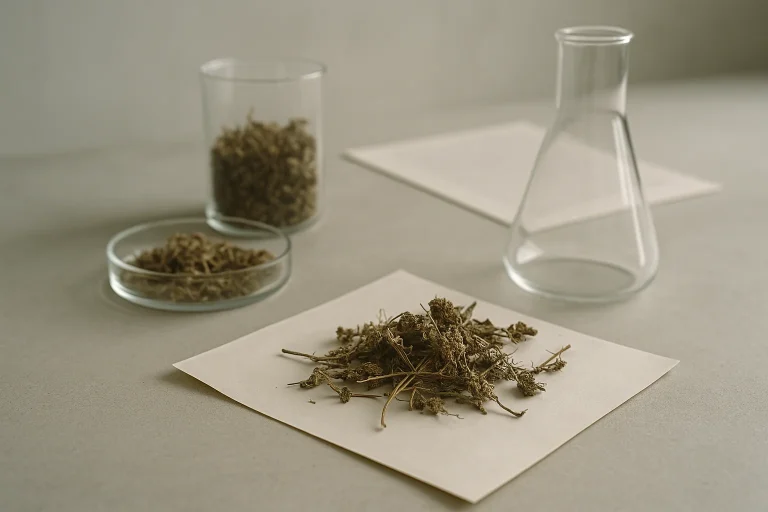
Cannabis terpenes are volatile aromatic molecules that determine whether the dried flower smells like lemon, pine, or pepper. They are produced in glandular trichomes on the inflorescence, in the same microscopic glands as cannabinoids, and constitute the main component of the plant’s essential oil (Sommano et al., 2020). This text explains where terpenes are produced, what the eight most commonly mentioned molecules smell like, and what research says about their effects and what remains unknown. A separate section is dedicated to the boiling point table of terpenes circulating throughout the cannabis internet, which cannot be attributed to any scientific work. Debunking this one table changes how you read a vaporizer’s instructions.
KEY INFORMATION
- Terpenes are produced in glandular trichomes together with cannabinoids; stalked trichomes have 12-16 secretory cells and a profile dominated by monoterpenes (Livingston et al., 2020).
- Beta-caryophyllene selectively binds to the CB2 receptor with a Ki constant of 155 nM and acts as its agonist (Gertsch et al., 2008).
- Russo described the entourage effect as a hypothesis to be proven, not as an established fact (Russo, 2011).
- The terpene boiling point table has no scientific source; values for a single molecule differ by over one hundred degrees.
- Terpenes lose concentration quickly under all storage conditions; the most favorable were 4 degrees Celsius and whole inflorescences (Milay et al., 2020).
What are cannabis terpenes at the molecular level?
Terpenes are hydrocarbons built from isoprene units. Monoterpenes have two such units and the formula C10H16, sesquiterpenes have three units and the formula C15H24. Hundreds have been identified in cannabis, but the aroma profile of a single strain is based on a few dominant molecules (Sommano et al., 2020).
The whole plant contains over 500 chemical compounds, of which terpenes are responsible for taste and smell (Weston-Green et al., 2021). Pure cannabinoids are odorless. The entire sensory difference between two dried flowers with similar THC content lies in terpenes, not cannabinoids. That is why the description “strong dried flower” says nothing about how it will smell.
Monoterpenes are lighter and more volatile than sesquiterpenes. They give freshly dried inflorescences the most distinct aroma and disappear fastest. Sesquiterpenes, including beta-caryophyllene and humulene, have greater molecular mass and persist longer. That is why old dried flower smells different than fresh: not simply weaker, but with a shifted profile where spicy notes prevail over citrus ones.
The word “volatile” here has a literal and practical meaning. A volatile molecule transitions to the gas phase at room temperature, meaning it diminishes with every hour of air contact. The smell you sense over an open jar is literally a loss of material. The more often you open the package, the poorer the profile inside becomes, and no packaging can reverse this.
Terpenes and cannabinoids share a biosynthetic pathway. The precursor of monoterpenes is geranyl diphosphate, and of sesquiterpenes farnesyl diphosphate; the same precursor type feeds cannabinoid synthesis, which Russo points to as the biochemical basis of their co-occurrence in the plant (Russo, 2011). The plant produces these substances to defend against insects and pathogens, not for our noses.
Where in the plant are terpenes produced?
Terpenes are produced in glandular trichomes, sticky hairs covering the inflorescence. Livingston et al. compared two types of these structures and showed that stalked trichomes have 12-16 secretory cells in the gland head and a profile strongly dominated by monoterpenes (Livingston et al., 2020).
Capitate sessile trichomes, the second type, have eight secretory cells and a terpene profile less dominated by monoterpenes. The same study showed that stalked trichomes develop from forms resembling sessile ones, so these are not two separate lines but two stages of one process. The authors detected strong expression of terpene pathway genes in isolated inflorescence trichomes, including two previously undescribed monoterpene synthases.
Thus, trichomes function as specialized metabolite factories, not decorations. A cannabis chemistry review describes them as a separate chapter in the plant’s chemistry, alongside cannabinoids and phenolic compounds (Andre et al., 2016). Practically, this means one thing: anything that damages trichomes damages the aroma profile. Rough handling, grinding in advance, and rubbing against jar walls cost aroma before the dried flower reaches the vaporizer.
One number circulating on this topic should be dismissed immediately. The claim that stalked trichomes produce 80-90 percent of all plant terpenes does not come from Livingston’s work or any other we could find. The study describes qualitative differences in profile and secretory cell counts, not percentage shares of total terpene mass. This is a typical pattern: a real paper, a real author, an added number.
How does the terpene profile change during inflorescence maturation?
It changes along with the proportion of trichome types, which shifts over time. Livingston et al. studied this process in detail and titled their paper: Cannabis glandular trichomes change morphology and metabolite content during flower maturation (Livingston et al., 2020).
The method was unusual and thus the result is strong. The authors used two-photon microscopy and identified trichome types based on their own fluorescence, without dyes. Stalked trichomes fluoresced blue, correlating with high cannabinoid content. Sessile trichomes fluoresced in a red-shifted band. The two populations differed measurably, not just visually under a magnifier.
Since stalked trichomes develop from forms resembling sessile ones, their share increases as the inflorescence matures. The monoterpene share rises with it, because stalked trichomes have a profile dominated by this fraction. The same inflorescence harvested at two different times thus yields two different aroma profiles, without any genetic change.
For the grower, this means harvest timing is a decision about aroma, not just potency. For the buyer, it means two batches of the same strain from the same producer may smell noticeably different if harvest dates differ by a few days. A complaint that “the dried flower smells different than before” can thus be a fact description, not nitpicking.
Which terpenes dominate in cannabis and what do they smell like?
The same eight often recur in cannabis texts: myrcene, limonene, pinene, linalool, beta-caryophyllene, humulene, terpinolene, ocimene. This list is not canonical. Russo’s 2011 review discusses a different set of eight terpenoids, where humulene, terpinolene, and ocimene are replaced by caryophyllene oxide, nerolidol, and phytol.
The difference arises from the list’s purpose. The eight below describe sensory profiles - what the nose senses and what determines strain recognition in the market. Russo’s set was chosen for pharmacological potential. Neither list is wrong, but mixing them leads to statements like “eight main terpenes according to Russo” that are unsupported by the paper’s text.
| Terpene | Aroma | Also found in | State of knowledge |
|---|---|---|---|
| Myrcene | earthy, musky | hops, mango, thyme | discussed by Russo, mainly animal data |
| Limonene | citrus | citrus peels, rosemary | studied for mood, preclinical |
| Alpha-pinene | piney, resinous | pine needles, sage | linked to short-term memory, preclinical |
| Linalool | floral, lavender | lavender, basil, coriander | most widely described, no good clinical studies |
| Beta-caryophyllene | peppery, spicy | black pepper, cloves | confirmed CB2 receptor binding |
| Humulene | hoppy, woody | hops, sage | described together with caryophyllene |
| Terpinolene | fresh, woody-citrus | tea tree, apples | mentioned in reviews, no clinical data |
| Ocimene | sweet, herbal | basil, mint, parsley | rarely dominant, least studied |
Intentionally, this table lacks columns for percentage share or evaporation temperature. Both circulate online in versions that cannot be pinned to any paper. Percentage shares like “myrcene constitutes 20-50 percent of the terpene fraction in indica strains” have been repeated for years without any underlying measurement, and the other column gets a separate section below.
Real percentage shares exist only in analyses of specific batches, as this value varies between harvests. A general table “how much percent a strain has” is by definition an average of something that does not average.
What do studies say about the effects of individual terpenes?
The strongest single result concerns beta-caryophyllene. Gertsch et al. showed it selectively binds to the cannabinoid receptor CB2 with a Ki constant of 155 nM and acts as a functional agonist (Gertsch et al., 2008). Hence the term “dietary cannabinoid.”
The same paper provides further details. Beta-caryophyllene at 500 nM concentration inhibited lipopolysaccharide-induced pro-inflammatory cytokine expression in peripheral blood. Orally administered to mice at 5 mg/kg, it significantly reduced carrageenan-induced inflammation, but only in animals with a functioning CB2 receptor; the effect disappeared in receptor-deficient mice. This is a rare example where mechanism and result were shown in one experiment.
For pinene and linalool, the picture is weaker. Weston-Green et al.’s review identifies both molecules as reasonable candidates for stroke, neuropathic pain, memory disorders, insomnia, and anxiety, but concludes unequivocally: evidence comes mainly from preclinical studies, and well-designed clinical trials are lacking (Weston-Green et al., 2021).
This difference in evidence levels is more important than the list of effects. A cell line result means the molecule does something in a test tube. An animal result means it does so in an organism, at a dose and administration route untested in humans. Only clinical trials say something about humans. Most terpene claims in commerce rely on the first or second level but sound like the third.
Russo adds an observation explaining why terpenes enter the discussion of effects at all. They are potent enough to influence animal and human behavior at concentrations of single nanograms per milliliter of serum after inhalation from ambient air (Russo, 2011). However, this does not mean every attributed effect has been demonstrated.
What is the entourage effect and has it been proven?
The entourage effect is the hypothesis that cannabinoids and terpenes act together differently than separately. Russo formulated it in a 2011 British Journal of Pharmacology review and closed the text conditionally: synergy of phytocannabinoids and terpenoids, if proven, increases the chance for a new drug family (Russo, 2011).
This conditional mode is lost in summaries. In marketing texts, the entourage effect is presented as an established mechanism justifying full spectrum’s superiority over isolate. Russo himself wrote more cautiously: he proposed mechanisms, indicated terpenoids with promising profiles, and suggested methods to study this synergy in future experiments.
The paper’s reception scale is not small. In the Europe PMC index, the review has 883 citations (as of August 10, 2026), and it was published in British Journal of Pharmacology, volume 163, pages 1344-1364. Citation count indicates influence on discussion, not that the hypothesis was confirmed. A review cited a thousand times remains a review.
It is also worth noting what Russo did not write. He did not provide a list of “terpene plus cannabinoid” pairs with calculated effects, did not give doses, and did not present human study results. He indicated areas where synergy might be expected: pain, inflammation, depression, anxiety, addiction, epilepsy, cancer, fungal and bacterial infections. This is a research direction map, not a set of indications.
The practical conclusion is simpler than it seems. Full spectrum provides a richer sensory profile, which can be verified immediately by your own nose. The promise of stronger therapeutic effect for the same reason remains a hypothesis. If you want to see how terpene profile translates into differences between strains, it is described in the text about chemovars instead of indica and sativa division.
Does eating mango before cannabis enhance THC effects?
There is no evidence, and the source supporting this idea does not contain it. The recipe has circulated in the same form for years: eat mango half an hour earlier because myrcene from the fruit will increase THC bioavailability. The citation usually leads to Russo’s 2011 review.
We checked the full text of that paper. It contains no claim that myrcene increases THC bioavailability or any measurement showing this (Russo, 2011). Myrcene appears there in the context of its own pharmacological properties, not influence on absorption of another molecule. The citation was added to an existing idea, not the other way around.
The hypothesis has two more holes. No one states how much myrcene an average mango contains, so the fruit portion is an unknown dose. It is also unknown by what mechanism myrcene would act: increasing bioavailability would require influence on absorption or first-pass metabolism, and no such measurement exists for myrcene in humans.
Eating mango before a session harms no one, and if it improves someone’s experience, there is no reason to stop. Just know it is custom, not pharmacology. The same pattern repeats throughout terpene topics: a real paper is appended as a citation to a claim it does not contain, and from that moment it looks verified.
At what temperature do cannabis terpenes evaporate?
It is unknown, and any table claiming otherwise has no source. Terpene boiling point tables circulating on cannabis sites are usually attributed to Russo’s 2011 review. We checked the full text twice, independently. It contains no terpene boiling point or any thermal threshold.
The second proof lies in the numbers themselves. For beta-caryophyllene in cannabis texts, at least three different values appear: 119 degrees, about 130 degrees, and 160 degrees Celsius. Three numbers for one molecule in publications citing the same source. The discrepancy arises from physics, not cannabis chemistry: boiling point depends on pressure, and under reduced pressure used in distillation, the same substance boils much lower than at atmospheric pressure. A number given without pressure means nothing.
You can check such a table yourself in a minute. Check if the pressure at which it was measured is given; if not, the value is incomplete. Check if the citation leads to a specific paper with page number or just to a name and year. Finally, check if the same substance has the same value in two independent tables. For cannabis terpenes, most tables fail the third test.
What remains useful? The distinction between vaporization and combustion is real and needs no table: in vaporization, plant material does not burn, and volatile compounds transition to gas phase; combustion breaks them down into pyrolysis products. Choose the exact temperature from your device’s instructions, not from a list of thresholds no one measured.
The effect of heat on plant material chemistry is described where measurable. If you want to understand what happens to acidic cannabinoid forms under heating, start with the text about decarboxylation. There, numbers are supported by measurements because they concern a chemical reaction, not aroma.
How do terpenes affect the taste and aroma of dried flower?
Terpenes are responsible for the entire sensory profile of cannabis. Sommano et al. describe them directly as the main component of essential oils and substances responsible for cannabis’s aroma characteristics, which largely determine consumer experience and raw material market price (Sommano et al., 2020).
The same paper organizes the concept of chemovar, a strain described by chemical composition instead of trade name. Two dried flowers with the same name may have different terpene profiles if cultivation conditions, harvest time, or drying method differed. Terpene profile is a phenotype trait, not genotype, explaining disappointments when buying “the same strain” from another source.
The practical consequence concerns labeling. The trade name says almost nothing about the profile, and the indica/sativa division has no chemical basis. Meaningful information is chromatographic analysis results broken down by individual terpenes. If the producer does not provide it, the sensory description on the package remains a declaration.
The nose is a better tool than often assumed. Recognizing citrus, pine, or pepper notes requires no sommelier training, just repetition. The problem is the nose assesses the profile at package opening, not production, so it says as much about freshness as about strain.
You can learn to read analysis results in about fifteen minutes. We show this with examples in the text on how to read a cannabis strain profile. After a few analyses, you start recognizing recurring patterns: citrus-pine, spicy-hoppy, floral-sweet.
How to choose cannabis products based on terpenes?
One document decides: the certificate of analysis with breakdown by individual terpenes. Without it, “full spectrum” is a marketing claim, not composition information. Producers measuring terpenes usually publish results as their advantage; those who do not measure write about them vaguely.
Product forms differ in how many terpenes they contain. Full spectrum retains the plant’s natural cannabinoid and terpene set. Broad spectrum is made by removing THC and loses some of the most volatile monoterpenes because purification affects them like heat. Isolate is a single molecule without scent or terpenes, useful where a precisely measured substance matters.
Look on the certificate for the terpene profile section given in mass percent or milligrams per gram, with names of individual compounds. The total “total terpenes” line says little, as two batches with the same total can smell completely different. Also check the analysis date: terpenes diminish over time, so a certificate from two years ago describes a different product than the jar.
Note what is missing on the certificate. Terpene analysis is often done on raw material before processing, not on the final product, so it describes something different than the bottle’s content. If the document lacks a batch number matching the package, you cannot verify it applies to what you bought.
The last point is the ratio between promise and measurement. The description “rich terpene profile” without a number means nothing, and a description with a number and date can be verified. If the producer gives one but not the other, that says more about them than the product.
Where else do these same terpenes occur?
In hundreds of plant species, and these are not analogs but exactly the same molecules. Russo emphasizes that terpenoids discussed in cannabis context are common flavor and aroma components of the human diet, recognized by the US food agency as safe for consumption (Russo, 2011).
Beta-caryophyllene is the best example. Gertsch et al. describe it as a common component of essential oils of many spice and food plants, and simultaneously as the main terpene component of cannabis (Gertsch et al., 2008). The same molecule that binds the CB2 receptor in experiments sits in every kitchen’s pepper grinder.
Practically, this means the aroma experience need not be sought exclusively in cannabis. You can smell linalool in lavender, limonene in lemon peel grated over a plate, humulene in a hop cone crushed between fingers. This is a good way to train your nose before reading terpene profiles, as reference samples are in your kitchen cabinet.
This chemical commonality also challenges the way cannabis is described as a unique plant. Terpenes are not unique: hops, sharing the botanical family, have a very similar repertoire. What is unique is the co-occurrence of these terpenes with cannabinoids in one gland, not their composition alone.
The purely aromatic side of this commonality even has its own commercial application. We described it separately in the text on cannabis terpenes as fragrance notes.
How to store dried flower to preserve terpenes?
Best whole, in darkness, at about 4 degrees Celsius. This was the only experiment tracking terpene and cannabinoid profiles over a year at different temperatures: storage at 25 degrees caused the greatest concentration changes, and optimal conditions were whole inflorescences kept at 4 degrees (Milay et al., 2020).
Two results contradict common advice. First, terpene concentrations dropped quickly under all tested conditions, so no storage method stops loss; only slowing it is possible. Second, temperatures below minus 20 degrees and grinding the inflorescence were among the least favorable conditions for terpenes. The advice “freeze dried flower to preserve aroma” does not withstand measurement.
For extracts, the same study indicated the best carrier. Olive oil preserved the natural phytocannabinoid composition better than other solvents tested. This finding goes against the industry belief that MCT carrier oil is the undisputed quality standard, and concerns the feature buyers assess last: composition stability in a bottle standing half a year in a cabinet.
The study included whole and ground inflorescences and extracts in various solvents, with samples from THC- and CBD-rich strains. Profiles were analyzed over a year. This is a rare setup in this field, as most storage reports rely on single measurements or producer experience.
Practical rules follow. Keep whole inflorescences, not ground; grind just before use. Choose a light-proof container and open it as rarely as possible, as each opening exchanges air. If possible, move your supply to the fridge rather than the freezer.
What does this mean in practice?
Terpenes are the part of cannabis chemistry easiest to overstate. It is well established where they are produced, what they smell like, and that beta-caryophyllene binds the CB2 receptor. Much less established are therapeutic effects of individual terpenes in humans, as data come mainly from animal models and test tube studies.
The weakest area is popular knowledge about temperatures. The thermal threshold table, repeated for years as supposedly from Russo’s work, has no source, and the range of values for one molecule exceeds one hundred degrees. Until someone publishes measurements with pressure and method given, treat such tables as industry folklore. The same applies to the mango recipe.
What remains is a set of decisions based on solid grounds. Choose products with a certificate of analysis containing a terpene profile, check the analysis date, store dried flower whole and cool, and take device temperature from its instructions. The rest is an area where the honest answer is “not yet known,” better heard from the seller than discovered after purchase.
We gathered the full dried cannabis offer in the dried cannabis category.
Frequently Asked Questions
What are cannabis terpenes and where are they produced?
Cannabis terpenes are volatile isoprene hydrocarbons: monoterpenes with the formula C10H16 and sesquiterpenes with the formula C15H24. They are produced in glandular trichomes of the inflorescence, together with cannabinoids. Stalked trichomes have 12-16 secretory cells and a profile dominated by monoterpenes (Livingston et al., 2020).
Is there a reliable boiling point table for terpenes?
No. The tables circulating online are attributed to Russo’s 2011 review, which contains no terpene boiling points. Values given for a single molecule differ by over one hundred degrees because they mix atmospheric pressure measurements with reduced pressure measurements.
Does eating mango before a session enhance THC effects?
There is no evidence for this. Russo’s 2011 review, which this claim is based on, does not state that myrcene increases THC bioavailability. It is also unknown how much myrcene an average mango contains, so the fruit portion is an unknown dose. This is custom, not pharmacology.
What distinguishes beta-caryophyllene?
It selectively binds to the cannabinoid receptor CB2 with a Ki constant of 155 nM and acts as its functional agonist. An oral dose of 5 mg/kg reduced inflammatory response in mice with a functioning CB2 receptor but not in mice lacking this receptor (Gertsch et al., 2008).
Has the entourage effect been proven?
No. Russo presented it as a hypothesis and stated conditionally: synergy of phytocannabinoids and terpenoids, if proven, increases the chance for new drugs (Russo, 2011). The paper proposes mechanisms and methods for study, not confirmation.
Does full spectrum have more terpenes than isolate?
Yes, and this can be verified on the certificate of analysis. Full spectrum retains the plant’s natural terpene set, broad spectrum loses some volatile monoterpenes during purification, and isolate is a single molecule without scent. Sensory advantage is certain; therapeutic advantage remains a hypothesis.
Where else do these same terpenes occur?
In hundreds of spice and food plants. Beta-caryophyllene is found in black pepper and cloves, linalool in lavender, limonene in citrus peels, humulene in hops. Russo emphasizes these are common components of the human diet recognized as safe for consumption (Russo, 2011).
How to store dried cannabis to preserve terpenes?
Whole, unground, in a dark container, at about 4 degrees Celsius. Storage at 25 degrees caused the greatest composition changes, and temperatures below minus 20 degrees and grinding the inflorescence were among the least favorable conditions for terpenes (Milay et al., 2020).
This article is informational and educational and does not constitute medical advice. Before starting cannabis or CBD for therapeutic purposes, consult a doctor, especially if you take other medications, are pregnant, or breastfeeding.
Author: Michał Waluk · Published: 2026-05-04 · Updated: 2026-08-10