
CBG and CBD - What is the Difference? Comparison of Cannabinoids 2026
CBG vs CBD: differences in structure, receptors, and research, plus the cost of 100 mg of six oils available at Bucha. Prices from the store, as of August 8, 2026.
The store at Bucha currently has six hemp oils in one category: three with a predominance of CBG and three with a predominance of CBD. This is enough to compare both molecules not on advertising paper, but on prices from the store as of August 8, 2026. Cannabigerol is sometimes called the mother of cannabinoids because the plant builds all others from its acidic form. Cannabidiol, on the other hand, is much better studied in humans. This asymmetry determines everything you will read below: one molecule has studies on patients behind it, while the other mainly has laboratory work and one survey. The price goes the other way, and this discrepancy confuses buyers the most. In this text, we break down the difference into four layers: molecular structure, receptor affinity, quality of scientific evidence, and the real cost of one hundred milligrams. At the end, you will find the answer to the question of when the surcharge for cannabigerol makes sense and when a regular cannabidiol oil does the job cheaper.
KEY INFORMATION
• In typical cannabis strains, CBG remains below 1% of the flower mass because the plant converts it into other cannabinoids (Nachnani et al., JPET, 2021).
• CBG is an agonist of the alpha-2 adrenergic receptor, while CBD acts more indirectly.
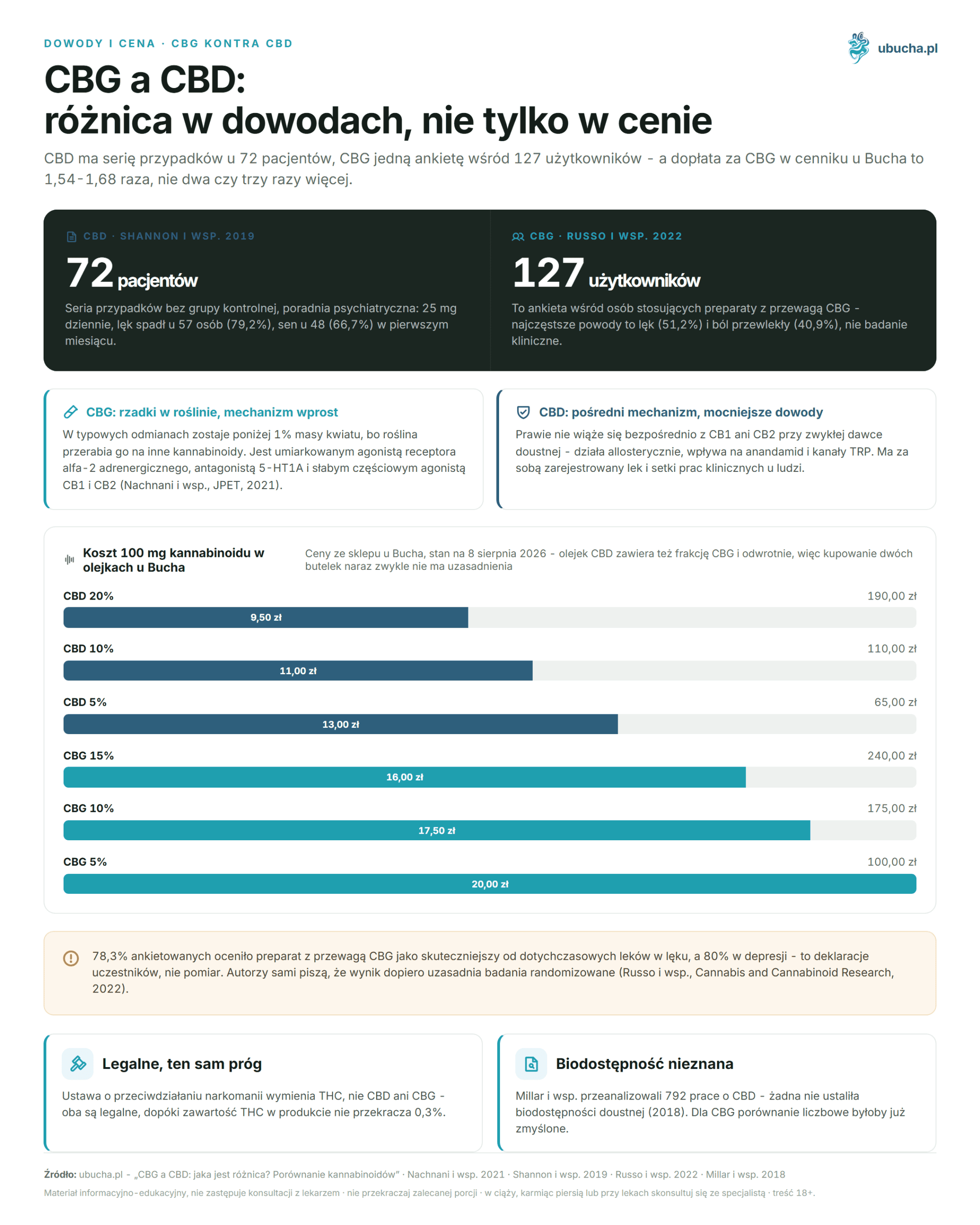
• 100 mg of CBD costs 9.50-13.00 PLN, while 100 mg of CBG costs 16.00-20.00 PLN (as of 2026-08-08).
• Both are legal with THC content below 0.3%.
How does CBG differ from CBD at the molecular level?
Both compounds have the same molecular formula C21H30O2 and differ only in the arrangement of bonds. CBG is produced in the plant earlier: from its acidic form, CBGA, the synthase enzymes produce CBDA, THCA, and CBCA. Hence the term mother of cannabinoids, which is even used in peer-reviewed literature (Nachnani et al., JPET, 2021).
However, the difference that really hits the wallet starts in the field, not in the lab. In most cannabis strains, the content of cannabigerol in mature flowers drops below one percent of the mass because by the time of harvest, CBGA has been converted into other cannabinoid acids. Cannabidiol in fiber strains reaches several percent at the same time.
A grower who wants to harvest a reasonable amount of cannabigerol has two paths. The first is early harvesting, before the enzymes finish their work, at the cost of a lower yield of mass per hectare. The second is genetic lines with a damaged final synthase, in which CBGA cannot be converted and remains in the plant at concentrations of several percent. Both cost more than regular cultivation aimed at cannabidiol.
This arithmetic explains the entire price discrepancy in the table below. Cannabigerol is not rare in a marketing sense. It is chemically rare because the plant treats it as an intermediate product on the way to something else. A producer who wants to sell it must stop or circumvent this natural process.
Decarboxylation completes the picture. The acidic form converts to the neutral form under the influence of temperature or the simple passage of time, which applies to both CBGA and CBDA. Therefore, on the analysis certificate of a good oil, you will usually find both positions separately, and the sum may be higher than the number on the label. Where the acidic forms of cannabinoids come from and what heating changes, we break down in the guide to cannabinoids and their effects.
How do CBG and CBD act on receptors in the body?
In short: cannabigerol binds directly to molecular targets, while cannabidiol prefers to act indirectly. A pharmacological review describes CBG as a moderate agonist of the alpha-2 adrenergic receptor, an antagonist of the 5-HT1A receptor, and a weak partial agonist of cannabinoid receptors CB1 and CB2 (Nachnani et al., JPET, 2021).
The alpha-2 receptor is the same target that drugs lowering sympathetic tone act on. Its stimulation reduces norepinephrine release. The antagonism against 5-HT1A is interesting because cannabidiol does something opposite in many models. Thus, two molecules with the same molecular formula can pull the same receptor in opposite directions.
Cannabidiol almost does not bind directly to CB1 or CB2 at concentrations achieved after a regular oral dose. Its action is described by allosteric modulation, influence on endogenous anandamide turnover, and interaction with TRP family channels. This is a mechanism spread over many small effects instead of one strong one.
The practical conclusion is less flashy than marketing suggests. The question of which cannabinoid is stronger makes no sense because both molecules target different places. A sensible question is: what do you want to achieve, and is there a human study that describes such an effect? For cannabidiol, there are many more such studies. The receptor profiles of both molecules compared to THC can be found in the comparison CBD, THC, and CBG.
We have noticed in conversations with customers that this distinction organizes the choice better than any ranking. A person asking about evening relaxation receives a different recommendation than one looking for something for morning neck tension. The same oil will not serve both needs equally well.
What do studies show about CBD, and what about CBG?
The disproportionality in evidence is greater than the disproportionality in price. Cannabidiol has a registered drug and hundreds of clinical studies behind it. Cannabigerol has one patient survey and a set of preclinical studies. This does not mean it works worse. It means we know less about it.
The most frequently cited clinical work on cannabidiol is a retrospective case series from a psychiatric clinic. It included 72 adult patients reporting anxiety or sleep disorders. Anxiety scores dropped in the first month for 57 individuals, or 79.2%, and sleep scores improved for 48 individuals, or 66.7% (Shannon et al., The Permanente Journal, 2019). The preparation was well tolerated by all but three patients.
On the side of cannabigerol, we have the first-ever survey of users of products with a predominance of this compound, meaning containing over 50% CBG. It involved 127 individuals. The most common reasons for using cannabigerol are anxiety (51.2%), chronic pain (40.9%), depression (33.1%), and insomnia (30.7%) (Russo et al., Cannabis and Cannabinoid Research, 2022).
This same survey brings a number that is impressive and requires caution at the same time: 78.3% of respondents considered the CBG-dominant preparation more effective than previous medications for anxiety, and 80% for depression. These are participant declarations, not measurements against placebo. The authors themselves state that the work justifies conducting randomized studies.
The difference in the quality of evidence is more important here than the difference in numbers. A case series and an online survey are two different levels of credibility, and neither replaces a study with a control group.
Which CBG and CBD oils are available at Bucha?
In the oil category, there are six positions from one brand, in three strengths of each cannabinoid. All have the same capacity of 10 ml and the same base, which is oil from hemp seeds with a full profile of phytocannabinoids. This makes the comparison fair: only the dominant compound and its concentration change.
| Place | Oil | What distinguishes it | Price | Cost per 100 mg |
|---|---|---|---|---|
| 1 | CANNOVA Natural CBD Oil 2000 mg - 20% - 10ml | Cheapest milligram in the entire category, version for those with developed tolerance | 190.00 PLN | 9.50 PLN |
| 2 | CANNOVA Natural CBD Oil 1000 mg - 10% - 10ml | One drop is 3.34 mg, so a dose of 20 mg fits in six drops | 110.00 PLN | 11.00 PLN |
| 3 | CANNOVA Natural CBD Oil 500 mg - 5% - 10ml | Lowest entry threshold in absolute terms, one drop 1.67 mg allows going very low | 65.00 PLN | 13.00 PLN |
| 4 | CANNOVA Natural CBG Oil 1500 mg - 15% - 10ml | Strongest cannabigerol in the offer, one drop is exactly 5 mg | 240.00 PLN | 16.00 PLN |
| 5 | CANNOVA Natural CBG Oil 1000 mg - 10% - 10ml | Middle of the range on the CBG side, one drop 3.34 mg like in the CBD equivalent | 175.00 PLN | 17.50 PLN |
| 6 | CANNOVA Natural CBG Oil 500 mg - 5% - 10ml | Test version for those checking cannabigerol for the first time | 100.00 PLN | 20.00 PLN |
The places in the ranking result from one verifiable converter: how much you pay for one hundred milligrams of the declared cannabinoid. Prices come from the store and describe the state as of August 8, 2026. You can find the full, current list in the oils category.
How much does 100 mg of CBG really cost compared to CBD?
The conversion to one hundred milligrams resolves a dispute that has been repeated in texts about cannabinoids for years. A popular claim speaks of a two- or three-fold surcharge for cannabigerol. In the real price list, the surcharge ranges from 1.5 to 1.7 times, depending on which strengths you compare.
The comparison of five percent strengths gives 20.00 PLN versus 13.00 PLN, which is 1.54 times. For ten percent: 17.50 PLN versus 11.00 PLN, which is 1.59 times. The furthest point is the comparison of the strongest versions of both lines, 16.00 PLN versus 9.50 PLN, which is 1.68 times. Nowhere do we approach doubling the rate.
The pattern also works in the other direction and applies to both cannabinoids. The higher the concentration in the bottle, the cheaper the milligram. Moving from five to twenty percent on the cannabidiol side reduces the cost of one hundred milligrams by 27%. An analogous jump on the cannabigerol side gives a saving of 20%.
This is even more clearly visible when calculated per day of use, as this reflects the real expense. At a dose of 25 mg per day, the 20% cannabidiol oil costs about 2.38 PLN per day, while the ten percent costs about 2.75 PLN. The same dose of cannabigerol from a 15% bottle comes out to exactly 4.00 PLN per day. Over a month, the difference ranges between forty and fifty PLN. This is an amount where it is worth first checking whether the more expensive molecule actually does something for you that the cheaper one does not.
What concentration of oil should you choose to start?
The answer depends on whether you are just checking your body’s reaction or have been dosing for a long time. In the first attempt, the lower concentration wins, despite the more expensive milligram, because a drop containing 1.67 mg allows you to go really low and increase the dose in small steps. The 5% bottle also costs the least in absolute terms.
The manufacturer provides conversion factors that are worth knowing before purchase. In the five percent version, one drop contains about 1.67 mg of the declared cannabinoid, in the ten percent version about 3.34 mg, and in the fifteen percent cannabigerol oil exactly 5 mg. A 10 ml bottle contains about three hundred drops, so it is easy to calculate how many weeks it will last.
For a person dosing 20 mg per day, a 5% bottle will last less than a month. The same dose from a 20% oil lasts over three months and costs one third less per day. Therefore, higher concentrations only pay off when you already know your dose.
A common mistake is buying the strongest bottle right away. At a concentration of 20%, one drop carries several times more material than at 5%, making precise downward adjustment difficult. It is hard to measure half a drop, and the difference between one and two can then be greater than the entire test dose.
If you are hesitating between lines, it is simpler to start with cannabidiol. It has a cheaper milligram, more data in humans, and a gentler entry threshold. Leave cannabigerol for the moment when you want to check something specific that cannabidiol does not do for you. How to choose the concentration for your daily dose, we have outlined separately in the guide on choosing CBD oil concentration.
Is the bioavailability of CBG and CBD really around several percent?
The numbers circulating on Polish cannabis sites need to be corrected here. A systematic review of the pharmacokinetics of cannabidiol in humans analyzed 792 works and selected 24 with pharmacokinetic data. The authors’ conclusion is clear: no study has established the absolute oral bioavailability of CBD in humans (Millar et al., Frontiers in Pharmacology, 2018).
The only route of administration with a calculated value is smoking, where the bioavailability was 31%. Popular ranges of 6-19% for the oral route are not supported in this review. Since there is no such measurement for cannabidiol, for cannabigerol, which has orders of magnitude fewer studies, a numerical comparison would simply be fabricated.
What the review established, however, is practical. The maximum concentration in the blood occurs between zero and four hours after administration. The half-life after intramuscular spray ranges from 1.4 to 10.9 hours, and after chronic oral administration, it extends to 2-5 days. The interindividual variability is large.
The most useful observation concerns food. The maximum concentration increases after a meal and in fat-based formulations. Oil based on hemp seed oil has fat built into the matrix, but taking it during a meal still increases absorption. This is a recommendation that costs nothing.
The conclusion for the reader is less flashy than a table of percentages, but it is true. Instead of comparing inflated bioavailability values, compare the declared content in the bottle and the method of administration.
How many drops to take and at what time of day?
A safe start is the lowest dose that can be measured, maintained for several days. In the cited case series, patients usually received 25 mg of cannabidiol per day, and doses were only increased in the absence of response (Shannon et al., The Permanente Journal, 2019). This is a good reference point for an adult.
Let’s translate this into drops from specific bottles. A dose of 25 mg from a five percent oil means 15 drops, from a ten percent oil 7 to 8 drops, and from a fifteen percent cannabigerol oil exactly 5 drops. Drops are held under the tongue for about a minute before swallowing.
The time of day is a matter of observation, not a rule. Cannabidiol at higher doses is often described as calming, so many people move it to the evening. Cannabigerol, due to its affinity for the alpha-2 receptor, is reported to be better tolerated in the morning. There is no study that confirms this intuition with measurement.
Do not evaluate the effect after one day. Modulating the endocannabinoid system is not like taking a sleeping pill, and a sensible observation window is 2-4 weeks at a constant dose. Write down the time of administration and the number of drops, because after two weeks, no one remembers this.
We have noticed that the most common reason for disappointment is not too low a dose, but a lack of regularity. Three days in a row, then a week off, and then two days again provide no material for evaluation.
Can hemp oil be combined with medications?
Here, caution is needed, not a table from the internet. Cannabidiol is metabolized by liver enzymes from the cytochrome P450 family and itself affects their activity, which can change the concentration of other drugs in the blood. This especially applies to preparations with a narrow therapeutic window, where a small change in concentration alters the effect.
If you are taking medications regularly, make the decision to add oil with your doctor or pharmacist. This statement sounds like a precaution, but it makes concrete sense: a pharmacist in a pharmacy can check your list of medications in the interaction database in a few minutes and do it better than any article.
The safety profile of cannabinoids themselves is mild. In a survey of 127 users of CBG-dominant preparations, as many as 44% reported no adverse effects. Among the others, dry mouth (16.5%), drowsiness (15%), increased appetite (11.8%), and dry eyes (8.7%) predominated (Russo et al., Cannabis and Cannabinoid Research, 2022).
This same work noted that 84.3% of respondents did not notice any symptoms after discontinuing the preparation. Sleep difficulties, indicated by two individuals, were the most frequently reported withdrawal symptom. With such a number, it is a signal, not evidence, but the direction is reassuring.
A separate matter is pregnancy, breastfeeding, and being under eighteen years of age. There is a lack of data in these groups, and none of the described studies included them.
What is the entourage effect and why combine both cannabinoids?
The entourage effect is a hypothesis stating that cannabinoids and terpenes work together differently than individually. It was formulated in a review in the British Journal of Pharmacology, which compiled data on synergy between THC, cannabidiol, and the terpene fraction of cannabis plants (Russo, British Journal of Pharmacology, 2011).
A newer review expands this topic towards mood and anxiety disorders, describing pairs of terpenes plus cannabinoids as a mechanism worth clinical investigation (Ferber et al., Current Neuropharmacology, 2020). The authors emphasize that we are talking about a hypothesis with solid preclinical justification, not a phenomenon confirmed in humans.
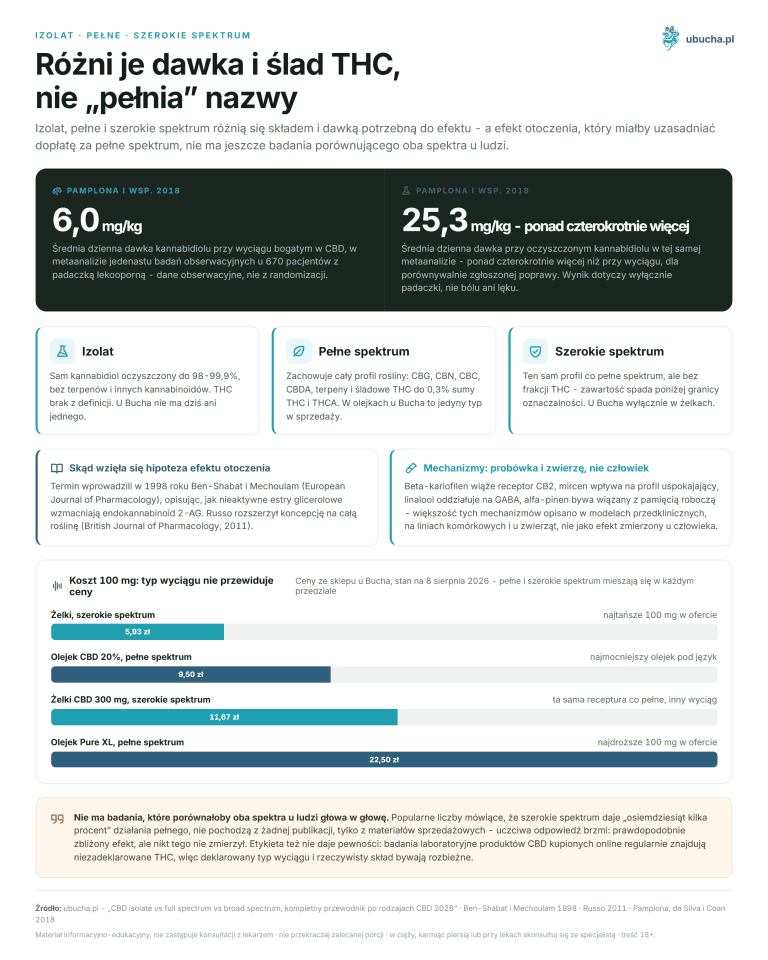
In practical purchasing terms, this is an argument for full-spectrum oils instead of isolates. All six positions in the table declare a full profile of phytocannabinoids: alongside the dominant compound, you will find CBDA, CBDV, CBN, CBC, and CBGA. An oil described as cannabidiol will therefore also contain a fraction of cannabigerol and vice versa.
This has a direct impact on the decision about the surcharge. If you just want to check whether cannabigerol does anything for you, you get it in trace amounts along with the cheaper cannabidiol oil. A dedicated CBG oil makes sense only when you want that compound to be the dominant fraction.
Isolates have their place in research, where it is necessary to know which substance is responsible for the effect. In everyday use, the advantage of full spectrum is more convenient and usually cheaper per milligram.
How to check this before purchase? The certificate of analysis of the batch lists individual phytocannabinoids separately and provides the terpene profile. If the producer does not publish such a document, the declaration of full spectrum remains only a slogan from the label, which you cannot verify.
Are CBG and CBD legal in Poland in 2026?
Both are legal, and the law treats them identically. The Act on Counteracting Drug Addiction lists THC and its derivatives in the annexes, but does not mention either cannabidiol or cannabigerol (Dz.U. 2005 Nr 179 poz. 1485). Products from industrial hemp Cannabis sativa L. remain allowed as long as the THC content does not exceed 0.3%.
They can be purchased, possessed, transported within the country, and sold both in-store and online. However, they cannot be presented as medicines or attributed therapeutic effects in specific diseases. Health claims on labels and in advertising are subject to separate food regulations.
This is where the cautious language on packaging comes from, which can be misleadingly perceived as a producer’s evasion. This is not marketing flirtation, but compliance with the law. A seller who promises a cure breaks the regulations regardless of whether they are factually correct.
The 0.3% limit applies to the product, not the raw material in the field, and is the value that should be confirmed by the certificate of analysis of the batch. If the producer does not publish such a document, you have no way to verify either the THC content or the declared amount of the main compound.
A separate layer is the food status. In the European Union, extracts from cannabis containing cannabinoids have been classified as novel food, so introducing them into circulation as a food ingredient requires prior authorization. Therefore, Polish sellers describe oils cautiously and avoid declarations they cannot make. This classification does not change the legality of possession or purchase; it only concerns the method of introduction into circulation.
It is worth remembering that regulations in this area change more often than once every few years. The state described above is valid as of the date of this text’s update.
Which claims about CBG and CBD are false?
Four repeated theses do not withstand the confrontation with the data we have cited above. It is worth listing them directly because each leads to a specific purchasing error, not just a misunderstanding of terminology.
- Cannabigerol costs two to three times more than cannabidiol. In the real price list, the surcharge ranges from 1.54 to 1.68 times when converted to 100 mg.
- The rarity of cannabigerol in the plant means greater potency. Rarity results from the fact that the plant uses it as an intermediate product, not from any pharmacological property.
- The oral bioavailability of cannabinoids is 6-19%. A systematic review states that there is no measurement of absolute oral bioavailability in humans (Millar et al., 2018).
- Cannabigerol causes a psychoactive effect because it acts on the CB1 receptor. It is only a weak partial agonist there, and participants did not report such effects.
The fifth belief concerns dosage and is the most costly. Assuming that more means better, people buy the strongest bottle right away and take several drops. Meanwhile, the case series in which improvement was achieved in two-thirds of patients was based on a dose of around 25 mg per day.
The sixth claim states that since cannabinoids are natural, they do not interact with medications. Natural origin has nothing to do with it, as interaction is determined by the effect on liver enzymes, not whether the substance grew in the field. A person taking medications regularly should ask a pharmacist regardless of how natural the product is. The same faulty reasoning underlies the belief that you cannot take too much oil, so it can be dosed by eye.
The last thing concerns full spectrum. An oil described as cannabidiol is not devoid of cannabigerol and vice versa, so buying two bottles at once to have both compounds usually has no justification.
Summary: CBG or CBD for You
Cannabidiol is cheaper per milligram, better studied in humans, and gentler in the first approach. Cannabigerol has a different receptor profile, one patient survey behind it, and a surcharge of about half the price for the same number of milligrams. That is all that can be said honestly today.
If you are starting, take 5% cannabidiol oil and a dose of about 25 mg per day for three weeks. If you have been dosing for a long time and know your amount, switch to a higher concentration, as it reduces the cost per day by one third. If you want to check cannabigerol as the dominant fraction, the 15% version has the cheapest milligram in its line.
What not to do? Do not buy the strongest bottle for testing, do not expect evaluation after three days, and do not add oil to chronic medications without talking to a pharmacist. These three rules protect against most disappointments we hear about in the store.
Finally, a number worth remembering instead of all the rest: one hundred milligrams of cannabidiol costs at Bucha from 9.50 PLN to 13.00 PLN, while one hundred milligrams of cannabigerol costs from 16.00 PLN to 20.00 PLN. Everything else in this text is a commentary on this difference. If a surcharge of about half the price seems reasonable to you for checking a different receptor profile, cannabigerol makes sense. If not, the cheaper molecule simply has more data behind it, and you lose nothing by that.
Frequently Asked Questions
How does CBG differ from CBD chemically?
Both have the molecular formula C21H30O2 and differ in the arrangement of bonds. CBG is produced earlier: from its acidic form CBGA, the plant produces CBDA, THCA, and CBCA. In typical cannabis strains, cannabigerol remains at less than 1% of the flower mass (Nachnani et al., JPET, 2021).
Does CBG work better for sleep than CBD?
The data is stronger on the side of CBD. In a series of 72 psychiatric patients, sleep outcomes improved in the first month for 66.7% of individuals (Shannon et al., The Permanente Journal, 2019). For CBG, we have a survey of 127 users, where insomnia was the fourth reason for using this cannabinoid.
Is CBG legal in Poland in 2026?
Yes. The Act on Counteracting Drug Addiction lists THC, not cannabigerol (Dz.U. 2005 Nr 179 poz. 1485). Products from industrial hemp Cannabis sativa L. are legal as long as the THC content does not exceed 0.3%. The same regulation applies to cannabidiol, so both cannabinoids are treated identically.
Can CBG be combined with CBD in one oil?
Yes, and this is how most full-spectrum oils work. The co-occurrence of cannabinoids and terpenes is described by the entourage effect hypothesis in a review in the British Journal of Pharmacology (Russo, 2011). CANNOVA oils declare a full profile of phytocannabinoids, so CBD oil also contains a fraction of CBG, and CBG oil contains a fraction of CBD.
Does CBG have better bioavailability than CBD?
There is no data to support such a claim. A systematic review of CBD pharmacokinetics in humans states that no study has established absolute oral bioavailability (Millar et al., Frontiers in Pharmacology, 2018). For cannabigerol, there are even fewer measurements, so a numerical comparison would be fabricated.
How much does 100 mg of CBG cost, and how much does 100 mg of CBD cost?
u Bucha, 100 mg of cannabidiol costs from 9.50 PLN to 13.00 PLN, while 100 mg of cannabigerol costs from 16.00 PLN to 20.00 PLN. This is an increase of about 1.5 to 1.7 times, not two or three times. Prices from the store, as of August 8, 2026.
Can CBG cause side effects?
In a survey of 127 people using CBG-dominant products, as many as 44% reported no adverse effects. The others reported dry mouth (16.5%), drowsiness (15%), increased appetite (11.8%), and dry eyes (8.7%) (Russo et al., Cannabis and Cannabinoid Research, 2022).
How quickly does sublingual oil work?
A review of CBD pharmacokinetics states that the maximum concentration in the blood occurs between zero and four hours after administration, depending on the route of administration and meal (Millar et al., Frontiers in Pharmacology, 2018). Drops held under the tongue fall within the lower part of this range.
Current stock levels and prices of all six oils can be checked in the oils category, and if you are looking for cannabis in another form, check the dried flower category or the gummy category.
This article is for informational and educational purposes. It contains internal links to product categories available in the store at Bucha. Prices and specifications may change: please check the current data on the product page before purchasing.
Author: Michał Waluk · Published: 2026-04-27 · Updated: 2026-08-08