
More Americans Using Marijuana Legalization, but Fewer Prescription Anxiety Medications: New Research Sheds Light on Changing Mental Health Dynamics
The legalization of marijuana in the USA and prescriptions for benzodiazepines and opioids. What the works of Bradford, Bachhuber, and Shover really showed and what this means in Poland.
The American market for tranquilizers is shrinking where marijuana has become legal. This statement has circulated in the media for several years and sounds like a ready conclusion. Data indeed exists: economists have counted prescriptions reimbursed by Medicare and Medicaid, and doctors have compared opioid death statistics. The problem is that some of these analyses say something different than what is attributed to them, and one of the loudest has been undermined after five years by its own replication. This text goes through the original works one by one and shows what each of them really measured, how large the studied group was, and what caveat the authors themselves raised. In the end, it explains why the substitution mechanism described in these analyses cannot work in the Polish psychiatric care system.
KEY INFORMATION
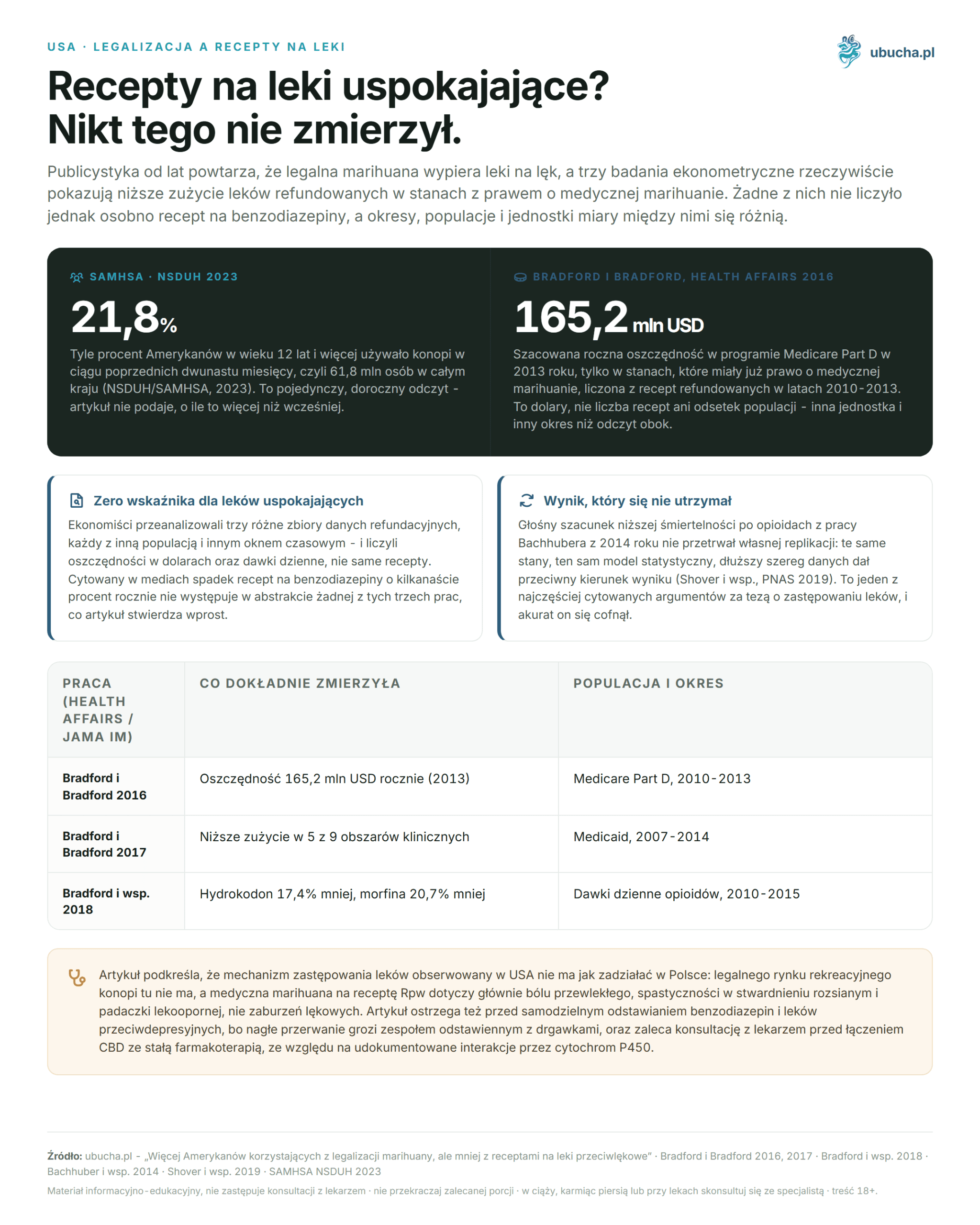
• In states with medical marijuana laws, the consumption of drugs reimbursed by Medicare Part D has decreased, with estimated savings of $165.2 million annually in 2013 (Bradford and Bradford, Health Affairs 2016).
• The effect of 24.8% lower mortality from opioids from Bachhuber’s 2014 work reversed after expanding the data (Shover et al., PNAS 2019).
• In a study with 42 volunteers, 7.5 mg of THC reduced tension after a stress test, while 12.5 mg worsened mood (Childs et al., Drug and Alcohol Dependence 2017).
• Among cannabis users, 22% meet the criteria for use disorder (Leung et al., Addictive Behaviors 2020).
• In Poland, the threshold of 0.3% is counted as the sum of delta-9-THC and THCA, and medical marijuana requires a prescription Rpw.
Does the legalization of medical marijuana in the USA reduce the number of prescriptions issued?
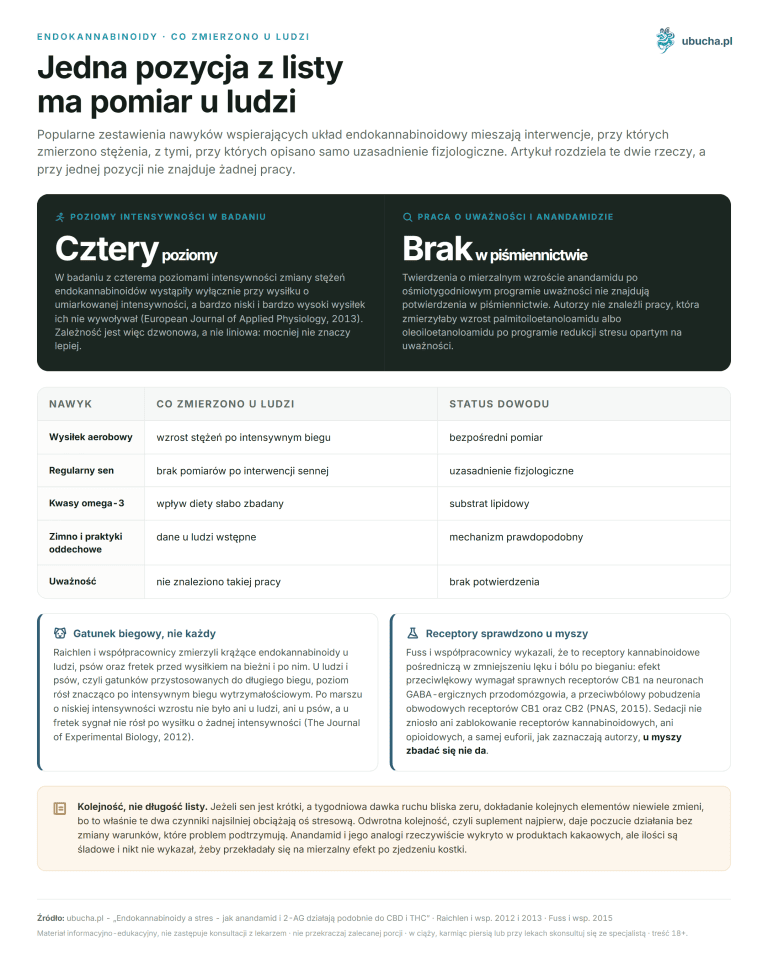
Yes, a decrease is visible in reimbursement data, but none of these works measured benzodiazepines separately or provided the annual rate of decrease in percentage. Economists Ashley and David Bradford analyzed three different reimbursement datasets, each in a different period and for a different population. The conclusions are consistent regarding direction and cautious regarding cause.
| Study | What it measured | Result stated in the abstract |
|---|---|---|
| Bradford and Bradford 2016, Health Affairs 35: 1230-1236 | all prescriptions filled in Medicare Part D, 2010-2013 | significant decrease in drug consumption for which marijuana is a clinical alternative; estimated savings of $165.2 million annually in 2013. |
| Bradford and Bradford 2017, Health Affairs 36: 945-951 | prescriptions in Medicaid, 2007-2014 | lower consumption in 5 of 9 analyzed clinical areas; estimated savings of $1.01 billion if the law had been in effect in all states in 2014. |
| Bradford et al. 2018, JAMA Internal Medicine 178: 667-672 | daily opioid doses in Medicare Part D, 2010-2015 | in states with dispensaries, 3.742 million fewer daily doses annually; hydrocodone 17.4% less, morphine 20.7% less |
The popular version of this thread states a decrease in benzodiazepine prescriptions by several percent annually. Such a value is not present in the abstract of any of these three works. They contain savings expressed in dollars, numbers of daily doses, and a breakdown by clinical areas, but there is no separate indicator for tranquilizers. It is also worth noting that all three analyses are econometric. They describe what the patient population did after the law changed, not what happens in the body of one person.
What did Bachhuber’s study on opioids show and why did replication undermine it?
The work by Bachhuber et al. (JAMA Internal Medicine 174: 1668-1673, 2014) showed that states with medical marijuana laws had a 24.8% lower average annual mortality rate from opioid overdose (95% CI from minus 37.5% to minus 9.5%). The analysis included death certificate data from all fifty states for the years 1999-2010. Three states had such a law before 1999, and ten more introduced it during the studied period.
The authors hypothesized substitution: patients with chronic pain who gain access to medical marijuana are less likely to reach for opioids and thus less likely to find themselves in a situation of fatal overdose. They themselves cautioned that this is a population-level correlation and that further research is needed on how such a law interacts with policies limiting opioid prescriptions.
Five years later, a team led by Shover et al. (PNAS 116: 12624-12626, 2019) repeated this analysis over a longer time frame. The title of their work states outright that the relationship between medical marijuana laws and opioid mortality reversed over time. This is one of the more important examples in the entire cannabis literature: the same model, the same states, a longer observation window, and an opposite sign of the result.
From conversations in the store, we know that customers usually receive the version from 2014, without replication. It is worth knowing it in full, as it shows how fragile a correlation calculated on aggregate data can be.
How many Americans use cannabis and how potent is today’s product?
According to the national NSDUH 2023 report (SAMHSA), 21.8% of people aged 12 and older used cannabis in the past twelve months, which translates to 61.8 million Americans. It is the most commonly used illegal substance in this context. However, the scale alone says nothing about what these people are actually consuming.
The answer to this question comes from an analysis of samples seized by the American anti-drug agency. The team led by ElSohly et al. (Biological Psychiatry 79: 613-619, 2016) examined 38,681 samples from 1995-2014. The average THC content in plant material increased during this time from about 4% to about 12%, while the CBD content decreased from an average of 0.28% in 2001 to below 0.15% in 2014. The THC to CBD ratio changed from fourteenfold in 1995 to about eightyfold in 2014. A newer work by the same team on samples from 2013-2022 shows that in most seized samples, THC exceeds 10%, and the profile of other cannabinoids is similar regardless of the region of the country.
This has direct implications for reading older studies. A study describing the effects of smoking material with 4% THC describes a different product than what is purchased today in a legal dispensary. The federal state has also changed: on April 28, 2026, an order came into effect transferring FDA-approved marijuana products and state-licensed medical marijuana to Schedule III, while other forms remain in Schedule I (analysis by Gibson Dunn, 2026).
Does THC have anxiolytic effects or does it rather increase anxiety?
It depends on the dose, and the threshold is surprisingly low. In the experiment by Childs, Lutz, and de Wit (Drug and Alcohol Dependence 177: 136-144, 2017), forty-two healthy volunteers took orally 0 mg, 7.5 mg, or 12.5 mg of THC and then underwent a standard social stress test. The dose of 7.5 mg reduced reported discomfort after the test and eased the assessment of the task as threatening. The dose of 12.5 mg had the opposite effect: it raised negative mood throughout the session, worsened task performance, and suppressed the blood pressure response to stress.
The difference here is five milligrams. This is less than the typical variability of active substance content between two portions of the same edible product, whose effects begin only after an hour or two. This is where descriptions of sudden panic attacks after eating a cookie, after which “nothing happened,” come from.
A systematic review by Crippy et al. (Human Psychopharmacology 24: 515-523, 2009) approaches the issue more cautiously. The authors state that anxiety reactions and panic attacks are the most common acute symptoms associated with cannabis use, that frequent users have a high prevalence of anxiety disorders, but that it is unclear whether cannabis use increases the risk of developing persistent anxiety disorders. According to them, the precise relationship has not yet been established.
What have studies on CBD in anxiety disorders really shown?
A review by Blessing et al. (Neurotherapeutics 12: 825-836, 2015) evaluated preclinical, experimental, and epidemiological evidence. The authors’ conclusion is clear regarding direction and cautious regarding scope: preclinical data strongly support the use of CBD in generalized anxiety, panic disorder, social phobia, obsessive-compulsive disorder, and PTSD when administered acutely, while chronic dosing has been studied by almost no one. Evidence in humans also concerns almost exclusively single-dose administration.
| Study | System | Dose | Result |
|---|---|---|---|
| Bergamaschi et al. 2011, Neuropsychopharmacology 36: 1219-1226 | 24 untreated patients with social phobia, double-blind trial | 600 mg single dose | less anxiety, less cognitive function impairment, and less discomfort during simulated public speaking |
| Crippa et al. 2011, Journal of Psychopharmacology 25: 121-130 | 10 untreated patients with generalized social phobia, SPECT imaging | 400 mg single dose | significantly lower subjective anxiety and changes in blood flow in limbic and paralimbic areas |
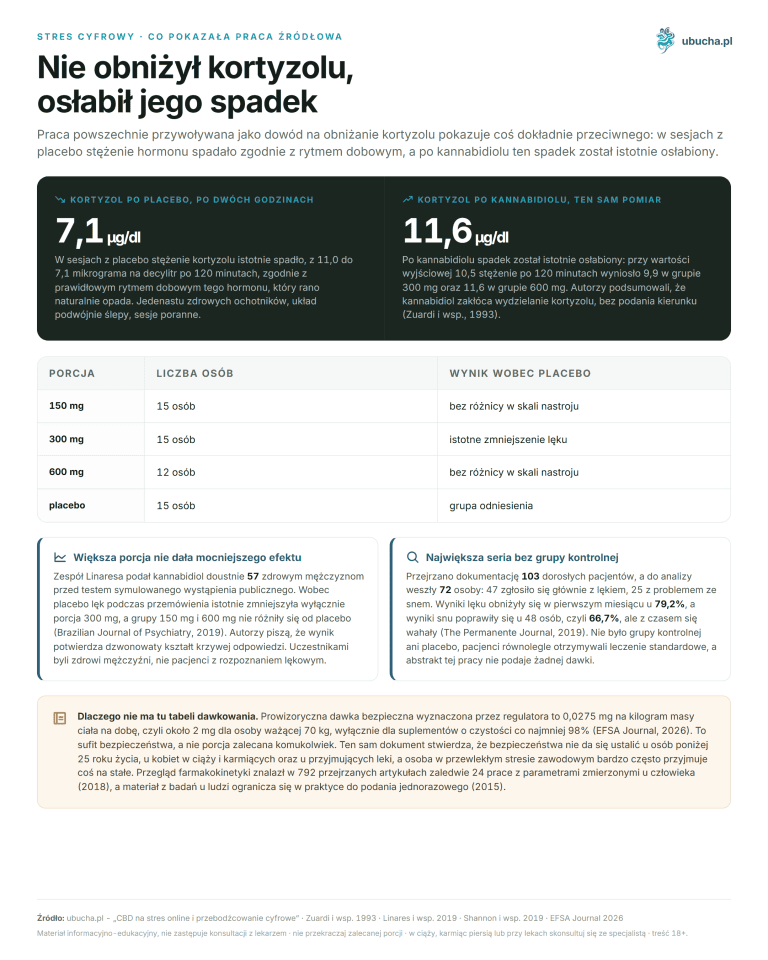
| Zuardi et al. 2017, Frontiers in Pharmacology 8: 259 | 60 healthy individuals, public speaking in a real situation | 100, 300, or 900 mg | anxiety decreased only after 300 mg; doses of 100 mg and 900 mg did not differ from placebo |
| Shannon et al. 2019, The Permanente Journal 23: 18-41 | 72 psychiatric outpatient clinic patients, retrospective chart review without a control group | doses not provided in the abstract | improvement in anxiety scores in 79.2% of individuals and sleep in 66.7% in the first month |
Zuardi’s work is the most instructive here, as it debunks the intuition that “more means better.” Nine hundred milligrams worked the same as placebo, while three hundred worked. This is an inverted U-shaped curve, previously described in animals. The mechanism by which CBD interacts with the serotonin receptor is separately discussed in our text about the 5-HT1A receptor.
Why can’t these studies be directly translated to everyday use of oil?
Because almost all measured a single dose given once, in a laboratory, before a pre-planned stressor. Blessing et al. stated this directly: chronic dosing has been studied by almost no one, and evidence in humans concerns almost exclusively acute administration. Oil from the shelf is bought, however, to be used daily for weeks.
The second difference concerns portion sizes. The cited studies mention three hundred, four hundred, and six hundred milligrams taken at once. The daily dose measured from a bottle of oil is many times smaller than these values. Someone reading about the effectiveness of 600 mg and translating it to their evening dose is comparing two completely different sizes.
The third issue is the quality of evidence. Shannon’s 2019 work is a retrospective chart review without a control group, so it does not separate the effect of the preparation from the natural course of symptoms or from the reaction to the initiation of treatment. The broadest available literature review rated the quality of evidence for anxiety relief as very low. This does not mean that there is no effect. It means that no one has reliably measured its size in the conditions in which people actually use these products.
How do CBD and THC fare in PTSD, OCD, and generalized anxiety?
The broadest review of this literature comes out noticeably cooler than individual studies. A meta-analysis by Black et al. (Lancet Psychiatry 6: 995-1010, 2019) included 83 studies, including 40 randomized trials involving 3067 participants. For PTSD, it found exactly one randomized trial with ten participants, for ADHD one with thirty.
The authors’ conclusion is that there is little evidence that cannabinoids improve conditions in depression, anxiety disorders, Tourette syndrome, PTSD, or psychosis. The only significant effect concerned pharmaceutical THC alleviating anxiety symptoms in individuals treated for other reasons, mainly chronic pain and multiple sclerosis, and was rated as very low-quality evidence. At the same time, THC increased the number of individuals with adverse effects (OR 1.99) and the number of study dropouts due to them (OR 2.78).
This one randomized trial in PTSD is the work by Jetly et al. (Psychoneuroendocrinology 51: 585-588, 2015). Ten Canadian soldiers with PTSD and persistent nightmares alternated between nabilone and placebo. The reduction of nightmares on the CAPS scale was 3.6 points compared to 1.0 points with placebo. The authors themselves call their trial preliminary and requiring replication in a larger group. In other words: the entire randomized evidence base for PTSD is ten people.
What risks does substituting medications with cannabis carry?
Three independent compilations describe them numerically, and none are comforting. They concern addiction, psychosis, and the role of high-THC material, which is exactly what dominates the legal market in the USA today.
| Phenomenon | Source | Value |
|---|---|---|
| cannabis use disorder among users | Leung et al. 2020, Addictive Behaviors 109: 106479 | 22% (18-26%); addiction in 33% (22-44%) of young people using at least once a week |
| risk of psychosis among the most intensive users | Marconi et al. 2016, Schizophrenia Bulletin 42: 1262-1269 | odds ratio 3.90 (95% CI 2.84-5.34) compared to non-users, based on 10 studies and 66,816 individuals |
| the share of high-potency cannabis in first episodes of psychosis | Di Forti et al. 2019, Lancet Psychiatry 6: 427-436 | if they disappeared from the market, 12.2% of cases could be avoided in 11 centers, 30.3% in London, and 50.3% in Amsterdam |
In Di Forti’s work, high-potency material was defined as that with THC reaching at least 10%. Daily use of such material was associated with nearly five times higher odds of psychosis compared to individuals who have never used. A separate problem is the very act of reaching for cannabis in response to anxiety: relief after consumption reinforces the behavior that brought it about, so the learning mechanism works against the user.
How do American data translate to Polish law?
Directly, not at all, because there is no legal consumer market in Poland where substitution could occur. Possession of cannabis other than hemp is punishable under the Act of July 29, 2005, on Counteracting Drug Addiction (consolidated text Journal of Laws 2023 item 1939). The threshold separating hemp from other cannabis is 0.3% and is counted as the sum of delta-9-THC and tetrahydrocannabinolic acid, rounded to one decimal place. This distinction changes the result of laboratory testing, and therefore it cannot be overlooked.
It is also worth separating two regulations that are often conflated in the press. The national threshold of 0.3% arises from the Act on Counteracting Drug Addiction as amended by the Act of March 24, 2022 (Journal of Laws 2022 item 763). EU law allows support under the Common Agricultural Policy for varieties with a THC content of up to 0.3% from January 1, 2023, based on Regulation 2021/2115. Previously, the EU threshold was 0.2% and came from the already repealed Regulation 1307/2013. The numerical value is now the same, but the legal basis is different: the national threshold corresponds to the EU one, and does not arise from it.
The use of pharmaceutical raw material from cannabis was permitted by the Act of July 7, 2017 (Journal of Laws 2017 item 1458), which came into effect on November 1, 2017. Issuing the raw material requires a prescription Rpw issued by a doctor. Typical indications include chronic pain resistant to standard treatment, spasticity in multiple sclerosis, and treatment-resistant epilepsy. Anxiety is not among the indications for which such therapy is routinely considered in Poland. What this path looks like from the patient’s perspective is described in our guide on becoming a medical marijuana patient.
cannabidiol is not listed in any controlled substance schedules, so products from hemp remain legal as food, supplements, or cosmetics. However, they are not medicinal products and cannot be presented as therapies for anxiety disorders. HHC is a controlled substance in Poland. The differences between the actions of both substances in the context of anxiety are developed in a separate entry on CBD and THC in anxiety states.
Why doesn’t CBD replace tapering off benzodiazepines under medical supervision?
Because benzodiazepines create physical dependence at the GABA-A receptor level, and reversing it requires gradual dose reduction conducted by a doctor. Sudden discontinuation of such treatment risks withdrawal syndrome with increased anxiety, insomnia, and seizures. None of the studies described above tested replacing benzodiazepines with cannabidiol in humans.
The second reason is pharmacokinetic. A review by Brown and Winterstein (Journal of Clinical Medicine 8: 989, 2019) compares data from the characteristics of registered CBD products. Nearly half of the people using CBD experienced adverse effects, and the frequency increased with dosage. The most common included increased aminotransferase activity, drowsiness, sleep disturbances, infections, and anemia. CBD interacts with CYP3A4 and CYP2C19 enzymes and P-glycoprotein, so the potential for interactions with medications taken regularly is assessed as high, and they recommend considering reducing the dose of the substrate drug or alternative therapy.
Let’s compare this with what the WHO expert committee stated about CBD. In a session from June 4-7, 2018, it concluded that pure cannabidiol has no psychoactive properties and does not create potential for abuse or dependence, and recommended that products with pure CBD not be subject to international drug control (WHO ECDD, 2018). However, the lack of addictive potential is something different from the lack of drug interactions, and these two findings must be read together.
Summary: what do these studies mean for the reader in Poland
American reimbursement data show that after the introduction of medical marijuana laws, the consumption of some prescription drugs decreases, and they present this in dollars saved and in the number of daily doses. They do not provide an annual rate of decrease for benzodiazepines, although such a number circulates in the media. The loud result of Bachhuber regarding lower opioid mortality did not hold up in replication over a longer data series.
Clinical evidence for CBD in anxiety exists, but is based on single doses in small groups, and the broadest literature review rates the quality of this evidence as low. For PTSD, the randomized evidence base is ten individuals. On the risk side, the numbers are much more certain: one in five cannabis users meets the criteria for use disorder, and high-THC material accounts for a significant portion of first episodes of psychosis in large European cities.
The practical conclusion is simple. Do not discontinue benzodiazepines or antidepressants on your own. If you are considering CBD supplementation while on regular pharmacotherapy, discuss it with your attending physician, as interactions via cytochrome P450 are documented. The simplified narrative of marijuana replacing medications is not supported by the works it cites.
Frequently Asked Questions
Can I stop taking alprazolam if I start using CBD oil?
No. Benzodiazepines create physical dependence and require gradual, supervised tapering, as sudden discontinuation risks withdrawal syndrome with seizures. No study has tested replacing benzodiazepines with cannabidiol in humans. CBD additionally inhibits CYP3A4 and CYP2C19 enzymes, so it may alter the concentrations of other medications.
Can I get medical marijuana for anxiety in Poland?
Anxiety is not among the indications for which medical marijuana is routinely considered in Poland. The pharmaceutical raw material is issued by prescription Rpw, mainly for chronic pain resistant to treatment, spasticity in multiple sclerosis, and treatment-resistant epilepsy. The basis is the act of July 7, 2017, Journal of Laws 2017 item 1458.
What doses of CBD were used in anxiety studies?
In single-dose studies, it was 400 mg in patients with social phobia (Crippa 2011) and 600 mg in a simulated public speaking test (Bergamaschi 2011). In Zuardi’s 2017 study, 300 mg was effective, while 100 mg and 900 mg did not differ from placebo. A higher dose does not mean a stronger effect.
Does a low dose of THC calm, while a high dose increases anxiety?
This is indicated by the experiment by Childs et al. in 2017 on forty-two volunteers. An oral dose of 7.5 mg of THC reduced reported discomfort after a social stress test, while 12.5 mg increased negative mood and worsened task performance. The difference between these doses is only five milligrams.
How often does cannabis use lead to addiction?
A meta-analysis by Leung et al. in 2020 included 21 epidemiological studies. Among cannabis users, 22% met the criteria for cannabis use disorder, with a confidence interval of 18% to 26%. In cohort studies, the risk of addiction increased to 33% among young people using at least once a week.
Does CBD interact with medications?
Yes. A review by Brown and Winterstein in 2019 indicates that CBD interacts with CYP3A4 and CYP2C19 enzymes and P-glycoprotein, making the potential for interactions with commonly used medications high. Nearly half of the people using CBD in studies experienced adverse effects, and their frequency increased with dosage.
Can American results be transferred to Poland?
Only as cognitive context. The substitution mechanism described in reimbursement data assumes legal access to THC products, which in Poland is only available with a prescription Rpw. The Polish system relies on reimbursed antidepressants and psychotherapy, so an analogous change in prescription statistics cannot occur.
If you are looking for THC-free products, browse the hemp oil category in our store.
This article is for informational and educational purposes only and does not constitute medical advice. Before starting to use cannabis or CBD for therapeutic purposes, consult your doctor, especially if you are taking other medications, are pregnant, or breastfeeding.
Author: Michał Waluk · Published: 2026-05-10 · Updated: 2026-08-10