
Endocannabinoids and Stress - How Anandamide and 2-AG Act Similarly to CBD and THC
Anandamide and 2-AG regulate the body's stress response. Discover what research has truly measured, how CBD works, and what remains unknown about safe dosing.
The human body produces its own cannabinoids. Anandamide was isolated from the brain by the Devane and Mechoulam team in 1992, and the molecule’s name comes from the Sanskrit word “ananda,” meaning bliss (Science, 1992). The second main endocannabinoid, 2-arachidonoylglycerol, was described three years later. Both are produced on demand from cell membrane lipids and disappear within minutes. Together with cannabinoid receptors and the enzymes that produce and break them down, they form the endocannabinoid system. This article shows what has actually been measured in this system: how chronic stress changes anandamide levels, what was found in cerebrospinal fluid of chronic migraine patients, how CBD affects this pathway, and what remains unknown about safe dosing.
KEY INFORMATION
• Anandamide was isolated in 1992, and its name derives from the Sanskrit “ananda,” meaning bliss (Devane, Science, 1992).
• Chronic stress lowers anandamide levels and reduces CB1 receptor availability in almost every brain area studied (Morena, Neuropsychopharmacology, 2016).
• In chronic migraine patients, anandamide concentration in cerebrospinal fluid is lower than in non-migraine individuals (Sarchielli, Neuropsychopharmacology, 2007).
• CBD inhibits anandamide breakdown and in a schizophrenia study increased its serum concentration (Leweke, Translational Psychiatry, 2012).
• EFSA explicitly states that CBD safety cannot be established for people under 25 years old, pregnant or breastfeeding women, and those taking medications (EFSA Journal, 2026).
What are endocannabinoids and why are they called “internal THC”?
Endocannabinoids are lipid signaling molecules produced by the body that stimulate the same cannabinoid receptors as tetrahydrocannabinol from cannabis. The two best described are anandamide and 2-arachidonoylglycerol. They are produced on demand, act locally, and break down within minutes, so they never produce effects comparable to externally administered THC.
The comparison to THC is accurate only in one aspect: the shared receptor target. Anandamide stimulates the CB1 receptor just like tetrahydrocannabinol, but its action ends before it can affect the entire brain. Tetrahydrocannabinol lacks an enzyme that would rapidly remove it, so it circulates for hours and causes psychoactive effects. Anandamide is removed by fatty acid amide hydrolase, FAAH for short, and disappears before the reader finishes the sentence.
The second difference concerns storage. Serotonin or dopamine wait in synaptic vesicles and are released on signal. Endocannabinoids have no storage at all. A neuron builds them from its own membrane lipids only when overactivated, then the molecule returns to the presynaptic neuron and suppresses neurotransmitter release. This is retrograde signaling, a brake mechanism activated by the inhibited cell itself.
The review by Lu and Mackie describes this system as an extensive neuromodulatory network involved in central nervous system development and synaptic plasticity (Biological Psychiatry, 2016). The authors emphasize a point often lost in popular descriptions: anandamide and 2-arachidonoylglycerol have similar structures but are produced and broken down by completely different enzymatic pathways. This explains their distinct physiological roles and different responses to stress. More about the bliss molecule itself can be found in the post on anandamide and its role in the body.
How does the body produce and break down anandamide and 2-AG?
Both endocannabinoids are produced from cell membrane lipids only when needed, each with its own pair of enzymes. Anandamide is synthesized by NAPE-PLD and broken down by FAAH. 2-arachidonoylglycerol is synthesized by diacylglycerol lipase (DAGL) and broken down by monoacylglycerol lipase (MAGL). The entire turnover occurs within minutes, not hours.
| Molecule | Synthesis Enzyme | Breakdown Enzyme | Behavior Under Stress |
|---|---|---|---|
| anandamide (AEA) | NAPE-PLD | FAAH | level decreases |
| 2-arachidonoylglycerol (2-AG) | diacylglycerol lipase (DAGL) | monoacylglycerol lipase (MAGL) | level increases |
| palmitoylethanolamide (PEA) | N-acylethanolamide pathway | FAAH | described separately below |
This enzymatic separation has a consequence seen in every stress study. Since anandamide and 2-arachidonoylglycerol have separate breakdown enzymes, one stimulus can lower one and simultaneously raise the other. This is exactly what the review by Morena et al. describes: in very different stress models, anandamide levels drop while 2-arachidonoylglycerol levels rise (Neuropsychopharmacology, 2016).
Pharmacology follows the same path. Instead of administering cannabinoids externally, one can block the degrading enzyme and let the body’s own molecule persist longer. FAAH inhibition prevents stress-induced anandamide decrease in the amygdala and facilitates extinction of learned fear, as shown in rodent models (Gunduz-Cinar, Trends in Pharmacological Sciences, 2013). These are preclinical studies, not human results. The FAAH inhibition mechanism is described in detail in the post on FAAH enzyme inhibition.
Which receptors mediate the stress response?
Endocannabinoids act through several protein families, not just one. The most important are cannabinoid receptors CB1 and CB2, but TRPV1 channels and nuclear PPAR receptors are also involved. Lu and Mackie list all these targets and note that CB1 is the most abundant (Biological Psychiatry, 2016).
| Receptor Target | Dominant Location | Role in Stress Context |
|---|---|---|
| CB1 | central nervous system, including amygdala and hippocampus | tones down excessive neuron excitation and inhibits anxiety response |
| CB2 | immune cells, microglia | modulates inflammatory response accompanying chronic stress |
| TRPV1 | sensory nerve endings | binds anandamide and participates in pain and heat perception |
| PPAR | cell nucleus | mediates slower anti-inflammatory effects of congeners |
The distribution of CB1 explains why this system is linked to emotions. The highest density is in areas responsible for emotional memory and anxiety regulation. Morena’s review shows that chronic stress leads to a reduction in CB1 receptors in almost every brain area studied (Neuropsychopharmacology, 2016). The effect is twofold: less signaling molecule and fewer sites where it can act.
CB2 receptors come into play differently. They are mainly on immune cells, so their activation affects inflammation rather than direct neuron inhibition. This is one of the bridges linking psychological stress with inflammation biology and explains why stress research increasingly measures cytokines alongside hormones.
What is retrograde signaling and how is it related to stress?
Retrograde signaling reverses the usual direction of communication between neurons. Normally, the signal goes from the presynaptic neuron to the postsynaptic neuron. In the endocannabinoid system, the receiving cell builds a lipid molecule and sends it back to the sender to slow down. It is a brake activated by the inhibited cell itself.
This mechanism directly affects synaptic plasticity, the ability of neural connections to change strength in response to experience. Lu and Mackie discuss this as fundamental to the system and note that this is how it participates in central nervous system development (Biological Psychiatry, 2016).
In the stress context, the direction of action is important. Excessive neuron excitation triggers endocannabinoid production, which suppresses neurotransmitter release and returns excitation to normal. As long as the system can build the molecule and enough CB1 receptors are present, the circuit self-stabilizes. When chronic stress lowers anandamide and reduces receptor availability, the circuit loses its brake.
This explains the asymmetry between acute and chronic stress described in literature. A single stressor triggers the full sequence: excitation, inhibition, return to baseline. Repeated stress keeps the system in excitation phase because the inhibition phase has nothing to act on. Morena’s review describes this as loss of the buffer that under normal conditions is endocannabinoid signaling (Neuropsychopharmacology, 2016).
What is the clinical endocannabinoid deficiency hypothesis?
The hypothesis suggests that some pain syndromes without detectable organ changes arise from chronically reduced endocannabinoid system activity. It was formulated by Ethan Russo, who in 2016 gathered evidence accumulated since then (Cannabis and Cannabinoid Research, 2016). The three conditions named in the paper’s title are migraine, fibromyalgia, and irritable bowel syndrome.
The logic is simple and thus easily misused. If the endocannabinoid system co-regulates pain perception and gut motility, its persistent weakening should cause symptoms in these areas. Russo notes that these syndromes overlap in patient populations, show pain hypersensitivity and central sensitization, and their patients were long labeled psychosomatic. These are clues, not proof.
The author points out the hypothesis’s weakest point. When formulated, hard measurements and clinical trial data were lacking. Only later were differences in anandamide levels in cerebrospinal fluid of migraine patients and changes in endocannabinoid system imaging in PTSD documented. Russo also mentions improved sleep and pain reduction after cannabinoids but describes these as clinical data supporting the theory, not confirmed therapy.
For readers, this has one practical consequence. The deficiency hypothesis is not a diagnosis and there is no lab test to confirm it in anyone. Measuring anandamide requires mass spectrometry in specialized centers and remains a research tool. No one will measure your “ECS level” at a clinic, and offers promising this are ahead of science.
What do measurements in migraine patients say about anandamide deficiency?
The strongest single measurement comes from cerebrospinal fluid. Sarchielli et al. measured anandamide, palmitoylethanolamide, and 2-arachidonoylglycerol in chronic migraine patients and compared them to non-migraine controls. Anandamide was significantly lower, and palmitoylethanolamide slightly higher (Neuropsychopharmacology, 2007).
The study adds a second layer often omitted in popular descriptions. Low anandamide correlated negatively with calcitonin gene-related peptide levels, the same molecule targeted by modern migraine drugs. A similar direction was seen for nitrites, nitric oxide breakdown products. The authors interpret this as endocannabinoid system impairment that may contribute to chronic headache.
A year later, the same group measured endocannabinoids in another material. Rossi et al. measured anandamide and 2-arachidonoylglycerol in platelets of twenty chronic migraine patients, twenty with medication overuse headache, and twenty controls. Both endocannabinoids were lower in both patient groups, and platelet serotonin was reduced and correlated with 2-arachidonoylglycerol (European Journal of Clinical Pharmacology, 2008).
It is worth separating these two studies because popular summaries sometimes swap them. Cerebrospinal fluid is Sarchielli 2007, platelets are Rossi 2008. Neither provides the percentage drop circulating online, and neither studies treatment. These are descriptive measurements in small groups, not randomized trials.
What about fibromyalgia and irritable bowel syndrome data?
Much weaker than for migraine. Russo mentions both syndromes in his endocannabinoid deficiency paper title, but direct evidence, i.e., concentration measurements in patients, is less robust than cerebrospinal fluid data in migraine (Cannabis and Cannabinoid Research, 2016).
The most cited clinical observation in fibromyalgia comes from Israel. Habib and Artul reviewed records of fibromyalgia patients treated with medical marijuana in two hospitals, including 26 mostly female patients averaging about 38 years old. All reported improvement on every questionnaire item assessing disease impact, and half discontinued other fibromyalgia medications (Journal of Clinical Rheumatology, 2018).
Two caveats affect interpretation. First, it is a retrospective review of 26 patients without control or blinding, so placebo effect cannot be separated from treatment effect. Second, medical marijuana containing tetrahydrocannabinol was studied, not CBD-predominant oil. Attributing this result to over-the-counter CBD products is a substitution not supported by the study.
In irritable bowel syndrome, the situation is even less clear. CB2 receptors in the gut wall participate in motility and barrier regulation, providing mechanistic rationale for the hypothesis. However, no study was found measuring endocannabinoid deficiency in IBS patients comparable to migraine measurements. The hypothesis remains well-motivated but poorly tested.
How does chronic stress dysregulate the endocannabinoid system?
Short-term and chronic stress affect this system differently. Morena et al.’s review shows that stress exposure lowers anandamide and raises 2-arachidonoylglycerol, with anandamide decrease contributing to the stress response: activation of the hypothalamic-pituitary-adrenal axis and increased anxiety behaviors (Neuropsychopharmacology, 2016).
The 2-arachidonoylglycerol increase is not a failure but the second half of the mechanism. This endocannabinoid participates in shutting down and adapting the stress axis response after stimulus cessation. Repeated stress shifts the balance: anandamide remains low, and CB1 receptors decrease. The system that should turn off the alarm stops responding.
The amygdala shows this best. Gunduz-Cinar et al. described that stress rapidly mobilizes FAAH, which removes anandamide signaling pool and increases excitability of the basolateral amygdala neurons. FAAH gene deletion or pharmacological blockade prevented anandamide decrease, dendritic hypertrophy, and anxiety behaviors (Trends in Pharmacological Sciences, 2013). These results come from rodents.
In humans, the genetic equivalent is the FAAH C385A variant. Dincheva et al. created a mouse with the same mutation and compared it to human carriers. In both species, reduced FAAH activity raised anandamide, strengthened prefrontal-amygdala connectivity, facilitated fear extinction, and lowered anxiety behaviors (Nature Communications, 2015). This is the closest evidence that the mechanism applies to humans.
What was measured in the endocannabinoid system of PTSD patients?
The most cited human measurement comes from Neumeister et al.’s imaging study. Contrary to many articles, PTSD patients showed increased, not decreased, CB1 receptor availability in the brain (Molecular Psychiatry, 2013).
Details matter for interpreting the result. The study included 25 untreated PTSD patients after non-combat trauma, 12 trauma-exposed without disorder, and 23 trauma-naive controls. The CB1 receptor ligand signal was 19.5% and 14.5% higher in patients versus comparison groups, strongest in women. Simultaneously, blood anandamide was 53.1% and 58.2% lower.
These results complement each other. Low signaling molecule, more free binding sites: the picture fits anandamide deficiency with secondary receptor upregulation. The authors combined receptor availability, anandamide, and cortisol measurements to correctly classify nearly 85% of PTSD cases.
Treatment data are weaker. Fraser described an open trial with nabilone, a synthetic cannabinoid receptor agonist, in 47 PTSD patients with treatment-resistant nightmares. 72% had nightmares cease or markedly reduce (CNS Neuroscience & Therapeutics, 2009). This is a chart review without control or blinding, showing a direction for further study, not efficacy.
Two later papers from this research line were retracted in 2020: one on CB1 receptor availability in the amygdala after trauma, the other on cortisol levels in PTSD. Retraction does not invalidate the imaging study above but shows the need for caution when reading single reports. Before citing, check if the paper has a retraction note.
How does CBD affect anandamide levels?
CBD does not stimulate CB1 like THC. Instead, it inhibits anandamide breakdown, allowing the body’s own molecule to persist longer. Leweke et al. tested this in a double-blind randomized trial comparing CBD to amisulpride in acute schizophrenia patients (Translational Psychiatry, 2012).
The result has two layers. Both drugs improved clinical symptoms and were safe, with CBD having a better side effect profile. More importantly, CBD treatment was accompanied by increased serum anandamide, and the magnitude correlated with clinical improvement. The authors state that inhibiting anandamide breakdown may underlie CBD’s antipsychotic effect.
Separately, Bergamaschi et al. gave a single dose of CBD or placebo to 24 untreated social anxiety patients before a simulated public speaking test; a third group of 12 healthy controls did the test without drug. CBD reduced anxiety, discomfort, and cognitive impairment during speech, with negative self-assessments similar to healthy controls (Neuropsychopharmacology, 2011). The authors call this a preliminary study.
A third result contradicts popular descriptions. Zuardi et al. gave CBD to healthy volunteers and measured cortisol. The normal morning cortisol decline after placebo was clear but was blunted after CBD, meaning hormone levels stayed higher (Brazilian Journal of Medical and Biological Research, 1993). The statement “CBD lowers cortisol” reverses what this study showed.
How does THC’s action on CB1 differ from CBD’s?
THC binds CB1 directly and mimics anandamide but lacks an enzyme that removes it quickly. Therefore, it acts for hours and causes psychoactive effects. CBD acts indirectly: it does not significantly stimulate CB1 but raises endogenous anandamide by inhibiting its breakdown.
The practical consequence is that the two compounds have very different action curves and risk profiles. Direct, prolonged receptor stimulation leads to tolerance, known for all agonists. Raising endogenous ligand levels acts more weakly but does not occupy the receptor permanently.
A third aspect is the entourage effect hypothesis, proposing synergy between cannabinoids and terpenes in plant extracts. Russo reviewed this, compiling data on individual components and proposing ways to test it (British Journal of Pharmacology, 2011). He formulates synergy conditionally, as a hypothesis to prove. Advertisements presenting the entourage effect as established fact go beyond what he wrote.
Data on other phytocannabinoids are even scarcer. Cannabigerol, cannabichromene, and cannabidivarin have described receptor profiles and preclinical studies but few human trials. Treating them as ready tools to support the endocannabinoid system is premature. Differences among the three cannabinoid families are detailed in a separate post on phytocannabinoids, endocannabinoids, and synthetics.
Does physical exercise really raise endocannabinoid levels?
Yes, and it is one of the best documented non-drug interventions. Raichlen et al. measured circulating endocannabinoids in humans, dogs, and ferrets before and after treadmill exercise. In humans and dogs, species adapted for long-distance running, levels rose significantly after intense endurance running (The Journal of Experimental Biology, 2012).
The same study shows what exercise does not do. No increase occurred after low-intensity walking in humans or dogs. In ferrets, non-running animals, no increase occurred at any intensity. The authors infer an evolutionary reward for running in species that benefited from it.
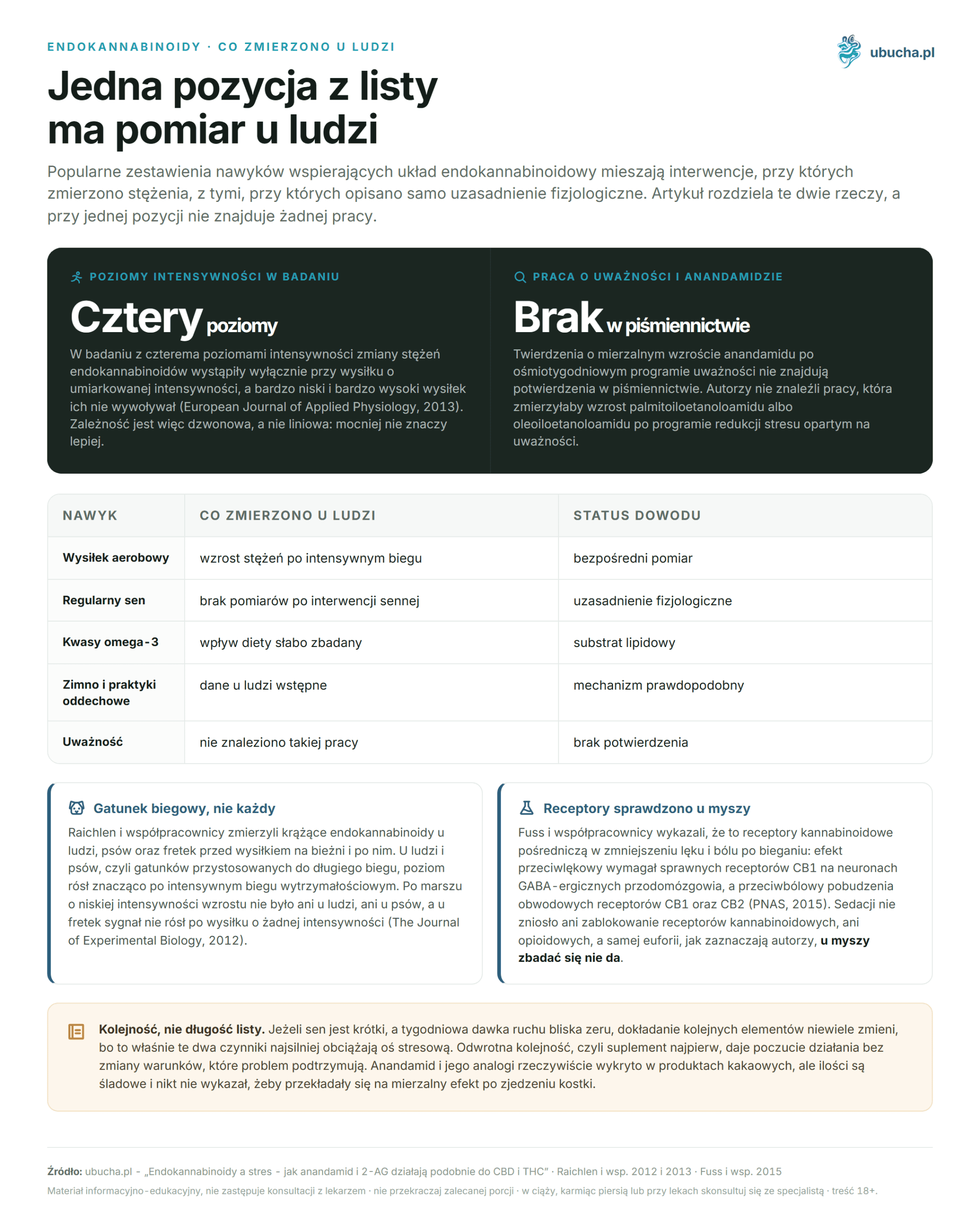
A year later, the team refined the threshold. In a study with four intensity levels, endocannabinoid changes occurred only with moderate effort; very low and very high effort did not trigger them (European Journal of Applied Physiology, 2013). The relationship is bell-shaped, not linear: stronger is not always better.
The role of receptors was tested in mice. Fuss et al. showed that cannabinoid receptors mediate anxiety and pain reduction after running: the anxiolytic effect required functional CB1 receptors on forebrain GABAergic neurons, and analgesia required peripheral CB1 and CB2 receptors (PNAS, 2015). Sedation was not reversed by blocking cannabinoid or opioid receptors, and euphoria, as authors note, cannot be measured in mice. The popular story of endorphins as the sole explanation is incomplete, but replacing it with a simple endocannabinoid story would be equally wrong.
Which habits besides exercise support the endocannabinoid system?
Evidence outside exercise is much weaker, and this is the key message in this section. Sleep, diet, and relaxation practices have good physiological rationale and affect the stress axis, but direct human endocannabinoid measurements after these interventions are scarce. The list below separates evidence from rationale.
- Moderate-intensity aerobic exercise - the only item with direct human endocannabinoid increase measurement (Raichlen, 2012 and 2013).
- Regular sleep - fundamental for hypothalamic-pituitary-adrenal axis regulation, which the endocannabinoid system inhibits; no concentration measurements after sleep interventions.
- Omega-3 fatty acids - lipid substrates for endocannabinoid pathways; dietary impact on human levels remains poorly studied.
- Cold exposure and breathing practices - probable mechanism via stress adaptation; preliminary human data.
- Mindfulness and social contact - reduce stress axis load; claims of measurable anandamide increase after eight-week mindfulness programs lack confirmation in literature.
The last point requires comment because it circulates online as fact. No study was found measuring palmitoylethanolamide or oleoylethanolamide increase after mindfulness-based stress reduction programs. Until such a study appears, mindfulness is worth practicing for stress relief itself, not for promised lab results.
Order matters more than the list. If sleep is short and weekly exercise near zero, adding other elements changes little because these two factors most strongly burden the stress axis. Only when the foundation is set do interventions with weaker evidence make sense. The reverse order, starting with supplements, is a common mistake, giving a sense of action without changing underlying conditions.
Similarly, treat reports about chocolate and truffles cautiously. Anandamide and analogs are indeed detected in cocoa products, but amounts are trace and no one has shown measurable effects from eating a bar. It is a biochemical curiosity, not a strategy to support your physiology.
Which symptoms do cannabinoids realistically alleviate according to large reviews?
The broadest review collected 79 randomized studies with 6462 participants. Moderate-quality evidence confirmed cannabinoid usefulness in chronic pain and spasticity. For chemotherapy-induced nausea, HIV-related weight gain, sleep disorders, and Tourette’s syndrome, evidence quality was low (Whiting, JAMA, 2015).
It is worth seeing the numbers behind this assessment. Compared to placebo, cannabinoids caused complete nausea and vomiting cessation in 47% vs. 20% of patients, with odds ratio 3.82 and only three studies analyzed. Pain reduction was reported by 37% vs. 31%, with confidence intervals including no difference. Authors note only four of 79 studies had low risk of bias.
The other side is adverse effects. The review found increased risk of short-term adverse events, including serious ones. Most common were dizziness, dry mouth, nausea, fatigue, drowsiness, euphoria, disorientation, balance disorders, and hallucinations. Percentage frequencies circulating online do not come from this summary and should not be repeated.
For this article’s topic, the conclusion is moderate. Cannabinoids have best data coverage where pain and muscle tension are concerned, not where marketing most eagerly places them, i.e., everyday stress and sleep. This does not mean they do not work; it means evidence quality in those indications is low, and the difference between “not studied” and “does not work” is often blurred both ways.
Can you measure your own endocannabinoid levels?
Not in clinical practice. Measuring anandamide and 2-arachidonoylglycerol requires chromatography coupled with mass spectrometry, using cerebrospinal fluid or plasma prepared by strict protocols. This is a research tool available in scientific centers, not a panel test at a clinic.
This is evident from the studies themselves. Sarchielli collected cerebrospinal fluid and measured concentrations by high-performance liquid chromatography with gas chromatography and mass spectrometry (Neuropsychopharmacology, 2007). Neumeister used positron emission tomography with a CB1 receptor ligand (Molecular Psychiatry, 2013). None of these procedures is ordered privately out of curiosity.
The only easily accessible parameter related to this system is the FAAH gene variant called C385A. Dincheva et al. showed that variant allele carriers have reduced enzyme activity, higher anandamide, stronger prefrontal-amygdala connectivity, and less anxiety behavior (Nature Communications, 2015). The authors discuss possible therapy response prediction, not consumer advice.
The practical takeaway is short. There is no test telling you if your endocannabinoid system is efficient or a threshold below which supplementation is justified. Offers promising “ECS level” measurement or dose selection sell a resolution science does not yet have.
What is known about safe CBD dosing and drug interactions?
Less than the market suggests. The European Food Safety Authority derived a provisional safe dose of 0.0275 mg per kilogram body weight per day, about 2 mg for a 70 kg person, using an uncertainty factor of 400 (EFSA Journal, 2026).
This value has a narrow scope. It applies only to supplements with at least 98% pure CBD, no nanoparticles, produced by a process recognized as safe and excluding genotoxicity. The panel also lists gaps not closed by new studies: liver toxicity in animal studies, signals of hepatotoxicity in humans taking drugs concurrently, thyroid hormone disturbances, and no immunotoxicity data.
The document’s most important sentence is different. CBD safety cannot be established for people under 25, pregnant or breastfeeding women, and those taking medications. If you belong to these groups, decide with a doctor, not based on drop count tables on labels.
Drug interactions are another layer. A systematic review by Stout and Cimino indicates CBD metabolism involves CYP2C19 and CYP3A4 isoenzymes, and THC metabolism involves CYP2C9 and CYP3A4 (Drug Metabolism Reviews, 2014). The authors assess clinically significant interaction risk as low with typical use but note lack of human data. EFSA’s hepatotoxicity warning with drug combinations makes this assessment preliminary.
How do endocannabinoids, phytocannabinoids, and synthetics differ?
All three groups target the same receptors but differ in origin, chemical structure, and duration of action. Endocannabinoids are produced by the body and vanish within minutes. Phytocannabinoids are cannabis plant compounds resistant to enzymes breaking down anandamide. Synthetics include both registered drugs and uncontrolled designer drugs.
| Group | Origin | Duration | Status |
|---|---|---|---|
| endocannabinoids | produced by the body from membrane lipids | minutes | cannot be taken orally as a preparation |
| phytocannabinoids | cannabis plants | hours | CBD available over the counter, THC controlled |
| medicinal synthetics | chemical synthesis | hours | prescription drugs, e.g., nabilone |
| uncontrolled synthetics | illegal synthesis | unpredictable | source of severe poisonings, never use |
The difference in duration has practical importance. Endocannabinoids are point signals sent from one synapse to a neighbor and immediately degraded. Exogenous cannabinoids reach everywhere blood flows and persist long after the triggering situation ends. Therefore, a preparation is never a substitute for own signaling, only a pharmacological enhancement.
The table also explains why “anandamide supplements” do not exist. The molecule is a fatty acid amide broken down by FAAH present in the gut and liver, so orally it would not reach the brain in useful concentration. All real ways to influence this system go through enzymes, receptors, or lifestyle.
What are PEA and OEA and how do they relate to anandamide?
Palmitoylethanolamide and oleoylethanolamide are lipids from the same chemical family as anandamide but with different receptor targets. They do not strongly stimulate CB1 or CB2 receptors but act via nuclear PPAR receptors. Both are broken down by the same FAAH enzyme as anandamide, which is their most interesting connection.
A shared enzyme means competition. When palmitoylethanolamide concentration rises in tissue, FAAH has more work, and anandamide breaks down more slowly and persists longer. This is one plausible mechanism cited by entourage effect supporters, and this one is based on biochemistry, not analogy.
Palmitoylethanolamide also appears in migraine research. In Sarchielli’s measurement, it was the only one of three lipids measured whose cerebrospinal fluid concentration was slightly higher in patients than controls, while anandamide was reduced (Neuropsychopharmacology, 2007). The authors do not conclude if this is a compensatory reaction.
Oleoylethanolamide is produced in the gut after meals and signals satiety via PPAR receptors. This explains why it is described with appetite regulation rather than stress regulation. This whole family is sometimes called the endocannabinoidome and has a separate discussion in the post on PEA, OEA, and related compounds.
What is the legal status of CBD and medical marijuana in Poland?
Cannabidiol is not a controlled substance in Poland, and industrial hemp is legal to cultivate and process with tetrahydrocannabinol content not exceeding 0.3%. The basis is the anti-narcotics law as amended on March 24, 2022 (Dz.U. 2022 poz. 763), with the consolidated text published as Dz.U. 2023 poz. 1939.
Two details of this threshold are often misstated. First, it applies to the plant and herb, not the finished product on the shelf. Second, it is calculated as the sum of delta-9-tetrahydrocannabinol and its acidic precursor THCA, rounded to one decimal place. Without this distinction, lab results can be interpreted in two ways.
The 0.3% limit has applied since May 7, 2022. Previously, it was 0.20%, and statements citing that as current are outdated. The national limit matches the EU limit but is a separate regulation with the same value.
Medical marijuana follows a different path. Non-industrial hemp flower is available in Poland as a pharmaceutical raw material by prescription since November 1, 2017, under the July 7, 2017 law (Dz.U. 2017 poz. 1458). Prescription requires personal patient examination, so teleconsultation is not equivalent. Hexahydrocannabinol, sometimes sold as a substitute, remains a controlled substance.
What are the practical conclusions?
The endocannabinoid system is a real stress regulation system, but knowledge about it is much less practical than supplement marketing suggests. The best documented non-drug intervention is moderate-intensity aerobic exercise, which emerges from this review as the first thing to do.
The second point is caution with numbers. Popular descriptions carry values not found in cited studies: percentage drops in anandamide, specific anxiety doses, promises of “ECS level” measurement. Sometimes references look solid but lead to unrelated fields. If a text gives a percentage without specifying the study group or a link you can open, treat it as advertising.
Separately, remember two reversals circulating online as facts. The statement “CBD lowers cortisol” comes from a study where CBD blunted the normal morning cortisol decline, i.e., acted oppositely. The statement “CB1 receptor binding is reduced in PTSD” comes from a study measuring increased receptor availability. Both errors persist because they fit the deficiency narrative and no one checks the source.
The third point concerns supplementation. CBD has a described mechanism affecting anandamide and human study data, but the European regulator cannot currently establish its safety in people taking medications, pregnant or breastfeeding women, or those under 25. This is not a formality to skip but a knowledge boundary.
If you want to do one thing after reading this, let it be talking to a doctor before combining any cannabis preparation with medications you already take. The rest - exercise, sleep, and reducing chronic stress sources - requires no permission and has better data support than most products sold as endocannabinoid system support.
Frequently Asked Questions
Does the human body produce cannabinoids on its own?
Yes. It produces anandamide and 2-arachidonoylglycerol. Anandamide was isolated in 1992 (Science, 1992), and the second was described three years later. Both are produced on demand from cell membrane lipids and are broken down within minutes by separate enzymes.
Do endocannabinoids act the same as CBD and THC?
Not exactly. Anandamide stimulates the same CB1 receptor as THC, but the body produces it locally and immediately breaks it down. CBD does not significantly stimulate this receptor; it only inhibits anandamide breakdown and thereby raises its concentration (Leweke, Translational Psychiatry, 2012).
What is the clinical endocannabinoid deficiency hypothesis?
It is a proposal by Ethan Russo suggesting migraine, fibromyalgia, and irritable bowel syndrome may share a common basis in reduced endocannabinoid system activity (Cannabis and Cannabinoid Research, 2016). It remains a hypothesis, not a diagnosis, and there is no test to confirm it in an individual.
How does chronic stress affect anandamide levels?
It lowers them. In many stress models, anandamide levels drop, 2-arachidonoylglycerol levels rise, and chronic stress reduces CB1 receptor availability in almost every brain area studied (Morena, Neuropsychopharmacology, 2016). The enzyme FAAH is responsible for rapid anandamide removal.
Does running increase endocannabinoid levels?
Yes, but it depends on intensity. In humans and dogs, levels rose after intense endurance running but not after low-intensity walking (The Journal of Experimental Biology, 2012). In a study with four exertion levels, changes occurred only with moderate effort.
Does CBD really increase anandamide levels in humans?
In Leweke’s study of patients in the acute phase of schizophrenia, CBD treatment was accompanied by increased serum anandamide, correlated with clinical improvement (Translational Psychiatry, 2012). This is one population and one randomized study, so the result should not be generalized to healthy individuals.
What did imaging studies of the endocannabinoid system in PTSD show?
Increased CB1 receptor availability in the brain and simultaneously decreased anandamide levels in the blood (Molecular Psychiatry, 2013). Popular summaries often reverse this result and write about decreased receptor binding, which does not match the measured data.
Is CBD legal in Poland?
Cannabidiol is not a controlled substance, and industrial hemp is legal with THC content not exceeding 0.3%, calculated as the sum of THC and THCA in the plant (Dz.U. 2023 poz. 1939). Hemp flower other than industrial hemp is available only by prescription.
If you are looking for cannabis preparations for daily use, the full offer is in the hemp oils category.
This article is for informational and educational purposes and does not constitute medical advice. Before starting cannabis or CBD for therapeutic purposes, consult a doctor, especially if you take other medications, are pregnant, or breastfeeding.
Author: Michał Waluk · Published: 2026-05-04 · Updated: 2026-08-10