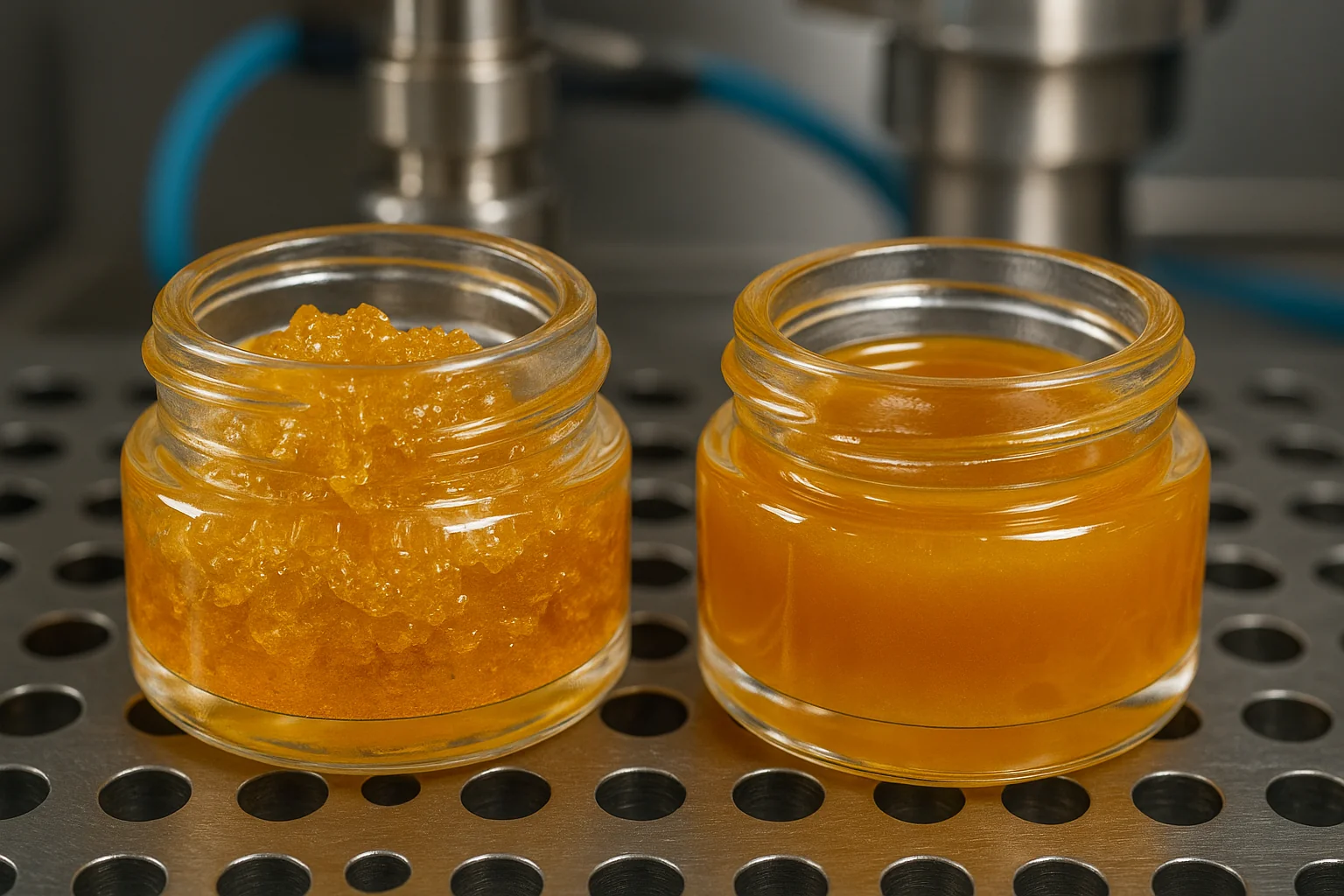

Live resin and live rosin - extracts from frozen flowers (table)
Live resin i live rosin: porownanie, roznice i co wybrac. Tabela od u Bucha.
Cannabis flowers can lose up to 60% of volatile terpenes during the standard drying and curing process. This observation led to the development of the live extraction technique - extraction from freshly frozen material immediately after harvest. The result is live resin and live rosin: two classes of concentrates that differ in aroma and flavor profile from traditional extracts as radically as fresh vegetables differ from freeze-dried ones. This article explains how they differ, how they are made, what research says about their composition, and why they cost more than standard concentrates.
KEY INFORMATION
• Live resin and live rosin are made from freshly frozen plant material - they retain 2-5 times more volatile terpenes than extracts from dried material (Russo, British Journal of Pharmacology, 2011).
• The key difference: live resin uses butane (BHO) as a solvent; live rosin is solventless - no chemicals, just heat and pressure.
• Live rosin typically retains 5-15% terpenes, compared to 1-5% in classic resin.
• Both products in Poland are available exclusively as CBD variants from industrial hemp - the article is educational in nature.
What does 'live' in the name of the extract mean - where did this term come from?
The term 'live' refers to the state of the plant at the time of extraction - alive, meaning unprocessed and uncured. The standard processing of cannabis looks like this: harvest → drying (2-4 weeks) → curing (additional weeks or months) → extraction. Each of these stages involves the loss of volatile terpenes - organic compounds responsible for aroma, flavor, and partly for the effect.
Studies on the terpene composition of dried cannabis have shown that myrcene, linalool, limonene, and terpinolene - the most important terpenes - evaporate in significant amounts within the first few days after harvest. Temperature, air exposure, and time play a crucial role. The 'live' technology addresses this issue simply: you harvest the plant and place it in liquid nitrogen or an industrial freezer within a few hours of harvest. Extraction occurs from frozen material - terpenes never have a chance to escape.
The live resin technique was developed in Colorado around 2013. A few years later, the first batches of live rosin appeared when extraction technicians began combining the freezing method with solventless techniques. Today, both products represent the premium segment of the concentrate market in legal markets in North America and Western Europe.
Live resin - premium BHO from frozen material
Live resin is a butane extract (BHO - butane hash oil) produced from freshly frozen plant material. The technological process is similar to standard BHO, but with two key modifications: the entire extraction occurs at low temperatures (often below 0°C), and the starting material has never been dried or cured.
Low-temperature extraction is essential for two reasons. First, butane at low temperatures is more selective - it extracts cannabinoids and terpenes while leaving more water and chlorophyll behind. Second, terpenes are volatile even at room temperature - extraction in a warm environment immediately deteriorates the aromatic profile of the product. The result is a concentrate with a vibrant, complex aroma that does not resemble classic shatter or wax.
Live resin can have various final consistencies - from a liquid, honey-like texture (the so-called live resin sauce) to budder, to a more solid shatter-like extract. They are differentiated by post-extraction processing. The popular 'sauce' is an extract in which THCA crystals spontaneously separate from the terpene-rich liquid (terp sauce) - the two components can be mixed in any proportions before use.
Terp sauce i inne odmiany live resin - mapa konsystencji
Terp sauce - also known as HTFSE (High Terpene Full Spectrum Extract) - is a specific type of live resin where the extract spontaneously separates into two distinct phases after extraction. The lower layer consists of THCA crystals (called diamonds), which can contain 95-99% THCA in nearly pure form. The upper layer, the actual sauce, contains 30-50% terpenes and serves as a concentrated source of flavor and aroma. Users can mix both phases in any proportions or use each separately. The spontaneous separation process, referred to as diamond mining, takes 2-4 weeks under controlled temperature and pressure, making the production of terp sauce more time-consuming than standard live resin.
Sugar wax is another variety of live resin, where partial crystallization of THCA gives the extract a granular texture resembling wet sugar. Sugar wax has a higher terpene content than classic shatter, though lower than terp sauce. It is considered one of the most versatile consistencies: easy to measure with a dabber, stable at room temperature longer than sauce, and retains more flavor than crumble. It is a good choice for those who are just starting their journey with live resin and are looking for a user-friendly format.
Live resin badder (also known as budder) is created by whipping the live resin extract during the purging process at slightly elevated temperatures - around 30-35°C. Mechanical aeration breaks down regular molecular structures and incorporates more terpenes into the final extract matrix. The result is a fluffy, opaque texture resembling peanut butter or soft margarine. Badder is one of the most popular formats of live resin among enthusiasts who value flavor intensity over the visual clarity of the product. It is easy to portion with a dabber, more resistant to changes in consistency during storage than sauce, and convenient for transport. For many users, it represents an optimal compromise between aroma intensity and everyday usability.
Live rosin - solventless from frozen material
Live rosin takes it a step further than live resin: it completely eliminates butane. Instead of a chemical solvent, it uses only cold water with ice, filter bags (bubble bag), and hot press plates. The process occurs in several stages.
Stage one: bubble hash (ice hash) is produced from frozen plant material by washing it with ice-cold water, which causes the brittle trichomes to detach from the leaves and flower bracts. The trichomes fall to the bottom through filter screens with increasingly finer mesh (25-220 microns). The highest quality bubble hash comes from a 70-120 micron screen, where the trichomes are full and unbroken.
Stage two: the isolated bubble hash goes to a rosin press - two heated plates compress it under pressure of several hundred kilograms per cm². Heat (65-80°C) and pressure mechanically squeeze cannabinoids and terpenes from the trichomes, and the raw rosin flows onto collection parchment. There are no chemicals, residual solvents, or additives.
An important observation from extraction practice: the quality of live rosin is almost linearly related to the quality of the starting material - which is not as true for BHO. Butane extraction can 'fix' some imperfections in the material by extracting cannabinoids from medium-quality raw material. The rosin press does not have this capability - it only squeezes out what is there. Therefore, live rosin producers invest significantly more in genetics and growing conditions. This is one of the reasons why live rosin is the most expensive among concentrates.
Live resin vs live rosin - comparison table
Both products share the same philosophy - frozen raw material to preserve terpenes - but differ in extraction method, final profile, and price. The table below compares the key parameters.
| Parameter | Live resin | Live Rosin |
|---|---|---|
| Extraction method | BHO (butan) - rozpuszczalnikowa | Solventless (water + pressure) |
| Raw material | Fresh frozen flowers | Frozen bubble hash from flowers |
| Typical THC content | 65-90% | 55-80% |
| Typical terpene content | 3-8% | 5-15% |
| Residual solvents | Possible (if purging is inadequate) | None |
| Consistency | Sauce, budder, sugar, shatter | Budder, badder, jam, caviar |
| Relative price | High (premium BHO) | Highest (top-shelf) |
| Extraction efficiency | 15-25% wagi surowca | 3-8% wagi surowca |
| Equipment availability | Professional closed loops | Press + bubble bags (available) |
Extraction efficiency is key to understanding prices. Live resin from 100 g of plant material yields 15-25 g of product. Live rosin from the same 100 g yields only 3-8 g - because bubble hash is first produced (10-20% efficiency), and then rosin is pressed (20-40% from bubble hash). The efficiency chain is significantly shorter, meaning: more raw material per gram of final product, higher production costs, and higher retail prices. However, it is worth noting that lower efficiency does not mean a worse product - quite the opposite. Live rosin from good raw material is referred to by many market experts as a reference product for the entire class of premium concentrates, precisely due to the purity of the process and the depth of the terpene profile.
The entourage effect and live terpenes - what does research say?
The concept of the entourage effect as a mechanism explaining the synergy of cannabinoids and terpenes was thoroughly discussed by Russo in a groundbreaking paper from 2011 (British Journal of Pharmacology). Russo gathered evidence that terpenes such as myrcene, linalool, limonene, and beta-caryophyllene modulate the activity of CB1 and CB2 receptors, and in some cases inhibit or enhance the effects of THC and CBD.
Specifically: myrcene increases the permeability of the blood-brain barrier and may enhance the sedative effects of THC. Limonene exhibits anxiolytic effects that can alleviate unwanted anxiety caused by THC. Linalool has a relaxing effect similar to lavender. These effects explain why the same strain of cannabis vaporized as fresh herb behaves differently than when vaporized as old herb with the same THC content.
Live resin and live rosin, maintaining a significantly richer terpene profile than standard concentrates, allow for a fuller experience of the entourage effect. Of course, research on the entourage effect is still preliminary and requires confirmation in controlled clinical studies. It is best to treat the available data as a promising hypothesis, not as a confirmed mechanism.
How to recognize good live resin or live rosin?
In legal markets, every live-class product should have a laboratory certificate with chromatography (COA - Certificate of Analysis) indicating the content of cannabinoids, terpenes, and residual solvents. Without a COA, there is no way to verify whether the product actually comes from frozen raw material - it can be sold as 'live' without any basis.
A few sensory tips: good live resin has an intense, multi-layered aroma reminiscent of fresh plant - fruity, earthy, and floral at the same time. Standard BHO usually has a more one-dimensional smell, often with a noticeable 'chemical' or 'waxy' note. Live rosin is usually lighter in color - from whitish to golden - and has a consistency similar to soft butter or thick jam. Very dark, brownish color of live rosin may indicate degradation or too high a pressing temperature.
Storage is crucial for quality. Both products should be kept in airtight silicone or glass containers and stored in the refrigerator (short-term) or freezer (long-term). Live rosin at room temperature starts to lose volatile terpenes within hours. If the product smells strong upon opening - that's good. If it has little scent - the terpenes have evaporated or were never there, which means that 'live' is just marketing.
Frequently Asked Questions
What is live resin and why is it more expensive than regular resin?
Live resin is a BHO extract produced from freshly frozen plant material, rather than from dried raw material. Freezing occurs immediately after harvest to preserve the volatile terpenes that evaporate during drying. Therefore, live resin has a distinctly richer flavor profile than classic resin. It is more expensive because it requires specialized freezing and low-temperature extraction infrastructure (Russo, British Journal of Pharmacology, 2011).
What is the difference between live rosin and live resin?
The key difference lies in the extraction method: live resin uses butane (BHO) to extract from frozen material. Live rosin is solventless - without any chemicals - and is produced by mechanically pressing frozen bubble hash between hot plates. Live rosin retains more terpenes (5-15%) and contains no residual solvents, making it preferred by consumers who care about product purity, although it is significantly more expensive due to low production efficiency (3-8% from raw material).
How much THC is in live resin and live rosin?
Live resin typically contains 65-90% THC. Live rosin contains slightly less - usually 55-80% THC - but compensates with a significantly richer terpene profile (5-15% compared to 3-8% in live resin). The terpene profile has a real impact on the subjective effect due to the entourage effect, which means that live rosin, with a lower % THC, can provide a more intense and complex experience.
How to store live resin and live rosin?
Both products should be stored in airtight silicone or glass containers in the refrigerator (2-8°C) or freezer. Exposure to heat, light, and air degrades terpenes and accelerates the oxidation of cannabinoids. Live rosin is particularly sensitive - at room temperature, it can change consistency and lose aromatic terpenes within a few days. It's best to use it in portions, storing the rest in the freezer.
What is the entourage effect and why does live rosin utilize it better?
The entourage effect is a hypothesis that cannabinoids and terpenes work synergistically. Studies Russo (British Journal of Pharmacology, 2011) suggest that terpenes such as myrcene, linalool, and beta-caryophyllene modulate the effects of THC and CBD. Live rosin retains 5-15% of terpenes (compared to 1-3% in products from dried material), making it one of the best concentrates for experiencing the full spectrum of the plant's effects.
What is terp sauce and how does it differ from standard live resin?
Terp sauce (HTFSE - High Terpene Full Spectrum Extract) is a variety of live resin, in which the extract spontaneously separates into THCA crystals (diamonds, 95-99% THCA) and a terpene-rich liquid layer (30-50% terpenes). Both phases can be mixed or used separately. The separation process - called diamond mining - takes 2-4 weeks under controlled temperature and pressure, making terp sauce more time-consuming to produce than standard live resin.
How is live resin budder made and why is it popular?
Live resin budder is created by whipping live resin extract during the purging process at slightly elevated temperatures - around 30-35°C. Mechanical aeration breaks down regular molecular structures and incorporates more terpenes into the final matrix, creating a fluffy, opaque texture. Budder is popular among enthusiasts who value flavor over visual clarity: easy to portion with a dabber and more stable during storage than sauce.
This article is for informational and educational purposes and does not replace consultation with a doctor. If you are pregnant, breastfeeding, taking medications, or have chronic conditions, consult the use of supplements or herbs with a specialist.
Author: Michał Waluk · Published: 2026-05-04 · Updated: 2026-05-04