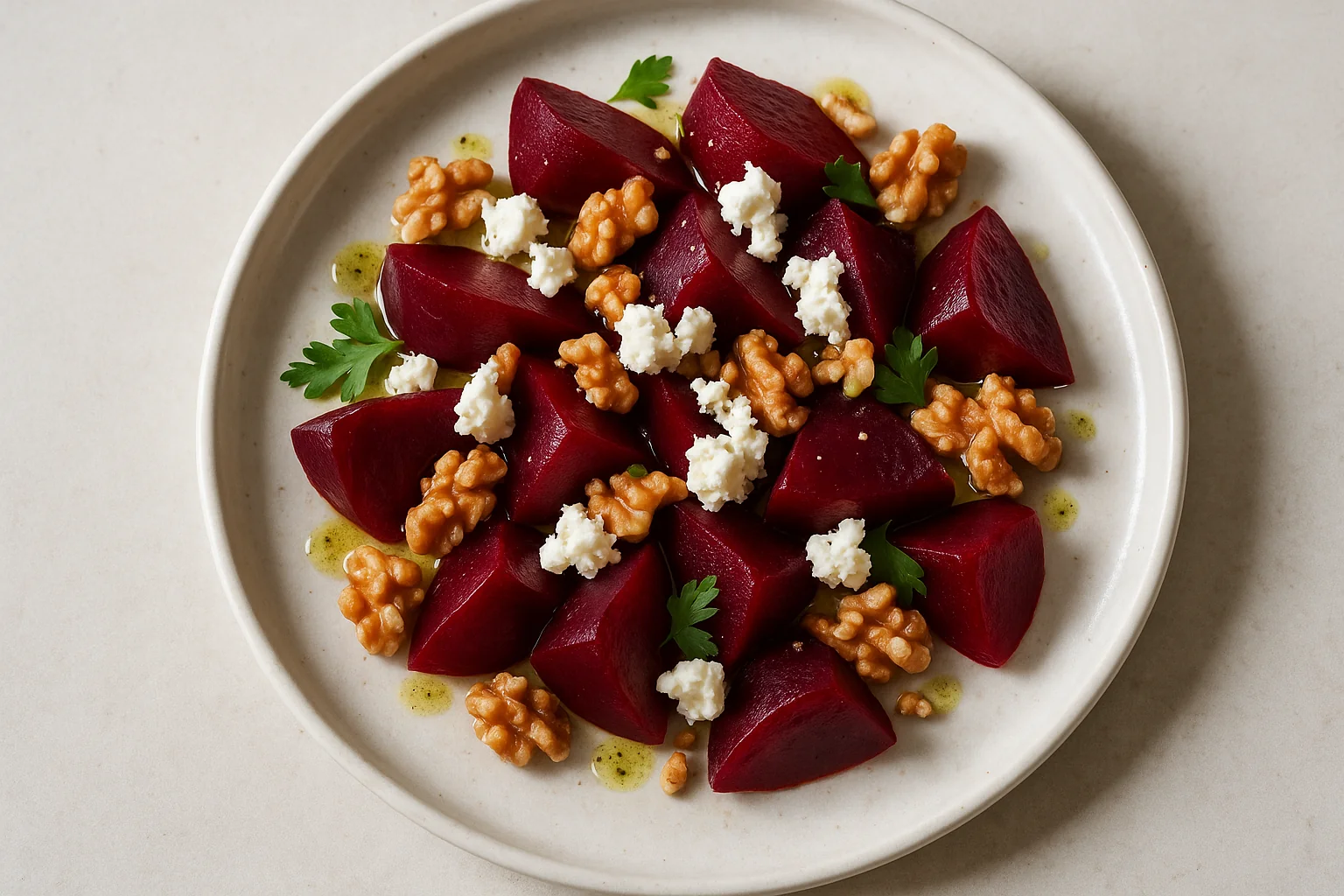

Salad with Beetroot, Feta and Hemp Oil
Salad with roasted beetroot, feta, and dressing made from hemp oil. Step-by-step recipe, numbers from the USDA database, and measurement of what heating does to the oil.
Beetroot with feta is an old and proven combination, but only the dressing made from cold-pressed hemp oil brings out its full flavor. The nutty note of the oil resonates with the earthy sweetness of the beetroot, and the saltiness of the cheese completes the whole. Hemp oil has a fatty acid profile that no other oil from the pantry can match, and it is the ingredient in this recipe best described in the literature. You can assemble the salad in ten minutes if you roast the beets the day before and store them in the fridge. Below you will find a step-by-step recipe, values from the USDA food composition database along with record numbers, and the reason why this oil should not be heated.
KEY INFORMATION
• Hemp seed oil has over 80% polyunsaturated fatty acids, and the omega-6 to omega-3 ratio is usually 2:1 to 3:1 (Callaway, Euphytica, 2004).
• The term “optimal for health” comes from Callaway, not from WHO or FAO.
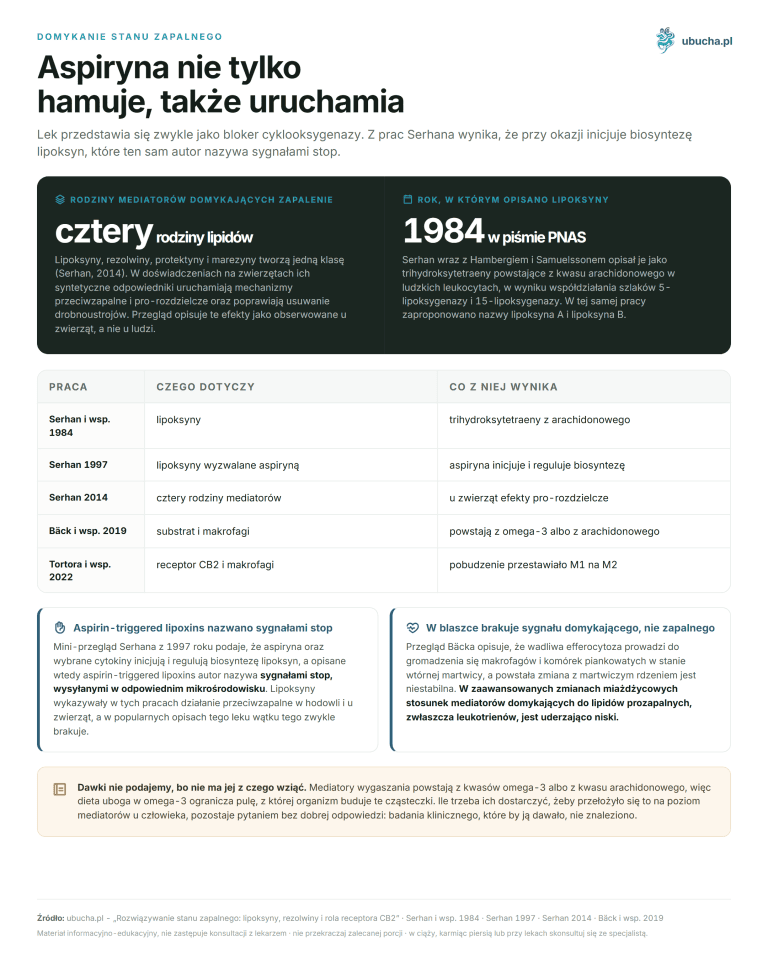
• At 85 degrees, the half-life of omega-6 fatty acids in this oil drops to seven hours (Pratap Singh et al., 2020).
• 100 g of raw beetroot contains 129 mg of betaine (USDA, record 169145).
What does hemp dressing add to the beetroot salad?
First of all, the fat profile. Callaway states that hemp seed oil contains over 80 percent polyunsaturated fatty acids, and the omega-6 to omega-3 ratio is usually between 2:1 and 3:1. In comparison, olive oil has this ratio at about 13:1, calculated from USDA record 171413.
It is worth immediately removing the layer that has stuck to this sentence in recipes. Callaway writes that such a ratio is considered optimal for human health, and does not indicate any institution. The circulating formula “WHO recommends below 4:1” does not come from this work, and we have not been able to find any WHO or FAO document with such a recommendation.
Measurements on specific varieties confirm the order of magnitude. Occhiuto and colleagues studied cold-pressed oil from two industrial varieties and obtained a ratio of 3:1 with tocopherol content of 81.7-101.5 mg per 100 g of oil (Occhiuto et al., Molecules, 2022). Tocopherols protect the fatty acids themselves from oxidation, which is important when storing the bottle.
A separate issue is the absorption of ingredients from the plate. Fat helps with fat-soluble compounds, thus with carotenoids from the leaves, not with betaine from beetroot, which is water-soluble. White and colleagues provided twelve women with five salads with dressing containing from 0 to 32 g of soybean oil and observed a linear increase in carotenoid absorption with the dose of fat (White et al., American Journal of Clinical Nutrition, 2017). In this salad, the carotenoids come from arugula, not beetroot.
Why shouldn’t hemp oil be heated?
Because what makes it valuable is also the most prone to oxidation. Polyunsaturated fatty acids have many double bonds, and each of them is a place where the reaction starts faster than in saturated fat. Heating accelerates this process many times over.
The scale of this acceleration has been measured directly on hemp seed oil. Pratap Singh and colleagues heated it at temperatures from 25 to 85 degrees for a day and calculated the half-lives of the fatty acids. At 25 degrees, they were about three days for omega-6 and five days for omega-3, while at 85 degrees they dropped to about seven and five hours (Pratap Singh et al., Scientific Reports, 2020).
Eighty-five degrees is a simmering temperature, not frying, so the practical conclusion is clear: hemp oil goes on the plate only at the end. For dressing, for drizzling over the finished dish, for cold pasta. This same work also shows that the addition of antioxidants reduced the degradation constant of polyunsaturated fatty acids by as much as 79 percent. In the kitchen, however, there is only one lever left, and that is temperature.
What does one serving of this salad provide?
A serving is about 200 g of roasted beetroot, 30 g of feta, 40 g of arugula, 15 g of walnuts, and one and a half tablespoons of dressing. From the calculations of USDA records, it comes out to about 450 kcal and about 37 g of fat, most of which comes from the oil along with the nuts.
| Ingredient (100 g) | kcal | What it provides | USDA Record |
|---|---|---|---|
| Raw beetroot | 43 | 129 mg of betaine | 169145 |
| Arugula | 25 | 1.42 mg of beta-carotene, 3.56 mg of lutein with zeaxanthin | 169387 |
| Feta | 265 | 14.2 g of protein, 1140 mg of sodium | 173420 |
| Walnuts | 654 | 47.2 g of polyunsaturated fatty acids | 170187 |
Two numbers from this table are worth remembering. Sodium in feta means that 30 g of cheese provides about 340 mg of sodium, so the salad does not need additional salt. Betaine from beetroot gives about 258 mg in a 200 g serving, and beets are among the most common sources of this compound in the diet along with spinach and whole grain products (Dobrijević et al., Molecules, 2023). The nuts contribute about 100 kcal per serving, and they, along with the oil, account for most of the calories in this salad.
What do you need for the salad?
There are nine ingredients, and the only one requiring advance preparation is the beets. Roasting takes 45 to 55 minutes, so do it in the evening or while preparing another dish in the oven. The rest takes ten minutes to assemble just before serving.
- 3 medium beets (400-450 g)
- 60 g of feta cheese
- 2 large handfuls of arugula or mixed greens (about 80 g)
- A handful of walnuts (about 30 g)
- 3 tablespoons of cold-pressed hemp oil
- 1 tablespoon of balsamic vinegar or lemon juice
- 1 teaspoon of honey or maple syrup
- Salt and freshly ground pepper
- Optional: 2 tablespoons of shelled hemp seeds for sprinkling
Buy the oil in a dark bottle and keep it in the fridge after opening, as the measurement from the previous section applies not only to the pan. Even at room temperature, the breakdown continues, just slower. Balsamic vinegar and lemon juice are not interchangeable in terms of flavor: the former enhances the sweetness of the beetroot, while the latter cuts it. Choose beets of similar size, as otherwise, the smaller ones will fall apart before the larger ones soften.
How to prepare the salad with beetroot step by step?
The order matters only in one place: the dressing goes on the salad only at the table. Everything else can be prepared in advance and kept separately in the fridge for several days. The six steps below yield two servings.
- Roast the beets. Wash them, do not peel, wrap each one separately in foil and bake at 200 degrees for 45-55 minutes, until a fork goes in easily. After cooling, peel with gloves and slice into centimeter-thick slices.
- Toast the nuts. Place them in a dry pan and toast over medium heat for three to four minutes, stirring until they start to smell. Remove from heat immediately, as they continue to cook from residual heat.
- Make the dressing. In a jar, combine 3 tablespoons of hemp oil, 1 tablespoon of balsamic vinegar, 1 teaspoon of honey, salt and pepper, then shake vigorously for 20 seconds. Hemp oil emulsifies less well than olive oil, so shake again before drizzling.
- Prepare the rest. Rinse the arugula and dry it thoroughly, as wet leaves dilute the dressing. Crumble the feta in your hands into larger pieces, which resonate better than small crumbs.
- Assemble the salad. On a plate, lay out the arugula, place the beet slices on top, scatter the feta and nuts.
- Drizzle and serve. Drizzle the dressing evenly over the entire salad and serve immediately, optionally sprinkling with a spoonful of shelled hemp seeds.
What variations of this salad make sense?
The salad tolerates substitutions well, as long as there is a contrast between the sweetness of the beetroot and something salty or sour. In the plant-based version, replace the feta with smoked tofu or cashews soaked in salted water for a few hours, and honey with maple syrup. Goat cheese works the other way: it is milder and creamier than feta, so it is worth adding more vinegar in that case.
The leafy base can also be changed. Baby spinach is milder and works better at a table with children, while endive cuts the sweetness of beetroot with a distinct bitterness. In winter, half a teaspoon of grated ginger with a pinch of cinnamon fits well into the dressing, as warm spices pair nicely with roasted beetroot.
We have noticed when repeating this recipe that the most common mistake is not about proportions, but timing. The salad dressed in advance wilts within half an hour, and the beetroot starts to stain the leaves pink. If you are taking it to work, transport the dressing in a separate jar.
A similar dressing base was used in the recipe for salad with pear and blue cheese and in buddha bowl with hemp dressing. Beetroot in a completely different role can be found in beetroot hummus with hemp seeds.
Frequently Asked Questions
Why does hemp oil go well with beetroot?
It has a nutty flavor that complements the earthy sweetness of beetroot, and a fatty acid profile unmatched by other cooking oils: over 80 percent polyunsaturated with an omega-6 to omega-3 ratio of 2:1 to 3:1 (Callaway, Euphytica, 2004).
Can you fry with hemp oil?
No. Measurements on this oil show that the half-life of omega-6 fatty acids drops from about three days at 25 degrees to seven hours at 85 degrees (Pratap Singh et al., 2020). Eighty-five degrees is still not frying, so on a pan, the breakdown is much faster.
Does the fat in the dressing improve the absorption of ingredients from the salad?
It improves the absorption of carotenoids from the leaves, as they are fat-soluble. In a study with twelve women, absorption increased linearly with the dose of oil in the dressing (White et al., 2017). Betaine from beetroot is water-soluble, so it does not apply to it.
Is this salad vegan?
In the version with feta, no, but the substitution is simple. Replace the cheese with smoked tofu or cashews soaked in salted water, and honey in the dressing with maple syrup. Beetroot, arugula, nuts, and hemp oil are entirely plant-based, so the rest of the recipe remains unchanged.
How long can the salad ingredients be stored?
Store roasted beets and dressing separately in closed containers in the fridge, and eat the assembled salad immediately. Arugula dressed with the dressing wilts in half an hour. Food composition databases describe the composition of products but do not answer questions about durability, so follow the dates on the packaging.
This article is for informational and educational purposes and does not replace consultation with a doctor. If you are pregnant, breastfeeding, taking medications, or have chronic conditions, consult the use of supplements or herbs with a specialist.
Author: Michał Waluk · Published: 2026-05-20 · Updated: 2026-08-16