
Zinc and Magnesium at Night (ZMA): Does It Really Work (FAQ)
ZMA did not raise testosterone or strength in a randomized study. What do the studies on zinc, magnesium, and sleep really show, and what blocks zinc absorption.
ZMA is the trade name for a combination of zinc aspartate, magnesium aspartate, and vitamin B6, taken in the evening before sleep. Marketing promises higher testosterone and faster recovery, while the forum version adds a story about calcium supposedly blocking the absorption of both minerals. When reviewing the source studies, the picture splits into two parts: one of these promises fell in a randomized study, the other has moderate support, and the popular justification for the timing of intake turns out to indicate the wrong component. The difference between these three situations is practical, as it determines whether it is worth spending money on a ready-made preparation or rather checking one’s own levels and supplementing what is actually lacking. Below we break down the issue into separate questions and provide what exactly supports the answer and who the given study actually included.
KEY INFORMATION
• In a double-blind study involving 42 men training with weights, ZMA taken before sleep for 8 weeks did not improve hormonal profile, body composition, or strength (Wilborn et al., Journal of the International Society of Sports Nutrition 2004).
• Zinc does have a real impact on testosterone, but only in cases of deficiency: reducing zinc in the diet lowered testosterone in young men, while supplementation raised it in deficient older men (Prasad et al., Nutrition 1996).
• Magnesium has a documented effect on sleep: 500 mg daily for 8 weeks improved sleep indicators and melatonin levels in older individuals with insomnia (Abbasi et al., Journal of Research in Medical Sciences 2012).
• The main inhibitor of zinc absorption is phytates from grains and legumes, not calcium from dairy (Lönnerdal, Journal of Nutrition 2000).
• Supplementation does not replace diagnostics: when suspecting a deficiency, it is more sensible to measure levels than to try blindly.
What is ZMA and where does the abbreviation come from?
ZMA is the trade name for a preparation combining zinc and magnesium in the form of aspartates with vitamin B6, taken on an empty stomach before sleep. The abbreviation comes from the English names of both minerals. It is a product designation, not a scientific category: no nutritional institution defines ZMA as a separate substance.
The rationale for the set itself comes from the roles of both minerals. Zinc and magnesium participate in many processes important for physically active individuals, and a review dedicated to their significance in sports indicates that both support strength and cardiovascular-respiratory endurance in healthy individuals and athletes (Lukaski, Canadian Journal of Applied Physiology 2001). The same author immediately adds a caveat that is worth remembering for the rest of the text: differences in study designs limit the ability to formulate recommendations regarding the intake needed for optimal performance.
The reference values for the intake of both minerals are established in the European Union by the European Food Safety Authority, in separate opinions for magnesium and for zinc. Commercial preparations may be dosed above these values, so comparing the label with the authority’s opinion is a more sensible starting point than comparing it with advertising.
Does ZMA raise testosterone levels?
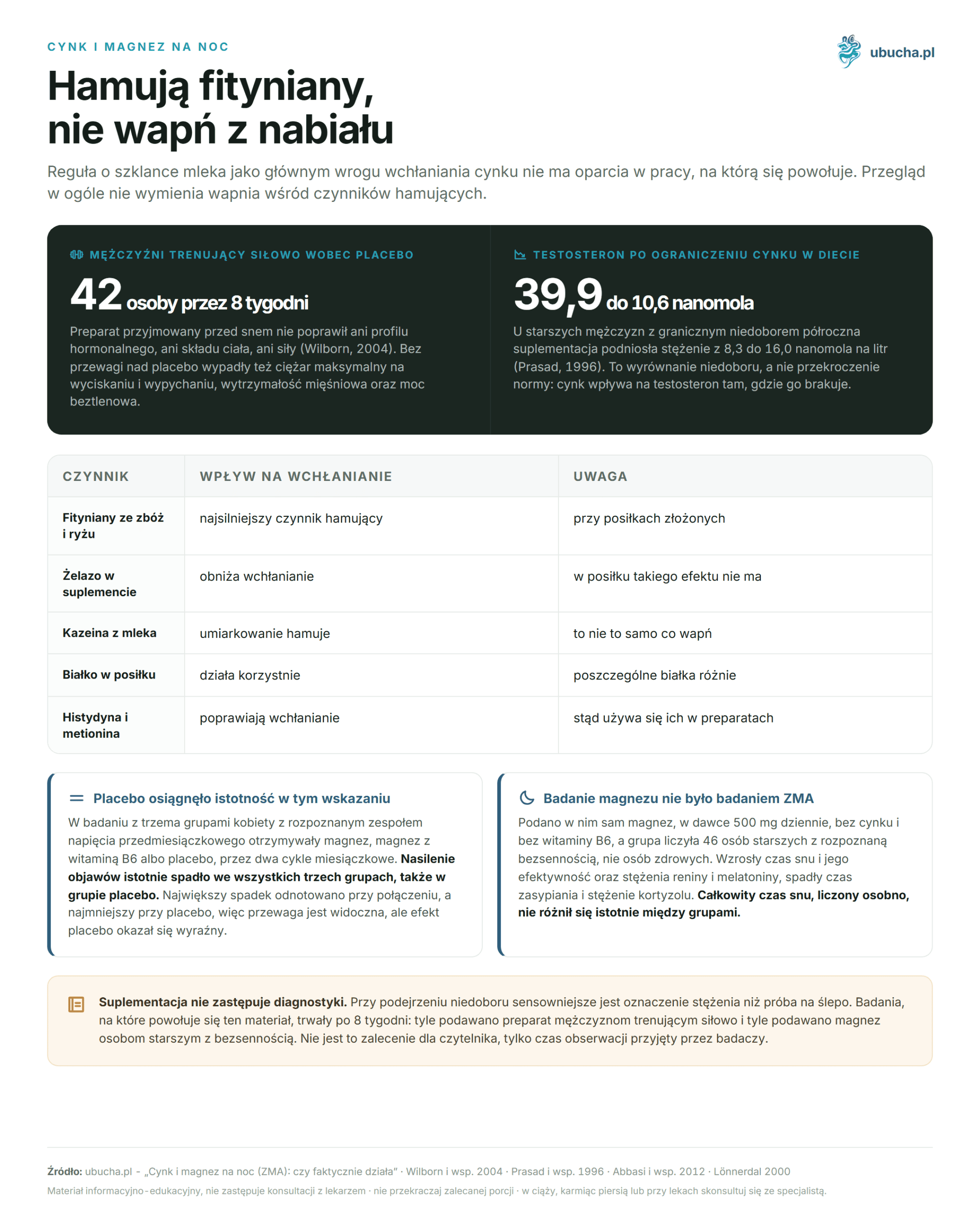
The preparation itself did not do this in a randomized study. Forty-two men training with weights were paired according to lean body mass and randomly assigned to ZMA or placebo with dextrose, taken 30-60 minutes before sleep for 8 weeks of standardized resistance training (Wilborn et al., Journal of the International Society of Sports Nutrition 2004).
The results were unequivocal in the opposite direction than the advertisement claims. Serum zinc levels increased by 11-17 percent, but the increase did not reach statistical significance. No differences were found between groups in the profile of anabolic or catabolic hormones, in body composition measured by densitometry, in maximum weight in bench press and leg press, in muscle endurance, or in anaerobic power. The authors concluded that ZMA taken during training does not improve training adaptations in resistance-trained individuals.
Completely different is the question of zinc itself in cases of deficiency. In a study involving 40 healthy men aged 20 to 80, testosterone levels correlated with zinc content in cells. In four young men, reducing zinc in the diet lowered testosterone after 20 weeks from 39.9 to 10.6 nanomoles per liter. In nine older men with borderline deficiency, six months of supplementation raised it from 8.3 to 16.0 nanomoles per liter (Prasad et al., Nutrition 1996). Correcting a deficiency is, however, something different than raising the norm above the norm. We discuss this more broadly in the text about supplements for men over forty.
Does magnesium in ZMA improve sleep?
Here, the evidence is clearly stronger than for testosterone. In a double-blind study, 46 older individuals with primary insomnia were randomly assigned to magnesium at a dose of 500 mg daily or to placebo for 8 weeks. The starting point was the observation that magnesium acts as a natural antagonist of the NMDA receptor and an agonist of the GABA receptor (Abbasi et al., Journal of Research in Medical Sciences 2012).
The results are interestingly distributed. In the magnesium group, sleep time and efficiency significantly increased, as did renin and melatonin levels in serum. The insomnia severity score, sleep onset time, and cortisol levels significantly decreased. Early waking and serum magnesium levels changed at the borderline of significance. One measure, however, showed no difference: total sleep time, counted separately from the other indicators, did not differ significantly between groups.
Three caveats must be made immediately. The study involved older individuals with diagnosed insomnia, not healthy individuals seeking better rest. It administered only magnesium, without zinc and without vitamin B6, so this is not a ZMA study. The group consisted of 46 individuals, which is a small number. The practical consequences of evening supplementation are collected in the entry about the evening supplementation protocol.
What really blocks zinc absorption?
Not calcium from dairy, but phytates from grain products. This is where the popular justification for taking ZMA on an empty stomach diverges from the literature. A review of dietary factors affecting zinc absorption indicates phytates, present in staple foods such as grains, corn, and rice, as the strongest negative factor in complex meals (Lönnerdal, Journal of Nutrition 2000).
The list of other factors also looks different than what is often repeated. Iron reduces zinc absorption when taken together in a supplement, but not when the same amounts are present in food as an enrichment. Cadmium from a contaminated environment inhibits absorption. The amount of protein in a meal acts favorably, although individual proteins behave differently: casein from milk has a moderate inhibitory effect compared to other sources. Amino acids such as histidine and methionine and organic acids improve absorption and are therefore used in zinc preparations.
The practical conclusion does not invalidate the recommended timing, but rather improves its justification. Taking it away from grain meals and from iron supplements has a basis. The rule about a glass of milk as the main enemy of zinc absorption does not have one: the referenced review does not mention calcium among the inhibiting factors at all, and from milk, it only points to casein, and that with a moderate effect. Separately, we discuss the mutual dependencies of both elements in the entry about magnesium and calcium.
Does ZMA make sense for women?
There is no separate study on ZMA in women, but the combination of magnesium with vitamin B6 has been tested in them for another indication. In a study with three groups, women with diagnosed premenstrual syndrome received magnesium, magnesium with vitamin B6, or placebo for two menstrual cycles (Fathizadeh et al., Iranian Journal of Nursing and Midwifery Research 2010).
The result must be read in full, as its second half gets lost in summaries. The severity of symptoms significantly decreased in all three groups, including the placebo group. The largest decrease was noted in the magnesium with vitamin B6 group, and the smallest in the placebo group. The advantage of the combination is therefore visible, but the placebo effect in this indication turned out to be so pronounced that it achieved statistical significance on its own.
Aside from this study, the differences between genders come down to demand, and that is a matter of reference values, not the preparation. Those considering supplementation will gain more from measuring levels than from choosing a specific brand from the supplements category. When taking medications regularly, the timing and composition of the preparation is a conversation with a doctor or pharmacist, not with the label.
Frequently Asked Questions
Does ZMA increase strength and muscle mass?
In a double-blind study involving 42 men training with weights for 8 weeks, ZMA did not provide an advantage over placebo in body composition, maximum weight in bench press and leg press, muscle endurance, or anaerobic power.
Who does zinc supplementation actually raise testosterone levels for?
For those with a deficiency. In Prasad’s study, reducing zinc in the diet lowered testosterone in young men from 39.9 to 10.6 nanomoles per liter, while six months of supplementation in older men with borderline deficiency raised it from 8.3 to 16.0 nanomoles per liter. This is correcting a deficiency, not exceeding the norm.
Why is ZMA taken on an empty stomach?
To avoid factors that inhibit zinc absorption from food. The strongest of these are phytates from grains, corn, and rice. Iron taken simultaneously in a supplement also reduces absorption, as does, to a moderate extent, casein from milk.
How long is the trial period for supplementation?
The studies referenced in this text lasted 8 weeks: that is how long ZMA was given to men training with weights and how long magnesium was given to older individuals with insomnia. This is not a recommendation for the reader, but the observation time accepted by researchers in both studies.
Does magnesium help everyone sleep?
This was not examined in the study. Improvement in sleep onset time, sleep efficiency, and melatonin levels pertained to 46 older individuals diagnosed with primary insomnia. The total sleep time did not differ significantly between the magnesium group and the placebo group.
Is it worth combining ZMA with other mineral supplements?
Iron taken simultaneously in a supplement reduces zinc absorption, although the same amounts in food do not have this effect. This is the only mineral interaction mentioned in the referenced review. For combining with medications taken regularly, consult with a doctor or pharmacist.
This article is for informational and educational purposes and does not constitute medical advice. Before starting supplementation, consult with a doctor, especially if you are taking medications regularly, are pregnant or breastfeeding, or have a chronic illness.
Author: Michał Waluk · Published: 2026-08-09 · Updated: 2026-08-11