Vaporizer Cleaning: How and With What? Complete Guide 2026
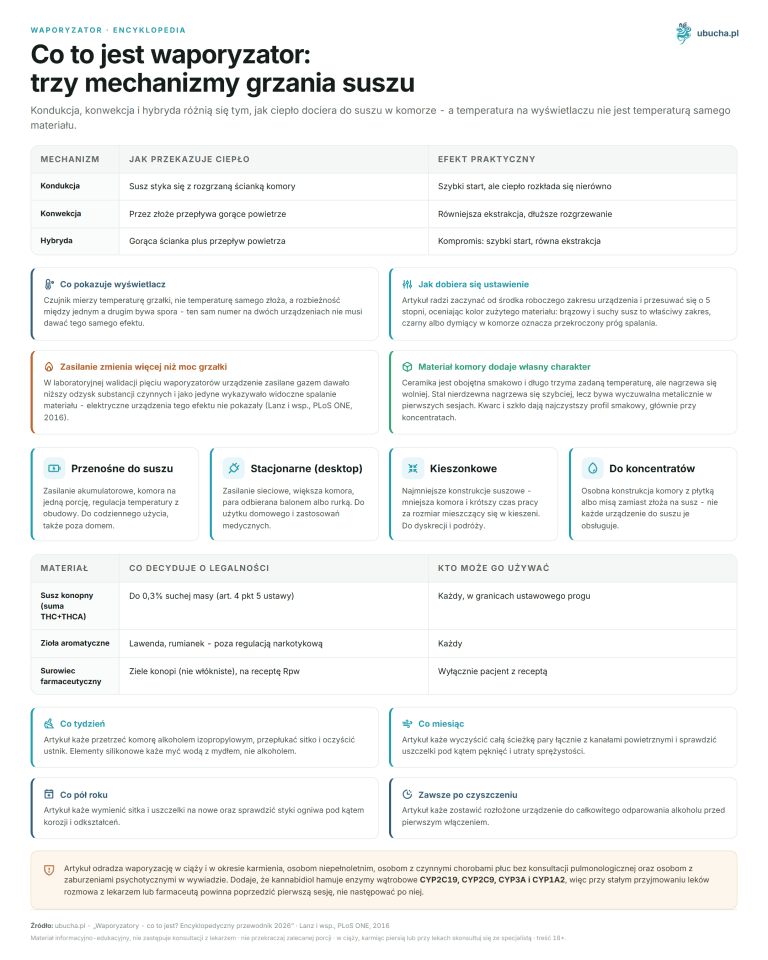
Isopropyl alcohol 90%, step order, drying time, and screen replacement. Practical guide to cleaning portable and stationary vaporizers.
The vaporizer gets dirty inside faster than it appears from the outside. Resin and plant dust settle in the chamber, air channel, and screen, narrowing the cross-section and changing the vapor taste to sharp and burnt. Repair is cheap and takes a few minutes, provided you know what to use and what not to touch. Below you will find the step order for portable and stationary devices, a list of things that irreversibly damage the equipment, the moment to replace screens and seals, and what vaporization studies say about chamber cleanliness. Separately, we explain what these studies do not resolve, as some repeated claims about vaporizer hygiene have no source. At the end, we describe the legal status of hemp dry herb in Poland, as the question regularly returns and is usually asked incorrectly.
KEY INFORMATION
• Arizer manufacturer provides a simple procedure for glass: two hours in isopropyl alcohol, then rinse with hot water.
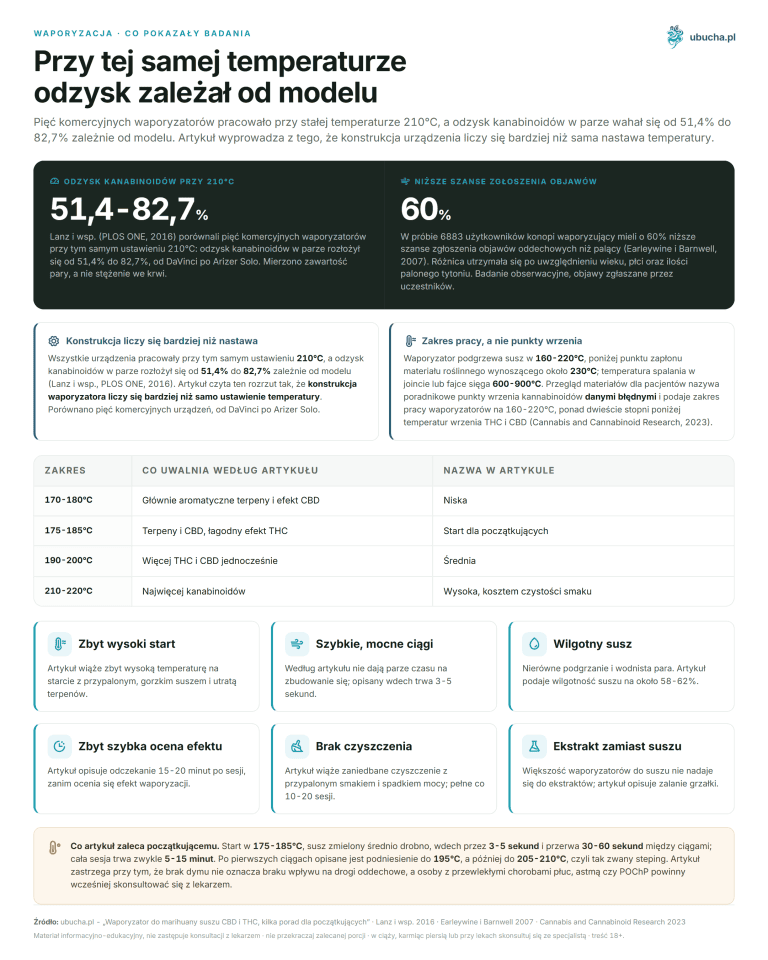
• Cannabinoid recovery in vapor varied among five tested vaporizers from 54.6% to 82.7% for THC (Lanz et al., PLoS ONE 2016).
• Temperature determines vapor purity: at 200 and 230 degrees, the cannabinoid to byproduct ratio was better than in smoke.
• After cleaning, allow the device at least 24 hours to dry.
How often should you clean the vaporizer?
Wipe surfaces contacting the herb every few sessions, and do a full cleaning with device disassembly once a month. With intensive use, this cycle shortens itself, as residue accumulates proportionally to the number of sessions, not elapsed time. A simpler signal than a calendar is the device itself.
Three signs indicate it’s time for full cleaning. The chamber changes color to dark brown or black. Draw resistance increases session by session with the same herb packing. The taste becomes burnt already on the first draw after filling with fresh dry herb, before the device heats up.
Residue buildup speed also depends on raw material moisture. Overdried herb crumbles and clogs the screen with dust; too moist leaves more sticky residue and dries longer in the chamber. A practical solution is storing in an airtight container with a hygrometer, maintaining humidity around sixty percent.
If you vaporize not only dry herb but also concentrates or oils, treat the schedule as definitely denser. Resin from concentrates hardens after cooling and after a few sessions requires not just wiping but several hours of soaking. Hybrid device manufacturers recommend separate chambers for each material type in such cases.
There is one more reason not to postpone cleaning, unrelated to taste. The longer residue stays in the chamber, the deeper it penetrates ceramic micropores and screen mesh, then it no longer comes off by wiping. Cleaning a neglected device takes not minutes but hours of soaking and usually replacing several parts. In short: regularity costs less time than catching up.
Why does a dirty vaporizer change what you inhale?
Because it changes two things at once: airflow and the actual temperature the herb reaches. Residue in the air channel narrows its cross-section, so at the same controller setting, less hot air passes through the herb layer. The temperature at the raw material level is then lower than indicated, although the display shows the set value.
That temperature matters for vapor composition is known from studies. A comparison of a stationary vaporizer with a marijuana cigarette showed that the cannabinoid to byproduct ratio in vapor obtained at 200 and 230 degrees Celsius was significantly better than in smoke, and the worst result was vapor at 170 degrees (Pomahacova et al., Inhalation Toxicology, 2009). Lower effective temperature thus pushes the device toward the worse result.
The second variable is the device itself. In a lab test of five vaporizers, total THC recovery in vapor ranged from 54.6% to 82.7%, and total CBD recovery from 45.9% to 70.0%. In four electric devices, decarboxylation efficiency exceeded 94% for both compounds, while the fifth gas-powered model caused plant material combustion (Lanz et al., PLoS ONE, 2016).
These two studies did not examine the effect of dirt itself, so you cannot read from them how much recovery drops in a clogged chamber. They show, however, that design and temperature differences translate into tens of percentage points of recovery. Maintaining airflow is the cheapest way to keep the device working as designed. How these conditions look in practice is described in the article on herb and hemp vaporization temperatures.
What do you need for cleaning?
The set is short and fully available in a pharmacy or drugstore. The basis is isopropyl alcohol at least 90% concentration, as it dissolves resin. The rest are tools to reach places your finger cannot, and distilled water to rinse off the alcohol.
| Item | Purpose |
|---|---|
| Isopropyl alcohol 90% or higher | dissolves resin residue from glass and metal |
| Cotton swabs | wiping chamber, contacts, and air channel |
| Soft brush | removing dry dust before using alcohol |
| Tweezers | removing screens and stuck debris near walls |
| Distilled water | rinsing after alcohol, no mineral deposits |
| Microfiber towel | mat for disassembly and drying parts |
| Glass container with lid | soaking glass and screens without alcohol evaporation |
What not to buy is also worth knowing. Acetone dissolves plastics and seals, thus damaging the chamber instead of cleaning it. Denatured alcohol leaves coloring additives. Dishwashing liquids leave a layer of surfactants that you then inhale with vapor. Ready-made cleaning solution kits usually contain the same isopropyl alcohol diluted with water.
Original manufacturer kits have one real advantage over improvisation: brushes matched in diameter to the openings of a specific model and inside the condenser. A universal toothbrush won’t fit into a capillary channel, and an aquarium hose brush works better in glass tubes than anything from a home drawer.
How to clean a portable vaporizer step by step?
The whole procedure takes a few minutes plus a day of drying. The order is not arbitrary: first remove dry debris, then use alcohol, and finally rinse and dry. Reversing these steps spreads dust throughout the chamber instead of removing it.
- Turn off the device and wait until completely cool. In models with removable batteries, remove and keep them away from alcohol.
- Remove the mouthpiece, take out the condenser, and disassemble it. Lay parts on a towel in disassembly order to ease reassembly.
- Invert the device and tap out dry herb remnants. Remove larger fragments near walls with tweezers, not sharp tools.
- Use a soft brush to remove dry dust from the chamber, crevices, and screen. This is the only dry step.
- Moisten a swab tip with alcohol and wipe inside the chamber, air channel, and mouthpiece contacts. Change swabs when they turn brown.
- Put removable parts - screens, condenser, and mouthpiece elements - into a glass container with alcohol. Do not leave silicone parts longer than half an hour.
- Rinse everything that contacted alcohol with distilled water. Tap water leaves a whitish residue.
- Lay parts on a towel in a ventilated place away from heaters and leave for 24 hours.
- Assemble the device and run an empty heating cycle at maximum temperature for one minute without herb. The first session after this should taste neutral.
One thing is non-negotiable: do not immerse the heating chamber. Alcohol entering under the chamber bottom reaches the seal and heating element contacts, from where it does not evaporate predictably. Clean the chamber interior only with a swab, even if ceramic and seemingly resistant.
How to clean a stationary vaporizer?
Stationary devices have more parts to disassemble but are easier to clean because most elements are glass and metal. Arizer provides a two-sentence procedure: soak glass parts in isopropyl alcohol for about two hours, then rinse with hot water and let them dry completely (Arizer Support, accessed August 10, 2026).
| Element | Method | Note |
|---|---|---|
| Glass tubes and chambers | soaking in alcohol, rinsing | tolerate long alcohol contact |
| Balloon | replacement, not cleaning | film loses elasticity with use |
| Mouthpiece with valve | disassembly and soaking | check o-ring each cycle |
| Spiral condenser | longer soaking, solution replacement | accumulates densest residue |
| Base with electronics | wipe with damp microfiber | never immerse |
The most common stationary device failure is not electronics but seals in the mouthpiece and balloon. Both wear mechanically and are replaceable, and their condition is easy to check without tools: squeeze the seal with fingers and release. If it does not return to original shape, it lost elasticity and no longer seals properly.
After full cleaning, run a heating cycle without herb. This checks two things simultaneously: whether the temperature sensor reacts properly after disassembly and reassembly, and whether any liquid residues remain in the chamber.
With stationary devices, it is easy to miss narrow channels invisible after disassembly. These are the tube connecting the chamber to the valve and the socket where the glass tube fits. Dense residue collects there, and a regular toothbrush is too thick. A thin capillary brush or a swab wrapped with cotton, moved in one direction to avoid leaving fibers, works well.
Manufacturers describe procedures for specific models in their knowledge bases, which is the first place to check before first disassembly. You will find information on which parts must not be immersed and which parts are replaceable.
What is the difference between deep and routine cleaning?
Routine cleaning is wiping the herb contact surfaces without disassembling the device. Deep cleaning means full disassembly, long soaking of glass, and replacing parts that no longer function. The first takes minutes; the second requires planning a break in use.
- Disassemble all parts the manufacturer allows.
- Leave glass parts in isopropyl alcohol for several hours or overnight.
- Replace the chamber screen if deformed or permanently dark.
- Clean the mouthpiece screen with a brush in alcohol, and replace if clogged.
- Inspect all silicone seals for cracks and loss of elasticity.
- Rinse every part that contacted alcohol with distilled water.
- Dry for one or two days, depending on soaking duration.
- Finish with an empty heating cycle at maximum temperature.
You recognize the time for full cleaning when routine cleaning stops working. Taste does not return after wiping the chamber, draw resistance remains despite fresh herb, and a dark residue visible on the screen is not removed by a swab. This means residue penetrated the screen mesh and ceramic micropores.
During full cleaning, check chamber sealing. Leakage is noticeable when air enters from the side during draw, not through the mouthpiece. The device then heats air bypassing the herb, increasing energy consumption and reducing efficiency, though the device looks clean.
When to replace screens, filters, and seals?
Replace screens when alcohol no longer removes dark residue or when mesh is stretched and deformed. This is the most frequently replaced part in portable vaporizers and the only one worth keeping in stock, as replacement takes seconds and requires no tools.
| Part | Wear signal |
|---|---|
| Heating chamber screen | stretched mesh, permanent dark residue, loss of elasticity |
| Mouthpiece screen | noticeably higher draw resistance |
| Condenser | residue on grids not removed by soaking |
| Seals and o-rings | cracks, deformation after squeezing, chamber leakage |
| Balloon in stationary device | film stiffening, vapor leakage |
Silicone seals wear even without intensive use, as silicone ages under heat and solvents. If you clean the device regularly and soak the same rings in alcohol each time, expect faster loss of elasticity than cleaning only with a swab.
When ordering spare parts, stick to the manufacturer’s markings for the model. Screens have different diameters and wire thicknesses, and too dense a screen raises flow resistance as effectively as a clogged one. Part availability is a sensible criterion when buying a device, alongside power and heating type.
Replacing the screen has another effect not immediately visible. A new screen restores original flow resistance, so the device again reaches the set temperature in the expected time and consumes the energy the manufacturer intended. With an old, partially clogged screen, the heater works longer each session, stressing the battery. The effect is slow and easily attributed to battery aging rather than the real cause.
What mistakes to avoid when cleaning?
The most costly mistakes are those that introduce liquid where it should not go and those that shorten drying. The first end with electronics or heating element damage; the second with alcohol residues evaporating during the first session and entering the respiratory tract.
- Do not immerse the heating chamber, battery, or electronics in any liquid.
- Do not use acetone, as it dissolves plastics, silicone, and paint coatings.
- Do not put parts in a dishwasher, even glass ones, as detergent leaves a surfactant layer.
- Do not replace isopropyl alcohol with salicylic spirit, as salicylic acid remains on the surface after evaporation.
- Do not scrub with metal brushes, as they scratch the chamber coating and create places where residue sticks more.
- Do not shorten drying, even if the surface looks dry.
- Do not rinse under tap water, as tap water leaves mineral deposits.
- Do not heat alcohol to speed up resin dissolution.
Separately about alcohol safety. Isopropanol at 90% and higher is flammable, so work away from open flames and heated surfaces. Vapors irritate mucous membranes, so ventilate the room and keep the container closed between steps. Keep the bottle out of children’s reach.
Rinsing with distilled water and full drying are not decorative but essential. Manufacturers include rinsing in instructions precisely to prevent alcohol residue on surfaces contacting inhaled air. If in doubt whether the device is dry, give it another several hours.
Do molds grow in a neglected vaporizer?
Microbiological risk is mainly related to the raw material, not the device. A review on fungi and mycotoxins in hemp flowers lists common types as Aspergillus, Penicillium, Fusarium, and Mucor, noting some produce toxic secondary metabolites (Gwinn et al., 2023).
Authors note these contaminants can cause opportunistic infections in immunocompromised persons. They did not study vaporizers, so the claim that a dirty chamber is a documented microbiological vector has no support in published data. Caution arises from reasoning, not measurement.
The reasoning is simple and worth knowing. Moist organic residues in a warm, closed place are conditions where molds grow. Two things prevent this: emptying the chamber after sessions instead of leaving used herb inside, and fully drying the device after each cleaning.
Immunocompromised persons, post-transplant or undergoing chemotherapy, should treat both rules as mandatory and pay attention to dry herb quality, as it is the spore source. If the material smells musty or has visible white mold on the flower, no device cleaning will fix it.
It is also worth examining dry herb storage, where most problems arise. Airtight container, no light exposure, and stable humidity limit mold growth more effectively than any later device treatment. A zip bag kept on a windowsill does the opposite: it heats during the day and cools at night, with condensing moisture settling on the flower.
Why vaporize instead of smoking?
Because combustion disappears, along with carbon monoxide and tar. A pilot study with 18 healthy subjects compared a stationary vaporizer with a marijuana cigarette. THC plasma concentrations were similar in both methods, and exhaled carbon monoxide after vaporization was lower. No adverse events were reported (Abrams et al., Clin Pharmacol Ther, 2007).
This difference has conditions, bringing back the cleanliness topic. Vaporization ceases to be vaporization once plant material starts smoldering. In the earlier test of five devices, one gas-powered caused combustion despite being sold as a vaporizer. Reduced airflow in a clogged channel acts similarly: part of the material contacts the hot wall longer.
Temperature itself also matters. A study comparing vapor with smoke showed the cannabinoid to byproduct ratio was best at 200 and 230 degrees Celsius, worst at 170. Too low a setting is not automatically gentler for airways, though often described so.
The practical conclusion is simple. Vaporization’s advantage over smoking depends on whether the device actually maintains the set temperature and whether air freely passes through it. Cleaning is a condition for this advantage, not a matter of aesthetics or taste.
It is worth marking the limits of these studies. Both measured vapor composition and blood concentrations under lab conditions on clean devices. None checked how results change in a chamber with residue, so no specific number describing this drop exists. Claims like “a neglected vaporizer loses thirty percent efficiency” circulate online without source and have no confirmation in publications or manufacturer documentation.
How to clean after concentrates and oils?
Differently than after dry herb and more often. Dried flower leaves mainly plant dust and a thin terpene film, removable in one cleaning cycle. Concentrates like wax or rosin create dense resin residue, and oils in cartridges leave a sticky layer blocking airflow in the atomizer.
One rule applies to concentrates, saving most work: clean the chamber immediately after the session while residue is warm and soft. After cooling, resin hardens and the same dirt requires hours of soaking instead of swabbing.
Disposable cartridges and pods are not cleaned; after use, they go for disposal. Reusable atomizers are cleaned by soaking in alcohol and dry burning, but the heater has a limited number of cycles and after burnout, the whole cartridge is replaced. A signal is weaker draw combined with burnt taste.
In devices supporting both material types, use separate chambers or inserts. Mixing leaves permanent flavor transfer not removed even by full cleaning, as some aromas penetrate ceramic micropores. If you use both regularly, two separate devices prove more convenient than one universal: no swapping inserts and cleaning the chamber with each material change. Design differences between heating types are described in the article on convection, conduction, and hybrid vaporizers.
What does an annual maintenance schedule look like?
The schedule makes sense if you use the device regularly. For someone using a vaporizer once a week, full cleaning once a month suffices. With daily use, it pays to break tasks into five levels, as otherwise some fall out of view over a year.
| Frequency | Tasks |
|---|---|
| After each session | empty chamber, wipe mouthpiece |
| Weekly | wipe chamber and channel with alcohol, clean screen with brush |
| Monthly | full cleaning with glass soaking, screen replacement, seal inspection |
| Semiannually | replace seals and o-rings, condenser check |
| Annually | inspection of all replaceable parts, battery condition check |
Additionally, one task is easy to forget as it does not concern cleanliness: monitoring charge state. Deep battery discharge shortens lifespan regardless of chamber cleanliness, and in most portable devices, the battery is not user-replaceable.
If starting from scratch, a good starting point is a set of spare screens and seals bought with the device. Vaporizers in our offer range from 374 to 499 PLN as of August 10, 2026, so consumables cost a fraction of that and determine whether the equipment lasts several years. Current offer is in the vaporizers category.
The schedule is easier to maintain when you attach tasks to events, not dates. Replace the screen when opening a new dry herb package, check seals with season changes, and check the battery when you notice the device heats slower than usual. Phone calendars work for few; associating with a repeated task lasts for years.
Is vaporizing hemp dry herb legal in Poland?
Legal is dry herb from fiber hemp. The law defines these as Cannabis sativa L. plants in which the sum of delta-9-THC and tetrahydrocannabinolic acid in flowering or fruiting tops does not exceed 0.3% dry weight, rounded to one decimal place.
The basis is art. 4 point 5 of the Act of July 29, 2005 on Counteracting Drug Addiction, consolidated text published as Dz.U. 2023 item 1939, as amended by the Act of March 24, 2022 (Dz.U. 2022 item 763), effective May 7, 2022. Previously, the threshold was 0.20%.
One distinction changes the lab test result and must be stated here. The threshold counts as the sum of delta-9-THC and THCA, not delta-9-THC alone. Material with delta-9-THC below the threshold may exceed it after adding the acid form.
It is also worth knowing what this regulation does not do. The national threshold corresponds to the EU threshold introduced by regulation 2021/2115 but does not derive from it: these are two separate regulations with the same number. Permissible THC levels in food from hemp seeds are regulated separately, expressed in milligrams per kilogram, not percent. When buying dry herb for vaporization, check the lab test result for the specific batch.
Frequently Asked Questions
How often should you clean a dry herb vaporizer?
Wipe surfaces contacting the herb every few sessions, and do a full cleaning with device disassembly once a month or after several dozen sessions. Frequency depends on herb moisture and whether you also vaporize concentrates, as these leave a much harder-to-remove residue.
Can I use spirit instead of isopropyl alcohol?
Better not. Manufacturers specify isopropyl alcohol in instructions, and salicylic spirit contains salicylic acid, which remains on the surface after alcohol evaporation. Ethyl alcohol at lower concentration dissolves resin worse and dries longer, thus extending the break between cleaning and the first session.
Can you soak the vaporizer in water?
Only removable parts: glass tubes, mouthpieces, and screens, and only as a rinsing step after alcohol. Heating chambers, batteries, or electronics must not be immersed in any liquid. Tap water leaves visible mineral deposits after drying, so use distilled water for rinsing.
How to clean glass tubes and chambers?
Arizer provides a simple procedure in its manual: soak glass parts in isopropyl alcohol for about two hours, then rinse with hot water. In most cases, this restores the tubes’ original clarity. The procedure can be repeated, and parts must be completely dry before reassembly.
What to do if the vaporizer smells burnt despite cleaning?
First, check the chamber screen. If it is dark or deformed, replace it, as alcohol does not remove residue embedded in the mesh. The second place is the air channel between the chamber and the condenser. If the smell remains after full cleaning, the problem usually lies in the heating element.
Does isopropyl alcohol damage plastic parts?
Materials used in vaporizer chambers, such as PEEK and PEI, tolerate short contact with isopropyl alcohol. Silicone loses elasticity with prolonged soaking, so do not leave seals and rings in the bath longer than half an hour. The model’s manual specifies the allowable time.
How long does a vaporizer take to dry after cleaning?
Plan at least 24 hours in a ventilated place at room temperature. After longer soaking of glass parts, extend drying to two days. Alcohol remains in micropores and crevices, and shortening this time means its residues will evaporate only during the first session.
Is vaporizing hemp dry herb legal in Poland?
Legal is dry herb from fiber hemp, i.e., those in which the sum of delta-9-THC and THCA does not exceed 0.3% of dry mass. The definition is contained in art. 4 point 5 of the Act on Counteracting Drug Addiction. The threshold is counted as the sum of both compounds, not just delta-9-THC alone, and this distinction changes the laboratory test result.
What to remember about vaporizer cleaning?
The procedure boils down to four steps in a fixed order: remove dry dust with a brush, dissolve residue with isopropyl alcohol at least 90%, rinse with distilled water, dry for 24 hours. Everything beyond this scheme concerns either a specific model or material other than dry herb.
Two boundaries are inviolable. The heating chamber, battery, and electronics do not contact any liquid, and drying is not shortened even if the surface looks dry. The rest is a matter of frequency, determined not by calendar but by chamber color, draw resistance, and taste of the first draw.
It is also worth remembering what cleaning does not fix. It will not improve raw material quality or repair a burnt heater, and residue embedded in screen mesh is not removed by any soaking. Screens and seals are consumables and must be treated as such. If you are choosing equipment, also check the article on how a vaporizer works: principle, types, and for whom - guide and the guide on cleaning and maintenance of glass accessories, as some rules are common.
The article is informational and educational and does not constitute legal advice. The legal status described is valid on the publication date: hemp regulations may change. Consult a lawyer or current legal acts before making decisions.
Author: Michał Waluk · Published: 2026-05-11 · Updated: 2026-08-10