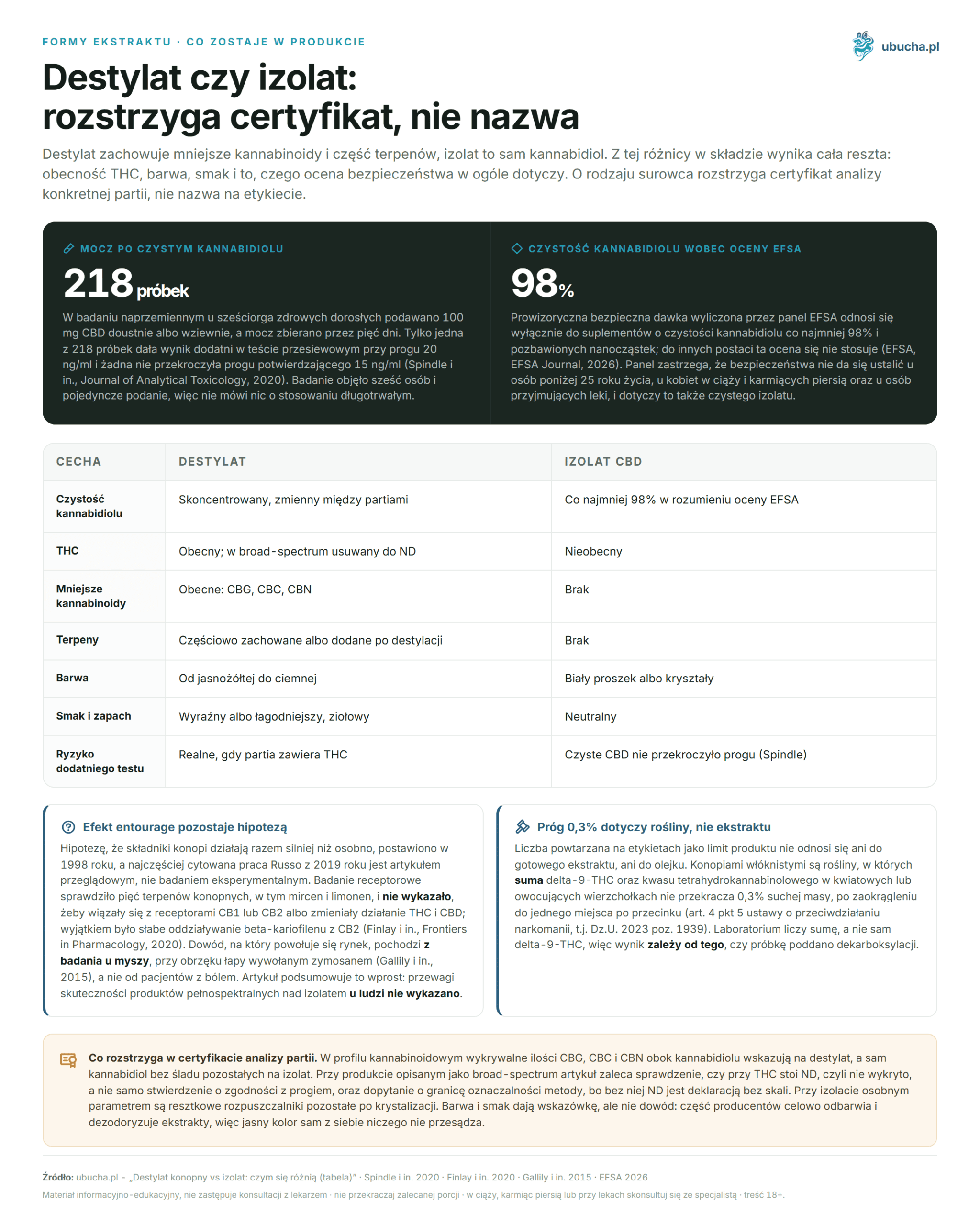

Hemp Distillate vs Isolate: What Are the Differences (Table)
Distillate or CBD isolate? How they are made, what studies say about the entourage effect, which one risks a positive THC test, and what the 0.3% threshold really refers to.
On the labels of hemp oils, four words keep coming back: distillate, isolate, full-spectrum, and broad-spectrum. Each stands for a different raw material and process, and the difference can be more significant than the concentration indicated in large print on the bottle. One study shows this most sharply: after administering pure CBD, only one of 218 urine samples exceeded the lowest screening threshold for THC, while inhaling vaporized CBD-rich cannabis resulted in nine positive results (Spindle et al., Journal of Analytical Toxicology, 2020). This article compares both forms from the production process to practical effects. You will find a table of characteristics that can be checked in the certificate of analysis, a review of evidence for the infamous entourage effect, and an explanation of what the 0.3% THC threshold really refers to. The goal is for you to know what to ask the seller before you pay for the name on the label after reading.
KEY INFORMATION
• Distillate is a concentrated extract retaining some terpenes and smaller cannabinoids; isolate is pure cannabidiol, without other plant components.
• After administering pure CBD, none of the 218 urine samples exceeded the confirmation threshold for the THC metabolite; THC-containing products gave positive results (Spindle et al., 2020).
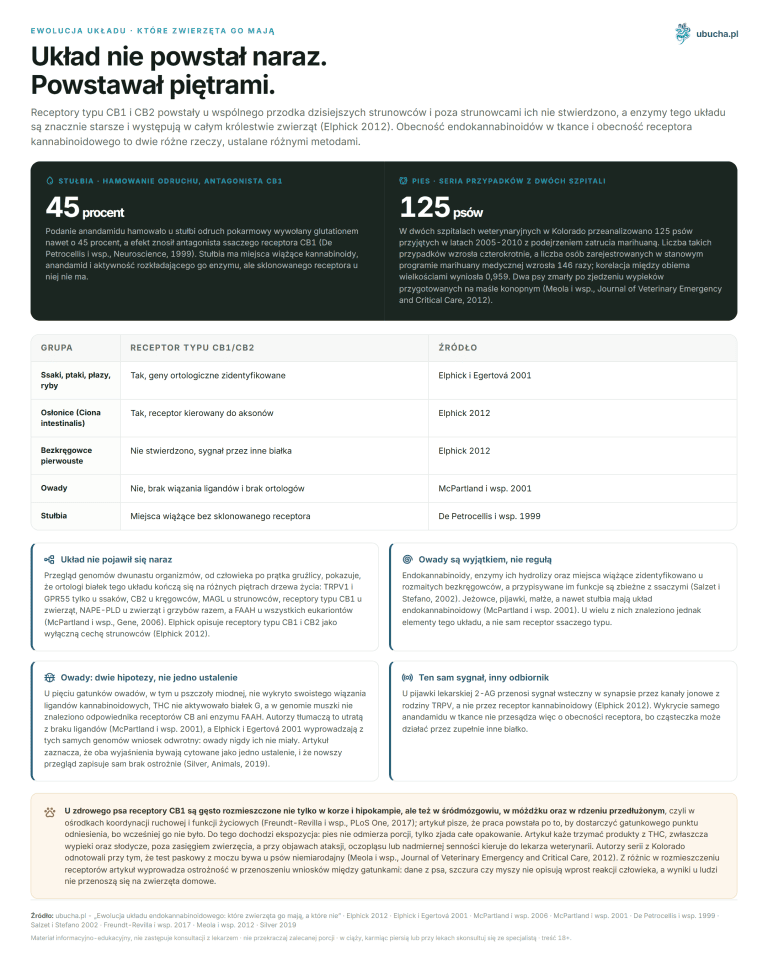
• The entourage effect is a hypothesis, not a determination: cannabis terpenes did not bind to CB1 and CB2 receptors nor altered the action of CBD in receptor studies (Finlay et al., 2020).
• The 0.3% threshold applies to the plant, not the finished extract, and is calculated as the sum of delta-9-THC and THCA.
• The type of raw material is determined by the certificate of analysis, not the name on the label.
How is hemp distillate made?
Hemp distillate is a raw extract purified by distillation, most often short-path or vacuum. The starting point is an extract obtained using supercritical carbon dioxide or ethanol, containing alongside cannabinoids waxes, chlorophyll, and lipids. Distillation separates these fractions from the rest.
In short-path distillation, the extract is heated under reduced pressure, allowing individual components to evaporate sequentially, according to their boiling points. Reduced pressure has practical significance: it allows the process to be conducted at lower temperatures and limits the degradation of cannabinoids. The product comes out as a thick liquid ranging in color from light yellow to amber.
Broad-spectrum distillate undergoes an additional stage of THC removal, usually chromatographic. This technique captures THC molecules, leaving CBD and smaller cannabinoids. Terpenes in both variants are only partially retained, as they boil at lower temperatures than cannabinoids, and some of them leave with the volatile fraction. Manufacturers may be aware of this loss and add terpenes back after distillation, which is worth checking in the composition. More about terpenes themselves is discussed in our post about terpenes in hemp oils.
How is CBD isolate made?
Isolate is produced by further purifying the distillate, most often by crystallization. High-concentration CBD distillate is mixed with a solvent, cooled, and left for slow crystallization. Cannabidiol precipitates as white crystals or powder, while other compounds remain in the solution.
After filtering the crystals, the solvent must be removed, and its residues are later tested in the certificate of analysis. This is not a formality: residual solvents are one of the few parameters that distinguish a well-made isolate from a shortcut version. An alternative method is column chromatography, which is more expensive but yields more consistent results.
The end result is the same in both cases: a colorless or whitish powder with no taste or smell. It is worth noting what this purity is useful for beyond marketing claims. The provisional safe dose of CBD calculated by the EFSA panel refers only to supplements with a purity of cannabidiol of at least 98% and free of nanoparticles (EFSA, EFSA Journal, 2026). This assessment does not apply to other forms, which in itself says something about the state of knowledge regarding other forms.
How does distillate differ from isolate?
The differences boil down to what besides cannabidiol remains in the product: other cannabinoids, terpenes, colorants, and THC. The table below compares characteristics that can be checked in the certificate of analysis or observed with the naked eye. Deliberately, it does not include declared ranges of purity percentages, as they differ between manufacturers and batches, and no publication establishes a binding range for them.
| Feature | Full-Spectrum Distillate | Broad-Spectrum Distillate | CBD Isolate |
|---|---|---|---|
| Cannabidiol Purity | Concentrated, but variable between batches | Concentrated, but variable between batches | At least 98% in the sense of the EFSA assessment |
| THC | Present, amount stated in the certificate | Removed chromatographically; certificate should show ND | Absent |
| Smaller Cannabinoids (CBG, CBC, CBN) | Present | Present | None |
| Terpenes | Partially retained or added back after distillation | Partially retained or added back after distillation | None |
| Taste and Smell | Distinct, herbal-bitter | Milder | Neutral |
| Color | From amber to dark | Golden to light yellow | White powder or crystals |
| Risk of Positive Urine Test for THC | Real; THC-containing products gave positive results | Dependent on the reliability of the batch certificate | In the Spindle et al. study, pure CBD did not exceed the confirmation threshold |
| Typical Use | Hemp oils | Oils without detectable THC | Gummies, cosmetics, homemade preparations |
Is the entourage effect proven?
No, to the extent suggested by product descriptions. The entourage effect is a hypothesis stating that the components of cannabis work together more strongly than separately. It was proposed in 1998, and its most frequently cited proponent is Ethan Russo, whose 2019 work in Frontiers in Plant Science is a review article, not an experimental study (Russo, Frontiers in Plant Science, 2019).
The experimental evidence cited by the market comes from a study on mice. Gallily and colleagues administered intraperitoneally or orally purified CBD and an extract from a CBD-rich cannabis strain and induced paw swelling with zymosan. Purified CBD produced a bell-shaped curve, meaning that above a certain dose, the effect decreased, while the plant extract reacted with an increase in response along with the dose (Gallily et al., Pharmacology & Pharmacy, 2015). This is an interesting result, but it was conducted on mice and in experimentally induced inflammation, not in patients with pain.
On the other side are studies that do not confirm the hypothesis. A receptor study examined five cannabis terpenes, including myrcene and limonene, and found no evidence that they bound to CB1 or CB2 receptors or altered the effects of THC and CBD; the exception was a weak interaction of beta-caryophyllene with CB2 (Finlay et al., Frontiers in Pharmacology, 2020). This one exception has its own earlier documentation: beta-caryophyllene selectively binds to the CB2 receptor and acts as its agonist (Gertsch et al., PNAS, 2008). A critical review from 2020 goes further and calls the entourage effect a poorly defined construct, mainly used for marketing purposes (Cogan, Expert Review of Clinical Pharmacology, 2020). See also our post about combining CBG with CBD.
Does isolate protect against a positive THC test?
Data indicate that pure CBD does not interfere with the test, while THC-containing products do. In an alternating study involving six healthy adults, 100 mg of CBD was administered orally or inhaled, along with vaporized CBD-rich cannabis (100 mg CBD and 3.7 mg delta-9-THC), and urine was collected over five days.
After administering pure CBD, only one of 218 samples gave a positive result in the screening test at a threshold of 20 ng/ml, and none exceeded the confirmation threshold of 15 ng/ml. After vaporizing CBD-rich cannabis, nine samples were positive at the 20 ng/ml threshold, two at the 50 ng/ml threshold, and four were confirmed by chromatographic method. The authors conclude that a single administration of pure cannabidiol will not yield a positive result at thresholds used in workplace tests, but products with THC admixture may (Spindle et al., Journal of Analytical Toxicology, 2020).
Two caveats. The study involved six people and a single administration, so it says nothing about long-term use, where metabolites accumulate differently. And what matters here is not the name on the label, but the actual THC content in the batch, and the authors directly advocate for better labeling of cannabis products for this reason.
How much THC can a cannabis product contain under the law?
The 0.3% threshold, repeated on labels as the product limit, does not apply to the finished extract or oil, but to the plant. Hemp plants are Cannabis sativa L. in which the sum of delta-9-THC and tetrahydrocannabinolic acid in the flowering or fruiting tops, from which resin has not been removed, does not exceed 0.3% when calculated on a dry weight basis, rounded to one decimal place.
The basis is Article 4 point 5 of the Act of July 29, 2005 on Counteracting Drug Addiction (t.j. Dz.U. 2023 poz. 1939), as amended by the Act of March 24, 2022 (Dz.U. 2022 poz. 763), effective from May 7, 2022. The same value applies in EU law, but as a separate regulation: from January 1, 2023, cannabis varieties eligible for support under the Common Agricultural Policy may contain up to 0.3% THC (Article 4 paragraph 4 of Regulation 2021/2115). Previously, the EU threshold was 0.2%. The national threshold corresponds to the EU one, but does not derive from it. A separate regulation, expressed in milligrams per kilogram rather than in percentages, applies to food from hemp seeds: for seed oil, the permissible level is 7.5 mg/kg, for the seeds themselves and products processed from them, 3.0 mg/kg (Commission Regulation 2023/915). This is a different act and a different subject than hemp extracts.
For the reader, this results in two things on the labels. First, the laboratory counts the sum of delta-9-THC and tetrahydrocannabinolic acid, not just delta-9-THC, so the result depends on whether the sample has undergone decarboxylation. Second, pure cannabidiol does not appear in the lists of controlled substances, but it also does not have authorization as a novel food in the European Union, and a sanitary notification of such authorization does not replace it. The legal status of the raw material and the legal status of the food product are two different matters.
When to choose isolate and when to choose distillate?
The decision is determined by the purpose, not the assumption that more natural means better. Isolate has an advantage where zero THC content is a requirement: in workplace tests, in sports subject to anti-doping control, or during roadside checks. It also works well when a neutral taste is needed, such as in homemade preparations.
Distillate is chosen by those who care about a fuller plant profile and natural aroma. It must be said honestly that the effectiveness advantage of full-spectrum products over isolate has not been demonstrated in humans; it is based on the entourage hypothesis and studies on animals. If someone promises you stronger effects from distillate, they should point to a study, not appeal to naturalness.
A separate note about groups to whom the market willingly recommends isolate as a safer version. The EFSA panel stated that the safety of cannabidiol cannot be established in individuals under 25 years of age, in pregnant and breastfeeding women, and in those taking medications. This also applies to pure isolate, as these are precisely the types of preparations that the EFSA assessment primarily concerns. A comparison of the types of spectrum can be found in our post about full spectrum and broad spectrum.
How to read the certificate of analysis?
The certificate of analysis for a specific batch is the only conclusive evidence of what the product really is. In the cannabinoid profile section, look for the presence or absence of CBG, CBC, CBN, and delta-9-THC. Detectable amounts of many cannabinoids indicate distillate, while pure cannabidiol without traces of others indicates isolate.
For products described as broad-spectrum, check if ND is stated next to THC, meaning not detected, rather than just a statement of compliance with the threshold. This distinction has practical consequences, as only the first record indicates that the THC analytical method did not find it. Also, ask about the limit of quantification of the method, as without it, ND is a declaration without scale.
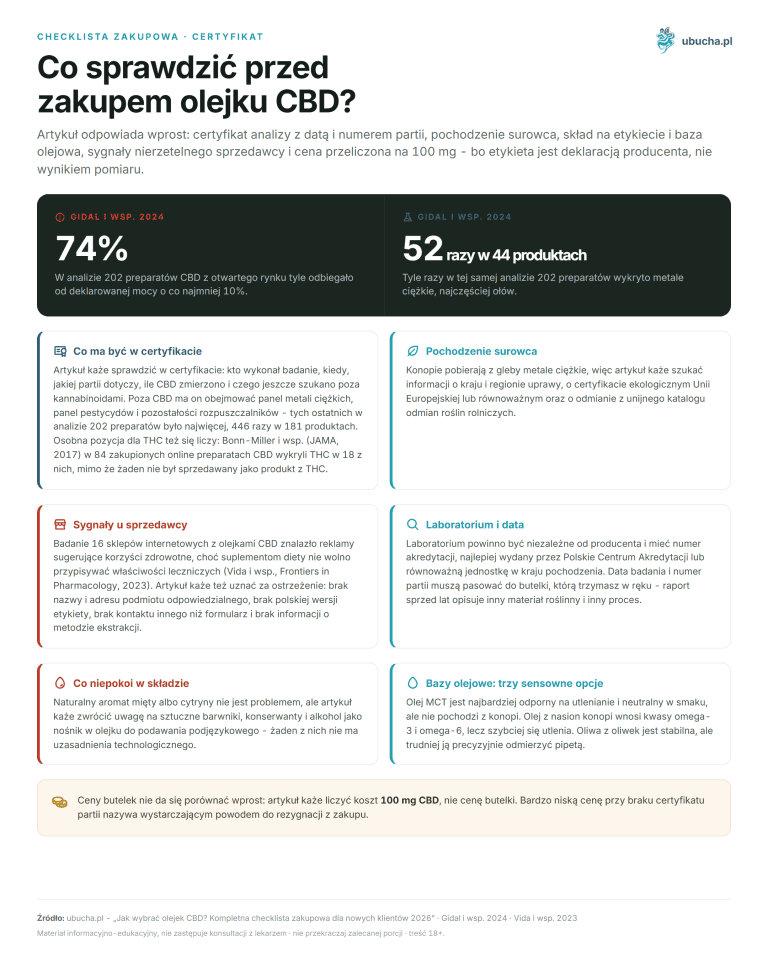
Color and taste provide a clue, but not proof. Full-spectrum distillate oil is usually dark and has a distinct herbal taste, while isolate oil in MCT oil can be almost colorless and odorless. Some manufacturers intentionally decolorize and deodorize extracts, so a light color alone does not determine anything. A practical checklist of things to check has been compiled in our post about how to choose CBD oil.
Frequently Asked Questions
What is hemp distillate?
It is a hemp extract purified by short-path or vacuum distillation, from which waxes, chlorophyll, and lipids have been removed. It retains smaller cannabinoids and some terpenes, although the latter evaporate at lower temperatures than cannabinoids. It is available in full-spectrum variant, with THC, and broad-spectrum, with THC removed chromatographically.
What is CBD isolate?
It is pure cannabidiol in the form of white powder or crystals, obtained from distillate through crystallization or chromatography. It does not contain other cannabinoids, terpenes, or colorants, so it has no taste or smell. The safety assessment by the EFSA panel refers specifically to products with a purity of cannabidiol of at least 98%.
Does distillate work stronger than isolate?
This has not been demonstrated in humans. The argument is based on the entourage effect hypothesis and a study in which a plant extract behaved differently than purified CBD, but it was conducted on mice (Gallily et al., 2015). Receptor studies did not confirm that cannabis terpenes altered the effects of CBD (Finlay et al., 2020).
Does CBD isolate protect against a positive THC test?
After a single administration of 100 mg of pure CBD, none of the 218 urine samples exceeded the confirmation threshold of 15 ng/ml for the THC metabolite, while vaporized CBD-rich cannabis gave positive results (Spindle et al., 2020). The study involved six people and one administration, so it does not account for long-term use.
Does the 0.3% THC threshold apply to the oil I buy?
No. The threshold applies to the plant: hemp plants are those in which the sum of delta-9-THC and tetrahydrocannabinolic acid in the tops does not exceed 0.3% dry weight, rounded to one decimal place. The basis is Article 4 point 5 of the Act on Counteracting Drug Addiction (t.j. Dz.U. 2023 poz. 1939) as amended by Dz.U. 2022 poz. 763.
How to distinguish a distillate product from an isolate product?
The certificate of analysis with the cannabinoid profile determines this. A distillate product shows measurable amounts of CBG, CBC, and CBN alongside cannabidiol, while an isolate product shows only cannabidiol. Color and taste provide a clue, but some manufacturers intentionally decolorize extracts, so a light color does not determine anything.
Can I prepare isolate oil at home?
Technically yes, because isolate dissolves in a carrier oil, such as MCT. However, it is worth knowing that cannabidiol does not have authorization as a novel food in the European Union, and the provisional safe dose calculated by the EFSA is about 2 mg per day for a person weighing 70 kg and does not include individuals under 25 years of age, pregnant women, or those taking medications.
The types of extracts described above can be found in the hemp oil category in the u Bucha store.
This article is for informational and educational purposes. It contains internal links to product categories available in the u Bucha store. Prices and specifications may change: check the current data on the product page before purchasing.
Author: Michał Waluk · Published: 2026-08-09 · Updated: 2026-08-15