
Natural CBD Supplements in Poland - 2026 Guide
Natural CBD supplements in Poland 2026: legal status, THC threshold 0.3%, how to read COA and price per milligram - a verified guide before first purchase.
The Polish market for natural CBD supplements entered 2026 as one of the fastest-growing segments of the European hemp market: according to Prohibition Partners, its value exceeded 900 million PLN already in 2021, with a forecast growth to 2 billion euros by 2028. Despite this scale, consumer awareness remains low - a Marygo survey (2021) showed that 90% of Poles declared lack of knowledge about CBD before their first purchase, and a groundbreaking Penn State College of Medicine study published in JAMA in 2017 showed that as many as 70% of 84 tested CBD products had labels inconsistent with actual cannabidiol content. This guide was created for people who want to buy natural CBD supplements consciously, without being misled into expensive sets and false healing promises. We present the legal status for 2026, quality verification via COA, the Novel Food situation in the EU, and criteria for evaluating producers - so that after reading, you can distinguish a reliable product from a marketing promise.
KEY INFORMATION
- Natural CBD supplements are legal in Poland if the sum of delta-9-THC and THCA does not exceed 0.3% dry weight (art. 4 point 5 of the Act on counteracting drug addiction, consolidated text Dz.U. 2023 item 1939).
- Broad spectrum oil is a safe choice combining the entourage effect with no risk of THC detection.
- A COA certificate from an independent, accredited laboratory is an absolute minimum for purchase.
- 70% of tested CBD labels were inconsistent with content (JAMA, Bonn-Miller et al., 2017).
- Price per milligram of CBD is a better value measure than price per bottle: approximate range is 0.10-0.20 PLN/mg in 2026.
What is the legal status of CBD in Poland in 2026?
Natural CBD supplements are legal in Poland if derived from industrial hemp Cannabis sativa L., and the sum of delta-9-THC and tetrahydrocannabinolic acid (THCA), rounded to one decimal place, does not exceed 0.3% dry weight. The basis is art. 4 point 5 of the Act of July 29, 2005 on counteracting drug addiction (consolidated text Dz.U. 2023 item 1939), as amended by the Act of March 24, 2022 (Dz.U. 2022 item 763), effective from May 7, 2022. Previously, the national threshold was 0.2%. CBD is not listed as a controlled substance.
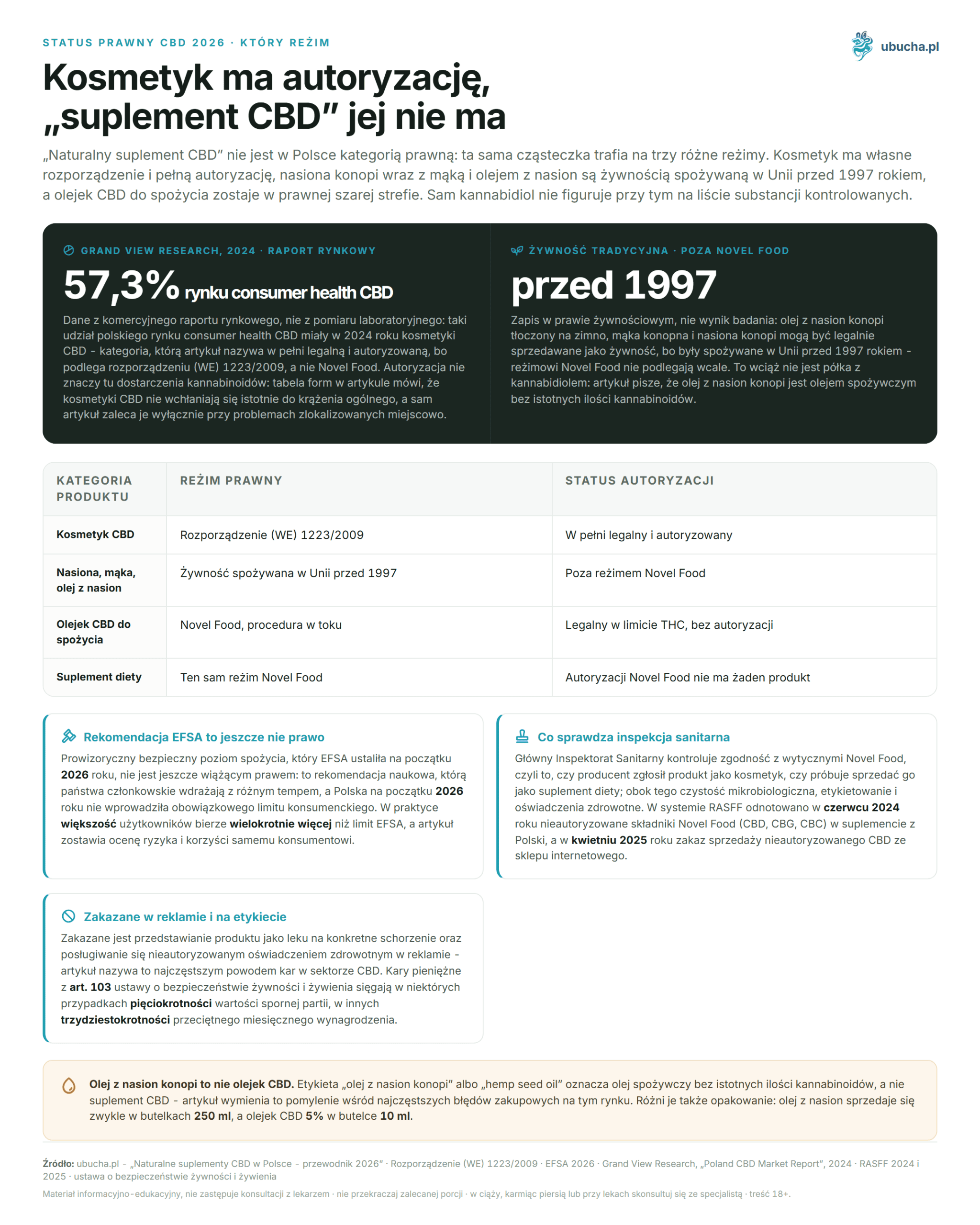
The same numerical threshold of 0.3% applies from January 1, 2023, in EU Regulation 2021/2115 for crops eligible for support under the Common Agricultural Policy, replacing the previous 0.2% limit from Regulation 1307/2013. These are two separate legal bases with the same numerical value: the Polish consumer threshold corresponds to the EU threshold but does not derive from it. CBD is most often sold in Poland as a cosmetic or “collector’s” product - full dietary supplement status would require EFSA authorization as Novel Food, which no CBD product has obtained as of this guide’s publication.
| Allowed | Prohibited |
|---|---|
| To buy, possess, and use CBD products with THC (sum of delta-9-THC and THCA) up to 0.3% | To sell products with THC above 0.3% |
| To sell them online and in stores, transport in domestic luggage | To present them as medicine for specific conditions (“cures depression”, “heals cancer”) |
| To legally import CBD oil produced in another EU country | To use unauthorized health claims in advertising |
The foundation of the last rule was defined by the CJEU ruling of November 19, 2020, in the Kanavape case (C-663/18): the Court recognized that CBD is not a narcotic under the 1961 UN Convention and benefits from the free movement of goods within the EU, so member states cannot prohibit the sale of CBD products legally produced in another EU country. Anyone buying oil from a Polish store or importing it from another EU country indirectly benefits from this decision - there is no legal basis for confiscating CBD oil at the border if it complies with the THC limit.
What forms of natural CBD supplements are available in Poland?
At least five main forms of natural CBD supplements are available on the Polish market. According to a Grand View Research report (2024), oils remain the most popular category, accounting for over half of the nutraceutical segment sales. The choice of form should depend on the supplementation goal, not price or trendy marketing - a full guide to CBD oil types elaborates these criteria in detail.
Each form has different bioavailability, i.e., the percentage of active substance reaching circulation. This parameter determines the actual dose delivered to the body. Low bioavailability does not mean the product is bad - it means it must be dosed differently and expectations about onset speed should be adjusted.
| Form | Bioavailability | Onset Time | Notes |
|---|---|---|---|
| Sublingual oil | 12-35% | 15-45 minutes | Bypasses first-pass liver effect; hold under tongue 60-90 seconds |
| Capsules | 9-13% | 60-120 minutes | Precise, repeatable dose; absorption increased with fatty meal |
| Gummies | similar to capsules | 60-120 minutes | Slow release; price per mg usually higher than oils |
| Hemp flower | variable, depends on method | a few minutes | Alternative form for those preferring traditional methods |
| CBD cosmetics | topical effect | product-dependent | Do not significantly absorb into systemic circulation; act on CB2 and TRPV1 receptors in skin |
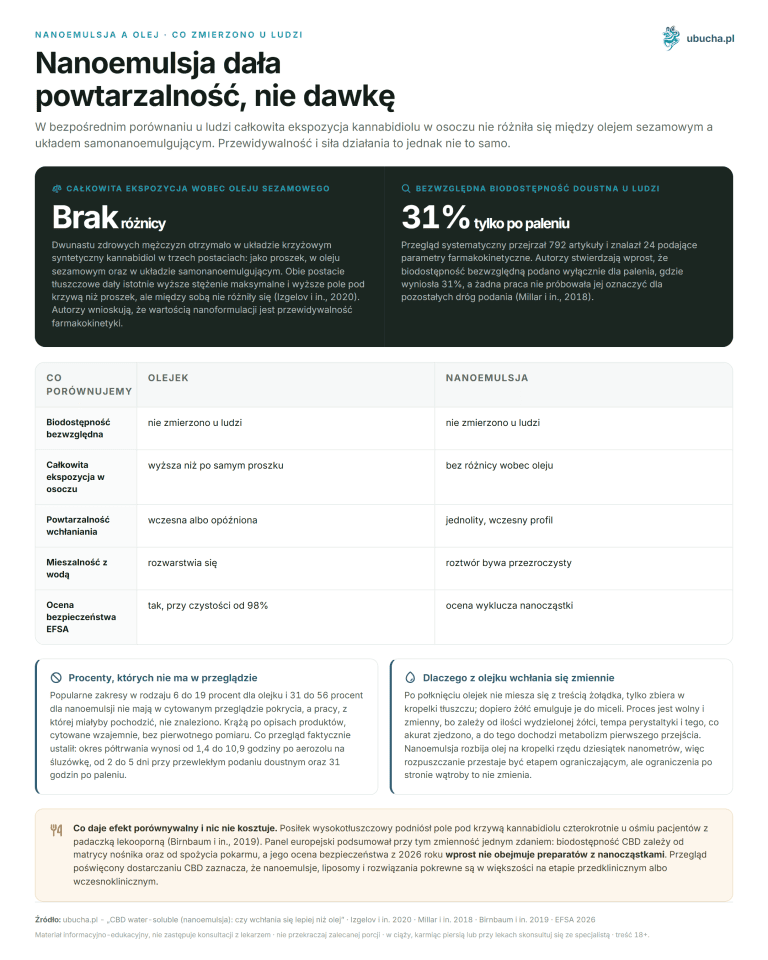
Bioavailability of sublingual oils ranges from 12-35%, clearly higher than capsules (9-13%), according to a pharmacological review of CBD (Hossain et al., International Journal of Molecular Sciences, 2023). According to Grand View Research, the CBD cosmetics category accounted for 57.3% of the Polish consumer health CBD market in 2024, making it a larger segment than might be expected before oils and capsules. The choice of form should match the goal: oil works well for fast, precisely dosed effect; capsules for regular, discreet supplementation without hemp taste; cosmetics only for localized issues like irritated skin or muscle tension after training.
What is the difference between broad spectrum, full spectrum, and isolate?
The product spectrum is the first technical choice a natural CBD supplement buyer makes. According to Project CBD (2023), about 62% of regular cannabinoid users choose combined products (full or broad spectrum) due to the entourage effect, first described by Russo and Mechoulam in the British Journal of Pharmacology (2011). The three spectra differ by extract composition, not packaging marketing - a good producer always provides this information in the product description and confirms it in the COA.
| Spectrum | Composition | THC | For whom |
|---|---|---|---|
| Broad spectrum | CBD, CBG, CBN, CBC, terpenes, flavonoids | below detection limit | Professional drivers, athletes, people with zero tolerance policies at work - see CBD and drug tests |
| Full spectrum | all cannabinoids in natural proportions | trace, up to 0.3% | People without drug test risk, seeking full entourage effect |
| Isolate | pure CBD, above 99% | none | People allergic to other hemp components or requiring absolute certainty of no THC |
Full spectrum is legal in Poland as long as THC is within the limit and does not cause a “high” - trace THC amounts are too low to cause psychoactive effects, even with regular use at doses described later in this guide. The choice between broad and full spectrum practically boils down to one question: is there a risk of a drug test at work, in sports, or during travel? If not, full spectrum usually provides a fuller entourage effect at the same CBD dose. Isolate lacks the entourage effect, so per milligram of CBD it usually has a weaker effect than broad or full spectrum - a 2015 study from the Lautenberg Center for General and Tumor Immunology in Jerusalem (Gallily, Yekhtin, Hanuš) described a bell-shaped dose-response curve for purified CBD, which a full spectrum hemp extract can bypass. If you see isolate advertised at a very low price, it is often a sign of a heavily diluted product.
An underrated nuance: isolates are sometimes advertised in Poland as “vegan”, “pure”, and “trace-free.” This is true but only a technical description of composition, not proof of pharmacological superiority over full or broad spectrum.
How to read a COA certificate for CBD oil?
The COA certificate is the most important document when buying a natural CBD supplement - without it, the choice is a lottery. The 2017 JAMA study by the Penn State College of Medicine team showed that 70% of 84 tested CBD products had labels inconsistent with actual cannabidiol content (JAMA, 2017). Independent European verifications in 2022 and 2023 indicated that 30-50% of products on EU markets still deviate from declarations, so the problem has not disappeared over the years. A broader regulatory context is described in our material on regulation issues of CBD products in Poland.
A full COA from an accredited laboratory contains six elements: cannabinoid profile (CBD, CBG, CBN, CBC, THC in mg/g or percentages), pesticide test covering over 200 substances, heavy metals analysis (lead, cadmium, mercury, arsenic), residual solvents analysis after extraction, microbiological test (bacteria, yeasts, molds, mycotoxins), and terpene profile responsible for the entourage effect. Missing any of these sections is a signal that should stop the purchase.
In Poland, the leading accredited laboratory for hemp products is Cannalabs by EkotechLAB in Gdańsk (Polish Accreditation Center AB 1755). The lab uses HPLC liquid chromatography and places unique QR codes on reports for authenticity verification. Warning signs in COA include missing unique batch identifier, mismatched fonts suggesting document forgery, outdated test date relative to the current product batch, and lack of contamination tests.
| Step | What to check |
|---|---|
| 1-2 | Find the batch number on the bottle, visit the producer’s website or scan the QR code |
| 3-4 | Compare the batch number in the COA with the number on the bottle; check if the test date matches the product’s shelf life period |
| 5 | Verify CBD content against label declaration - tolerance should be within ±10% (“10% CBD” oil means 9-11%) |
| 6-7 | Check that the THC sum is within the 0.3% limit and that the laboratory accreditation number is visible |
At u Bucha store, we regularly verify COA certificates of products purchased elsewhere upon customer request. Recurring problems include mismatched batch numbers, no online access to the document, or its complete absence - therefore, since 2024, we publish COA as a permanent link on the card of every oil we sell.
Why do the producer and country of origin of hemp matter?
Hemp is a bioaccumulator: it absorbs heavy metals, pesticides, herbicides, and industrial residues from soil. The lead limit in plant food in the EU is 0.1 mg/kg, and some samples of cheap CBD from Asia showed clearly higher concentrations. The country of raw material origin is not a cosmetic detail: Polish hemp from certified crops, hemp from Slovenia and Switzerland are premium raw materials, and American hemp is subject to the USDA Hemp Program from 2018 with solid control. Every good label states the country of cultivation.
The Polish market has several leading producers: CannabiGold (HemPoland, Elbląg), HempKing (BIODIO Sp. z o.o.), Cannabis Poland S.A. listed on NewConnect, and smaller artisanal brands like SOOL or Cannova. A reliable producer publishes the country of cultivation and raw material type, extraction method, batch number and COA for each product, industry certificates (GMP, ISO, organic), and a full ingredient list including carrier oil (MCT from coconut, hemp oil, olive oil). GMP certificate confirms a standardized, repeatable production process, ISO system quality management across the organization, and organic means no synthetic fertilizers or pesticides at the cultivation stage - three different, complementary guarantees, not substitutes for the same thing.
| Extraction Method | Advantages | Disadvantages |
|---|---|---|
| Supercritical CO2 | Gold standard, no solvents, eliminates molds and bacteria, high yield | Expensive equipment, mainly for premium producers |
| Ethanol | Faster and cheaper, preserves terpene profile well | Requires thorough purification from residues (below 50 ppm for good producers) |
| Hydrocarbon (butane, propane) | High efficiency | Risk of toxic residues - should be avoided in consumable products |
Price per milligram of CBD - how to calculate purchase value?
Price per milligram of CBD is the fairest measure of natural CBD supplement value: price divided by total CBD amount in milligrams gives a unit cost comparable across products regardless of bottle size. Why is a very low price a warning sign? The real cost of quality CO2 extract from European hemp, plus laboratory quality control and distribution margin, rarely allows going significantly below the lower market range without quality compromises - this mostly concerns isolates advertised as broad spectrum or diluted products.
In CBD-specialized stores, price per milligram usually decreases with concentration increase, because bottle, label, and production costs remain similar regardless of CBD amount inside: the approximate range is about 0.10-0.20 PLN/mg for broad spectrum oils with increasing strength (as of August 2026). For people with stabilized dosing above 30 mg daily, switching to a stronger concentration is sensible due to this relationship.
Higher prices are justified for organic-certified products, dedicated CBG formulas, nanoemulsions, and liposomal products. CBG is present in the plant in much smaller amounts than CBD, so its extraction costs more - on the market, CBG products usually cost noticeably more per milligram than standard CBD, reflecting production cost, not just margin.
What is the current Novel Food status in the EU in 2026?
EFSA at the beginning of 2026 set a provisional safe intake level of CBD at 0.0275 mg/kg body weight per day, corresponding to about 2 mg daily for a 70 kg person (EFSA, 2026). This position applied a strict uncertainty factor of 400, much higher than typically used values, which the industry interprets as almost a “technical ban” given current research status.
The CBD Novel Food authorization procedure has been ongoing since 2019 - over 200 applications from producers have been submitted to the European Commission, but none has yet received full authorization. Therefore, natural CBD supplements in Poland are sold as cosmetics, collector’s products, or wellness aids, not as officially registered dietary supplements. The EFSA provisional limit is not yet binding law: it is a scientific recommendation implemented by member states at varying pace, and Poland at the beginning of 2026 has not introduced a mandatory consumer limit. In practice, most users take 10-50 mg CBD daily, many times above the EFSA limit - the discrepancy between actual use and regulator position remains unresolved, and consumers must assess their own risk and benefit.
Some hemp products are exempt from Novel Food regime: cold-pressed hemp seed oil, hemp flour, and hemp seeds can be legally sold as food because they were consumed in the EU before 1997. CBD cosmetics fall under Regulation (EC) 1223/2009, not Novel Food, so they are fully legal and authorized. CBD oils for consumption remain in a legal gray zone where producers balance food, cosmetic, and general consumer law.
How does GIS control the CBD supplement market in Poland?
The Chief Sanitary Inspectorate (GIS) applies Novel Food guidelines and takes enforcement actions against non-compliant CBD products. According to a 2021 NIK report, the dietary supplement supervision system had serious gaps: by May 2021, only 11% of nearly 63,000 dietary supplement notifications submitted in 2017-2020 were analyzed (NIK, 2021). The RASFF system also recorded alerts concerning Polish CBD products: in June 2024, unauthorized Novel Food ingredients (CBD, CBG, CBC) were detected in a Polish supplement, and in April 2025, unauthorized CBD sales were banned from an online store.
| GIS Control Area | Practical Meaning |
|---|---|
| Compliance with Novel Food guidelines | Whether the producer registered the product as a cosmetic or tries to sell it as a dietary supplement |
| Microbiological purity | No contamination shown in lab tests |
| Labeling | Correct ingredient and allergen list |
| Health claims | Ban on statements like “cures insomnia”, “helps depression” - the most common reason for fines in the CBD sector |
Buyers have no tools to verify all aspects of producer operation but can check batch number, COA, producer data, country of production, and ingredient list. These elements are publicly available and show whether the producer takes compliance seriously - lack of any is a warning sign.
Food law violations are subject to fines under the Food Safety and Nutrition Act (art. 103), with amounts depending on violation type: in some cases up to five times the disputed product batch value, in others up to thirty times the average monthly national economy wage for the previous year. The decision is issued by the competent provincial sanitary inspector, considering the harm degree, fault degree, and previous market activity.
What did the 2017 JAMA Penn State study really show?
The study by Marcel Bonn-Miller’s team at Penn State College of Medicine, published in JAMA in 2017, tested 84 CBD products from 31 companies sold online (JAMA, Bonn-Miller et al., 2017). Only 30.95% of products had labels consistent with actual CBD content. Discrepancies were bidirectional: 42.85% had under-declared content (actual content higher than label), and 26.19% had over-declared content (actual content lower). Eighteen products (21.43%) contained detectable THC amounts, up to 6.43 mg/ml - the study did not convert this to a percentage comparable directly with the Polish 0.3% threshold, so this number is treated as a risk signal, not proof of limit breach.
Mandatory COA introduction by most European stores has since reduced discrepancy scale. Independent tests in 2022 and 2023 indicate 30-50% of products still deviate from declarations, but the problem is smaller than in 2017. Worst cases concern products sold at gas stations, non-specialist drugstores, and online marketplaces, not specialized sellers publishing COA.
Three simple rules eliminate most risk: buy only products with current COA publicly available, verify batch number in COA matches bottle, and if the store has no COA, do not buy.
How to build a checklist before buying CBD?
According to a Marygo survey (2021), 90% of Poles declared lack of knowledge about CBD before their first purchase. The ten-point checklist below allows any buyer to make an informed decision in about 10 minutes and significantly reduces the risk of buying low-quality or non-compliant products. Our first CBD purchase guide leads through this step-by-step in more detail.
- Does the product have publicly available COA from the current batch?
- Does the batch number in COA match the number on the bottle?
- Does the COA come from an independent, accredited laboratory, not the producer’s internal lab?
- What is the product spectrum (broad, full, isolate) and does COA confirm it?
- What is the hemp cultivation country and extraction method?
- What is the carrier oil (MCT, hemp, olive)?
- What is the price per milligram of CBD and does it fall within the approximate 0.10-0.20 PLN/mg range?
- Does the producer avoid medical claims (“cures”, “heals”)?
- Does the label provide a full ingredient and allergen list?
- Does the producer have a registered address, contact info, and respond to inquiries in a reasonable time?
For a first-time natural CBD supplement buyer, a good starting configuration is: 5% broad spectrum oil, 10 ml, Polish brand, public COA, CO2 extraction, MCT carrier oil. The approximate price for 5% concentration is about 60-90 PLN for 10 ml, depending on the brand (as of August 2026). Starting dose is 5-10 mg daily, i.e., 2-4 drops sublingually in the evening. The first weeks should be treated as an observation window: note effects, sleep quality, and possible side effects, and after 2-3 weeks assess whether to increase dose, change spectrum, or form.
What are the most common CBD market purchase mistakes?
According to a Project CBD survey (2023), about 41% of consumers have incorrect beliefs about CBD effects, leading to specific purchase mistakes. Five common errors repeat in stores, costing buyers money and negating supplementation effects - each has a simple solution.
| Mistake | How to recognize and avoid |
|---|---|
| Confusing hemp seed oil with CBD oil | Label “hemp seed oil” or “hemp seed oil” means edible oil without significant cannabinoids, not a CBD supplement; price also shows difference (hemp seed oil usually 30-50 PLN for 250 ml, 5% CBD oil 60-100 PLN for 10 ml) |
| Buying solely based on price | Hemp is a bioaccumulator, and a price clearly below market range per mg usually means isolate sold as spectrum or diluted product |
| Believing unrealistic health claims | FTC in December 2020 fined six CBD companies for false claims about curing cancer, heart disease, and Alzheimer’s; only Epidiolex, synthetic pharmaceutical CBD, is FDA and EMA registered for resistant childhood epilepsy |
| Ignoring extraction method | A good producer always states the method; CO2 is gold standard, hydrocarbons carry risk of toxic residues |
| Neglecting carrier oil | MCT from coconut provides best absorption and long stability; lack of carrier info on label is a warning sign |
Dosing natural CBD supplements - how to start?
WHO in a 2018 review assessed CBD as generally well tolerated in humans, with a good safety profile (WHO ECDD, 2018). Typical consumer doses are many times lower than clinically studied doses: most users take 10-50 mg CBD daily, divided into 1-2 doses. The “start low, go slow” principle is universal for cannabinoids.
| Level | Daily Dose | Use |
|---|---|---|
| Micro | 1-20 mg | General wellness, mild tension, introduction to supplementation (4 drops of 5% oil is about 10 mg) |
| Standard | 20-50 mg | Moderate tension, sleep issues, post-sport recovery; morning and evening dose |
| Macro | 50-200 mg | Strong tension and inflammation, after specialist consultation; higher concentrations reduce number of drops |
Five factors influence optimal dose: body weight (larger usually requires more, though not linearly), symptom severity, individual metabolism (cytochrome P450 enzyme variants), product type (full and broad spectrum work better at lower doses due to entourage effect, isolate requires higher), and concurrent medication - CBD inhibits CYP3A4 and CYP2C9 enzymes, which may affect metabolism of many drugs. The most common reasons for no noticeable effect are too low dose, too short use period (CBD requires 2-4 weeks of regular use), low product quality, or individual ECS receptor resistance.
Summary - how to buy natural CBD supplements in 2026?
The Polish natural CBD supplement market in 2026 is larger, more mature, and better controlled than five years ago. Still, buyers encounter products with labels inconsistent with content, lack of producer transparency, and marketing healing promises. Conscious choice requires about 10 minutes of analysis before purchase but protects against money wasted on ineffective or low-quality products.
Five things to remember: verify COA from an independent lab, check extraction method (CO2 or ethanol), choose broad spectrum for safety or full spectrum for maximum entourage effect, compare price per milligram of CBD, avoid products with medical claims and unclear brands without a clear producer address.
Natural CBD supplements are not a cure-all. They are a wellness support tool whose effectiveness depends on product quality, dose, and duration. Start with 5% broad spectrum oil from a Polish brand with public COA, use 10-20 mg daily for 2-3 weeks, and note effects - only then decide whether to increase dose, change spectrum, or form.
Frequently Asked Questions
Are natural CBD supplements legal in Poland in 2026?
Yes. CBD products derived from industrial hemp Cannabis sativa L. are legal in Poland if the sum of delta-9-THC and THCA does not exceed 0.3% dry weight (art. 4 point 5 of the Act of July 29, 2005 on counteracting drug addiction, consolidated text Dz.U. 2023 item 1939). CBD is not listed as a controlled substance. However, they are most often sold as cosmetics or collector’s items, not as dietary supplements.
What do broad spectrum, full spectrum, and CBD isolate mean?
Broad spectrum is an extract containing cannabinoids and terpenes but no THC. Full spectrum contains all natural hemp compounds, including trace THC up to 0.3%. Isolate is purified CBD with purity above 99%. According to Project CBD (2023), about 62% of users choose combined products due to the entourage effect.
How to read a COA certificate for CBD oil?
A COA should come from an independent, accredited laboratory and include cannabinoid profile (CBD, CBG, CBN, THC), pesticide testing, heavy metals, solvents, and microbiology. The batch number on the COA must match the number on the bottle. According to JAMA (2017), as many as 70% of CBD products had labels inconsistent with actual cannabidiol content.
How much should a good CBD oil cost in 2026?
The best metric is price per milligram of CBD, not price per bottle. For broad spectrum from Polish hemp, the approximate market range is about 0.10-0.20 PLN per mg of CBD, with higher concentrations usually costing less per milligram than lower ones. A price significantly below this range suggests an isolate sold as broad spectrum or a diluted product.
Does CBD have Novel Food authorization in the European Union?
No. According to EFSA (2026), no CBD product has yet received full authorization as novel food. The procedure has been ongoing since 2019. In February 2026, EFSA set a provisional safe intake level at about 2 mg daily for a 70 kg person, with a strict uncertainty factor.
Which forms of natural CBD supplements are worth buying?
Sublingual oils offer the highest oral bioavailability (12-35%) and precise dosing. Capsules provide convenience and consistent dosing but have lower absorption (9-13%). Gummies act within 60-120 minutes. Hemp flower and CBD cosmetics serve other functions. For a first purchase, we recommend a 5% broad spectrum oil from Polish production.
Does a CBD producer have to indicate the country of origin of the raw material?
Yes, the label of a cosmetic or supplement in the EU must indicate the origin of the raw material. Hemp from Poland, Italy, Slovenia, and Switzerland is considered a high-quality standard. Hemp from industrial soils may contain elevated heavy metals (EU lead limit: 0.1 mg/kg). Reliable brands publish the country of cultivation in the COA and product description.
What are the most common mistakes made by first-time CBD buyers?
Five typical mistakes are: confusing hemp seed oil with CBD oil, lack of COA verification, buying solely based on price, ignoring extraction method, and believing marketing claims of healing. According to a Marygo survey (2021), 90% of Poles declared lack of knowledge about CBD before their first purchase, making education a priority.
If you are looking for a specific CBD oil meeting the criteria from this guide, browse the oil category at u Bucha store.
This article is informational and educational and does not constitute medical advice. Natural CBD supplements are not registered medicines and do not replace pharmacological treatment. Before starting use, especially if you take prescription drugs, are pregnant, breastfeeding, or have chronic conditions, consult a doctor or pharmacist. CBD may interact with drugs metabolized by cytochrome P450 enzymes, including warfarin, antiepileptics, and some antidepressants.
Sources: art. 4 point 5 of the Act of July 29, 2005 on counteracting drug addiction (consolidated text Dz.U. 2023 item 1939, as amended Dz.U. 2022 item 763); Regulation (EU) 2021/2115; EFSA, “Update of the statement on the safety of cannabidiol as a novel food”, 2026; JAMA, Bonn-Miller et al., “Labeling Accuracy of Cannabidiol Extracts Sold Online”, 2017; Project CBD, “Consumer Survey”, 2023; Russo, Mechoulam, “Taming THC: potential cannabis synergy”, British Journal of Pharmacology, 2011; Hossain et al., “Current Challenges and Opportunities for Improved Cannabidiol Solubility”, International Journal of Molecular Sciences, 2023; WHO ECDD, “Cannabidiol Critical Review Report”, 2018; Grand View Research, “Poland CBD Market Report”, 2024; NIK, “Informacja o wynikach kontroli suplementów diety”, 2021; CJEU, case C-663/18 Kanavape, 2020.
Author: Michał Waluk · Published: 2026-05-11 · Updated: 2026-08-10