
Which CBD Oil to Choose in 2026? A Practical Buyer’s Guide
Six criteria for choosing CBD oil: spectrum, concentration, carrier, laboratory report, producer, and price per milligram. Without health promises or fabricated numbers.
The label on CBD oil can be fictitious, and this has been quantified. Bonn-Miller and co-authors purchased 84 products online from 31 companies and tested their actual composition: only 30.95% of products had a declaration consistent with content within accepted tolerance (JAMA, 2017). The rest contained less or more cannabidiol than promised, and tetrahydrocannabinol was detected in one in five samples. This guide leads through six things you can check before purchase: extract spectrum, concentration, carrier oil, independent laboratory report, producer transparency, and price per milligram. Additionally, it covers legal status and what today’s European scientific assessment says about cannabidiol safety. You will not find health promises or daily dose recommendations here, as both would be inconsistent with current knowledge.
KEY INFORMATION
- 30.95% of 84 tested products bought online had CBD content consistent with the declaration (Bonn-Miller et al., JAMA 2017).
- The entourage effect remains a hypothesis: Russo in 2011 wrote about synergy conditionally and proposed methods to study it.
- Absolute bioavailability of CBD was measured in humans only for inhalation; no study established it for oral administration (Millar et al., 2018).
- The 0.3% threshold applies to the plant and is the sum of delta-9-THC and THCA, not delta-9-THC alone.
- CBD safety cannot be established for people under 25, pregnant and breastfeeding women, and those taking medications (EFSA, 2026).
- Price per milligram in the oil category at Bucha, as of August 10, 2026, is about 0.10-0.13 PLN for CBD.
What exactly are you buying when you take CBD oil?
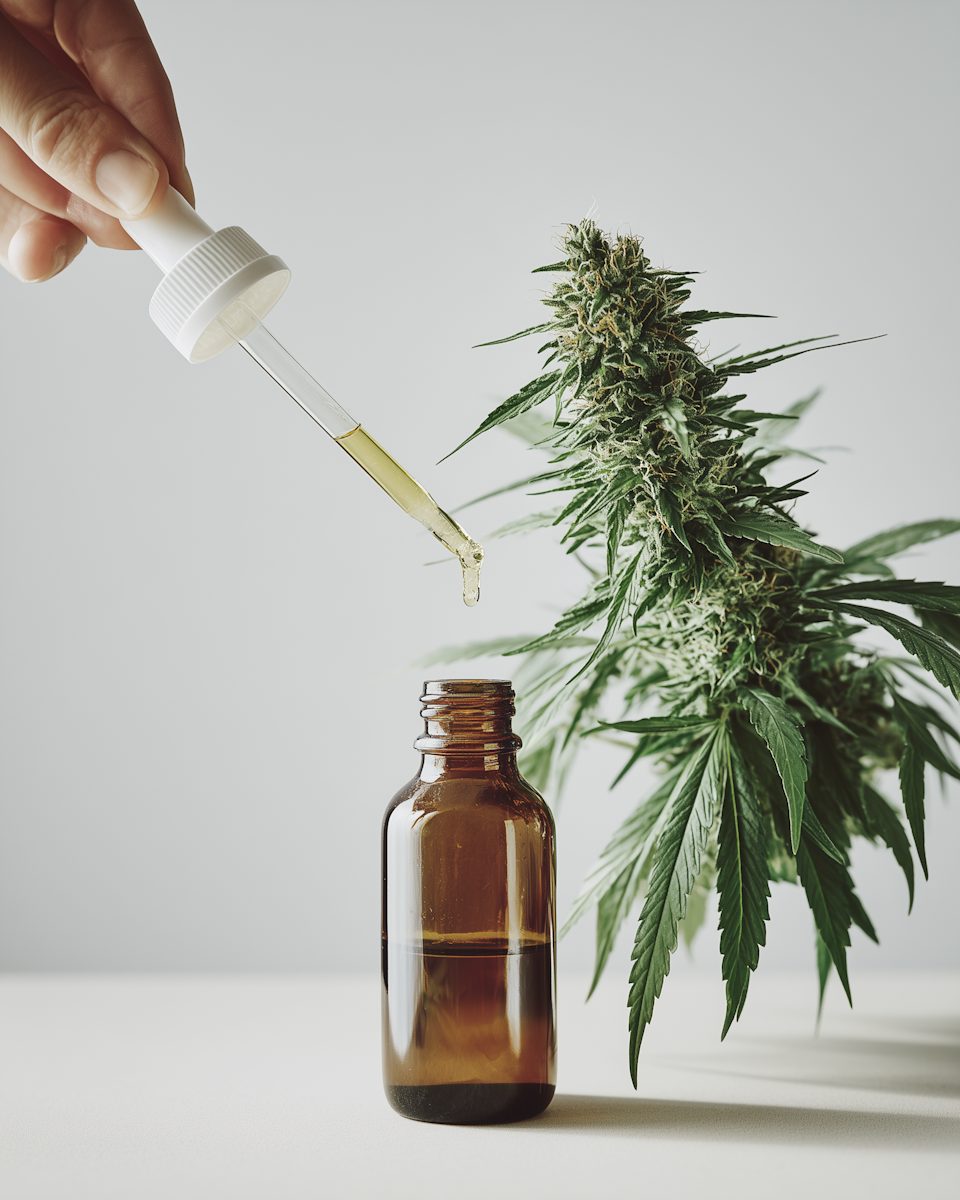
You are buying an extract from industrial hemp dissolved in fat. The extract itself is a dense, dark substance with a resin-like consistency and is not sold in this form. The producer dilutes it in a carrier oil, most often MCT oil from coconut, hemp seed oil, or olive oil.
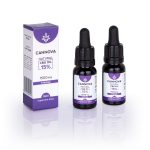
The percentage on the label describes the cannabidiol share in the total product mass. A 10 ml bottle with a 10% declaration contains 1000 mg CBD, and with full or broad spectrum also minor cannabinoids and terpenes. This is arithmetic, not a recommendation: how much of this bottle corresponds to a dose is a question for a doctor, not the label.
A separate issue is terminology, which confuses most buyers. CBD oil is not the same as hemp seed oil, also called hemp oil. The latter is pressed from seeds only, sold in the food section, and contains only trace amounts of cannabinoids because seeds simply do not have them. If the label shows only “hemp seed oil” without CBD content in milligrams, you are buying a food product, not a cannabinoid preparation.
The extraction method is the third element of this puzzle. Supercritical carbon dioxide extraction allows extracting cannabinoids and terpenes without solvent residues but requires expensive equipment. Ethanol extraction is cheaper and yields a pure product if the alcohol is thoroughly evaporated. Hydrocarbon solvents require confirmation in the laboratory report that none remain in the final oil. A producer unwilling to disclose the method has just answered the question.
It is worth clarifying one distinction that recurs throughout the text. The producer’s declaration and the laboratory result are two different things, and they match less often than intuition suggests. Everything described below as a selection criterion boils down to whether this declaration can be verified in a document issued by someone other than the seller.
Which CBD spectrum to choose: full, broad, or isolate?
Spectrum indicates what besides cannabidiol remains in the extract, and this is the first purchase decision. Full spectrum retains the entire plant profile including trace THC, broad spectrum the same profile without THC, and isolate is pure cannabidiol with purity up to 99%.
The argument for full-spectrum formulas is the entourage effect, a hypothesis that cannabinoids and terpenes enhance each other. It is worth knowing what its author really wrote. Russo in 2011 analyzed cannabis terpenoids and their possible interactions with phytocannabinoids but formulated synergy conditionally and proposed methods to study it in future experiments (British Journal of Pharmacology). This is a hypothesis with good chemical justification, not a measured difference in efficacy between products. Statements like “isolate requires higher doses for the same effect” are not supported in this work.
However, the terpene profile itself is a real comparative criterion because the laboratory report shows it. Russo discusses limonene, myrcene, alpha-pinene, linalool, and beta-caryophyllene, reminds that terpenoids share a precursor with phytocannabinoids, and that as flavor and aroma components they have GRAS status in the United States. He also notes they act at concentrations of single nanograms per milliliter of serum. If the producer declares broad or full spectrum, the report should list specific terpenes, not just the word “terpenes.”
| Spectrum | Contains | For whom | Risk |
|---|---|---|---|
| Full | CBD, minor cannabinoids, terpenes, trace THC | People without THC presence control at work and in sports | THC detectable in tests with regular use |
| Broad | Same without THC removed by additional purification step | Most buyers, including drivers | Depends on THC removal efficiency, check in report |
| Isolate | Pure cannabidiol with purity up to 99% | Allergy to other cannabis components, anti-doping control | No terpene profile, so no potential synergy |
Choosing a spectrum is not a choice between better and worse but a choice of risk profile. Full spectrum takes the most from the plant and risks the most in sobriety control. Isolate eliminates risk and loses potential synergy, which no one has yet measured in humans. Broad spectrum is in the middle and therefore most often chosen. Differences between distillate and isolate are detailed in a separate comparison.
Which CBD oil concentration to choose for yourself?
Concentration is convenience of measuring, not product strength. The same amount of cannabidiol in 5% and 20% oil is the same amount of cannabidiol, just in a different number of drops. Low concentration allows finer dosing steps; high concentration shortens dosing time.
Before arithmetic, one reservation that cannot be omitted. The European Food Safety Authority updated its position on cannabidiol as novel food in 2026 and derived a provisional safe dose by the benchmark dose method with an uncertainty factor of 400 (EFSA Journal). It is 0.0275 mg per kilogram of body weight per day, about 2 mg for a 70 kg person, and applies only to preparations with cannabidiol purity of at least 98%, without nanoparticles. This is many times less than doses described in online guides, and the often repeated 1500 mg per day figure attributed to WHO comes from a document no longer available at its address. The panel added a sentence that should appear in every text about dosing: CBD safety cannot be established for people under 25, pregnant and breastfeeding women, and those taking medications. Therefore, this guide does not provide any daily dose.
| Concentration | CBD content in 10 ml bottle | CBD per drop | Convenient for |
|---|---|---|---|
| 5% | 500 mg | about 2.5 mg | Finest dosing steps, first weeks of observation |
| 10% | 1000 mg | about 5 mg | Compromise between precision and number of drops |
| 15% | 1500 mg | about 7.5 mg | Fewer drops for established dose |
| 20% | 2000 mg | about 10 mg | Shortest dosing, hardest for small doses |
The practical conclusion is opposite to the intuition “the stronger, the better.” High concentration makes measuring small doses difficult because a single drop contains several times more substance. If you are buying for the first time, lower concentration gives more room to observe your body’s reaction. Comparison of concentrations from 5 to 30 percent is described in detail in a separate article.
Which carrier oil provides better absorption?
The answer is: no one has properly measured this in humans, and anyone giving a percentage advantage of one carrier over another goes beyond the data. Millar and co-authors reviewed 792 papers and found 24 with pharmacokinetic parameters of cannabidiol in humans (Frontiers in Pharmacology, 2018).
Their conclusion is cautious and therefore credible. Absolute bioavailability was measured only for inhalation and was 31%. No study has done this for any other administration route, although intravenous forms were available. The authors noted two useful things when choosing a carrier: maximum concentration increases after meals and in fat-based formulations. EFSA confirms this, stating cannabidiol bioavailability is variable and depends on the carrier matrix and food intake.
The same work clarifies another frequently asked question: how long cannabidiol stays in the body. Half-life ranged from 1.4 to 10.9 hours after oral mucosa spray, 2 to 5 days with chronic oral administration, about one day after intravenous administration, and about 31 hours after smoking. Maximum concentration was reached within the first four hours, faster for inhalation than oral. The authors emphasize data are limited and sometimes inconsistent.
What does this mean for the three most popular carriers? Fractionated MCT coconut oil is flavor-neutral and chemically stable, facilitating storage and dosing. Hemp seed oil brings its own fatty acid profile and a distinct grassy taste that overlays the extract’s flavor. Olive oil is well tolerated and sometimes used in studies but has a shorter shelf life after opening. None has proven bioavailability superiority over others in humans.
Hemp seed oils have a separate legal limit rarely mentioned by producers. Commission Regulation (EU) 2023/915 sets the maximum allowable THC level at 3.0 mg/kg for hemp seeds and processed products and 7.5 mg/kg for hemp seed oil, counting the sum of delta-9-THC and THCA expressed as delta-9-THC.
What should a laboratory report contain?
An independent laboratory report, abbreviated COA, is the only proof that the bottle contains what the label promises. Without it, you buy a declaration. The scale of the problem is shown by the Bonn-Miller study published in JAMA: of 84 products bought online, 26.19% contained less cannabidiol than the label stated, and 42.85% more (JAMA, 2017).
The authors also noted something less often mentioned. Tetrahydrocannabinol was detected in 18 of 84 samples, i.e., 21.43%, and they pointed out such concentrations may cause psychoactive effects, especially in children. For a professional driver or athlete under anti-doping control, this is not a technical detail but a real risk with a product described as THC-free.
A good report has six elements and checking them takes a minute. It lists the cannabinoid profile with separate items for CBD, CBDA, THC, and THCA. It provides results for heavy metals, pesticide residues, and solvents. It contains the batch number matching the bottle, sample collection date, laboratory name with accreditation, and method detection limits for each substance. A report without batch number or lab accreditation is not a report but a graphic.
Separately check if specific values are given, not just annotations like “pass” or “compliant.” The European Union sets binding maximum contamination levels in food in Regulation 2023/915, so the lab has a reference and no reason to hide numbers. A broader guide on what to check before purchase is described separately.
How to check the producer and raw material origin?
A transparent producer provides four things without being asked: headquarters address, raw material origin, extraction method, and a laboratory report assigned to a specific batch. Missing even one is information itself, as none of these data is a trade secret.
Raw material origin has legal significance, not just marketing. Since January 1, 2023, hemp varieties eligible for support under the Common Agricultural Policy may contain up to 0.3% THC, based on European Parliament and Council Regulation (EU) 2021/2115. Previously, the EU threshold was 0.2% from Regulation 1307/2013, repealed on January 1, 2023. Raw material from cultivation registered in a member state has documented variety and profile, which cannot be said about material without papers.
When verifying a brand, a simple rule applies: check what cannot be bought. Reviews on rating sites and social media activity can be ordered, but tax identification number, product batch history, and contact to the quality responsible person cannot. A brand existing for a few months without history may be a rebranding of a previous company, which does not determine quality but removes the only easy proof of credibility: time.
A control question worth asking the seller before purchase is: from which batch is the bottle I will receive, and can I see the report for it? The answer “we have reports on the website” is not an answer to this question because a report from two years ago describes a different product than the one that will reach your shelf.
How much should a milligram of cannabidiol cost?
Price per milligram is the only measure allowing comparison of two different packages. It is calculated by dividing the bottle price by the declared cannabidiol content in milligrams, not by volume in milliliters. Without this calculation, a larger package always looks more expensive, although usually it is cheaper per substance.
For scale: in the oil category at Bucha, as of August 10, 2026, the price per milligram of cannabidiol ranges about 0.10-0.13 PLN, with the lower end for higher concentration packages. Oils with cannabigerol are clearly more expensive in the same set, about 0.16-0.20 PLN per milligram, as the raw material for this cannabinoid is harvested earlier and yields less. The range is given for the category and date because the catalog changes faster than the article.
Extremes in both directions signal to check the laboratory report, not immediately proof of fraud. A price clearly below market may mean actual content is lower than declared, exactly the defect measured by Bonn-Miller. A clearly higher price may be justified for rarer cannabinoids or formulations with modified matrix but often covers packaging and positioning in a drugstore. In both cases, the deciding document is the batch report.
One arithmetic trap at the end. If the product contains less cannabidiol than the label declares, the actual price per milligram increases proportionally to the discrepancy. A product with half the declared content effectively costs twice as much as the receipt calculation shows, and no promotion will compensate for this.
From this follows the order in which it pays to look at the offer. First, establish if the product has a batch report, then calculate the price per milligram, and only then compare with others. The reverse order leads to comparing numbers that may not correspond to the bottle content.
What is the legal status of CBD oils in Poland?
Cannabidiol is not listed in any controlled substances lists, and preparations from industrial hemp are legal in Poland. This is decided by the plant definition, not the finished product composition, and this distinction changes the laboratory test result.
Industrial hemp are Cannabis sativa L. plants in which the sum of delta-9-THC and tetrahydrocannabinolic acid in flowering or fruiting tops, from which resin has not been removed, does not exceed 0.3% dry weight, with the sum rounded to one decimal place. The basis is Article 4 point 5 of the Act of July 29, 2005 on Counteracting Drug Addiction (consolidated text Dz.U. 2023 item 1939), as amended by the Act of March 24, 2022 (Dz.U. 2022 item 763), effective from May 7, 2022. The threshold is calculated as the sum of delta-9-THC and THCA, not delta-9-THC alone.
The national threshold corresponds to the EU threshold but does not derive from it. These are two separate regulations with the same numerical value: the Polish one is set by the Act on Counteracting Drug Addiction, the EU one by Regulation 2021/2115 effective from January 1, 2023. The often repeated statement that the Polish threshold derives from EU regulations is false, as is attributing the 0.3% threshold to Regulation 1307/2013, which set 0.2% and was repealed.
The second layer concerns food. Cannabidiol remains under the novel food procedure in the EU, and EFSA’s 2026 position indicates that data gaps reported earlier remain open. The practical effect for the buyer is that a CBD product cannot carry health claims, and sanitary notification is not a novel food authorization and does not change the ingredient’s status. Advertising promising treatment of anything violates regulations regardless of product quality.
The third issue concerns what should not be in the basket. Hexahydrocannabinol, sold under the abbreviation HHC, is a controlled substance in Poland. Since July 28, 2026, it is listed in the psychotropic substances list in group II-P, previously in group I-P, and moving between groups is not legalization. If a store offers HHC products alongside CBD oils, it signals about the store, not an offer to consider.
What is known today about cannabidiol safety?
Less than the popularity of these products suggests, and this is an institutional finding, not an opinion. The EFSA panel assessed cannabidiol as novel food and in the 2026 update stated that data gaps reported in 2022 remain open because new studies have non-standardized protocols, short observation times, and concomitant treatments.
What the panel noted on the risk side. Animal studies showed consistent liver toxicity, with liver mass and histopathological changes as the most sensitive endpoints. Human data indicated hepatotoxic potential, especially when cannabidiol was taken with other drugs. Gastrointestinal symptoms were reported at higher doses, and neurological and psychiatric safety data were deemed insufficient. Hormonal disorders, including altered thyroid hormone levels, and adrenal histopathological changes were also noted. No reviewed study examined immunotoxicity.
Separately stands pregnancy and age. Cannabidiol crosses the placenta and accumulates in the body, and prenatal exposure has been associated with long-term, sex-dependent neurodevelopmental effects. Hence the panel’s conclusion, repeated twice in this text because it should be reiterated: cannabidiol safety cannot be established for people under 25, pregnant and breastfeeding women, and those taking medications.
For the buyer, this means a concrete change in thinking about the category. CBD oil is not a neutral product anyone can try without consequences but a preparation with recognized risks and an unsettled safety profile in several large groups. If you belong to any of these, you make the decision with a doctor, not based on a store website description.
What mistakes do buyers most often make?
The most common mistakes do not stem from lack of chemical knowledge but from comparing the wrong things. Four of them recur most often regardless of buyer experience, and each has a simple correction.
- Comparing bottle prices instead of price per milligram. Two bottles at the same price may differ in substance content fourfold. Calculate before judging if something is expensive.
- Ignoring the laboratory report. This is the only measurable defect on this list and has been measured: nearly 70% of tested products had labels inconsistent with content (Bonn-Miller et al., JAMA 2017).
- Buying the highest concentration at the start. High concentration is not a stronger product but a denser solution, and small doses are hardest to measure from it.
- Confusing hemp seed oil with CBD oil. A food product from seeds contains trace cannabinoids and does not replace an extract preparation.
The fifth mistake is more serious than the others because it concerns health, not the wallet. It is skipping consultation with a doctor when taking medications regularly. Cannabidiol affects enzymes responsible for drug metabolism and P-glycoprotein involved in excretion, so the potential for interactions with commonly used preparations is high (Journal of Clinical Medicine, 2019). The authors also noted adverse effects occurred in nearly half of CBD users and depended on dose size, with the most common being elevated aminotransferase activity and sedation.
How to assess CBD oil in a minute before purchase?
The eight points below are our own checklist, composed of things you can check on the product page before adding it to the cart. It is not an industry norm or someone else’s standard but a set of questions a transparent seller answers effortlessly.
| What to check | What to look for |
|---|---|
| CBD content | Number of milligrams per bottle and per milliliter, not just percent |
| Spectrum | Clear “full”, “broad”, or “isolate”, without marketing terms |
| Hemp origin | Country of cultivation and variety, not just “made in the EU” |
| Extraction method | Named explicitly, and for solvents confirmation of absence in report |
| Laboratory report | For specific batch, with lab accreditation and sample date |
| Carrier oil | Specific oil name, not general “vegetable oil” |
| Producer | Address, tax identification number, contact to quality responsible person |
| Price per milligram | Calculated independently and compared with other products in the category |
If the product passes all eight points, you buy consciously. If it fails on the laboratory report or raw material origin, skip it regardless of price and reviews. These two points are the only ones that cannot be verified after purchase, while all others can be compensated by asking store staff.
It is worth going through the list in the order it appears in the table. Start with numbers because without milligram content you cannot calculate price or compare products. Finish with the producer, as it is the most time-consuming point and makes no sense to check if the offer failed earlier. The whole process takes less time than reading the marketing description on the same page.
Summary: what to really base your decision on
Choosing CBD oil boils down to six verifiable things: spectrum matched to your risk profile, concentration matched to dosing convenience, carrier with known composition, laboratory report for a specific batch, transparent producer, and price calculated per milligram.
Three things from this guide are worth remembering longer than until purchase. The entourage effect remains a hypothesis, not a measured advantage of full formulas over isolate. Oral cannabidiol bioavailability has not been established in humans, so promises of percentage advantage of one carrier over another are invented. The 0.3% threshold applies to the plant and is calculated as the sum of delta-9-THC and THCA, which causes misunderstandings when reading reports.
What this text deliberately does not contain: daily dose recommendations, health promises, and indication of a single “best” product. The first is absent because the European safety assessment does not allow formulating it for people taking medications. The second is absent because no health claim for cannabinoids has been approved. The third is absent because the catalog changes faster than the article, and the criteria on this list outlive any single product.
If you take medications regularly, are pregnant, or breastfeeding, all the above criteria become secondary to consulting a doctor. The European safety assessment has not established a safety profile for these groups, and the best-documented product does not change that. This is the only point in this guide that cannot be resolved by a laboratory report.
The full, up-to-date offer of oils containing cannabinoids can be found in the oils category at Bucha’s store.
Frequently Asked Questions
Which CBD oil should I start with if I’m buying for the first time?
Start with a product that has a laboratory report for a specific batch and a clearly defined spectrum. Lower concentration makes measuring small doses easier because one drop contains less substance. The decision on how much and whether to use it at all is made by a doctor, especially if you are taking medications regularly.
What is the difference between full spectrum, broad spectrum, and isolate?
Full spectrum retains the entire plant profile including trace THC, broad spectrum has the same profile without THC, and isolate is pure cannabidiol with purity up to 99%. The entourage effect, cited as an advantage of full-spectrum formulas, was conditionally formulated by Russo in 2011, who also proposed methods to study it.
Does the oil carrier affect cannabidiol absorption?
Probably yes, but no one has measured the scale in humans. Millar and co-authors established absolute bioavailability only for the inhalation route, which was 31%, and noted increased maximum concentration after meals and in fat-based formulations (Frontiers in Pharmacology, 2018). Percentage advantages of specific oils are unjustified.
Why check the laboratory report before purchase?
Because the label can be inconsistent with the content. In the study by Bonn-Miller and co-authors, 30.95% of 84 products bought online matched the label, and tetrahydrocannabinol was detected in 21.43% of samples (JAMA, 2017). A report for a specific batch is the only proof that cannot be replaced by the seller’s opinion.
How to calculate the price per milligram of cannabidiol?
Divide the price of the bottle by the declared CBD content in milligrams, not by volume. In the oil category at Bucha, as of August 10, 2026, it is about 0.10-0.13 PLN per milligram of cannabidiol, and for oils with cannabigerol significantly more, as the raw material for this cannabinoid yields less.
Are CBD oils legal in Poland?
Yes, if they come from industrial hemp. Cannabidiol is not listed in controlled substances, and the 0.3% threshold applies to the plant and is calculated as the sum of delta-9-THC and THCA, according to Article 4 point 5 of the Act on Counteracting Drug Addiction effective from May 7, 2022.
Can a producer claim that the oil helps with something?
No. No health claims for cannabinoids have been approved, and cannabidiol remains under the novel food procedure in the European Union. Sanitary notification is not an authorization and does not change the ingredient’s status, so advertising promising treatment violates regulations regardless of product quality.
Can CBD be combined with medications taken regularly?
Only after consulting a doctor. Cannabidiol affects enzymes metabolizing drugs and P-glycoprotein, so the potential for interactions is high, and adverse effects occurred in nearly half of users (Brown and Winterstein, Journal of Clinical Medicine, 2019). EFSA has not established safety for people taking medications.
Sources
Each item was verified at the source regarding the identity of the work and the content of the abstract or regulation.
- Bonn-Miller M.O. et al. (2017). Labeling Accuracy of Cannabidiol Extracts Sold Online. JAMA.
- Russo E.B. (2011). Taming THC: potential cannabis synergy and phytocannabinoid-terpenoid entourage effects. British Journal of Pharmacology.
- Millar S.A. et al. (2018). A Systematic Review on the Pharmacokinetics of Cannabidiol in Humans. Frontiers in Pharmacology.
- Brown J.D., Winterstein A.G. (2019). Potential Adverse Drug Events and Drug-Drug Interactions with Cannabidiol Use. Journal of Clinical Medicine.
- EFSA NDA Panel (2026). Update of the statement on safety of cannabidiol as a novel food. EFSA Journal.
- Act of July 29, 2005 on Counteracting Drug Addiction, consolidated text Dz.U. 2023 item 1939, Art. 4 point 5.
- Act of March 24, 2022 amending THC content threshold, Dz.U. 2022 item 763, effective May 7, 2022.
- European Parliament and Council Regulation (EU) 2021/2115, Art. 4 para. 4, effective January 1, 2023.
- Commission Regulation (EU) 2023/915, Annex I, THC limits in food from hemp seeds.
This article is informational and educational. It contains internal links to product categories available at Bucha’s store. Prices and specifications may change: check current data on the product page before purchase.
Author: Michał Waluk · Published: 2026-05-11 · Updated: 2026-08-10