
FAQ CBD - The Largest Set of Questions and Answers 2026
Legality, dosage, drug interactions, sleep, anxiety, epilepsy, and skin. Answers to the most common questions about CBD, each with a link to a specific study.
CBD is sold in Poland as a cosmetic, collectible product, and an additive to oils, with store descriptions promising sleep, calm, and regeneration. Readers’ questions repeatedly return to very basic issues: is it legal, how much to take, does it interact with medications, and does it even work. This article answers fourteen such questions plus eight short ones, each answer linking to a specific study or regulation. Where research is lacking, we state it plainly instead of filling the gap with a statement that sounds scientific. For several popular figures, the source says something quite different than Polish descriptions repeat, and one of the most frequently cited bioavailability tables has no basis in any human measurement. We start with basics, then move to law, dosage, and interactions, and finally to indications and purchase.
KEY INFORMATION
• The EFSA panel derived in 2026 a temporary safe dose of 0.0275 mg per kilogram of body weight per day, about 2 mg daily for a 70 kg person.
• The 0.3% threshold applies to the plant and is counted as the sum of delta-9-THC and THCA, not THC alone in the finished product.
• The Millar et al. (2018) review found measured absolute bioavailability of CBD only for inhalation route, about 31%.
• Bansal et al. (2023) measured in humans that a CBD-predominant extract increased exposure to omeprazole by 207%.
What is CBD and how does it differ from THC?
CBD, cannabidiol, is one of the compounds produced by industrial hemp Cannabis sativa L. It differs from THC not in quantity but in the way it acts on cannabinoid receptors. The Pertwee review, British Journal of Pharmacology 2008 describes delta-9-THC as a partial agonist of CB1 and CB2 receptors, thus a compound that stimulates these receptors. This stimulation is responsible for the psychotropic effect.
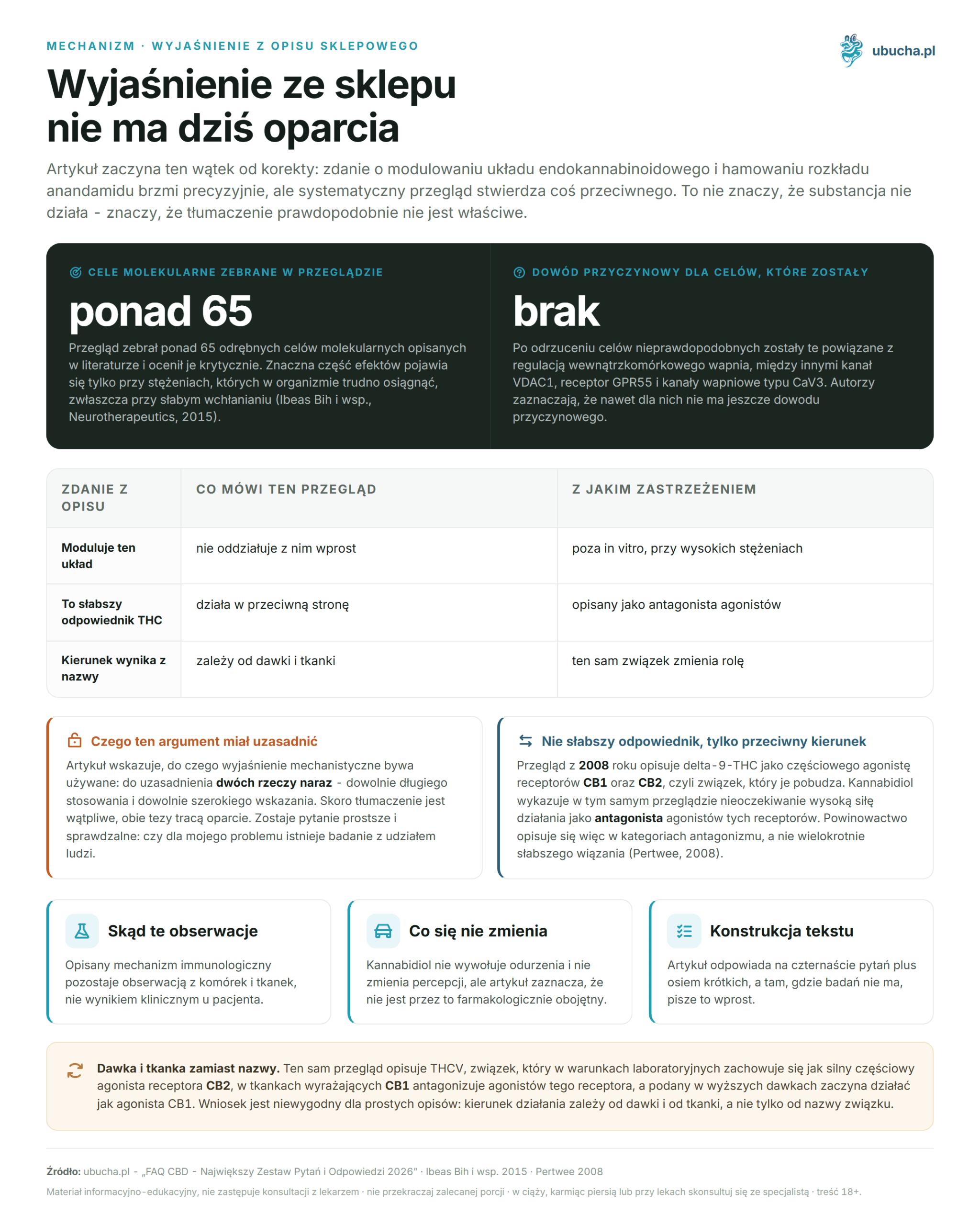
CBD behaves differently, and popular descriptions often err here. The same review states that cannabidiol unexpectedly shows high potency as an antagonist to agonists of CB1 and CB2 receptors in cells and tissues expressing these receptors. In other words, CBD is not simply a weaker THC. It is a compound that acts oppositely in these systems, and its affinity is described in terms of antagonism, not as millions of times weaker binding.
The practical conclusion for the reader is simple and unchanged for years. CBD does not cause intoxication or alter perception, so it is not a substance that prohibits driving. However, this does not mean it is pharmacologically inert, as the rest of this article explains. The basics of plant structure and other cannabinoids are collected in the entry about what CBD is.
The same review also describes a third compound worth knowing about because it appears in full-spectrum extract descriptions. Delta-9-THCV behaves in laboratory conditions as a strong partial agonist of CB2 receptor and antagonizes CB1 receptor agonists in tissues expressing CB1. At higher doses in the body, however, it begins to act as a CB1 agonist. The inconvenient conclusion for simple descriptions is that the direction of cannabinoid action depends on dose and tissue, not just its name.
The author also notes how CBD interacts with the CB2 receptor and links it to the ability to inhibit immune cell migration induced by a stimulus. This is one of the few points where cannabidiol has a described immunological mechanism, not just correlation. Still, this is an observation from cells and tissues, not a clinical patient result.
How does CBD work in the body?
Here we must start with a correction because the most repeated explanation on the Polish internet lacks good support today. The sentence “CBD modulates the endocannabinoid system and inhibits anandamide breakdown” sounds precise, but the systematic review Ibeas Bih et al., Neurotherapeutics 2015 states the opposite. The authors write that CBD does not directly interact with the endocannabinoid system except in vitro at supraphysiological concentrations.
The same review collected over 65 distinct molecular targets described for CBD in the literature and critically assessed them. Many effects appear only at concentrations difficult to achieve in the body, especially given CBD’s low bioavailability. After excluding unlikely targets, those remaining are linked to intracellular calcium regulation, including VDAC1 channel, GPR55 receptor, and CaV3-type calcium channels. The authors note that even for these there is no causal proof yet.
The authors’ conclusion is strong and worth remembering: it is very unlikely that CBD acts in neurological diseases through modulation of the endocannabinoid system. This does not mean CBD does not act. It means the mechanism used to explain its action in store descriptions is probably not the correct one.
Why is this important when buying? Because the argument about modulating the endocannabinoid system is often used to justify two things at once: arbitrarily long use and arbitrarily broad indication. Since the mechanistic explanation is doubtful, both theses lose support. What remains is a simpler and testable question: is there a human study for my problem.
The authors also point out something that returns later in the article. Some effects described for cannabidiol require concentrations difficult to achieve in the body, and its bioavailability is low. In other words, even a well-documented effect in cell culture does not automatically translate to sublingual drops.
Is CBD legal in Poland?
Yes, and the legal basis is different than most store descriptions state. Cannabidiol itself is not listed in the register of psychotropic substances, narcotics, or new psychoactive substances maintained by the Minister of Health’s regulation of August 17, 2018, consolidated version Dz.U. 2024 poz. 1139. The word “cannabidiol” does not appear there even once.
The 0.3% threshold applies to the plant, not the finished product, and this is the most common error in Polish descriptions. According to art. 4 point 5 of the Act of July 29, 2005 on Counteracting Drug Addiction, consolidated text Dz.U. 2023 poz. 1939, fiber hemp are Cannabis sativa L. plants in which the sum of delta-9-THC and tetrahydrocannabinolic acid in flower or fruiting tops, from which resin has not been removed, does not exceed 0.3% dry weight. The sum is rounded to one decimal place.
Two clarifications worth asking the seller about. First, the sum of delta-9-THC and THCA is measured, not THC alone, so a lab result counting only delta-9-THC does not answer the statutory question. Second, the 0.3% wording was introduced by the Act of March 24, 2022, Dz.U. 2022 poz. 763, effective May 7, 2022. The previous threshold was 0.20% and appears in older texts as current. The national threshold corresponds to the EU threshold from Regulation 2021/2115 but does not derive from it: these are two separate regulations with the same value.
It is also worth separating two substances that stand side by side in stores. Cannabidiol is not controlled, whereas HHC, hexahydrocannabinol, is a controlled substance in Poland. Since July 28, 2026, it is listed as a second group psychotropic substance, previously first group. This is a reclassification, not legalization, so its trade and possession outside the Act’s provisions remain prohibited.
Why is CBD not a dietary supplement?
Because under EU food law, CBD extracts are treated as novel food, and novel food requires authorization before being placed on the market. Until such authorization exists, the product cannot be sold as a dietary supplement, hence the cosmetic or collectible product category in Polish stores.
Safety assessment is ongoing and in 2026 received a new update. The EFSA panel on nutrition and novel food published an updated opinion on cannabidiol safety as novel food (EFSA Journal, 2026). The panel searched animal and human literature up to June 2024 and found data gaps identified in 2022 remain. New studies have methodological limitations: non-standardized protocols, short observation time, concomitant treatments.
Three findings from this document have direct consumer relevance. Animal studies showed consistent liver toxicity, with liver mass and histopathological changes as sensitive endpoints. In humans, hepatotoxic potential was noted, especially with concomitant drug use. CBD crosses the placenta and accumulates systemically, with prenatal exposure showing sex-dependent and long-lasting neurodevelopmental effects.
The panel also indicated areas where data are lacking in a different sense than “weak.” Gastrointestinal effects were reported at higher doses, neurological and psychiatric safety data were insufficient, and reproductive toxicity studies reinforced earlier concerns. Hormonal disturbances were noted, including altered thyroid hormone levels and adrenal histopathological changes. No included study examined immunotoxicity.
A common misunderstanding is treating sanitary notification as product approval. Notification only means the producer reported placing the preparation on the market. It does not change the ingredient’s status, is not novel food authorization, and does not mean anyone assessed efficacy. If a seller cites sanitary inspection notification as proof of quality, they cite a document that does not confirm that.
How much CBD is considered safe daily today?
The answer has changed and is much more cautious than what circulates in stores. The EFSA panel derived in 2026 a temporary safe dose using the benchmark dose method, based on subchronic studies compliant with good laboratory practice. Applying an uncertainty factor of 400, it obtained 0.0275 mg per kilogram of body weight per day, about 2 mg daily for a 70 kg person.
This number has a narrow application range and it is worth knowing it fully. It applies exclusively to supplement preparations with CBD purity of at least 98%, without nanoparticles, with a safe manufacturing process and excluded genotoxicity. It does not apply at all to other forms, including full-spectrum extracts.
The panel also adds groups for which safety cannot be established at all today: people under 25 years old, pregnant and breastfeeding women, and people taking medications simultaneously. These are three very broad groups, and most store descriptions do not mention them.
The table below shows the range usually missed in dose discussions. The amount recognized as temporarily safe in supplements and the amount given in clinical studies differ by several orders of magnitude. This is not a contradiction: the therapeutic dose given under supervision and the dose taken without control by anyone are two different situations, assessed by different criteria. It is worth knowing on which side of this scale your bottle lies.
| Context | Dose | Source |
|---|---|---|
| Temporary safe dose in supplement | 0.0275 mg/kg per day, about 2 mg at 70 kg | EFSA 2026 |
| Epilepsy drug in registration study | 20 mg/kg per day under doctor supervision | Devinsky 2017 |
| Single dose in anxiety study | 600 mg before public speaking | Bergamaschi 2011 |
| Dose with strongest anxiolytic effect | 300 mg; no effect at 100 and 900 mg | Zuardi 2017 |
What adverse effects have been reported in studies?
The most reliable adverse effect data come from the registration study, where they were systematically counted. In the Devinsky et al., New England Journal of Medicine 2017 trial, effects more frequent in the cannabidiol group than placebo were diarrhea, vomiting, fatigue, fever, drowsiness, and abnormal liver tests. More people withdrew from the CBD group than placebo.
The second often cited source is the case series Shannon et al., The Permanente Journal 2019. In this work, CBD was well tolerated by all but three of 72 patients. Percentages like 12% drowsiness or 11% dry mouth, repeated in Polish descriptions citing this study, do not appear in its abstract and were removed from this article.
A signal repeated in all sources concerns the liver. The EFSA panel in 2026 recognized liver toxicity as a consistent finding in animal studies and indicated hepatotoxic potential in humans, especially combined with drugs. If you take anything regularly or have diagnosed liver disease, this is the one piece of information from the entire article worth discussing with a doctor before the first drop.
It is also important to understand what “well tolerated” means in the case series. It means the treating physician did not record a problem in documentation, not that patients were systematically asked about a symptom list. The registration study works oppositely: it collects adverse events in a set protocol and compares them to placebo. That is why the list from Devinsky et al. is longer, though it concerns the same substance.
Does CBD interact with medications?
Yes, and since 2023 this is known from human measurements, not just microsome studies. In Bansal et al., Clinical Pharmacology and Therapeutics 2023, eighteen healthy adults alternately ate a cookie without extract, a cookie with a CBD-predominant extract containing 640 mg cannabidiol and 20 mg delta-9-THC, or a cookie with THC alone. Thirty minutes later, participants took a test drug panel probing cytochrome P450 isoenzymes.
The results are concrete and translatable to pharmacy situations. The CBD-predominant extract increased the area under the curve of omeprazole by 207%, losartan by 77%, midazolam by 56%, and caffeine by 39%. This corresponds to inhibition of CYP2C19, CYP2C9, CYP3A, and CYP1A2, while CYP2D6 remained unaffected. The THC-only cookie did not inhibit any tested isoenzymes.
There is one more figure worth knowing for full-spectrum preparations. CBD presence increased exposure to delta-9-THC by 161%, explained by inhibition of THC clearance via CYP2C9. The same drop can raise blood THC levels more than the product’s THC content suggests. The practical rule is: if you take a drug metabolized by CYP2C19 or CYP2C9, e.g., proton pump inhibitor or anticoagulant, decide on CBD with a doctor or pharmacist.
Two notes on the study’s scope. The 640 mg cannabidiol dose is high for a consumer product, so at a dozen milligrams daily the interaction scale will be smaller. However, the authors do not provide a threshold below which interaction disappears, and pharmacokinetic modeling predicted measured effects within 26% accuracy except for caffeine. This means the mechanism is recognized well enough to take seriously even at lower doses.
The practical consequence is less obvious than it seems. Spacing the time of drug and oil intake does not remove enzyme inhibition, because inhibition affects the enzyme, not the meeting of two molecules in the stomach. The only responsible way is to talk to a doctor about drug dose and, for some therapies, monitor drug blood levels.
Does CBD help with anxiety?
In experimental studies, yes, but doses are much higher than those in the oil bottle. In Bergamaschi et al., Neuropsychopharmacology 2011, twenty-four untreated patients with social phobia received a single 600 mg CBD dose or placebo 1.5 hours before simulated public speaking. The cannabidiol group had less anxiety, less cognitive impairment, and less discomfort during speech.
The second study explains why increasing dose does not always help. Zuardi et al., Frontiers in Pharmacology 2017 gave sixty healthy people placebo, 1 mg clonazepam, or CBD at 100, 300, or 900 mg before a real situation. Subjective anxiety measures decreased post-event only at 300 mg. No effect at 100 or 900 mg. This inverted dose-effect curve is cited in store descriptions, but its source is this study, not the producer’s guide.
The third source is clinical practice with weaker design. In the Shannon et al. (2019) case series, anxiety scores decreased in the first month in 57 of 72 patients (79.2%) and persisted during observation. This retrospective chart review lacks a control group, so authors conclude controlled clinical trials are needed.
What these three studies do not say? Nothing about daily small doses over many weeks, exactly how consumer oils are used. The first two measured single dose effect before a specific stressor; the third describes add-on treatment to psychiatric therapy. Applying these results to a dozen milligrams in the morning is the reader’s inference, not the authors’.
Does CBD help with sleep?
Data here are clearly weaker than for anxiety, and it is worth seeing the difference in the same study. In the Shannon et al. (2019) case series, sleep quality improved in the first month in 48 of 72 patients (66.7%) but fluctuated in subsequent months. Anxiety improvement persisted; sleep improvement did not. This distinction is lost in descriptions citing only 66.7%.
It is also important to remember the source of this figure. The review covered 103 adult psychiatric outpatients; 72 were analyzed who had anxiety or poor sleep as main problem. CBD was given as add-on to existing treatment, so its effect cannot be separated from other therapy or natural course.
There is no randomized placebo-controlled trial confirming CBD efficacy in insomnia in adults without other diagnoses. If you seek sleep support, honest advice is: treat CBD as an element to test for several weeks with effect recording, not as a hypnotic. Comparison of forms and duration is collected in the entry about administration methods.
There is also an argument for caution with sleep. Drowsiness appears in the Devinsky et al. study as an adverse effect more frequent with cannabidiol than placebo. This means the sedative effect is real but described at therapeutic doses as a side effect, not a benefit for insomnia. At oil bottle doses, it is unknown if it appears at all.
Does CBD work for epilepsy?
This is the only area where cannabidiol has full drug registration and the only one with large randomized trials. In the Devinsky et al. (2017) trial, 120 children and young adults with Dravet syndrome and drug-resistant epilepsy received 20 mg CBD per kilogram per day or placebo alongside existing antiepileptic treatment.
Results are worth giving precisely as they are often rounded up. Median monthly convulsive seizure count dropped from 12.4 to 5.9 in the cannabidiol group, versus 14.9 to 14.1 in placebo. Adjusted median difference was 22.8 percentage points favoring CBD. The proportion with at least 50% seizure reduction was 43% vs. 27% placebo, but this difference was not statistically significant. Seizure-free were 5% in CBD group and none in placebo.
Two caveats close this picture. Reduction concerned convulsive seizures; non-convulsive seizures were not significantly reduced. The 20 mg/kg dose equals 1400 mg daily for a 70 kg adult, far beyond consumer oil doses, given under liver test monitoring.
It is also worth noting who participated. These were patients with Dravet syndrome, a severe childhood epilepsy with high mortality, unresponsive to prior treatment. CBD was added to standard therapy, not replaced it. No element resembles an adult buying oil for well-being, which is why drug registration is not an argument for supplement efficacy.
What does CBD do for skin?
Material here is laboratory but concrete and well described. The Oláh et al., Journal of Clinical Investigation 2014 study showed in human sebocyte cultures and organotypic skin culture that cannabidiol acts as a strong sebostatic agent, inhibiting sebum production.
The mechanism was established more precisely than in most cannabis cosmetic studies. CBD inhibited lipogenesis induced by arachidonic acid and a combination of linoleic acid with testosterone and limited sebocyte proliferation via TRPV4 channel activation. This activation disrupted the prolipogenic ERK1/2 MAPK pathway and lowered NRIP1 protein. Separately, anti-inflammatory action dependent on adenosine A2a receptor and NF-kB pathway inhibition was described.
What does this study not say? It does not say that CBD cream cures acne in humans, as it was not a clinical trial. The authors conclude CBD has potential as a promising therapeutic agent in acne vulgaris, and potential is not the same as confirmed patient efficacy. We also found no data on antibacterial action against acne bacteria, though Polish descriptions regularly attribute this to the study.
From a consumer perspective, two questions remain for cosmetic labels. How much cannabidiol is really in the product, as cream concentrations are often symbolic and rarely numerically stated. And whether the producer promises therapeutic effect, since cosmetics cannot treat disease, and acne vulgaris is a disease entity. A cure promise on a cosmetic package signals the producer, not the ingredient.
How much CBD reaches the blood from drops versus capsules?
There is no full answer today, and that is the answer. The systematic review Millar et al., Frontiers in Pharmacology 2018 reviewed 792 articles and found 24 reporting human CBD pharmacokinetics. Absolute bioavailability was measured only for inhalation route, about 31%. No other route was measured despite intravenous forms existing.
This means tables with sublingual bioavailability 13-19% and oral 6-15%, repeated in Polish descriptions, have no basis in this review. We removed them from this article and did not replace with other figures because such measurements do not exist.
What the review reliably reports? CBD half-life ranged from 1.4 to 10.9 hours after oral mucosa spray, 2 to 5 days with chronic oral dosing, 24 hours after intravenous administration, and 31 hours after smoking. Maximum concentration rises with dose and is reached faster via inhalation than oral. It also rises after food and in fat-based preparations, which is the only practical tip: oil taken with food gives higher concentration than on an empty stomach.
The authors end with a note worth remembering when comparing products. Data are scarce and sometimes inconsistent despite widespread CBD use. Without understanding bioavailability and half-life, conscious dosing is difficult, and every table converting drops to absorption percentage is today a marketing construct, not a measurement result.
What is the difference between full spectrum, broad spectrum, and isolate?
The difference is in composition, not potency. Isolate is purified cannabidiol without other plant components. Broad spectrum contains other cannabinoids and terpenes but with THC removed. Full spectrum retains the full plant profile including trace THC within the legal threshold for raw material.
The sales argument is always the same: the full profile acts stronger due to entourage effect. The Russo, British Journal of Pharmacology 2011 review was written by one author, not Russ and Mechoulam as many descriptions claim. The author discusses hemp terpenoids and proposes mechanisms where they might complement cannabinoid action, ending with methods to test such effects in future experiments.
The closing sentence is conditional and should be cited as such: synergy of phytocannabinoids and terpenoids, if proven, increases chances for new therapeutic products. This is a 2011 research hypothesis, not confirmed superiority of full-spectrum over isolate. When choosing forms, base your choice on THC presence and your professional situation, not on promised stronger effect. Practical criteria for first product selection are collected in the entry about first purchase.
There is a concrete reason why form choice matters practically, from Bansal et al. (2023). Cannabidiol presence increased exposure to delta-9-THC by 161% because CBD inhibits the enzyme responsible for oral THC clearance. A full-spectrum product can thus give higher blood THC levels than its composition suggests. For someone subject to workplace sobriety tests, this is a stronger argument than any entourage effect theory.
How to read a COA certificate before purchase?
COA, certificate of analysis, is the test result of a specific batch by a laboratory. Without it, you do not know how much cannabidiol is in the bottle, how much THC, or if the raw material was clean. It is the only document allowing verification of the producer’s declaration and the only one worth asking for before purchase.
A sensible certificate answers five questions. How much CBD and THC were measured in milligrams per gram or percent. Whether heavy metals were tested. Whether pesticide and solvent residues from extraction were tested. Which batch the result concerns and its date. Who performed it, i.e., whether the lab is independent from the producer.
| What to check | Warning sign |
|---|---|
| CBD content in milligrams per package | only percent given, no conversion |
| Batch number and test date | certificate several years old or without number |
| THC content | result given only for delta-9-THC, no THCA |
| Contaminants | no heavy metals or pesticides tested |
| Laboratory | test done by the producer itself |
Instead of comparing bottle prices, calculate cost per milligram of cannabidiol. A bottle with a higher price and concentration can be cheaper per milligram than a cheap bottle with low content, and without a certificate none of these calculations can be done reliably.
One item in this table deserves a separate sentence because it relates to the earlier regulation. A result given only for delta-9-THC does not answer the statutory question, as the law refers to the sum of delta-9-THC and THCA. A certificate giving one value and silent on the other does not allow determining if the raw material met the threshold. This question is worth asking the seller directly.
Most frequently asked questions
Is CBD legal in Poland?
Yes. Cannabidiol is not listed in the register of controlled substances (Dz.U. 2024 poz. 1139). The 0.3% threshold applies to the plant and is counted as the sum of delta-9-THC and THCA in flower tops, according to art. 4 point 5 of the Act on Counteracting Drug Addiction (Dz.U. 2023 poz. 1939).
How much CBD can be safely taken daily?
The EFSA panel derived in 2026 a temporary safe dose of 0.0275 mg per kilogram of body weight per day, about 2 mg daily for a 70 kg person. This applies exclusively to preparations with cannabidiol purity of at least 98%, without nanoparticles.
Does CBD cause addiction or intoxication?
CBD does not cause intoxication. The Pertwee review (2008) describes delta-9-THC as a partial agonist of CB1 and CB2 receptors, whereas cannabidiol acts as a strong antagonist to agonists of these receptors, so it does not stimulate the pathway responsible for the psychotropic effect.
Will CBD show up in a drug test?
Tests detect THC, not CBD. However, full-spectrum preparations contain trace THC, and Bansal et al. (2023) measured that the presence of CBD increases exposure to delta-9-THC by 161%. For sobriety tests, a THC-free preparation is safer.
Is it allowed to use CBD during pregnancy and breastfeeding?
No. The EFSA panel stated in 2026 that CBD safety cannot be established for pregnant and breastfeeding women. Cannabidiol crosses the placenta, and prenatal exposure showed long-term sex-dependent neurodevelopmental effects.
Can CBD be combined with medications?
Only after consultation. Bansal et al. (2023) measured in humans an increase in exposure to omeprazole by 207%, losartan by 77%, midazolam by 56%, and caffeine by 39% after an extract with CBD predominance. This corresponds to inhibition of CYP2C19, CYP2C9, CYP3A, and CYP1A2.
How long does it take for CBD to start working?
It depends on the route of administration. Millar et al. (2018) report that maximum concentration is reached faster via inhalation than oral route, with time to peak between zero and four hours. Food and a fatty carrier increase concentration.
Does CBD require a prescription?
Consumer products do not require a prescription. The registered drug with purified cannabidiol, used in drug-resistant epilepsy at doses around 20 mg per kilogram of body weight, is dispensed only by prescription and administered under liver function test monitoring.
Hemp oils available in the store can be found in the oils category. Check ingredient content and batch documentation on the specific product page.
This article is for informational and educational purposes and does not constitute medical advice. Before starting cannabis or CBD for therapeutic purposes, consult a doctor, especially if you take other medications, are pregnant, or breastfeeding.
Author: Michał Waluk · Published: 2026-05-11 · Updated: 2026-08-10