
Coenzyme Q10: what it is, when to supplement and what doses are effective
Ubiquinone or ubiquinol, how much do statins really take away and what did studies on migraines show. A review of what has been measured about coenzyme Q10 and what has been added.
Coenzyme Q10 is one of the substances surrounded by the most unsupported numbers. It is repeated that statins lower its level by half, that ubiquinol is absorbed several times better, and that it helps with migraines by a specified percentage. Each of these statements has a source to which it refers, and each says something different than is commonly believed. Some of these numbers are inflated by about two times, some describe a completely different measure than the one they name, and one comes from a study of a combination preparation. This text goes through them one by one and shows what this substance is, in what forms it occurs, and where exactly the evidence ends.
KEY INFORMATION
• Coenzyme Q10 transfers electrons in the mitochondrial respiratory chain and acts as an antioxidant in its reduced form.
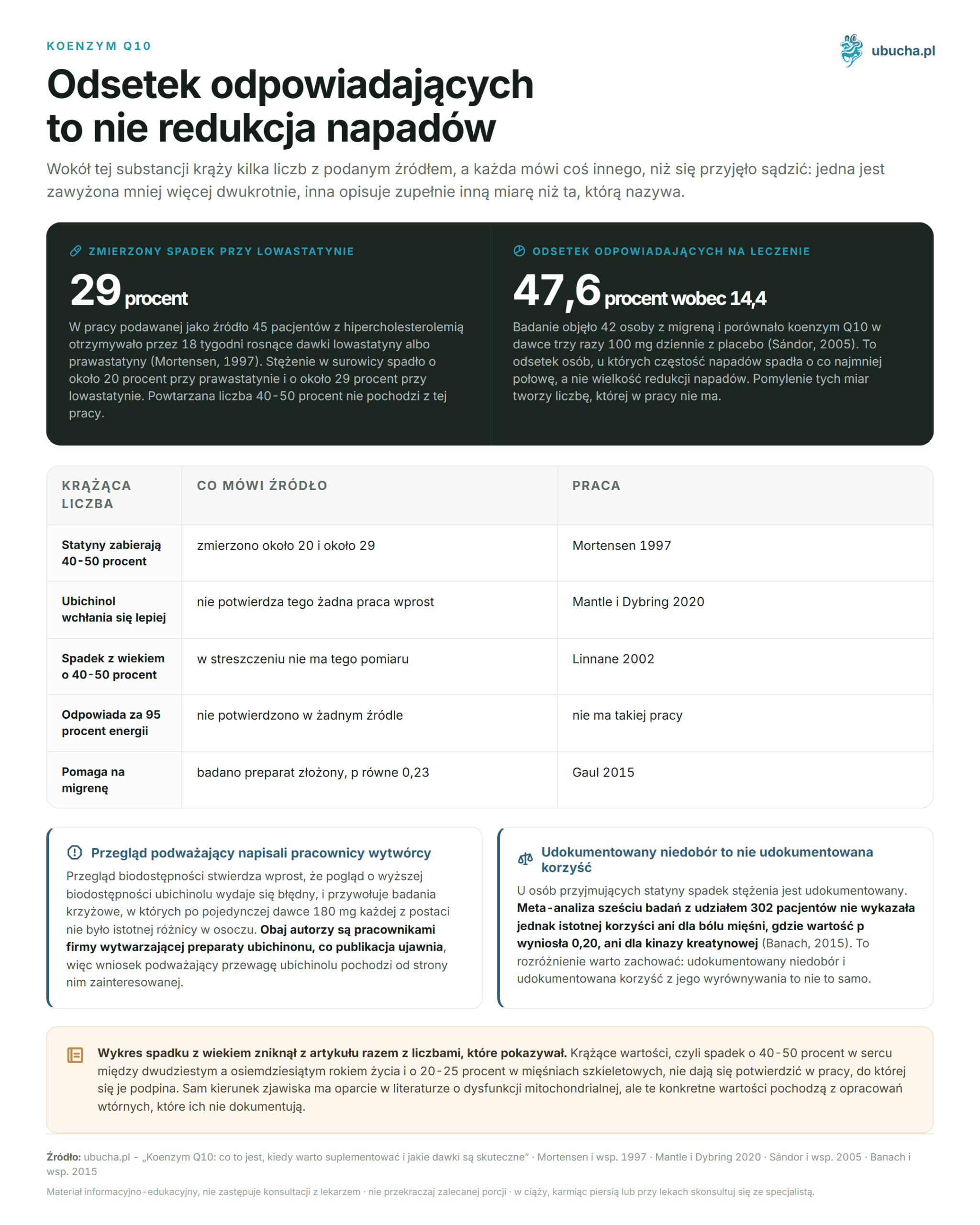
• The repeated figure of 40-50 percent decrease with statins does not come from the work to which it is attached. Measured values are about 20 and about 29 percent (Mortensen et al., Molecular Aspects of Medicine, 1997).
• No study comparing both forms confirms the absorption advantages of ubiquinol 2-4 times. The review that undermines it was written by employees of the ubiquinone manufacturer (Mantle and Dybring, Antioxidants, 2020).
• The migraine study concerned a combination preparation, and the frequency of attacks did not differ significantly from placebo.
• In the store at Bucha, coenzyme Q10 is in the supplements category, in the form of ubiquinone.
What is coenzyme Q10 and what does it do in the cell?
Coenzyme Q10, also known as ubiquinone, is a fat-soluble molecule produced in the mitochondria of eukaryotic cells. The name comes from the Latin ubique, meaning everywhere, and reflects its prevalence in tissues. The highest concentrations are found in organs with high energy demands, primarily the heart, liver, and kidneys.
Its role in the respiratory chain is well described. It transfers electrons from complexes I and II to complex III of the inner mitochondrial membrane, driving further reactions leading to ATP. A review dedicated to this substance in aging and disease (Hernández-Camacho et al., Frontiers in Physiology, 2018) adds a second function: the reduced form neutralizes free radicals in membranes and regenerates vitamins C and E to their active forms.
The popular claim that coenzyme Q10 accounts for about 95 percent of cellular energy has not been confirmed in any of the checked sources. The number mixes the contribution of oxidative phosphorylation in ATP production with the role of a single transporter in this process, so it is not included in this text.
What is the difference between ubiquinone and ubiquinol?
The substance circulates in the body in two forms. Ubiquinone is oxidized, ubiquinol is reduced, and cells constantly convert one form into the other. The antioxidant action is attributed to the reduced form.
Supplement manufacturers derive the conclusion that ubiquinol is absorbed better and sell it at a higher price. A review dedicated to the absorption of coenzyme Q10 (Mantle and Dybring, Antioxidants, 2020) states directly that the view of higher bioavailability of ubiquinol seems incorrect. The authors cite crossover studies in which, after a single dose of 180 mg of each form, there was no significant difference in plasma, measured as Cmax and area under the curve.
The picture is not uniform. The same review notes studies in which ubiquinol performed better, especially in older individuals, and explains why: it was compared to ubiquinone without thermal dispersion of crystals. The lack of this procedure reduces bioavailability by 75 percent.
A caveat is needed here, which the publication itself reveals: both authors are employees of Pharma Nord, a manufacturer of ubiquinone preparations. Therefore, the conclusion undermining the superiority of ubiquinol comes from a party interested in it. A cautious reading thus sounds like this: no study comparing both forms in the same participants confirms the factor of 2-4 times, but the opposite claim is also not based on a source free from conflicts of interest. What is absorbed is rather determined by the method of capsule production than the name on the label.
Does coenzyme Q10 decrease with age?
This thesis is treated as a certainty in supplementation and is most often supported by Linnane’s work from 2002 (Linnane et al., Annals of the New York Academy of Sciences, 2002). The work exists and concerns aging, but its content is different from what is attributed to it.
The authors summarize their own research on human skeletal muscle: mutations and remodeling of mitochondrial DNA accumulating throughout life, changes in the profile of fiber types, and a decrease in their number and size. They also formulate a hypothesis that coenzyme Q10 regulates gene expression in this muscle via hydrogen peroxide. However, the available abstract does not contain either the measurement of concentration in the heart or the percentage values attributed to this work in guides.
The circulating numbers, i.e., a decrease of 40-50 percent in the heart between the age of twenty and eighty and 20-25 percent in skeletal muscles, cannot be confirmed in this source. The direction of the phenomenon is supported by literature on mitochondrial dysfunction in aging, but these specific values come from secondary studies that do not document them. Therefore, they disappeared from here along with the graph that showed them.
How much coenzyme Q10 do statins take away?
The mechanism is true and simple. Statins inhibit HMG-CoA reductase, which is the first step in the mevalonate pathway, where both cholesterol and coenzyme Q10 are produced. However, the scale of this effect is inflated on the internet by about two times.
In the work cited as a source (Mortensen et al., Molecular Aspects of Medicine, 1997), 45 patients with hypercholesterolemia received increasing doses of lovastatin or pravastatin for 18 weeks. The serum concentration decreased from 1.27 to 1.02 mmol/l with pravastatin and from 1.18 to 0.84 mmol/l with lovastatin, i.e., by about 20 and about 29 percent. Simvastatin, which is often mentioned here, was not in the study.
A meta-analysis of eight placebo-controlled arms (Banach et al., Pharmacological Research, 2015) calculated it collectively: the weighted mean difference was -0.44 μmol/l with a confidence interval from -0.52 to -0.37. The result was given in units of plasma concentration, not in percentages and not as a synthesis rate.
A separate question is whether supplementing this deficiency gives the patient anything. A meta-analysis of six studies involving 302 patients taking statins (Banach et al., Mayo Clinic Proceedings, 2015) did not show significant benefit either for muscle pain, where the p-value was 0.20, or for creatine kinase.
What did the studies on migraines show?
Migraine is the most frequently mentioned non-cardiac indication for this substance, and the numbers attributed to it, from 31 to 50 percent reduction in attacks, are a mix of two studies and two different measures.
The first of these (Sándor et al., Neurology, 2005) involved 42 people with migraines and compared coenzyme Q10 at a dose of three times 100 mg daily with placebo. The percentage of people whose attack frequency decreased by at least half was 47.6 percent compared to 14.4 percent with placebo. This is the percentage responding to treatment, not the magnitude of attack reduction. Confusing these measures creates a number that is not present in the work.
The second (Gaul et al., The Journal of Headache and Pain, 2015) is sometimes described as a meta-analysis, but it is a randomized study on 130 people. It tested a combination preparation with magnesium and riboflavin, so it says nothing about coenzyme Q10 itself. The number of days with migraines decreased from 6.2 to 4.4 in the active group and from 6.2 to 5.2 with placebo, but the difference between groups was not significant, with p equal to 0.23. The intensity of pain and the score on the disease burden questionnaire improved significantly. A decrease of about 29 percent within one arm is sometimes cited as the effectiveness of the preparation, although the study did not demonstrate this. One of the authors is an employee of the manufacturer, which the publication reveals.
Who might benefit from supplementation, and who might not?
The strongest data concern sick individuals, not healthy ones. Hard endpoints were studied in patients with heart failure and in people over seventy, and this was on ubiquinone. More about what exactly was measured in these studies is written in the article Coenzyme Q10 for heart and energy after 40.
In individuals taking statins, the decrease in concentration is documented, but the benefit of supplementing it has not been confirmed in studies on muscle pain. It is worth keeping this distinction: documented deficiency and documented benefit from its correction are two different things, and the latter has not been demonstrated in this case.
Two situations require a conversation with a doctor before starting supplementation. Coenzyme Q10 may weaken the effect of warfarin, meaning the risk is thrombosis, not bleeding. It may also slightly lower blood pressure, which is significant with antihypertensive medications. For the same reason, you will not find a dosage table here: the numbers given above describe what was given to whom in a specific study, not how much the reader should take.
Frequently asked questions
What is coenzyme Q10?
It is a fat-soluble molecule produced in the mitochondria that transfers electrons between the complexes of the respiratory chain and participates in the formation of ATP. In its reduced form, as ubiquinol, it acts as an antioxidant in cell membranes.
Ubiquinone or ubiquinol, which to choose?
A 2020 review of bioavailability considers the superiority of ubiquinol to be a mistaken view, but it was written by employees of the ubiquinone manufacturer. Several crossover studies did not show a significant difference in plasma. The repeated factor of 2-4 times does not come from work comparing both forms directly.
By how much do statins lower coenzyme Q10 levels?
A 1997 study on 45 patients showed a decrease in serum concentration of about 20 percent with pravastatin and about 29 percent with lovastatin over 18 weeks. A meta-analysis from 2015 reports a weighted mean difference of -0.44 μmol/l. The figure of 40-50 percent does not come from these studies.
Does coenzyme Q10 help with muscle pain from statins?
A meta-analysis of six studies involving 302 patients, published in Mayo Clinic Proceedings in 2015, did not show significant benefit. For muscle pain, the p-value was 0.20. The authors concluded that larger and better-designed studies are needed.
Does coenzyme Q10 work for migraines?
In a 2005 study of 42 people, the percentage responding to treatment was 47.6 percent compared to 14.4 percent with placebo. A later study on 130 people involved a combination preparation, and the frequency of attacks did not differ significantly from placebo, with p equal to 0.23.
Does coenzyme Q10 have side effects?
It is usually well tolerated, and reported adverse effects are mild and include nausea, diarrhea, and headaches. It may weaken the effect of warfarin and slightly lower blood pressure, so it requires medical consultation when taken with medications on a regular basis.
Coenzyme Q10 in the form of ubiquinone can be found in the supplements category. The store does not carry separate ubiquinol or selenium. It is also worth looking at texts about carnosine and coenzyme Q10 and male fertility, where the same substance returns in a different research context.
This article is for informational and educational purposes and does not constitute medical advice. Before starting supplementation, consult your doctor, especially if you are taking medications regularly, are pregnant or breastfeeding, or have chronic illnesses.
Author: Michał Waluk · Published: 2026-05-28 · Updated: 2026-08-16