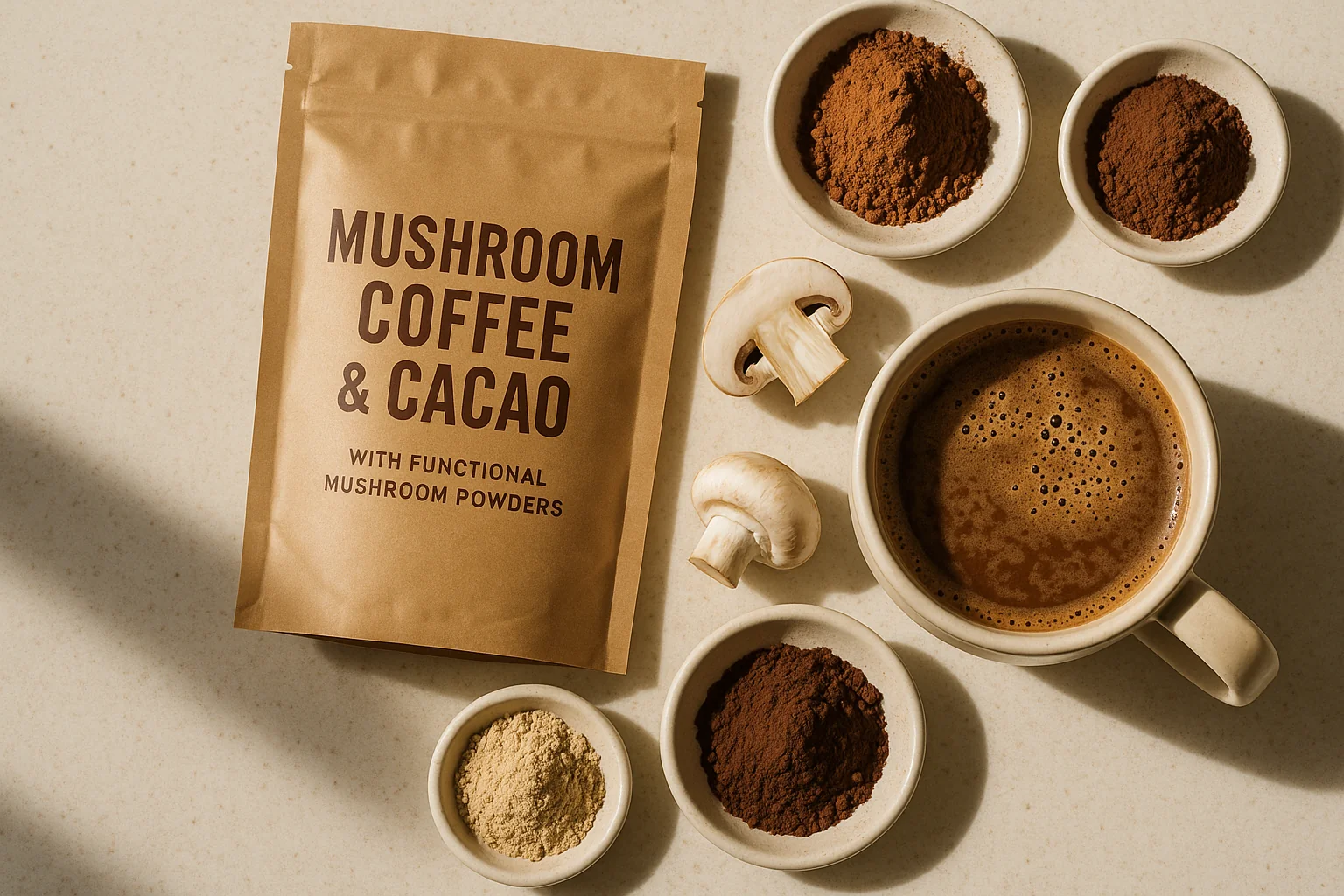

Functional Mushrooms in Cocoa and Coffee: Just a Trend or Does It Really Work
Coffee and cocoa with functional mushrooms: what is the difference between the fruiting body and mycelium on grain, what did the study of lion's mane in humans show, and how to read the label.
Coffee with lion’s mane and cocoa with reishi have emerged from the niche and now sit on the shelf next to regular instant coffee. However, under the name “mushroom drink” are products that differ in everything except the label: on one side, an extract from the fruiting body with a declared beta-glucan content, on the other, ground grain on which the mycelium grew. The difference is visible in the composition, not in the packaging, and the manufacturer is not obliged to show it. Additionally, there is a layer of promises that no one is allowed to place on the label because they have no approved basis. Below, we separate these three things: what can be verified before purchase, what has really been shown in studies involving people, and where the area begins where nothing certain is yet known.
KEY INFORMATION
• Analysis of chaga supplements showed that products from mycelium grown on grain are rich in starch, which is not present in the natural raw material (Windsor et al., Int J Mol Sci 2025).
• Beta-glucans have documented immunomodulatory effects, but in the EU, they do not have an approved health claim (van Steenwijk et al., Nutrients 2021).
• The most cited study of lion’s mane in humans involved 30 people and lasted 16 weeks; after discontinuation, the effect disappeared (Mori et al., Phytother Res 2009).
• On the label, look for the species name in Latin, the word “fruiting body,” and numbers for beta-glucans and raw material mass per serving.
• The absence of this information does not prove poor quality but makes it impossible to assess the product.
Why can cheap mushroom products not work?
Because many of them contain little mushroom. A cheaper production method is growing mycelium on a grain substrate, most often on rice or oats. The mycelium overgrows the grain, after which the whole thing, together with the substrate, is dried and ground. What ends up in the sachet is therefore a mixture of mycelium and grain, and no one provides the proportions on the packaging.
The difference this method makes was shown in an analysis of chaga supplements published in 2025. The team compared raw material collected in nature with preparations containing products from fermented grain, using among other things beta-glucan measurement and iodine-starch testing. Products from fermented grain were found to be rich in starch, while the true raw material contained no starch at all. Metabolomics and NMR spectra showed such a large discrepancy in composition that the authors directly speak of products presented inconsistently with their nature (Windsor et al., Int J Mol Sci 2025).
It should be honestly noted what the scope of this work was. Chaga was studied, not lion’s mane, reishi, or other species, so the numbers from this analysis cannot be transferred to the entire market. The conclusion that can be transferred is methodological: the name of the species on the packaging says nothing about how much mushroom is inside. We discuss how different species differ in their effects separately in the text about adaptogenic mushrooms.
What are beta-glucans and what is really known about them?
They are polysaccharides that make up the cell wall of the mushroom, considered the main class of compounds responsible for its immunomodulatory effects. They are not an invention of the supplement industry: they have been used in traditional Chinese medicine for centuries and have been studied with modern immunological methods for several decades.
A review from the journal Nutrients summarizes this state and poses a question that advertisements do not ask: are mushroom beta-glucans more of a supplement or more of a drug? The authors compare data on their efficacy and safety with the requirements that the European Food Safety Authority places on health claims regarding immunity and defense against pathogens. Their conclusion is cautious: beta-glucans may support and maintain health, and such an effect could be declared if approved (van Steenwijk et al., Nutrients 2021).
The last sentence is worth reading twice, as it speaks in the subjunctive mood. As of now, there is no approved health claim for mushroom beta-glucans in the EU, so no manufacturer can legally state on the packaging that their powder boosts immunity. The declared beta-glucan content is therefore information about the raw material, not a promise of effect. This is an important distinction when reading a label, as the percentage number is often read as proof of action.
What to look for on the label of a mushroom drink?
For four pieces of information, the absence of which makes any assessment of the product impossible. They are not a guarantee of quality, just a prerequisite: if they are missing, it is unclear what you are buying, regardless of the price and appearance of the packaging.
| What to look for | Good entry | Entry that says nothing | Why it matters |
|---|---|---|---|
| Species name | Hericium erinaceus, Ganoderma lucidum, Inonotus obliquus | “lion’s mane blend”, “mushroom mix” | Common names may refer to several species with different compositions |
| Part of the mushroom | fruiting body, extract from the fruiting body | no information, “full spectrum”, “mycelium on grain” | Mycelium grown on grain is harvested together with the substrate, the proportion of which no one declares |
| Beta-glucan content | percentage number or analysis result from a laboratory | “rich in polysaccharides”, “high potency” | This is the only number that allows comparing two products with each other |
| Raw material mass per serving | stated in milligrams or grams | “with added mushrooms” | Without mass, you cannot relate the serving to the amounts used in studies |
Note on the last row, as this is where popular guides often miss the truth. The circulating thresholds like “at least half a gram of extract per serving” do not come from any guidelines or meta-analysis. They are generalizations from various research protocols, which differ in species, form of raw material, and duration. The mass on the label allows comparing the product with specific research, not with an invented norm.
What did the study of lion’s mane in humans show?
It showed an improvement that disappeared after discontinuation. The most cited human trial was published in 2009 in Phytotherapy Research. It involved Japanese individuals aged 50 to 80 diagnosed with mild cognitive impairment, and the result was measured using a scale based on the revised Hasegawa Dementia Scale, abbreviated HDS-R.
After a two-week preliminary observation, thirty individuals were randomly assigned to two groups of fifteen. The experimental group took four tablets of 250 milligrams each, containing 96 percent dried powder of lion’s mane, three times a day for 16 weeks. In the eighth, twelfth, and sixteenth weeks, the cognitive function scores in this group were significantly higher than in the placebo group and increased with the duration of intake. Four weeks after the end of administration, the results significantly dropped. Laboratory tests did not show any adverse effects (Mori et al., Phytother Res 2009).
Two things from this description contradict what sellers usually write. First, thirty individuals is a very small sample, and the authors formulate their conclusion cautiously, as a suggestion. Second, dried mushroom powder was administered, not a concentrated extract with a high conversion rate. The belief that only such an extract makes sense has no support in the work that is most often cited. We discuss this species more broadly in the text about lion’s mane.
Does hot water destroy the ingredients of mushrooms?
In the case of beta-glucans, it likely helps rather than harms. The traditional method of preparing medicinal mushrooms involves long boiling in water, as hot water is the solvent that extracts polysaccharides from the cell wall. Therefore, adding powder to a cup of hot coffee or cocoa is not a technological mistake.
More caution is needed when talking about other ingredients. Guides provide specific temperature and time thresholds at which compounds characteristic of individual species supposedly break down, but we could not find any work from which these thresholds originated. An honest answer is therefore: no one has systematically measured this under home brewing conditions.
The practical conclusion is therefore more modest than it is usually presented. Brewing powder in a hot drink is fine, long boiling makes sense for traditional decoctions, and pretending precision where data is lacking only serves sales. If you are interested in how such a drink compares to regular coffee, the topic is expanded in the text about coffee with mushrooms.
What does cocoa itself bring to such a drink?
More than its role as a flavor carrier suggests. Raw, non-alkalized cocoa is a source of flavanols, magnesium, and theobromine, an alkaloid related to caffeine. Therefore, a cocoa drink has its own profile of action, independent of what we add to it.
This is also the reason why evaluating “adaptogenic cocoa” can be difficult. If after an evening cup you feel calmer, the source of that feeling could just as well be the warm drink itself and the bedtime ritual as the added mushroom, and separating these factors without research is impossible. Advertisements attribute the entire effect to the most expensive ingredient, which is convenient but not a conclusion.
The homemade version has one advantage over ready-made mixes: you know what is inside. Heat 200 milliliters of plant milk without bringing it to a boil, and mix in two teaspoons of raw cocoa, a pinch of cinnamon, and a portion of mushroom powder measured according to the description on the packaging. You can sweeten it with honey. We have gathered more variations of such a drink in the text about cocoa with adaptogens.
Frequently Asked Questions
Do mushrooms in coffee and cocoa really work?
It depends on what is in the sachet. For lion’s mane, there is a small placebo trial that showed improvement in cognitive functions after 16 weeks in 30 people aged 50 to 80, but the effect disappeared after discontinuation. That’s too little to speak of certain effects, and too much to say it’s just marketing.
What is the difference between the fruiting body and mycelium grown on grain?
The fruiting body is the part of the mushroom that we commonly call the mushroom. Mycelium grown on grain is harvested together with the substrate, so the finished powder also contains grain. In the analysis of chaga supplements, products from fermented grain were found to be rich in starch, which is absent in the natural raw material.
Does the beta-glucan content on the label guarantee anything?
It guarantees the ability to compare two products, not a health effect. In the EU, there is no approved health claim for mushroom beta-glucans, so the declared percentage is information about the raw material. A manufacturer who does not provide this number makes any comparison impossible.
Does hot water destroy the active ingredients of mushrooms?
Not likely for beta-glucans, as hot water is a traditional solvent used for their extraction. For other compounds, no one has systematically measured this under home brewing conditions, so the temperature thresholds circulating in guides have no basis in sources.
How much mushroom should one serving of the drink contain?
There are no standards or guidelines to refer to. The thresholds repeated in guides are generalizations from various research protocols that differ in species and form of raw material. It makes sense to compare the mass on the label with specific research, not with an invented number.
Is it worth making such a drink yourself?
It has one measurable advantage: you know how much and what went into the cup, as you measure the ingredients yourself. A ready-made mix is more convenient, but you only know its composition to the extent that the manufacturer decided to describe it on the packaging.
Coffee and chocolate with adaptogens and gummies with mushroom extracts can be found in the adaptogens category (as of August 16, 2026).
This article is for informational and educational purposes and does not replace consultation with a doctor. If you are pregnant, breastfeeding, taking medications, or have chronic conditions, consult the use of supplements or herbs with a specialist.
Author: Michał Waluk · Published: 2026-05-29 · Updated: 2026-08-16