
Cocoa Flavanols and Cognitive Functions in Seniors: CoCoA Study
The CoCoA study: 90 individuals over sixty, eight weeks, three doses of cocoa flavanols. What did the primary endpoint achieve and what COSMOS did not show.
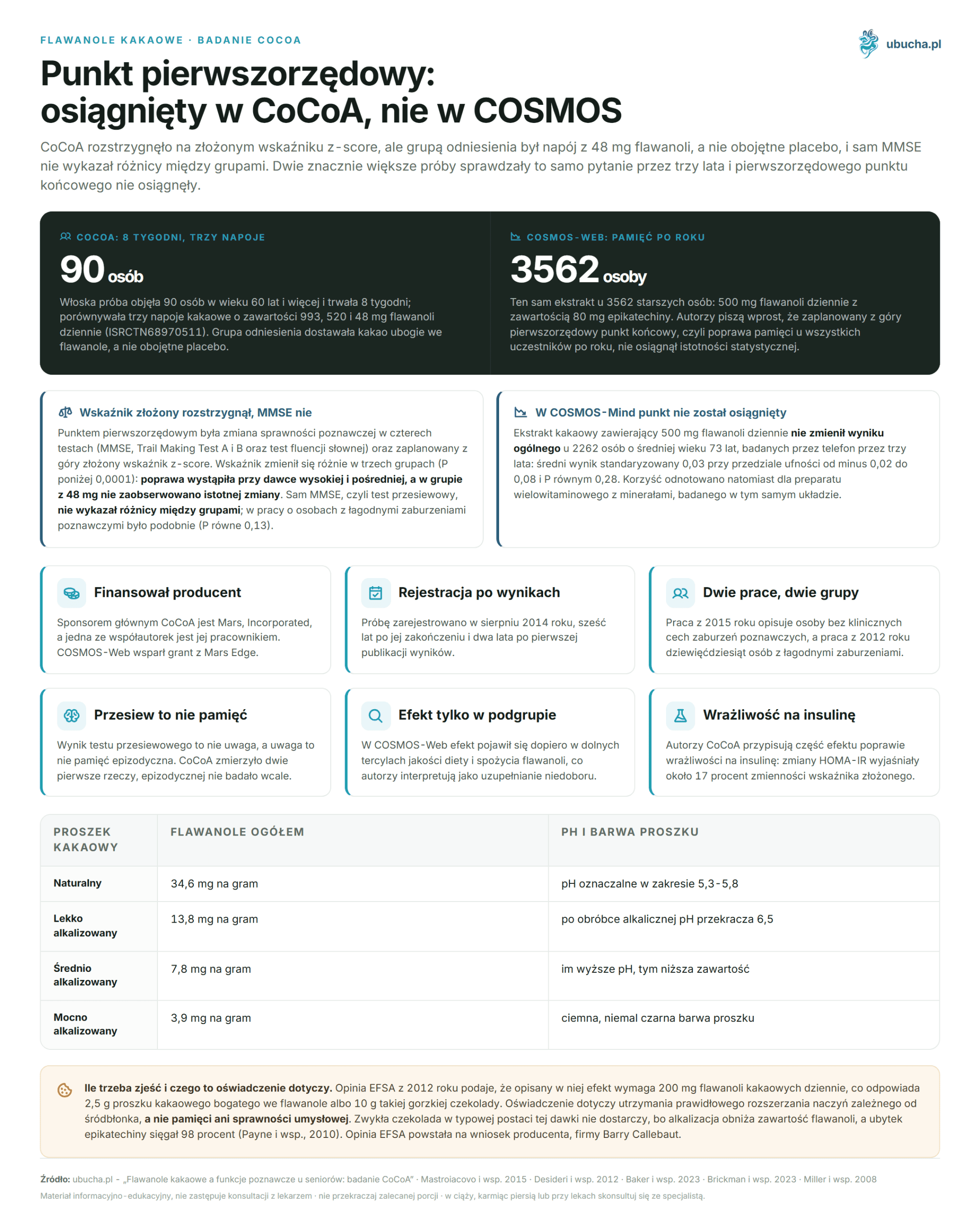
CoCoA is an acronym for Cocoa, Cognition and Aging: an Italian trial in which ninety individuals over sixty consumed a cocoa drink with three different flavanol contents for eight weeks. The study exists, is registered under the number ISRCTN68970511, and has published results. It also has three features that disappear in popular summaries: it was funded by a cocoa producer, the reference group was not a placebo but a drink with a low dose of flavanols, and the most well-known cognitive function screening test showed no difference. Below, we break down CoCoA into its components and compare it with two much larger trials that examined the same question over three years. Both ended differently than the headlines remembered, and this discrepancy is the most interesting part here.
KEY INFORMATION
• CoCoA involved 90 individuals aged 60 and older for 8 weeks, with doses of 993, 520, and 48 mg of cocoa flavanols daily (registration ISRCTN68970511).
• The primary endpoint was the change in cognitive performance in four tests and a composite z-score index, which favored higher doses.
• The MMSE screening test score did not differ between groups.
• The study was sponsored by Mars, and one of the co-authors is an employee of the company.
What is the CoCoA study and who did it involve?
It is a single-center, double-blind, randomized trial with a parallel design, conducted in L’Aquila, Italy. Recruitment began in December 2006, and the study closed in July 2008. The planned sample size was 90 individuals, and the intervention duration was eight weeks.
The entry criterion from the registry states: individuals aged 60 or older who did not self-report concerns about their memory and had no clinically significant comorbidities. This is an important distinction, as two papers under the same program name have appeared with different populations. Results from individuals without cognitive impairment were published in the American Journal of Clinical Nutrition (Mastroiacovo et al., 2015). A separate paper in the journal Hypertension (Desideri et al., 2012) describes ninety older adults with mild cognitive impairment. Anyone citing CoCoA should specify which of these two groups they are referring to.
Participants consumed a milk-based drink daily containing 993, 520, or 48 mg of cocoa flavanols. The reference group received cocoa low in flavanols, not an inert placebo. The drinks were matched for fat, theobromine, and caffeine content to differ mainly in the ingredient of interest to researchers.
What was the primary endpoint of CoCoA and was it achieved?
The registry defines it as the change in cognitive performance after eight weeks, measured by four tests: MMSE, Trail Making Test A and B, and a verbal fluency test. A composite z-score index was also planned as a pre-defined procedure, combining these measurements into a single number. This composite index was decisive.
However, the resolution is heterogeneous in the middle. The composite index changed differently in the three groups (P below 0.0001): improvement occurred with high and intermediate doses, while no significant change was observed in the 48 mg group. The time taken to complete both parts of the Trail Making Test decreased more significantly after high and intermediate doses than after the low dose. Verbal fluency improved in all three groups, but the increase was greatest with 993 mg.
The MMSE itself, the screening test most commonly used to describe “memory status,” showed no difference between groups. The same was repeated in the paper on individuals with mild cognitive impairment, where MMSE was similar across the three arms with P equal to 0.13. The screening test score is not the same as attention, and attention is not the same as episodic memory. CoCoA measured the first two things; it did not examine episodic memory at all. The authors attribute part of the effect to improved insulin sensitivity: changes in the HOMA-IR index explained about 17 percent of the variability in the composite index.
What did the large COSMOS studies show?
Two trials from the COSMOS program examined the same question on a sample several dozen times larger and over three years instead of eight weeks. In both, the primary endpoint for cocoa extract was not achieved. This is a finding that popular summaries usually do not convey.
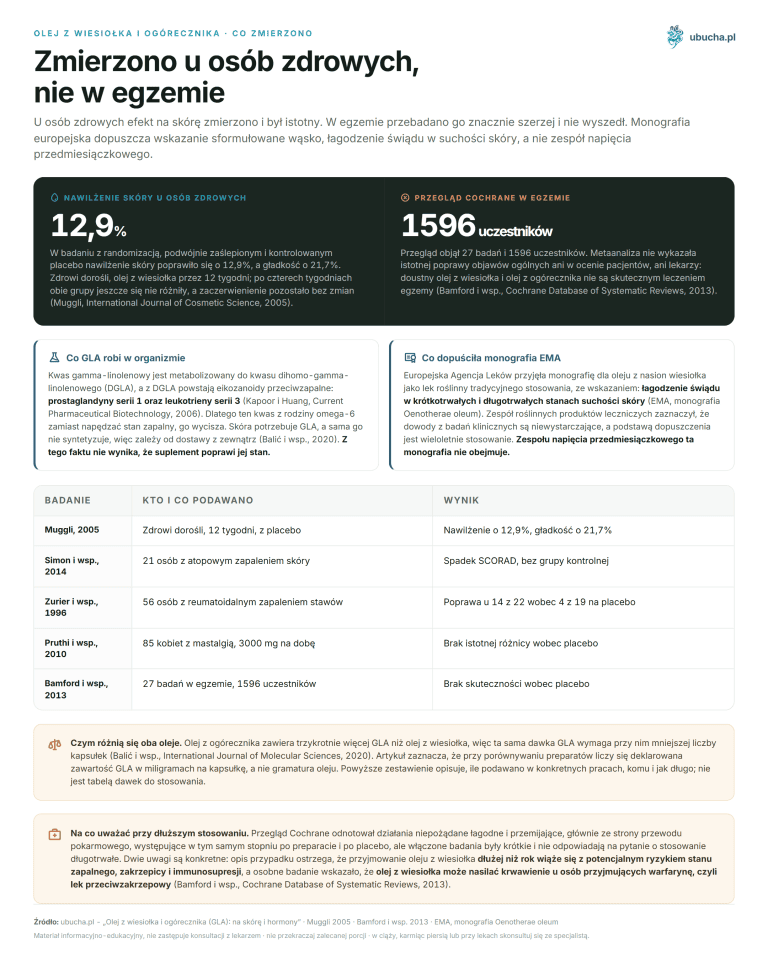
COSMOS-Mind (Baker et al., Alzheimer’s and Dementia, 2023) involved 2262 individuals with an average age of 73, with cognitive tests conducted by phone. Cocoa extract containing 500 mg of flavanols daily did not change the overall score: the mean standardized score was 0.03 with a confidence interval from minus 0.02 to 0.08 and P equal to 0.28. A benefit was noted for a multivitamin-mineral preparation tested in the same setup.
COSMOS-Web (Brickman et al., PNAS, 2023) involved 3562 older individuals taking the same extract, 500 mg of flavanols daily with 80 mg of epicatechins. The authors state directly that the pre-planned primary endpoint, which was memory improvement in all participants after one year, did not achieve statistical significance. The effect only appeared in the lower terciles of diet quality and habitual flavanol intake, which the authors interpret as compensating for a deficiency rather than a pharmacological effect. A broader review of supplements studied for memory can be found in the text on concentration supplements.
Who funded these studies?
The cocoa producer, in each of the described cases. This does not invalidate the results, but the reader has the right to know this before comparing the strength of evidence with studies without such backing.
In the CoCoA registry, the main sponsor is Mars, Incorporated, and the funding source is Mars. The paper in the American Journal of Clinical Nutrition states that the study was supported by a grant from this company, that one of the co-authors is an employee, and that the drinks with high and intermediate flavanol content were prepared from the company’s cocoa powder. It is also worth noting that the trial was registered in August 2014, six years after its completion and two years after the first publication of results.
In COSMOS-Web, the funding section mentions a grant from Mars Edge, and in the conflict of interest declaration, two authors are employed by Mars, Incorporated, two others received a research grant from this company, and the studied extract was provided by the same company. The opinion of the European Food Safety Authority on cocoa flavanols from 2012 was also produced at the request of the producer, Barry Callebaut.
How much flavanols are really in cocoa and chocolate?
Significantly less than would be inferred from the headlines, and this is determined by processing, not the raw material itself. Alkalization, a process known as dutching, linearly reduces flavanol content as the pH of the finished powder increases. The difference between natural cocoa and heavily alkalized cocoa is nearly tenfold.
A review of commercial cocoa powders (Miller et al., Journal of Agricultural and Food Chemistry, 2008) reports an average total flavanol content of 34.6 mg per gram for natural cocoa, 13.8 for lightly alkalized, 7.8 for medium, and 3.9 mg per gram for heavily alkalized. The circulating figure of “2-5 mg per gram of raw cocoa” corresponds, therefore, not to the raw material but to the powder after the most severe processing. A separate paper from the same team (Payne et al., 2010) measured a loss of epicatechin reaching 98 percent after alkalization.
A reference point is provided by the EFSA opinion from 2012: to achieve the effect described therein, one must consume 200 mg of cocoa flavanols daily, which corresponds to 2.5 g of flavanol-rich cocoa powder or 10 g of such dark chocolate. Note the scope of this statement: it concerns maintaining proper endothelium-dependent vasodilation, not memory or cognitive performance. Anyone wanting to check how cocoa behaves in the home kitchen can find a recipe in the text on hemp chocolate.
Frequently Asked Questions
Does a study called CoCoA really exist?
Yes. The full name is Cocoa, Cognition and Aging, and the trial is registered as ISRCTN68970511. It involved 90 people aged 60 and older, lasted eight weeks, and compared three cocoa drinks with daily flavanol contents of 993, 520, and 48 mg. The sponsor was Mars, Incorporated.
Did CoCoA involve people with cognitive impairments?
It depends on which publication you refer to. The 2015 paper describes individuals over sixty without clinical features of cognitive impairment. Desideri’s 2012 paper in the journal Hypertension describes ninety older adults with mild cognitive impairment. Mixing these two groups is a common mistake in summaries.
Do cocoa flavanols improve memory in seniors?
Large trials have not confirmed this. In COSMOS-Mind, cocoa extract did not change the overall cognitive score after three years (P equals 0.28). In COSMOS-Web, the planned primary endpoint regarding memory did not achieve significance in all participants, and the effect appeared only in the subgroup with the poorest diet.
Can regular chocolate provide such a dose?
Not in typical form. The EFSA opinion from 2012 indicates 10 g of dark chocolate rich in flavanols as a source of 200 mg, but this refers to a product prepared while preserving flavanols. Alkalization reduces their content in cocoa powder from about 34.6 to 3.9 mg per gram (Miller et al., 2008).
How to recognize cocoa rich in flavanols?
By the information about the lack of alkalization on the label. Natural cocoa has a pH measurable in the range of 5.3-5.8, while alkalized powders exceed 6.5, with higher pH indicating lower flavanol content (Miller et al., 2008). A dark, almost black color of the powder indicates strong alkalization.
Can cocoa be combined with medications?
The statement accepted by EFSA concerns vasodilation, so combining it with blood pressure-lowering medications should be discussed with a doctor. We did not find clinical studies evaluating the combination of cocoa flavanols with popular adaptogens, so the absence of described interactions is not evidence of their absence. We develop the topic of polypharmacy in older adults in the text on polypharmacy.
This article is for informational and educational purposes and does not replace consultation with a doctor. If you are pregnant, breastfeeding, taking medications, or have chronic conditions, consult the use of supplements or herbs with a specialist.
Author: Michał Waluk · Published: 2026-08-09 · Updated: 2026-08-16