
Cocoa - a natural ally of long life and excellent memory
What cocoa really does: data from the Cochrane review, cognitive studies, and flavanol measurements. Dose from the EFSA claim, alkalization, cadmium, and risk for dogs.
A cup of bitter cocoa will not replace hypertension medication, but a Cochrane review from 2017, covering 35 studies and 1804 participants, showed something more interesting: products rich in cocoa flavanols lowered systolic blood pressure by an average of 1.76 mmHg, and in the subgroup of people with hypertension by 4 mmHg (Ried et al., Cochrane 2017). The effect is small, repeatable, and well described. The problem is that most chocolate bars from the store shelf have little to do with it, as flavanols are lost in processing. This text separates what studies confirm from what marketing has added: you will find here doses from clinical trials, the impact of alkalization on flavanol content, and real dangers for pets.
KEY INFORMATION
• Cochrane review of 35 studies and 1804 participants: systolic blood pressure down by 1.76 mmHg, in people with hypertension by 4 mmHg (Ried et al., 2017).
• The EU health claim requires 200 mg of cocoa flavanols daily.
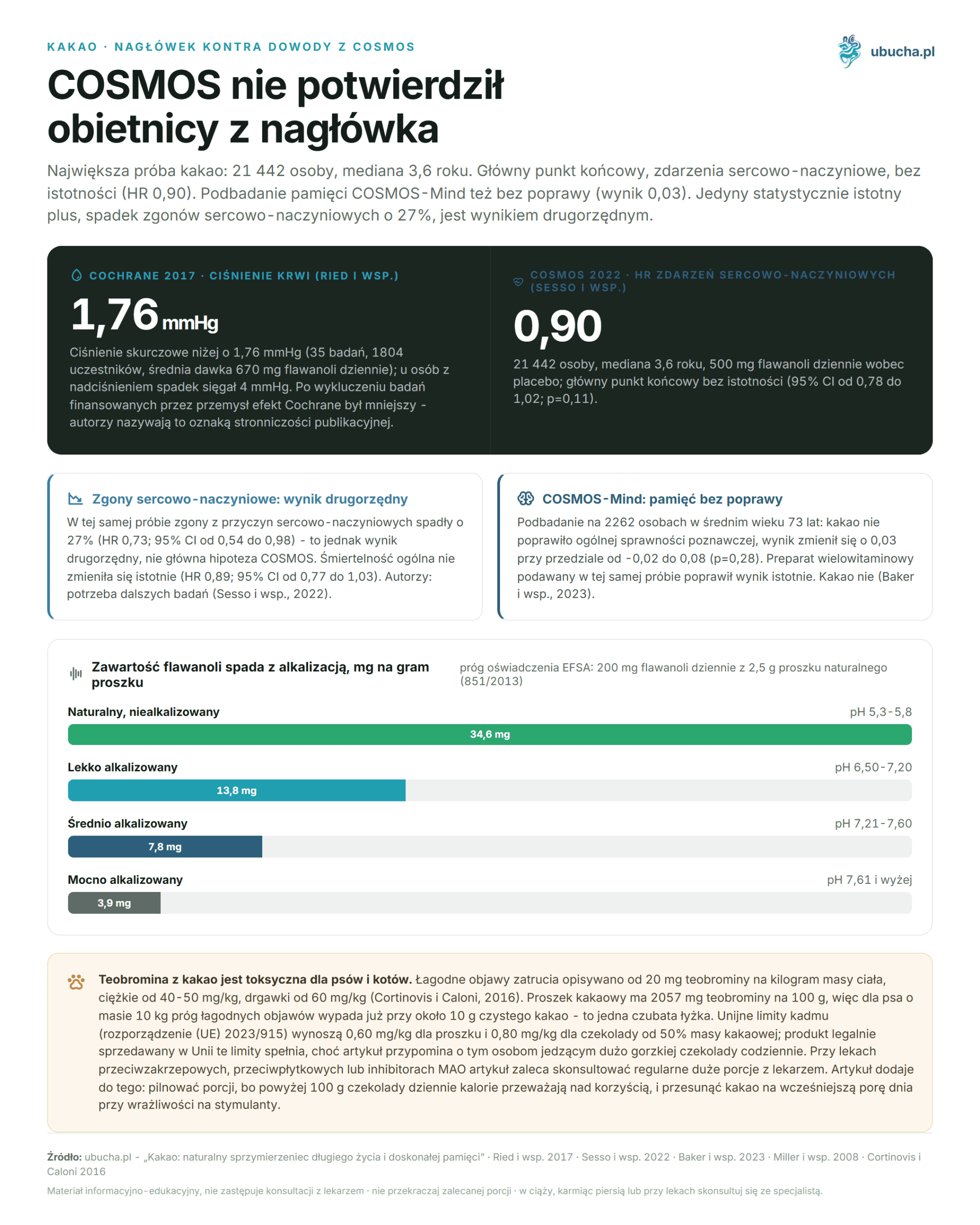
• Alkalization reduces flavanols from 34.6 to 3.9 mg per gram of powder (Miller et al., 2008).
• Theobromine from cocoa is toxic to dogs and cats.
Where did cocoa come from and why is it called the food of the gods?
The botanical name Theobroma cacao, in Greek “food of the gods”, was given to the plant by Carl Linnaeus in 1753. However, cocoa had the status of a ritual drink much earlier. In Mesoamerica, fermented beans were consumed, paid with, and served during ceremonies for nearly three thousand years before anyone in Europe heard of them.
The drink that the Mayans consumed did not resemble today’s cocoa with milk. It was bitter, thick, and spicy from chili, frothed by pouring from vessel to vessel. Sweetness was added only by the Spaniards, and mass availability was provided by nineteenth-century mechanization.
| When | What happened |
|---|---|
| around 1500 BC | The oldest traces of processed cocoa beans in vessels of the Olmec culture in present-day Mexico |
| Mayan and Aztec cultures | Bitter drink spiced with chili and vanilla, beans as a means of payment and ceremonial gift |
| 1528 | Hernán Cortés brings beans to Spain; the court sweetens the drink with cane sugar and cinnamon |
| 1828 | Coenraad van Houten patents a press separating cocoa butter from powder |
| 1875 and 1879 | Daniel Peter adds milk to chocolate, Rodolphe Lindt develops conching |
The separation of fat from powder had a side effect that is rarely remembered: it is precisely from van Houten’s press that cocoa powder begins as a separate product, along with alkalization, which still determines how many flavanols will remain in the finished product.
What bioactive compounds make cocoa work?
Cocoa’s effects are due to several groups of compounds at once, not just one active ingredient. The best-documented are flavanols: epicatechin, catechin, and procyanidins. Alongside them works the alkaloid theobromine and an unusually dense set of minerals, with magnesium at the forefront.
| Component | Per 100 g of unsweetened powder | What it contributes |
|---|---|---|
| Flavanols | 34.6 mg per gram of natural powder | Stimulate nitric oxide synthase in the endothelium of blood vessels |
| Theobromine | 2057 mg | Methylxanthine alkaloid, acts milder and longer than caffeine |
| Caffeine | 230 mg | About 12 mg in one tablespoon of powder |
| Magnesium | 499 mg | One of the densest sources of magnesium among food products |
| Iron, zinc, copper | 13.86 mg, 6.81 mg, 3.79 mg | Copper in amounts rarely found in the diet |
| Energy value | 228 kcal | Applies to unsweetened powder, not bars |
Epicatechin stimulates endothelial nitric oxide synthase, resulting in more nitric oxide being produced in the vessel wall. The vessel dilates, peripheral resistance decreases, and blood pressure drops. This mechanism underlies the health claim I discuss below.
An interesting fact concerns anandamide. In 1996, a team led by Daniele Piomelli described in Nature the presence of this endocannabinoid in cocoa beans along with compounds that delay its breakdown (di Tomaso et al., Nature 1996). However, the amounts are trace and no study has shown that they translate into a noticeable psychoactive effect. The same applies to phenylethylamine: intestinal monoamine oxidase breaks it down before it reaches the brain.
How does cocoa affect blood pressure and blood vessels?
This is the best-studied area. The Cochrane review from 2017 gathered 35 studies and 40 comparisons involving 1804 participants who were given between 30 and 1218 mg of flavanols daily (an average of 670 mg) for 2 to 18 weeks. Systolic blood pressure decreased by 1.76 mmHg, and diastolic by the same amount.
Confidence intervals are more important here than the averages themselves: for systolic pressure, they range from -3.09 to -0.43 mmHg, for diastolic from -2.57 to -0.94 mmHg. The authors summarize this as an effect of around 2 mmHg with moderate quality evidence, rather than as an intervention comparable to treatment.
The subgroup of people with hypertension performed better, with a decrease in systolic pressure of 4 mmHg, while there was no difference in people with normal blood pressure. The test for differences between subgroups was on the borderline of significance, so the authors themselves treat this result as a hypothesis to be confirmed.
There is one more thing that marketing summaries of this review do not provide. Sensitivity analysis, which excluded studies with authors employed by the sponsoring industry, yielded a smaller effect. Cochrane reviewers directly call this a sign of publication bias, and this is one of the reasons for lowering the evidence rating from high to moderate.
Does cocoa really improve memory and brain function?
Partially yes, but the picture is more complex than headlines suggesting reversing brain age. Three controlled trials on older adults yielded positive results in some tests and zero in others, and the largest and most recent of them did not reach its primary endpoint.
| Study | Who and for how long | Flavanol dose | Result |
|---|---|---|---|
| Mastroiacovo et al., 2015 | 90 older adults without cognitive impairment, 8 weeks | 993, 520 or 48 mg daily | Shorter time in the point connection test and better verbal fluency score; MMSE score with no differences between groups |
| Brickman et al., 2014 | Healthy individuals aged 50-69, 3 months | High or low flavanol diet | Improvement in dentate gyrus function in fMRI imaging and in cognitive task |
| Sloan et al., 2021 | 211 individuals aged 50-75, 12 weeks | 260, 510 or 770 mg daily | Primary endpoint with no improvement; improvement in list learning test, mainly in individuals with the worst diet quality |
It is worth comparing these three studies with each other, as they show how narrow the actual conclusions are. In Mastroiacovo, the improvement concerned processing speed and verbal fluency, not overall cognitive performance measured by the MMSE scale. The participants had no cognitive impairments, so no conclusions can be drawn from this work about treating anything.
In Sloan’s study, the effect appeared primarily in individuals with the worst baseline diet quality. This suggests that flavanols close the deficiency in someone who does not receive them, rather than adding efficiency to someone who eats well. If you are looking for a broader overview of ingredients described as memory support, I have gathered them in a ranking of natural nootropics.
What did the largest cocoa study in history show?
The largest trial on cocoa flavanols, COSMOS, involved 21,442 older adults and lasted a median of 3.6 years. Participants took daily cocoa extract with 500 mg of flavanols or a placebo. The primary endpoint, the total number of cardiovascular events, was not significant: HR 0.90 with a confidence interval from 0.78 to 1.02 and a p-value of 0.11.
The secondary outcome looks different and it made headlines. Deaths from cardiovascular causes decreased by 27% (HR 0.73; 95% CI from 0.54 to 0.98), while overall mortality did not change significantly (HR 0.89; 95% CI from 0.77 to 1.03). A protocol-compliant analysis, cutting off observation at the time of discontinuation of the preparation, showed a lower risk of combined events (HR 0.85). The authors do not declare success on this basis: they state that further research is needed (Sesso et al., 2022).
The same trial included a cognitive sub-study, COSMOS-Mind, involving 2262 individuals with an average age of 73, conducted over three years. Cocoa extract did not improve overall cognitive performance: the average change in the standardized score was 0.03 with a range from -0.02 to 0.08 and a p-value of 0.28 (Baker et al., 2023). A multivitamin preparation given in the same trial significantly improved the score. Cocoa did not.
Comparing these two publications with the short trials described above provides a coherent picture. Cocoa shifts intermediate parameters: blood pressure, flow in vessels, insulin sensitivity, and some cognitive tests in the horizon of weeks. However, when hard endpoints are measured over several years, the effect either disappears or remains within uncertainty. This is not an argument against cocoa. It is an argument against treating it like a drug.
What does cocoa do to metabolism and insulin sensitivity?
It improves insulin sensitivity, at least in the short term and with large portions. The most frequently cited work is Grassi’s crossover study from 2008: 19 individuals with hypertension and impaired glucose tolerance received 100 g of flavanol-rich chocolate or white chocolate without them daily for 15 days.
After flavanol-rich chocolate, insulin resistance measured by the HOMA index decreased, insulin sensitivity and beta cell function increased, systolic blood pressure dropped by 3.82 mmHg, and diastolic by 3.92 mmHg (Grassi et al., 2008). Total cholesterol decreased by 6.5%, and LDL fraction by 7.5%. White chocolate changed nothing.
The same direction is seen in Mastroiacovo, where the improvement in insulin resistance explained about 17% of the change in the composite cognitive score. Metabolism and the brain are connected here, not separate.
However, before you translate this into your own kitchen, calculate the portion. One hundred grams of chocolate daily for two weeks is a research protocol, not a dietary recommendation: such a portion carries several hundred calories and a lot of saturated fat, and the study did not check what happens after two weeks.
How to choose cocoa and dark chocolate to retain flavanols?
The content of flavanols is determined by processing, not the declared percentage of cocoa. Alkalization, known as the Dutch process, involves treating the bean or powder with alkalis. It gives a darker color and milder taste, while removing most flavanols.
| Type of cocoa powder | pH | Average flavanol content (mg per gram) |
|---|---|---|
| Natural, non-alkalized | 5.3-5.8 | 34.6 |
| Lightly alkalized | 6.50-7.20 | 13.8 |
| Medium alkalized | 7.21-7.60 | 7.8 |
| Strongly alkalized | 7.61 and above | 3.9 |
The measurement comes from a review of the composition of commercial cocoa powders, in which the decrease in flavanol content proved to be linear with respect to the pH of the finished product (Miller et al., 2008). The difference between natural powder and strongly alkalized is nearly ninefold, which is significantly more than the change from 70% to 85% chocolate would be.
On the label, look for terms like “natural cocoa” or “non-alkalized”. The phrase “processed with alkali” or “Dutch process” indicates a loss. Milk chocolate is excluded for another reason: it has little cocoa mass and a lot of sugar, so even with intact flavanols, the portion would be unrealistic.
How much cocoa daily and at what time?
The reference point is the health claim approved in the EU by Regulation (EU) 851/2013 based on the EFSA opinion from 2012. It states that cocoa flavanols help maintain the elasticity of blood vessels, contributing to proper blood flow.
The condition for use is specific: 200 mg of cocoa flavanols daily, provided by 2.5 g of high-flavanol cocoa powder or 10 g of high-flavanol dark chocolate (EFSA Journal 2012;10(7):2809). The term “high-flavanol” is a technical term, not a synonym for a high percentage of cocoa, and it determines whether the portion makes sense.
Doses from cognitive studies were clearly higher, from 260 to 993 mg daily, and came from standardized drinks prepared for the study. It is difficult to achieve these amounts from regular food without excess calories, so treat them as a description of an experiment, not as a target to reach.
The time of day matters for those sensitive to stimulants. Cocoa contains both caffeine and theobromine, and the latter acts milder but longer. If you sleep worse after afternoon coffee, the same will happen with evening cocoa. The simplest form is unsweetened powder in a smoothie or warm drink: a ready recipe for cocoa with hemp oil shows a sugar-free version.
Which claims about cocoa do not hold up?
Four statements repeated in articles about cocoa have no backing in the data they cite. It is not that cocoa does not work, but that it works in a different place and on a different scale than popular summaries suggest.
| Repeated claim | What the data say |
|---|---|
| Cocoa is the same as chocolate | Unsweetened powder has 228 kcal per 100 g and no sugar; milk chocolate has more than twice that with little cocoa mass |
| Dark chocolate helps lose weight | None of the discussed studies measured body weight; improvement in insulin resistance is not the same as weight loss |
| Cocoa can replace magnesium supplements | 499 mg of magnesium is in 100 g of powder, but a real tablespoon gives about 25 mg, which is a few percent of the requirement |
| Any dark cocoa has a lot of flavanols | After strong alkalization, only 3.9 mg of flavanols per gram remain compared to 34.6 mg in natural powder |
The most common mistake is confusing the density of the ingredient with the size of the portion. Cocoa is indeed one of the densest dietary sources of magnesium per hundred grams, but no one eats a hundred grams of powder. The same mistake recurs with iron and copper.
The second repeatable mistake concerns what the study actually measured. None of the trials described above had body weight as an endpoint, so the statement about weight loss has no basis, even if it sounds credible alongside true data about insulin resistance.
Is cocoa safe for everyone?
For healthy adults, culinary portions are safe, but three issues require attention: pets, cadmium, and medications. The first is the most serious, as it concerns doses that accidentally appear at home.
Theobromine is toxic to dogs and cats. In a review of food poisoning in small animals, mild symptoms were reported after 20 mg of theobromine per kilogram of body weight, severe after 40-50 mg/kg, and seizures after 60 mg/kg (Cortinovis and Caloni, 2016). Combine this with the theobromine content in cocoa powder, which is 2057 mg per 100 g, and it turns out that for a 10 kg dog, the threshold for mild symptoms is around 10 g of pure cocoa. That’s one heaping tablespoon.
Cadmium is a problem of the plant itself, which absorbs it from the soil, so it cannot be washed out or sifted. The EU has set maximum allowable levels in Regulation (EU) 2023/915: 0.60 mg/kg for cocoa powder sold to consumers and 0.80 mg/kg for chocolate with a cocoa dry mass content of 50% or higher. A product legally sold in the EU meets these limits, and it is worth reminding those who eat large amounts of dark chocolate daily.
Then there are medications. If you are taking anticoagulants, antiplatelet drugs, or monoamine oxidase inhibitors, discuss regular large portions of cocoa with your doctor, rather than estimating it yourself. The same applies to pregnancy and breastfeeding, where the total daily dose of caffeine from all sources matters, not just cocoa.
What can you find on the Polish cocoa market?
The market today is divided into three layers, which differ not only in price. At the bottom are alkalized powders from the food shelf, above are dark chocolates from mass brands and artisanal bean-to-bar manufacturers, and separately, the category of functional cocoa with additives is growing.
Alkalized powders win in taste and solubility, but lose in flavanol content. Manufacturers sourcing beans from specific plantations provide a clearer sensory profile, but rarely state the flavanol content, so the health difference compared to a good mass bar cannot be read from the label.
The third layer includes cocoa and chocolates with functional mushrooms or adaptogens added. Here, the promise concerns not the cocoa itself, but the additive, and its dose must be checked on the label. In the category of adaptogens, functional chocolates today cost from 69 to 79 PLN for 100 g, as of the catalog date of August 10, 2026. How such a combination performs in daily drinking is described separately in the post about cocoa with adaptogens.
No producer operating in Poland states the flavanol content on the packaging, as the law does not require it. The declared percentage of cocoa refers to the share of cocoa mass and fat, not to how much of the flavanols survived roasting and possible alkalization. This is a discrepancy that cannot be resolved from the store shelf.
The practical conclusion is therefore modest. If you care about flavanols, buy powder described as natural or non-alkalized and prepare it yourself. If you care about taste, choose by flavor and do not pay extra for a health promise that the label cannot support with numbers.
Is it worth including cocoa in your daily diet?
Yes, provided you treat it as a good dietary ingredient, not as a drug. Data from controlled trials show a small decrease in blood pressure, improvement in insulin sensitivity, and a narrow improvement in some cognitive functions. None of these effects replace treatment, and none appear after one cup.
The title of this entry promises long life and excellent memory, so it is fair to say directly where this promise ends. In the COSMOS trial, cocoa extract did not significantly reduce the total number of cardiovascular events or overall mortality, and in the cognitive sub-study, it did not improve mental performance at all. The only remaining outcome is a reduction in cardiovascular deaths as a secondary result, which requires confirmation. Cocoa is a good food product with a moderate impact on intermediate parameters, and that is all that can be defended with data today.
Practically, this boils down to four decisions. Choose non-alkalized powder, as this is where the biggest difference in flavanol content lies. Watch your portions, as above one hundred grams of chocolate daily, calories outweigh the benefit. Move cocoa to an earlier time of day if you react to stimulants. Keep it out of reach of dogs and cats, as the risk scale is completely different than for humans.
The rest is a matter of taste. Cocoa has the rare property that the best-documented form of its consumption, namely unsweetened powder without additives, is also the cheapest and most readily available.
Frequently asked questions
How many cocoa flavanols should I eat daily?
The EU health claim approved by Regulation (EU) 851/2013 states that 200 mg of cocoa flavanols daily is required, which is 2.5 g of high-flavanol powder or 10 g of high-flavanol dark chocolate. Cognitive studies reported higher amounts, from 260 to 993 mg daily, and such quantities cannot be provided by a regular chocolate bar.
Does alkalized cocoa have any value?
It has taste and mineral value, not flavanol value. In measurements by Miller and colleagues, natural powder had an average of 34.6 mg of flavanols per gram, while strongly alkalized had 3.9 mg, which is nearly nine times less. Magnesium, iron, and theobromine remain, as alkalization does not affect them.
By how much does cocoa lower blood pressure?
The Cochrane review from 2017 reports a decrease in systolic blood pressure by 1.76 mmHg (95% CI from -3.09 to -0.43) and diastolic by 1.76 mmHg (95% CI from -2.57 to -0.94). In the subgroup of people with hypertension, the decrease in systolic pressure reached 4 mmHg. The authors describe this effect as small, and the quality of evidence as moderate.
Can I drink cocoa every day?
Yes, as long as it is a culinary portion, meaning a tablespoon or two of unsweetened powder. Such an amount will not approach the doses from cognitive studies, but it falls within the threshold of 200 mg of flavanols from the EU claim, provided the powder is non-alkalized. Daily 100 g of chocolate already means several hundred calories in excess.
How much caffeine is in cocoa?
Unsweetened cocoa powder contains 230 mg of caffeine and 2057 mg of theobromine per 100 g according to the USDA FoodData Central database. A tablespoon of powder weighs about 5 g, which gives approximately 12 mg of caffeine. A cup of brewed coffee provides several times more.
Can cocoa replace a magnesium tablet?
Not in a typical portion. One hundred grams of powder contains 499 mg of magnesium, but no one eats a hundred grams: a tablespoon provides about 25 mg, which is a few percent of the daily requirement. Cocoa is a very dense source of magnesium by weight, but the portion turns out small.
How much chocolate does it take to harm a dog?
Mild symptoms have been reported in dogs after 20 mg of theobromine per kilogram of body weight, severe after 40-50 mg/kg, and seizures after 60 mg/kg. Cocoa powder contains 2057 mg of theobromine per 100 g, so for a 10 kg dog, the threshold for mild symptoms is already around 10 g of pure cocoa.
Does dark chocolate from the shelf provide as much flavanols as natural cocoa?
Usually not. The EU claim refers to high-flavanol dark chocolate, which is a technical category, not a synonym for a high percentage of cocoa. The manufacturer may use alkalized mass, after which only a fraction of flavanols remains, and still describe the bar as 70% dark.
Functional cocoa and blends with additives have been gathered in the cocoa category, and a wider selection of products with mushrooms and adaptogenic herbs can be found in the adaptogens category.
This article is for informational and educational purposes and does not constitute medical advice. Before starting supplementation, consult your doctor, especially if you are taking medications regularly, are pregnant or breastfeeding, or have chronic illnesses.
Author: Michał Waluk · Published: 2026-05-11 · Updated: 2026-08-10