
Why Some Strains Stimulate While Others Soothe: Chemovar, Not Indica/Sativa
The indica or sativa label does not predict the composition or action of a cannabis strain. We check what has really been measured about terpenes, chemovars, and the entourage effect.
The seller says: this strain is sativa, so it stimulates, and that one is indica, so it soothes. It sounds like practical knowledge, but it describes the plant’s morphology and the history of names, not its chemistry. Geneticists studied 81 cannabis strains, and the agreement between their declared origin of indica or sativa and the actual genetic structure was only moderate, with many names lacking distinct genetic identity. Chemists went further and checked whether commercial labels matched the composition of real samples sold. They do not match. In this text, we show what a chemovar is, what has actually been measured regarding terpenes, and why popular tables linking one terpene to one mood have no basis in human studies today.
KEY INFORMATION
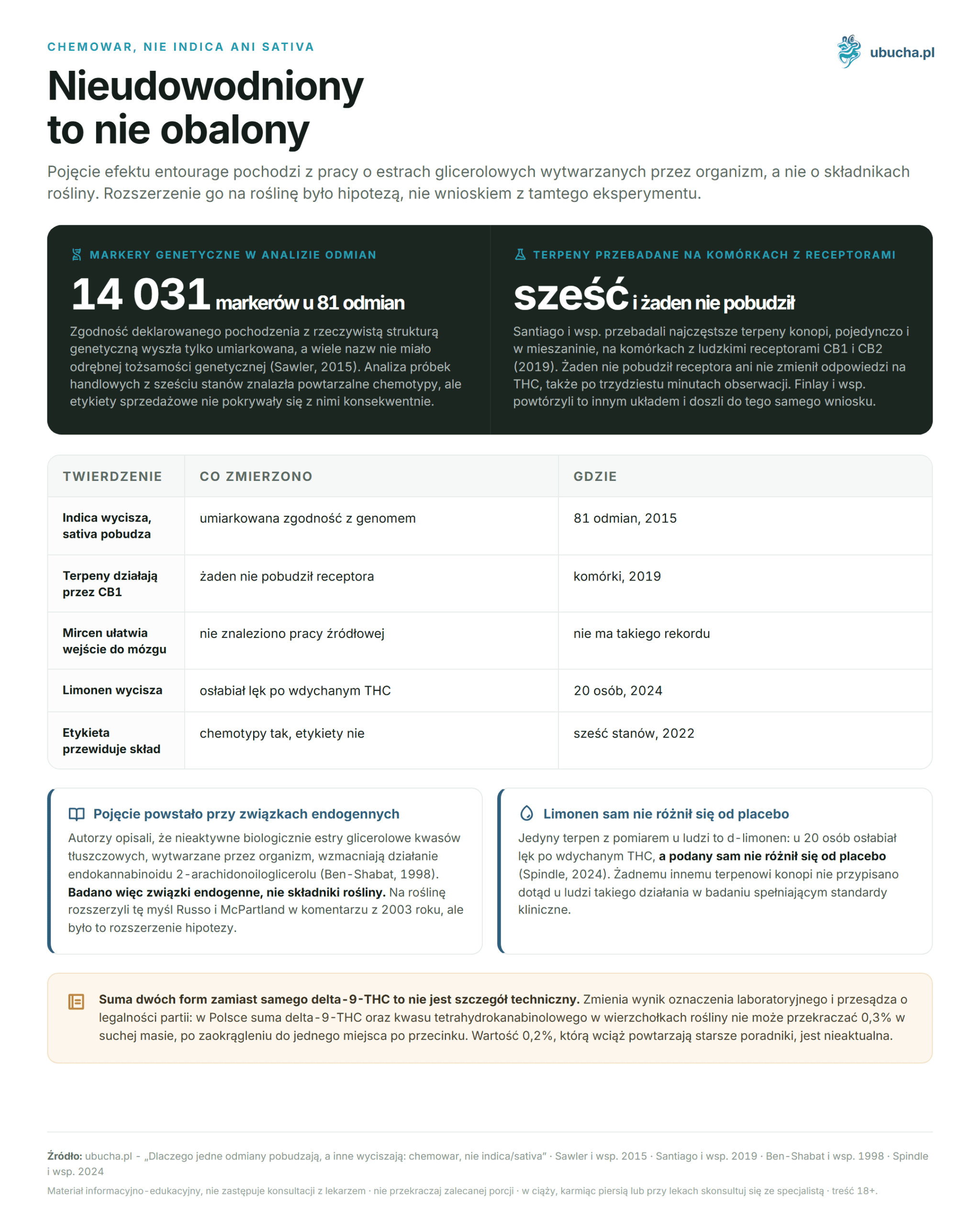
• An analysis of 14,031 SNP markers in 81 cannabis strains showed only moderate agreement between the indica or sativa label and the genome, and strain names often did not correspond to distinct genetic identity (Sawler et al., PLoS ONE, 2015).
• An analysis of commercial samples from six US states found repeatable chemotypes, but sales labels did not consistently match them (Smith et al., PLoS ONE, 2022).
• The six most common cannabis terpenes did not stimulate CB1 or CB2 receptors and did not change the response to THC in cell studies (Santiago et al., Cannabis and Cannabinoid Research, 2019).
• The only terpene with measurement in humans is d-limonene: in 20 individuals, it reduced anxiety after inhaled THC, and when administered alone, it did not differ from placebo (Spindle et al., Drug and Alcohol Dependence, 2024).
• In Poland, legal flower is industrial hemp: the sum of delta-9-THC and THCA from the plant’s tops cannot exceed 0.3% (Article 4 point 5 of the Act on Counteracting Drug Addiction).
Where Did the Names Indica and Sativa Come From?
Both names date back to the 18th century and were created to describe economic plants. Carl Linnaeus named Cannabis sativa in 1753 for the plant cultivated in Europe for fiber and seeds. Jean-Baptiste Lamarck distinguished Cannabis indica in 1785 based on specimens from India, noting narrower leaves, a sturdier stem, and different resin. Neither studied the psychological effect, as they lacked the tools to do so.
Breeders added practical significance two centuries later. In the 1970s and 1980s, the thumb rule became established: sativa gives energy, indica puts you to sleep. The rule is convenient because it reduces the complex plant to two categories, and it has persisted because it was accurate in some cases. However, it was not accurate due to the reason given by the label. Analysis of commercial samples shows that some names exhibit a bias towards certain chemotypes, meaning that the hits come through composition, not through leaf morphology (Smith et al., PLoS ONE, 2022).
Intensive crossing over the last four decades has blurred this relationship as well. Practically the entire current offer consists of hybrids, and the trade name is the property of the breeder, not a botanical category. A broader historical outline is described in the text Sativa vs Indica: how do they differ.
Does the strain label predict its chemical composition?
Not to the extent that would allow anything to be based on it. Sawler and colleagues genotyped 14,031 SNP markers in 81 cannabis strains and 43 industrial hemp strains. The agreement between the declared origin of indica or sativa and the actual genetic structure was moderate, and the authors state outright that strain names often do not correspond to distinct genetic identity. Along the way, something unexpected emerged: industrial hemp turned out to be genetically closer to indica-type strains than to sativa-type strains (Sawler et al., PLoS ONE, 2015).
However, the genome is not the same as the composition, and the customer is interested in the composition. This second layer was measured by Smith’s team, analyzing cannabinoid and terpene content in commercial samples from six US states. Repeatable chemotypes exist and can be described numerically. Commercial labels do not consistently match them, although some names exhibit a bias towards a specific chemotype (Smith et al., PLoS ONE, 2022).
The practical conclusion is more cautious than the popular slogan “indica and sativa are myths.” The division describes real differences in the appearance of the plant and a real naming tradition. However, it does not describe what will be found in a specific jar, as between the name and the analysis stand the breeder, growing conditions, and drying method.
What is a chemovar and what does this term actually describe?
A chemovar, or chemical variant, is a strain described by its chemical profile instead of morphology. In the case of cannabis, the description includes the dominant cannabinoid, dominant terpenes, and the ratios between them. Chemotypic classification divides plants most often by the ratio of THC to CBD: THC-dominant type, mixed type, and CBD-dominant type. This is a laboratory division, not a label one, so it can be replicated.
This change in language has one clear advantage and one clear limitation. Advantage: a chemovar is verifiable. Two samples with the same trade name may have different analysis results, and then it is immediately visible, without referring to impressions. Limitation: the chemical profile itself still does not predict the experience of a specific person, as between composition and sensation stand dosage, route of administration, tolerance, and context of consumption.
It is worth keeping these two layers separate, as the corpus of texts about cannabis notoriously merges them. The statement “this sample has 2.1% limonene” is a measurement. The statement “this sample will stimulate you” is a prediction that cannot be derived from the measurement in the current state of research. Everything below concerns this very difference.
Does a single terpene account for stimulation or soothing?
Tables assigning one terpene to one mood have circulated in industry materials for years and have no basis in human studies. Their foundation is work on cell cultures and rodents, conducted at concentrations higher than those found in flower. Checking at the source gives a more modest picture, but one that is verifiable.
| Terpene | What was measured | On what | What does not follow from this |
|---|---|---|---|
| Beta-caryophyllene | Selective binding to CB2 receptor and anti-inflammatory action | Cells and mice (Gertsch et al., 2008) | No effect measured in humans after flower |
| D-limonene | Reduction of anxiety and paranoia after inhaled THC | 20 adults, double-blind (Spindle et al., 2024) | Administered alone did not differ from placebo |
| Myrcene, linalool, limonene, both pinene, beta-caryophyllene | No effect on CB1 and CB2 receptor signaling, even in the presence of THC | Cells (Santiago et al., 2019; Finlay et al., 2020) | The entourage effect does not run through these two receptors |
| Alpha-humulene, geraniol, linalool, beta-pinene | Cannabinoid-like behaviors and enhancement of agonist action | Mice (LaVigne et al., 2021) | Result has not yet been transferred to humans |
The most interesting row is the one with limonene, as it is the only entry with measurement in humans. Twenty healthy adults underwent nine blinded outpatient sessions with inhaled THC, d-limonene alone, or both substances together. Limonene administered alone did not differ from placebo in any measured parameter, while together with a higher dose of THC, it significantly reduced anxiety and paranoia ratings. Other effects remained unchanged (Spindle et al., Drug and Alcohol Dependence, 2024). This is a real result, but much narrower than the slogan “limonene stimulates.”
Separately, it is worth noting what we did not find. The popular statement that myrcene facilitates THC’s passage through the blood-brain barrier has no source literature to which one could refer. Title queries in Europe PMC about myrcene together with the blood-brain barrier and myrcene together with sedation return no records. Until such a paper appears, this is an unmeasured claim.
What has really been shown about the entourage effect?
The concept comes from the work of Ben-Shabat’s team in 1998 and referred to something different than today’s marketing suggests. The authors described that biologically inactive glycerol esters of fatty acids, produced by the body, enhance the action of the endocannabinoid 2-arachidonoylglycerol (Ben-Shabat et al., European Journal of Pharmacology, 1998). Thus, endogenous compounds were studied, not plant components. Russo and McPartland expanded this thought to the plant in a 2003 commentary, arguing that the action of cannabis is not limited to delta-9-THC alone (Psychopharmacology, 2003). However, this was an extension of the hypothesis, not a conclusion from Ben-Shabat’s experiment.
The hypothesis has been tested several times since then. Santiago and colleagues studied the six most common cannabis terpenes, both individually and in mixtures, on cells with human CB1 and CB2 receptors. None stimulated the receptor or changed the response to THC, even after thirty minutes of observation. Finlay and colleagues repeated this with a different setup, adding a radioligand binding study, and reached the same conclusion, with the possible exception of a weak interaction of beta-caryophyllene with CB2.
A 2023 review by Christensen cautiously summarizes the dispute: the literature is still sparse, preclinical and clinical studies rely on simplified methods and yield conflicting results, and clinical data is mainly anecdotes and observations from practice. The authors propose explaining the phenomena through ordinary pharmacological concepts, namely synergy and enhanced bioavailability, rather than a separate name (Christensen et al., Biomedicines, 2023). The entourage effect is therefore not disproven. It is unproven, which is a completely different state.
How to read the laboratory test result of flower?
The certificate of analysis is the only document that provides verifiable numerical information about the product. It is worth looking at three things at once: who performed the test, which compounds it covered, and which sample it pertains to. The terpene panel is measured by gas chromatography, as terpenes are volatile. Cannabinoids are measured by liquid chromatography, which separates acidic forms from neutral ones, and at the legal threshold, the sum of delta-9-THC and THCA counts. Both techniques are described in a review of analytical methods for cannabis (Micalizzi et al., Journal of Chromatography A, 2021).
The batch number links the document to a specific collection. A certificate without a batch number or date describes some plant, not necessarily the one in the package. Aroma is a weaker clue than commonly assumed: in the 2025 lexicon of flower aroma, terpene profiles poorly predicted the experiences of assessors, which we discuss in the text New Cannabis Aroma Dictionary.
There remains the legal threshold, without which everything else hangs in the air. In Poland, industrial hemp is defined as plants in which the sum of delta-9-THC and tetrahydrocannabinolic acid in the plant’s tops does not exceed 0.3% in dry mass, rounded to one decimal place. The basis is Article 4 point 5 of the Act on Counteracting Drug Addiction as amended by the Act of March 24, 2022, Journal of Laws 2022 item 763. The national threshold corresponds to the EU threshold, but it does not follow from it, as these are two separate regulations of the same value. The value of 0.2%, which older guides still repeat, is outdated. The sum of the two forms instead of just delta-9-THC is not a technical detail: it changes the result of the laboratory measurement and determines the legality of the batch.
Frequently Asked Questions
What is a chemovar and how does it differ from a strain?
A chemovar is a description of a plant by its chemical profile: dominant cannabinoid, dominant terpenes, and the ratios between them. A strain is a trade name given by the breeder. A chemovar can be replicated in a laboratory, while a trade name cannot be verified by anything other than the seller’s declaration.
Is the division into indica and sativa completely useless?
No. It describes real differences in the plant’s morphology and a real naming tradition. However, it does not describe how a specific batch will act. An analysis of 81 cannabis strains showed only moderate agreement between the declared origin and the genetic structure (Sawler et al., PLoS ONE, 2015).
Which terpene stimulates and which soothes?
No cannabis terpene has yet been assigned such effects in humans in a study meeting clinical standards. The only result involving humans concerns d-limonene, which reduced anxiety after inhaled THC in 20 individuals, while being administered alone did not differ from placebo (Spindle et al., 2024).
Does the entourage effect exist?
It remains a hypothesis. The six most common cannabis terpenes did not stimulate CB1 or CB2 receptors and did not change the response to THC in cell studies. A 2023 review states that clinical data is mainly based on anecdotes and suggests explaining the phenomenon through ordinary pharmacological synergy.
Does myrcene facilitate THC’s passage to the brain?
We did not find a source paper that measured this. Title queries in Europe PMC about myrcene together with the blood-brain barrier and myrcene together with sedation return no records. The claim circulates in industry materials without reference to a study and should be treated as unverified.
How much THC can legal hemp flower contain in Poland?
The sum of delta-9-THC and tetrahydrocannabinolic acid in the plant’s tops cannot exceed 0.3% in dry mass, rounded to one decimal place. The basis is Article 4 point 5 of the Act on Counteracting Drug Addiction, as amended by Journal of Laws 2022 item 763. The value of 0.2% is outdated.
If you want to compare the terpene profiles of specific products, a compilation of legal batches along with analytical documents can be found in the flower category.
This article is for informational and educational purposes and does not replace consultation with a doctor. If you are pregnant, breastfeeding, taking medications, or have chronic conditions, consult the use of supplements or herbs with a specialist.
Author: Michał Waluk · Published: 2026-08-09 · Updated: 2026-08-16