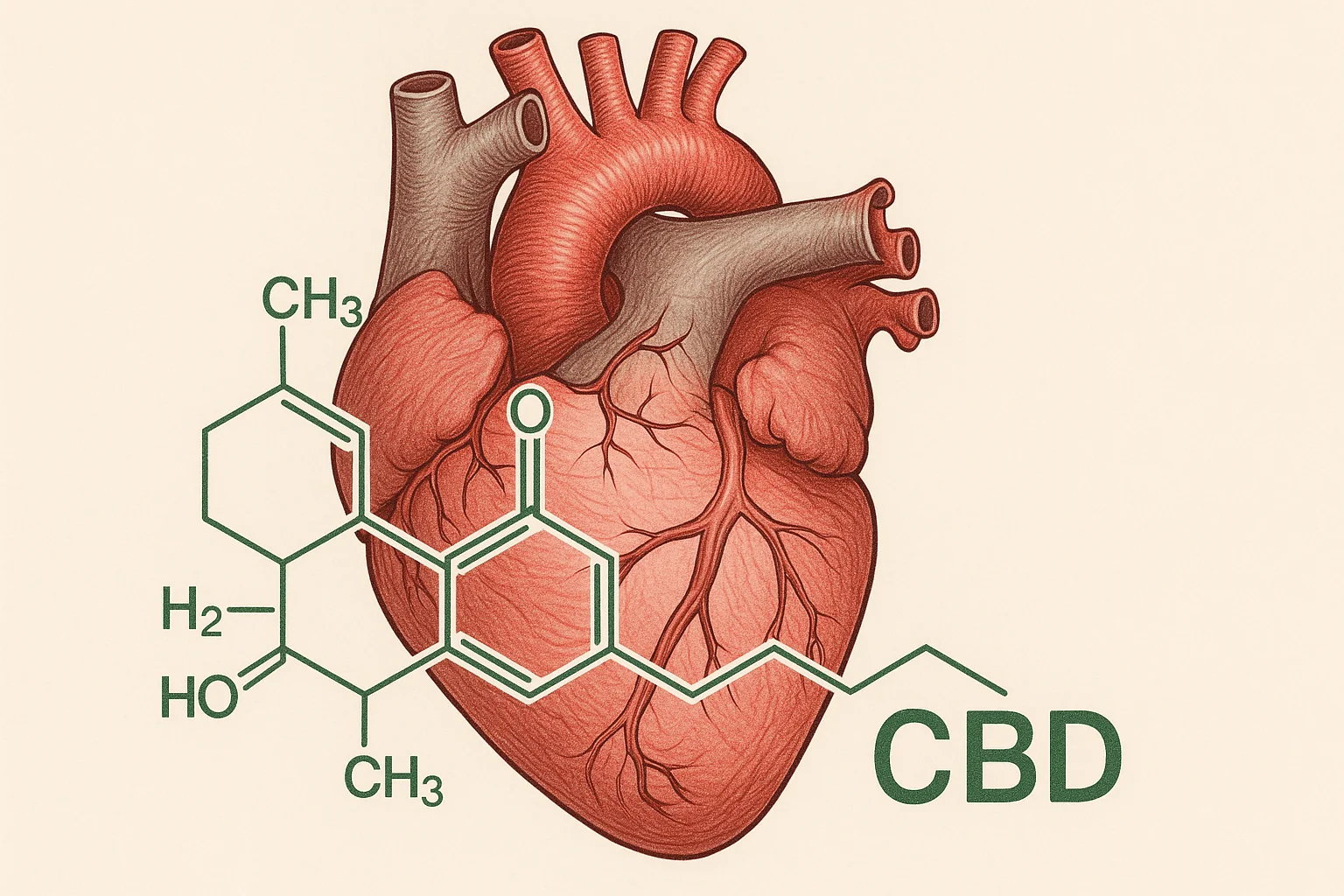

Heart and Ischemia: CBD as an Antiarrhythmic Compound Acting Through the CB1 Receptor
CBD, reperfusion arrhythmia, and the CB1 receptor: what has been shown in animal models, why the attributed mechanism is questionable, and what are the interactions with drugs.
Arrhythmias occurring in the first minutes after restoring blood flow to the ischemic heart muscle are a separate problem in cardiology, distinct from the infarction itself. For several years, the topic of the endocannabinoid system and the CB1 receptor has resurfaced in this context, along with the thesis that CBD acts antiarrhythmically precisely through this receptor. We checked the work on which this thesis is based, and the result is uncomfortable: the study indeed showed fewer arrhythmias after CBD administration, but the proposed mechanism was different. Below you will find what was actually measured, in what model, and the numbers and names of journals that have been mixed up in Polish discussions between two different works. The article does not provide any dosing scheme, as the decision in heart disease lies with the cardiologist.
KEY INFORMATION
• In a study on rats, CBD reduced the number of arrhythmias caused by ischemia and the size of the infarct, and the authors linked the antiarrhythmic effect to the inhibition of platelet activation, not to the CB1 receptor (Walsh et al., British Journal of Pharmacology, 2010).
• The reduction of the infarct area by 66% comes from another study, on rats, published in the American Journal of Physiology, not in PNAS (Durst et al., 2007).
• In the same study, the protective effect was visible in a living organism and disappeared in an isolated heart.
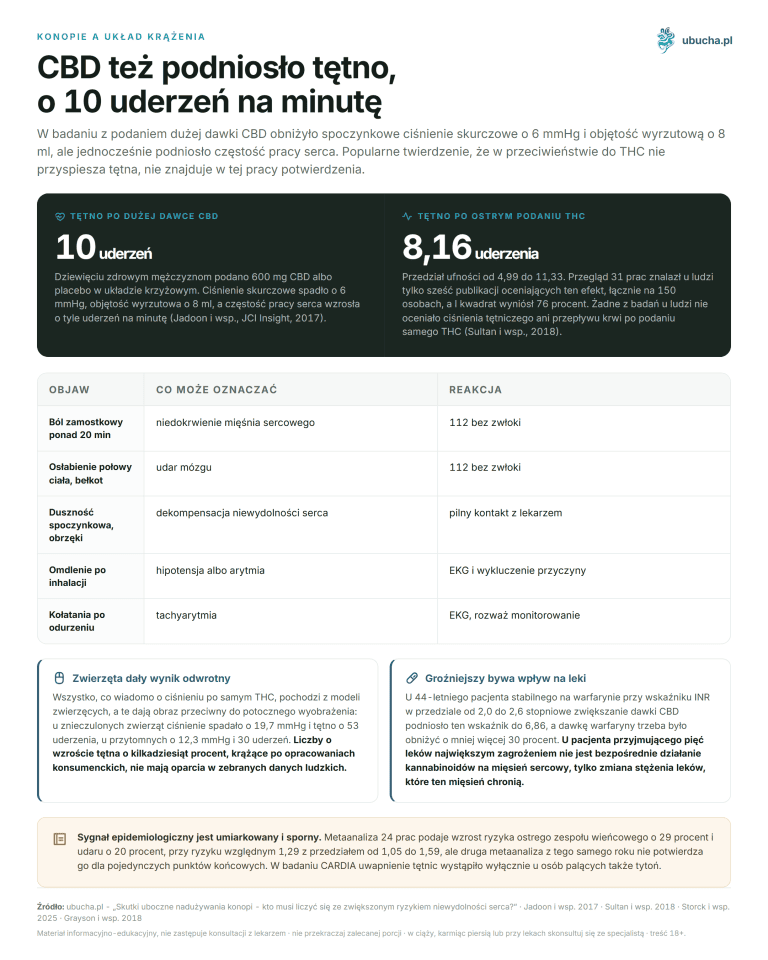
• In nine healthy men, oral CBD lowered resting blood pressure and suppressed the stress response, but at the same time accelerated heart rate (Jadoon et al., JCI Insight, 2017).
• There are no clinical studies in people with ischemic heart disease. With cardiological drugs, consultation with a cardiologist is a prerequisite, not a formality.
What is the CB1 receptor and what does it do in the heart?
The CB1 receptor is a G protein-coupled receptor, primarily found in the nervous system, but also present in the heart and blood vessels. Its activation by the endogenous anandamide lowers the contractility of the heart muscle and blood pressure. This part of the description has solid experimental backing.
In a study on rats with spontaneous hypertension, CB1 receptor antagonists raised blood pressure and left ventricular contractility, while inhibition of the enzyme that breaks down anandamide lowered blood pressure, contractility, and vascular resistance to levels found in animals without hypertension. All these effects were abolished by CB1 antagonists (Bátkai et al., Circulation, 2004). In animals without hypertension, these same interventions did not change anything, which is a significant caveat.
CBD is not a classical agonist of the CB1 receptor. A systematic review of mechanistic studies describes it as a ligand with very low affinity for this receptor, which nonetheless can influence its activity in the body, but in an indirect way (McPartland et al., British Journal of Pharmacology, 2015). The authors also emphasize that results from in vitro studies do not directly translate to effects in a living organism. Separately, CBD acts as an antioxidant and anti-inflammatory, independently of cannabinoid receptors. This multi-target action is why it is difficult to attribute its effects to a single receptor, and this returns later in the text. More about the receptors themselves can be found in the text about CB1 and CB2 receptors.
Why does reperfusion itself damage the heart?
Because restoring blood flow is not just a rescue. The process of reperfusion can cause the death of cardiomyocytes, described as reperfusion injury, for which there is still no effective treatment. This phenomenon is distinct from damage caused by hypoxia.
The preferred approach for a patient with an infarction remains rapid and effective restoration of flow, using thrombolytic therapy or primary coronary angioplasty. The problem is that part of the damage occurs only then, and strategies that would prevent this remain in the research phase (Hausenloy and Yellon, Journal of Clinical Investigation, 2013).
At the moment of oxygenated blood flowing into hypoxic tissue, the amount of reactive oxygen species rises sharply, and weakened cells cannot neutralize them in time. Ionic changes in cell membranes create a substrate for dangerous ventricular arrhythmias. It is precisely at this moment that compounds with protective effects, including CBD, are being tested. It is worth noting that the time window here is narrow and measured in minutes, which complicates translating experimental results into practice. A related mechanism in neural tissue is described in the text about the neuroprotective effects of cannabis in ischemia models.
What did the study on arrhythmia in rats really show?
It showed a real protective effect and a completely different mechanism than is usually attributed to this study. Male rats were administered CBD intravenously or a carrier ten minutes before a thirty-minute closure of the coronary artery, followed by a two-hour reperfusion.
CBD administered before ischemia reduced both the total number of ventricular arrhythmias and the size of the infarct, and the effect depended on the size of the administered dose. The area of the infarct also decreased when CBD was administered just before reperfusion. Separately, collagen-stimulated platelet aggregation was measured: administration of CBD before ischemia weakened it, while administration just before reperfusion did not (Walsh et al., British Journal of Pharmacology, 2010).
The authors’ conclusion is straightforward: the antiarrhythmic effect, but not tissue protection, may be mediated by the inhibition of platelet activation. The study does not mention the use of a CB1 receptor antagonist or conclude that this receptor mediates the effect. Polish discussions have added both the percentage reduction of arrhythmias and the experiment with a CB1 blocker that was not conducted. They even mention the name of such a blocker, which further legitimizes the description of a procedure that was never performed.
Does this action run through the CB1 receptor?
This has not been demonstrated. Let us separate two things that are usually conflated in texts about CBD and the heart. The role of the CB1 receptor in regulating blood pressure and contractility is documented by an experiment with an antagonist, but it concerns endocannabinoids in a hypertension model, not CBD in an arrhythmia model.
The second thread is CBD and reperfusion arrhythmia, where the effect is described, but the mechanism remains open, and the authors themselves pointed to platelets. We did not find a study that would connect both threads, i.e., showing that a CB1 antagonist abolishes the antiarrhythmic effect of CBD. Until such a study exists, the titular mechanism should be treated as a hypothesis, not a finding.
| What was measured | Model and conditions | Study |
|---|---|---|
| Fewer ventricular arrhythmias and smaller infarct, depending on the size of the dose | Rats, intravenous administration before coronary artery closure | Walsh, 2010 |
| Weakened collagen-stimulated platelet aggregation; no effect on mast cell degranulation | Rats, administration before ischemia | Walsh, 2010 |
| Infarct area reduced by 66%, weaker inflammatory response, and lower interleukin 6 concentration | Rats, intraperitoneal administration for seven days | Durst, 2007 |
| Protective effect present in a living organism, absent in an isolated heart | Rats, comparison of in vivo and ex vivo studies | Durst, 2007 |
| Lower resting blood pressure and suppressed stress response, with accelerated heart rate | Nine healthy men, oral administration, crossover study | Jadoon, 2017 |
The table also shows where the confusion with the numbers came from. The reduction of the infarct area by 66% comes from the work of Durst and colleagues, published in the American Journal of Physiology, not from the arrhythmia study and not from the journal PNAS (Durst et al., American Journal of Physiology: Heart and Circulatory Physiology, 2007).
How does CBD interact with cardiological drugs?
By inhibiting liver enzymes that break down many drugs used in cardiology. In studies on cell microsomes, CBD competitively inhibited the enzymes CYP3A4, CYP2B6, CYP2C9, CYP2D6, and CYP2E1. This is a result from laboratory conditions, but the direction of the relationship is clear.
The authors of this work point out that cannabinoid metabolites circulate in the blood longer and at higher concentrations than the cannabinoids themselves, so the picture of interactions is broader than would be suggested by CBD alone (Nasrin et al., Drug Metabolism and Disposition, 2021). The best-described clinical case is the interaction with warfarin in a patient taking pharmaceutical CBD, after which the authors recommended monitoring the INR when introducing cannabinoids (Grayson et al., Epilepsy and Behavior Case Reports, 2018).
Additionally, there is an observation from a study in humans that is easy to overlook. Oral CBD lowered resting blood pressure and suppressed its increase under stress in healthy men, but at the same time accelerated heart rate and reduced stroke volume (Jadoon et al., JCI Insight, 2017). The authors state directly that these hemodynamic changes must be taken into account in individuals taking CBD. The pressure thread develops the text on CBD and hypertension and the heart.
What do the studies not resolve?
They do not resolve anything at the patient level. All the cardioprotective effects described above come from animal studies or a small study in healthy volunteers. There are no clinical trials with randomization in people with coronary disease, after infarction, or with arrhythmia disorders.
It is also impossible to convert doses used in animals to humans. A systematic review of available data on the fate of CBD in the human body showed that no study has determined the absolute bioavailability of oral CBD, despite the existence of intravenous forms, and the half-life varied multiple times depending on the route of administration (Millar et al., Frontiers in Pharmacology, 2018). The ranges of oral bioavailability provided in guides have no basis in this review.
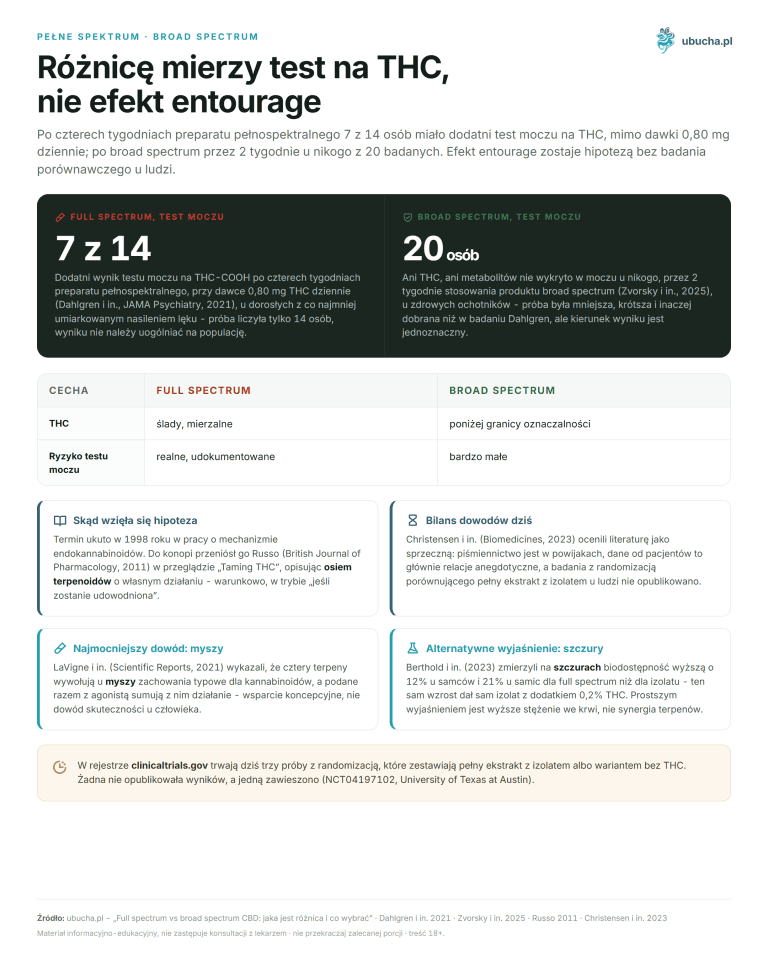
The last caveat concerns the transfer of results. The studies involved isolated CBD, not full-spectrum oils that contain other cannabinoids and terpenes with their own effects. The effects described in this article do not automatically transfer to such preparations. Separately, it is worth seeing the text on CBD in diabetic cardiomyopathy.
Frequently Asked Questions
Does CBD reduce arrhythmias after ischemia?
In an animal model, yes. In rats, CBD administered before the closure of the coronary artery reduced the total number of ventricular arrhythmias and the size of the infarct, and the effect depended on the size of the administered dose. There are no clinical studies verifying this in humans with ischemic heart disease.
Does the antiarrhythmic effect of CBD run through the CB1 receptor?
This has not been demonstrated. The authors of the study in rats linked the antiarrhythmic effect to the inhibition of platelet activation and did not use a CB1 receptor antagonist. The role of this receptor in regulating blood pressure and contractility is documented separately, in a hypertension model, not in arrhythmia.
Where does the figure of a 66% reduction in infarction come from?
From the work of Durst and colleagues from 2007, conducted on rats and published in the American Journal of Physiology. In Polish discussions, it is sometimes attributed to a study on arrhythmia or the journal PNAS, which is not factually correct.
Is CBD safe for people with heart diseases?
It is unknown, as there is a lack of studies in this group. It is known, however, that CBD inhibits liver enzymes that metabolize cardiological drugs, an interaction with warfarin requiring INR monitoring has been described, and in healthy volunteers, CBD accelerated heart rate. A cardiological consultation is a prerequisite here.
Do studies on animals indicate a dose of CBD for humans?
No. A systematic review showed that no study has determined the absolute bioavailability of oral CBD in humans, and the half-life strongly depends on the route of administration. Without this data, converting doses from animals to humans has no basis.
The article is for informational and educational purposes and does not constitute medical advice. Before starting to use cannabis or CBD for therapeutic purposes, consult a doctor, especially if you are taking other medications, are pregnant, or breastfeeding.
Author: Michał Waluk · Published: 2026-08-09 · Updated: 2026-08-11