
Mushroom Adaptogens: Chaga (Inonotus obliquus)
Chaga (Inonotus obliquus): what studies really show, what compounds the black fungus contains, and why oxalates make it risky for the kidneys.
Chaga, known in Polish as błyskoporek podkorowy, and scientifically named Inonotus obliquus, is a parasitic fungus that develops for years inside the trunk of a birch tree, emerging as a black, cracked growth resembling charred wood. In Russian and Northern European folk medicine, it has been used since at least the 16th century, and today it is sold as powder, infusion, and extract. However, there is more marketing surrounding chaga than evidence. Most claims about its effects come from test tubes or mice, and a documented case of kidney failure shows that this fungus has a real risk profile. Below, I break down what is known about chaga from research, what is still unknown, and what should deter some readers from reaching for it.
KEY INFORMATION
• Chaga’s sclerotium produces large amounts of melanin, alongside lanostane-type triterpenoids and phenolic compounds (Zheng et al., 2010).
• Six compounds have been isolated from chaga, among which ergosterol, ergosterol peroxide, and trametenolic acid inhibited nitric oxide production and NF-kappaB activity in RAW 264.7 macrophages (Ma et al., 2013).
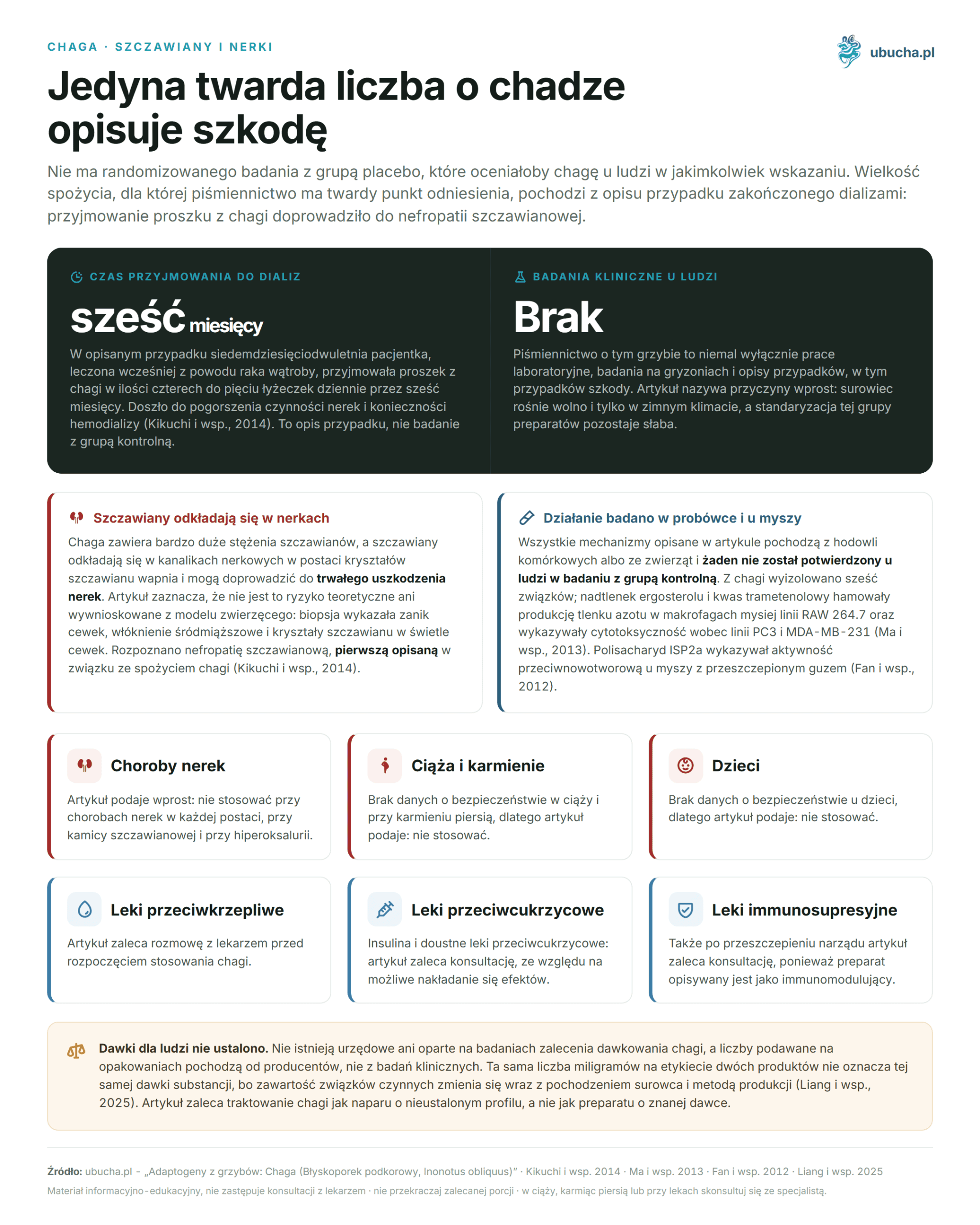
• A case of oxalate nephropathy ending in dialysis was described in a patient who took chaga powder for six months (Kikuchi et al., 2014).
• There is no good quality data from clinical studies on beta-glucans in cancer patients (Chan et al., 2009).
• The fungus grows slowly and only in cold habitats, and attempts to cultivate it in pure culture reduced the production of metabolites, so chaga is not a reliable source of these compounds (Zheng et al., 2010).
What is chaga and why does it attract scientific interest?
Chaga is the common name for the fungus Inonotus obliquus, a white rot fungus that causes white rot in wood. In nature, it rarely produces a typical fruiting body; instead, it forms an irregular, hard growth called a sclerotium, which is what is traded under the name chaga (Zheng et al., 2010).
Researchers’ interest stems from two things at once. First, the sclerotium has an unusually dense chemical profile for a wood-decaying fungus. Second, chaga has a long tradition of use in Russia and Northern Europe as a remedy for gastrointestinal and cancer-related ailments, providing researchers with a ready hypothesis to test. However, newer review articles point out that knowledge about the fungus’s composition remains limited, complicating the interpretation of results (Fordjour et al., 2023).
The Polish name błyskoporek podkorowy describes how the fungus develops. The mycelium colonizes the wood from the inside, and the visible growth breaks through the bark from within, creating a rough, black mass. This habitus distinguishes chaga from typical fungi growing on the surface of the trunk and explains why the raw material cannot be harvested without damaging the tree. The natural range of the species includes the cold forests of the Northern Hemisphere, including Siberia, Scandinavia, Canada, and the northern states of the USA. If you are looking for a shorter introduction to the raw material itself, I have described it separately in a post about chaga as a birch fungus.
What is the taxonomy and ecology of Inonotus obliquus?
Taxonomically, Inonotus obliquus belongs to the Basidiomycota and the Hymenochaetaceae family. It is a white rot fungus, meaning it decomposes the lignin of living trees, and its occurrence is limited to very cold habitats (Zheng et al., 2010).
| Feature | Chaga (Inonotus obliquus) |
|---|---|
| Type and family | Basidiomycota, Hymenochaetaceae |
| Lifestyle | white rot fungus, parasite of hardwood trees, mainly birches |
| Form collected | sclerotium (black growth), not fruiting body |
| True fruiting body | rarely forms, usually only after the tree’s death |
| Habitat | very cold regions of the Northern Hemisphere |
| Growth rate | very slow |
The characteristic black surface is due to the melanin that the fungus produces in large quantities and excretes on the growth. The combination of slow growth and limitation to cold climates has a practical consequence, emphasized by the authors of the review of the chemistry of this species: wild chaga is not a reliable, renewable source of interesting compounds, as the rate of biomass growth is incomparably slower than the rate of harvesting.
This ecology also explains why the raw material can be so heterogeneous. A growth taken from a different geographical latitude, from a tree of a different age, and in a different phase of infection may not have the same composition, and the buyer has no way to verify this by the appearance of the powder. This is the first reason why data on chaga is difficult to compare across studies.
What bioactive compounds does chaga contain?
Chaga produces three main groups of secondary metabolites: phenolic compounds, melanins, and lanostane-type triterpenoids. Among them are substances responsible for the described antioxidant and anti-cancer activity, as well as antiviral activity, studied in laboratory conditions (Zheng et al., 2010).
The best insight into specific molecules comes from a study in which six main components of the ether and acetate fractions were isolated and identified from chaga (Ma et al., 2013). These are not names from a marketing leaflet, but real compounds with assigned activity.
| Compound | Class | Activity in this study |
|---|---|---|
| Ergosterol | sterol | anti-inflammatory |
| Ergosterol peroxide | sterol | anti-inflammatory and cytotoxic against PC3 and MDA-MB-231 lines |
| Trametenolic acid | lanostane-type triterpenoid | anti-inflammatory and cytotoxic against PC3 and MDA-MB-231 lines |
| Inotodiol | lanostane-type triterpenoid | isolated, with no distinguished activity in this test |
| Lanosterol | triterpenoid | isolated, with no distinguished activity in this test |
| Melanins | pigment polymers | produced in large quantities, responsible for the black color of the growth |
It is worth noting what is not in this table. There are no percentage contents of individual fractions, as they depend on the source of the raw material and the method of determination, and manufacturers’ declarations rarely align with independent determinations. I write more broadly about the groups of compounds in medicinal fungi in the guide to medicinal fungi.
What are the documented mechanisms of action of chaga?
All mechanisms described below come from studies on cell cultures or animals. None have been confirmed in humans in a controlled study, so read this section as a description of working hypotheses, not a set of effects you can expect from the drink.
The ether and acetate fractions from chaga inhibited nitric oxide production and NF-kappaB activity in mouse RAW 264.7 macrophages, and ergosterol peroxide and trametenolic acid exhibited cytotoxicity against PC3 prostate cancer and MDA-MB-231 breast cancer lines (Ma et al., 2013). This is a test-tube model: cancer cells in a culture dish react to concentrations that cannot be translated into an oral dose.
Separately, a water-soluble polysaccharide designated ISP2a was studied. In mice with transplanted tumors, it exhibited anti-cancer activity, enhanced lymphocyte proliferation, and increased TNF-alpha production (Fan et al., 2012). This is already at the animal level, which is higher than a test tube, but still below the threshold at which therapeutic efficacy is discussed.
The third thread concerns beta-glucans, present in the cell walls of all fungi. They act on Dectin-1 receptors, complement receptor CR3, and TLR-2/6, activating macrophages, neutrophils, monocytes, NK cells, and dendritic cells (Chan et al., 2009). However, the authors of this review formulate a conclusion that rarely appears in product descriptions: there is currently no good quality clinical data on purified beta-glucans in cancer patients.
What do clinical studies in humans really show?
Practically nothing, and that is an honest answer. We do not have a randomized study with a placebo group evaluating chaga in humans for any indication. The literature on this fungus consists almost exclusively of laboratory works, studies on rodents, and descriptions of individual cases, including cases of harm.
The situation has two causes, both structural. The first is the raw material. Chaga grows slowly, occurs only in cold climates, and cultivation in pure culture consistently reduced the production of metabolites considered active, so researchers do not have repeatable material for randomization (Zheng et al., 2010). The second is standardization. A review of the safety of adaptogenic and immunomodulating products indicates variability in composition and lack of standardization as the main obstacle to a reliable assessment of the risks and benefits of this entire group of preparations (Liang et al., 2025).
The consequence for the reader is direct. When a product description promises immune support or anti-cancer action, that promise is based on cells and mice, not on humans. This does not mean that chaga definitely does not work. It only means that no one has properly checked it yet, and the burden of proof lies with the claimant.
How is chaga harvested and cultivated?
The raw material comes from two sources: harvesting growths from living birches and cultivating mycelium in laboratory conditions. They differ not only in price but primarily in the chemical composition of the final product, and this is a difference that the label usually does not explain.
Wild harvesting involves cutting a mature sclerotium from the trunk. The growth does not regrow, and the tree remains infected, so harvesting is a one-time event at a given site. Since the fungus grows very slowly and only in cool regions, the pressure of harvesting easily exceeds the rate of resource renewal (Zheng et al., 2010).
An alternative is submerged cultivation, which involves multiplying mycelium in a bioreactor instead of waiting for the growth. This solves the supply problem but introduces another. All described attempts to cultivate this species in pure culture ended with reduced production of metabolites considered active, so research is now focused on modulating biosynthetic pathways to compensate for this decline. In practice, this means that mycelium powder and powdered growth are two different products, even if both are described as chaga.
The conclusion for the buyer is simple: the label should state whether the product contains sclerotium or biomass from cultivation. If it does not state this explicitly, assume you are dealing with the cheaper variant.
What forms of chaga are there and how do they differ?
Chaga is sold as pieces of growth for brewing, fine powder, water extract, alcohol extract, and so-called double extract combining both extractions. This division arises from chemistry: some components of the fungus dissolve in water, while others only in alcohol, so a single method by definition leaves something in the raw material.
| Form | What passes into the product | What to watch out for |
|---|---|---|
| Pieces for infusion | water-soluble fraction, including polysaccharides and phenolic compounds | the composition of the infusion depends on the time and temperature of brewing |
| Powder from growth | the entire raw material, including indigestible fractions | the cell walls of the fungus are made of chitin, which we do not digest |
| Water extract | polysaccharides, including beta-glucans | excludes the triterpenoid fraction |
| Alcohol extract | triterpenoids and sterols | excludes the polysaccharide fraction |
| Double extract | both fractions | a declaration without laboratory designation guarantees nothing |
The repeated claim in sales materials that double extract is always better makes chemical sense, but does not automatically translate into health effects. Since there are no studies in humans for any of these forms, the choice between them is a choice between ingredient profiles, not between proven efficacies.
How to dose chaga and what to pay attention to?
There are no official or research-based dosage recommendations for chaga in humans. No institution has established a safe or effective dose, and the numbers on packaging come from manufacturers, not from clinical studies. This is more important than it seems, as the only well-documented information about consumption size concerns harm, not benefits.
In the described case of oxalate nephropathy, the patient took chaga powder at four to five teaspoons daily for six months (Kikuchi et al., 2014). This is the only consumption size for which we have a solid reference point in the literature, and it is a reference point for poisoning.
Additionally, there is a problem that no dosage recommendation can solve. Since the content of active compounds varies depending on the source of the raw material and the production method, and the standardization of this group of preparations remains weak, the same number of milligrams on the label of two products does not mean the same dose of the substance (Liang et al., 2025).
The practical conclusion is cautious. Treat chaga like an herbal infusion with an uncertain profile, not as a product with a known dose. If you still want to try it, stick to amounts found in culinary tradition, take breaks instead of drinking it daily without end, and do not increase portions in the belief that more means better. With any kidney diseases, completely avoid it for the reasons described in the next section.
What are the risks, interactions, and contraindications?
This is the most important section of this text. Chaga contains very high concentrations of oxalates, and oxalates can deposit in the renal tubules as calcium oxalate crystals and may lead to permanent kidney damage. This is not a theoretical risk or inferred from an animal model.
In the described case, a seventy-two-year-old patient, previously treated for liver cancer, took chaga powder for six months. She experienced worsening kidney function and required hemodialysis, and a biopsy revealed diffuse tubular atrophy, interstitial fibrosis, and oxalate crystals in the tubule lumen and urine sediment. Oxalate nephropathy was diagnosed, the first described in connection with chaga consumption (Kikuchi et al., 2014). Oxalate nephropathy as a disease syndrome includes a distinct form related to consumption, which is exactly this mechanism (Rosenstock et al., 2022).
It is also worth knowing the background of the entire group of preparations. An analysis of adverse event reports for adaptogenic and immunomodulating products describes reactions from the gastrointestinal tract, skin, liver, circulatory system, and immune system, and among reports indicating a single ingredient as suspicious, 15.8% concerned serious events, including eight deaths, with the authors noting that a causal relationship could not be established (Liang et al., 2025).
- Kidney diseases in any form, oxalate stones, and hyperoxaluria: do not use.
- Anticoagulants: consult a doctor before starting.
- Insulin and oral antidiabetic drugs: consult due to possible overlapping effects.
- Immunosuppressive drugs and post-organ transplant state: consult, as the product is described as immunomodulating.
- Pregnancy and breastfeeding: no safety data, do not use.
- Children: no safety data, do not use.
- Planned surgery: discontinue in advance after setting a date with the doctor.
How to choose a high-quality chaga extract?
Since there are no studies determining efficacy, quality assessment comes down to the transparency of the manufacturer. You are not assessing whether the product will work, but whether it is known what is in the package. This is a lower bar, but a significant portion of the market does not clear it.
- Species name Inonotus obliquus stated explicitly, without collective terms like mushroom mix.
- Information on whether the raw material is sclerotium or biomass from cultivation.
- Extraction method stated specifically: water, alcohol, or double.
- Results of testing for heavy metals, as the fungus absorbs them from the tree and substrate.
- Region and year of harvest, and for cultivation, information on separating the substrate from the biomass.
- Batch number and expiration date, which is the basis for any complaint.
Treat percentage declarations given without a method of determination with suspicion. A number on the label costs nothing, while determination in an independent laboratory does, so a manufacturer who invested in testing usually boasts about its method. Variability in composition and poor standardization are documented problems in this group of preparations, not mere suspicions (Liang et al., 2025).
Does chaga work the same as other adaptogenic mushrooms?
No. Mushrooms commonly classified as adaptogens share a common denominator in the form of beta-glucans in the cell wall, but apart from that, they differ in the profile of secondary metabolites, which are responsible for the distinct action of each species. Interchangeably treating them in product descriptions is a marketing simplification.
| Species | Distinctive metabolites | Main research direction |
|---|---|---|
| Chaga (Inonotus obliquus) | melanins, lanostane-type triterpenoids, phenolic compounds | antioxidant and anti-inflammatory, in laboratory models |
| Lion’s Mane (Hericium erinaceus) | erinacines, hericenones | neurotrophic, with one small study in humans |
| Common to both | beta-glucans in the cell wall | immunomodulation, without good clinical data |
The difference has practical implications. If someone reaches for a mushroom thinking about memory, chaga is not the species around which data has been gathered in that direction. If thinking about immunity, it hits on beta-glucans, a component present in each of these species and lacking good quality clinical confirmation (Chan et al., 2009). I have outlined the comparison of species for specific purposes in the text about adaptogenic mushrooms and which to choose.
How does chaga fit into the tradition of adaptogens?
The concept of adaptogen originated in Russian pharmacology in the mid-twentieth century and described substances with non-specific protective effects, normalizing the body’s function with low toxicity. Chaga entered this category through tradition rather than meeting criteria, and this distinction matters today.
Historical use is well documented. Chaga growth was used in Russia and Northern Europe as early as the sixteenth century as a folk remedy for malignant tumors and other ailments (Zheng et al., 2010). In Russian and Eastern European folk practice, it was also used for gastrointestinal, cardiovascular diseases, and diabetes (Fan et al., 2012).
However, newer studies remind us that tradition also included uses that are hard to call medical, such as the ritual smoking of the raw material in a pipe (Fordjour et al., 2023). A long history of use indicates that people reached for chaga and that traditional amounts did not record mass harm. It does not, however, say that the fungus acted in a way that we would today call effective, and it does not exempt from checking the risks that tradition could not know about, as it did not have kidney biopsy.
Frequently Asked Questions
Does chaga cure cancer?
There is no clinical data in humans to support this. Cytotoxicity of selected compounds from chaga against prostate and breast cancer cell lines has been demonstrated in laboratory conditions (Ma et al., 2013) and anti-cancer activity of polysaccharide in mice (Fan et al., 2012). Translating these results to human treatment is unwarranted.
Can chaga damage the kidneys?
Yes, and this is documented. A case was described of a patient whose six months of taking chaga powder at four to five teaspoons daily led to oxalate nephropathy requiring hemodialysis, with oxalate crystals confirmed in kidney biopsy (Kikuchi et al., 2014). People with kidney diseases should not use chaga.
How much chaga can be safely consumed daily?
No safe dose of chaga for humans has been established, and there are no studies to determine it. The numbers on packaging come from manufacturers. The only solid reference point in the literature concerns the amount that caused kidney damage, not an amount considered safe (Kikuchi et al., 2014).
Does chaga boost immunity?
Beta-glucans present in chaga stimulate Dectin-1, CR3, and TLR-2/6 receptors and activate immune system cells in laboratory studies. However, the authors of the review of this data state directly that there are no high-quality clinical studies evaluating the effectiveness of purified beta-glucans in humans (Chan et al., 2009).
How to brew chaga?
The traditional method is to steep crushed growth in water below boiling temperature, usually for several hours. The composition of such an infusion depends on time and temperature, and only the water-soluble fraction passes into the water. Triterpenoids remain in the raw material as they require alcoholic extraction.
Does chaga contain caffeine?
No, chaga is not a source of caffeine or other stimulants, which distinguishes it from yerba mate and guarana. The dark color and bitter taste of the infusion may be confused with coffee’s profile, but chemically, they have nothing in common.
What is the difference between wild and cultivated chaga?
Wild chaga is a growth collected from birch, while cultivated chaga is biomass of mycelium multiplied in a bioreactor. All described attempts to cultivate this species in pure culture resulted in reduced production of metabolites considered active (Zheng et al., 2010), so both products differ in composition despite having the same trade name.
Does chaga interact with medications?
Possible interactions concern anticoagulants, antidiabetic, and immunosuppressive drugs, and with medications that burden the kidneys, there is a risk of cumulative damage. Formal interaction studies for chaga have not been conducted, so any ongoing pharmacotherapy decisions should be discussed with the attending physician.
What do we really know today about chaga?
We know that Inonotus obliquus produces an interesting set of secondary metabolites, that some of them exhibit anti-inflammatory and cytotoxic activity in cell cultures, and that polysaccharide from this fungus acted anti-cancer in mice with transplanted tumors. We also know that the fungus has a documented history of folk use in Russia and Northern Europe for several hundred years.
However, we do not know the most important thing: whether any of this translates to humans. There is no randomized study with a placebo group evaluating chaga for any indication, and without repeatable, standardized raw material, it is difficult to design such a study at all. At the same time, we have a well-documented case of permanent kidney damage after six months of using the powder, which, given the fungus’s very high oxalate content, makes the kidneys the first organ to consider, not the last.
A reasonable approach looks like this: treat chaga as an infusion with a long tradition and an uncertain profile, not as a therapeutic product. Check if the manufacturer states explicitly what they are selling. Completely avoid it if you have any kidney problems, are pregnant, breastfeeding, or taking anticoagulants. And do not replace anything prescribed by a doctor with chaga.
Mushroom and herbal extracts, including chaga, can be found in the herbs and plant extracts category in the u Bucha store.
This article is for informational and educational purposes and does not replace consultation with a doctor. If you are pregnant, breastfeeding, taking medications, or have chronic conditions, consult the use of supplements or herbs with a specialist.
Author: Michał Waluk · Published: 2026-05-06 · Updated: 2026-08-10