
Natural support for kidneys and urinary tract: herbs and supplements (ranking)
Ranking of 8 herbs and supplements for the urinary tract according to the strength of evidence: cranberry, D-mannose, horsetail, magnesium. What studies have shown, and what is just tradition.
Urinary tract infections recur in some women despite successfully treating the first episode, and kidney stones are among the diseases with a high tendency to recur. Hence the popularity of herbs and supplements described as kidney support. The problem is that the strength of evidence in this group is extremely uneven. For two positions, we have meta-analyses of randomized trials, for the next two only a monograph from the European Medicines Agency based on long-term use, and for the rest, tradition and animal studies. This ranking organizes the eight most frequently mentioned options according to what has really been demonstrated and shows the boundary beyond which herbal support is no longer sufficient. For each position, we provide the type of evidence, not just the manufacturer’s promise, as this information determines what can be expected.
KEY INFORMATION
• Cranberry preparations are associated with a lower risk of urinary tract infections: risk ratio 0.62 (95% CI 0.49-0.80) in a meta-analysis of randomized trials involving 1494 participants (Wang et al., Archives of Internal Medicine, 2012).
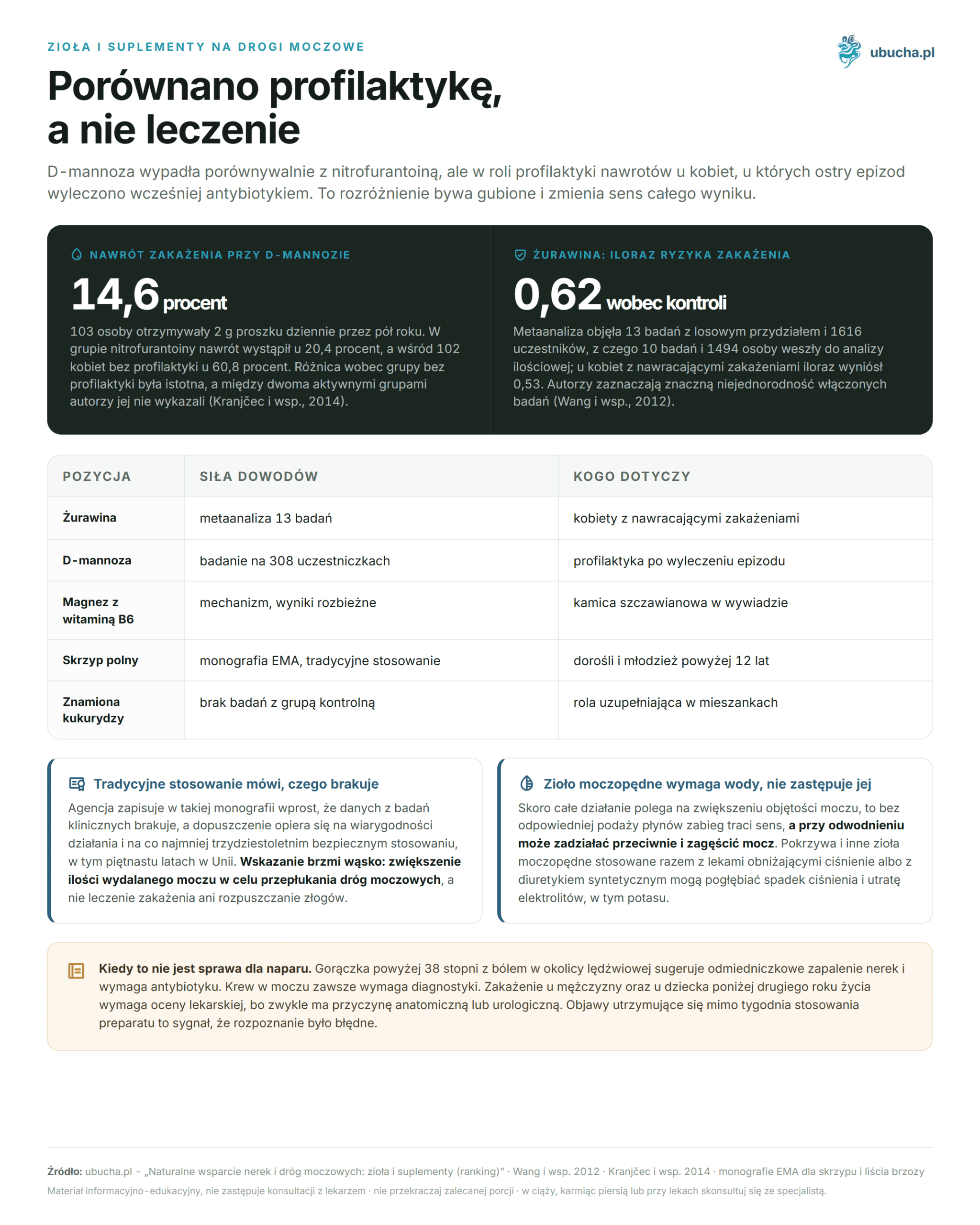
• D-mannose powder, 2 g daily for six months, reduced the recurrence rate to 14.6% compared to 60.8% without prophylaxis in 308 women (Kranjčec et al., World Journal of Urology, 2014).
• Horsetail and birch leaf have EMA monographs only in the category of traditional use: the agency states directly that there is a lack of sufficient data from clinical studies.
• No herb treats chronic kidney disease or stones requiring urological intervention.
• Fever with lumbar pain, blood in urine, infection in a man or small child are situations for a doctor, not for an infusion.
How did we evaluate herbs and supplements for kidneys?
The ranking arranges positions according to the strength of evidence, not popularity. The highest is what has been verified in randomized trials and summarized in a meta-analysis, lower is what has only regulatory approval based on long tradition, and the lowest is what has not been studied in humans.
We applied four criteria. The first is the type of evidence: a study with a control group in humans counts differently than an observation on an animal model, and a systematic review differently than a single trial. The second is a described safety profile along with documented interactions, as one can work consciously with a plant with known adverse effects. The third is the presence of a European Medicines Agency monograph, distinguishing two categories that are often confused in guides. Established use means that effectiveness has been confirmed by clinical data. Traditional use means something entirely different: the agency records in such a monograph that there is a lack of clinical study evidence, and the approval is based on the credibility of the mechanism and at least thirty years of safe use.
The fourth criterion is availability in standardized form. An infusion from self-collected herbs and an extract with a specified content of active substances are not the same product, and most studies were conducted on standardized preparations. This difference can be the reason why the study result does not translate to a tea bag.
Which herbs and supplements have the strongest evidence?
Two positions clearly stand out from the rest. Cranberry and D-mannose have behind them studies with randomized participant allocation and meta-analyses, while the rest of the field is based on monographs of traditional use or just tradition. The table below shows this distribution without smoothing.
| Place | Position | Described mechanism | Strength of evidence | Who it concerns |
|---|---|---|---|---|
| 1. | Cranberry (Vaccinium macrocarpon) | Prevents bacteria from adhering to the urinary tract epithelium | Meta-analysis of 13 randomized trials | Women with recurrent infections |
| 2. | D-mannose | Binds adhesins of E. coli in urine | Randomized trial, 308 participants | Prevention of recurrences after treatment of an episode |
| 3. | Magnesium with vitamin B6 | Magnesium binds oxalates in the intestine | Mechanism described, study results inconsistent | People with a history of oxalate stones |
| 4. | Horsetail (Equisetum arvense) | Increases urine volume, flushes the urinary tract | EMA monograph, traditional use | Adults and adolescents over 12 years |
| 5. | Birch leaf (Betula pendula) | Increases urine volume | EMA monograph, traditional use | Adults and adolescents over 12 years |
| 6. | Nettle (Urtica dioica) | Diuretic and anti-inflammatory action | EMA monograph, traditional use | Caution with blood pressure-lowering medications |
| 7. | Parsley (Petroselinum crispum) | Diuretic action attributed to apiol | Tradition and animal studies | Contraindicated in large doses during pregnancy |
| 8. | Corn silk (Zea mays) | Mild diuretic action | No studies with a control group in humans | Complementary role in mixtures |
Note the jump between second and fourth place. This is not a difference in degree, but a difference in kind: positions 1-3 are based on studies measuring a hard endpoint, positions 4-8 on regulatory agreement or custom.
Does cranberry really reduce bladder infection recurrences?
Yes, although the effect is weaker and less certain than suggested by packaging. A meta-analysis published in Archives of Internal Medicine included 13 randomized trials with 1616 participants, of which 10 trials and 1494 people were included in the quantitative analysis. The combined risk ratio for those using cranberry preparations was 0.62 with a confidence interval from 0.49 to 0.80 (Wang et al., 2012).
In the subgroup that interests the reader of this text the most, namely women with recurrent infections, the risk ratio was 0.53 with a confidence interval from 0.33 to 0.83. However, the authors themselves added a caveat that advertisements do not repeat: there was significant heterogeneity between studies, so the overall result should be read with caution. The included trials differed in the form of the preparation, dosage, and observation time, and one outlier study was excluded from the analysis.
The mechanism is attributed to type A proanthocyanidins, polyphenols with a structure that hinders Escherichia coli from adhering to the urinary tract epithelium. Since the content of these compounds in juice and extracts can vary greatly, standardization on proanthocyanidins is the only information on the label that says anything about the strength of the preparation. A detailed comparison of forms and concentrations has been gathered in a separate text about cranberry for the urinary tract.
Does D-mannose work as well as antibiotics?
In a large randomized study, D-mannose performed comparably to nitrofurantoin, but in the role of preventing recurrences, not treating an ongoing infection. This distinction is often lost and changes the meaning of the entire result.
The study involved 308 women with recurrent urinary tract infections, who were first treated with antibiotics for an acute episode of cystitis. They were then randomly assigned to three groups: 103 received 2 g of D-mannose powder daily for six months, 103 received nitrofurantoin, and 102 received no prophylaxis. A recurrence occurred in 14.6% in the D-mannose group, 20.4% in the nitrofurantoin group, and 60.8% without prophylaxis. The difference compared to the group without prophylaxis was statistically significant, while the authors did not show a difference between the two active groups (Kranjčec et al., World Journal of Urology, 2014).
Adverse effects were reported by 17.9% of participants in both active groups, less frequently with D-mannose, and were mild and did not require stopping prophylaxis. The authors conclude the work with a caveat that the results are preliminary and require confirmation in further studies. The mechanism is based on the fact that D-mannose saturated in urine binds the adhesins of E. coli, so it pertains to infections caused by this species, not every bladder infection. Further development of this topic can be found in the text about D-mannose for recurrent bladder infections.
What does the EMA monograph really say about horsetail and birch leaf?
It says less than is attributed to it. Both plants have monographs from the European Medicines Agency, but only in the category of traditional use. The agency states directly in them that there is a lack of clinical study data, and the approval is based on the credibility of the action and at least thirty years of safe use, including fifteen years in the EU.
The indication is formulated narrowly and for both plants sounds the same: minor urinary tract ailments, increasing the amount of urine excreted to flush the urinary tract. This is not treating an infection or dissolving stones, just increasing urine volume. The monographs limit use to adults and adolescents over twelve years of age. For birch leaf, use is recommended for two to four weeks, and for horsetail, the agency recommends contacting a doctor if symptoms persist for more than a week.
The practical conclusion is simple and often overlooked. Since the entire action is based on increasing urine volume, without adequate fluid intake, the procedure loses its meaning, and in dehydration, it may act contrary and concentrate the urine. A diuretic herb does not replace drinking water, but requires more of it. Horsetail is also often recommended completely outside this indication, for example, for hair and nails due to its silicon content, which we described in the text about horsetail for hair and nails.
Do magnesium and vitamin B6 protect against oxalate stones?
The mechanism is well described, but the clinical evidence is weaker than guides repeat. Most kidney stones are calcium oxalate deposits, and magnesium in the light of the small intestine binds oxalates, forming an insoluble compound that is excreted in feces instead of entering the bloodstream and then the kidneys. A smaller oxalate load reaching the kidneys means a lower risk of crystal precipitation.
However, this is where the agreement ends. The results of studies on magnesium supplementation as a prevention of recurrences are inconsistent, and some studies show an effect on urine parameters without translating to the number of new stones. A specific number circulating in guides speaks of a several percent reduction in recurrences after magnesium supplementation, cited along with a meta-analysis that we could not find in the literature. If you encounter such a number, ask for a reference to the work.
With vitamin B6, the situation is similar. Its role in oxalate metabolism is real, but well-documented use pertains to primary hyperoxaluria type 1, a rare genetically conditioned disease, where the response to pyridoxine depends on a specific gene variant. Transferring this conclusion to stone disease in a person without this condition is an abuse. Since dosing in diagnosed stone disease is determined by a doctor based on a 24-hour urine collection, and not an article, you will not find specific milligrams here. Magnesium preparations, also in combination with vitamin B6, are available in the category of supplements; we wrote about combining magnesium with calcium in a separate text.
When are herbs not enough and you need to see a doctor?
Herbal support makes sense for mild, recurrent ailments in a person without accompanying diseases. The following situations exclude self-treatment and require contact with a doctor, as delays cost health, not just time.
- Fever above 38 degrees with pain in the lumbar area, not just the bladder, suggests pyelonephritis and requires antibiotics, sometimes in the hospital.
- Blood in urine always requires diagnostics, as it may come from a stone, a tumor, or glomerulonephritis.
- Urinary tract infection in a man and in a child under two years requires medical evaluation, as it usually has an anatomical or urological cause.
- Diagnosed chronic kidney disease, diabetes, catheter, or a state after kidney transplantation exclude self-use of diuretic herbs.
- Symptoms persisting despite a week of using an herbal preparation signal that the diagnosis was incorrect.
It is also worth remembering about summing effects. Nettle and other diuretic herbs used together with blood pressure-lowering medications or synthetic diuretics can deepen the drop in blood pressure and loss of electrolytes, including potassium. This mechanism rarely makes it into herbal guides, but can be significant with several weeks of use or when combining several diuretic preparations at once. If you take medications regularly, show the list of herbal preparations to your doctor or pharmacist before you start.
Frequently asked questions
Which herb most effectively supports the urinary tract?
The strongest evidence is for cranberry: a meta-analysis of randomized trials showed a risk ratio of 0.62 compared to control groups, and in women with recurrent infections, 0.53 (Wang et al., Archives of Internal Medicine, 2012). However, the authors note significant heterogeneity in the included studies, so the result should be read with caution.
Can herbs replace treatment for kidney disease?
No. Plant preparations act as supportive and preventive, but do not replace treatment for chronic kidney disease, glomerulonephritis, or infections requiring antibiotics. If kidney disease is diagnosed, discuss any herbal preparation with a nephrologist beforehand, as some are contraindicated in renal failure.
How much water should I drink with diuretic herbs?
EMA monographs for horsetail and birch leaf base their entire indication on increasing the amount of urine excreted, so without increased fluid intake, the preparation loses its meaning. Drink enough to keep your urine clear. Dark urine when using a diuretic herb indicates a fluid deficiency and is a reason to stop using it.
Does cranberry in tablets work the same as juice?
The 2012 meta-analysis included both juices and preparations in capsules and tablets, and in the subgroup analysis, a beneficial result was noted among those drinking juice. This work does not resolve the direct comparison of both forms. Look for standardization on proanthocyanidins on the label, as the mass of the extract alone says nothing.
Is parsley good for the kidneys?
Parsley is attributed with diuretic effects, but this is based on tradition and animal studies, not on clinical studies in humans. As a culinary ingredient, it is safe. In large amounts as an infusion or extract, it is contraindicated in pregnancy, which is why it ranks seventh.
Does magnesium prevent recurrence of kidney stones?
The mechanism of binding oxalates in the intestine is described, but the results of studies on the effect of supplementation on the number of new stones are inconsistent, and some studies do not show such an effect. In diagnosed stone disease, the course of action is determined by the doctor based on a 24-hour urine collection, as prevention depends on the composition of the stone.
Is horsetail safe with kidney disease?
The EMA monograph limits use to adults and adolescents over twelve years of age and recommends contacting a doctor if symptoms persist for more than a week. In diagnosed chronic kidney disease, diuretic preparations are not used without the supervision of a nephrologist, as impaired filtration changes the fate of any substance taken orally.
This article is for informational and educational purposes and does not constitute medical advice. Before starting supplementation, consult your doctor, especially if you are taking medications regularly, are pregnant or breastfeeding, or have chronic illnesses.
Author: Michał Waluk · Published: 2026-08-09 · Updated: 2026-08-15