Lion’s Mane: Side Effects and What Research Has Shown
Lion's mane side effects are mild and gastrointestinal. What seven human studies showed, what they did not, and who should be cautious with this mushroom.
The most commonly reported side effects of lion’s mane are gastrointestinal issues: bloating, loose stools, and abdominal discomfort, usually transient. Less frequently, skin reactions, probably allergic, have been described. People allergic to mushrooms and those taking anticoagulant or antidiabetic medications should be cautious. Hericium erinaceus is marketed in Poland under the slogan “mushroom for memory,” with product descriptions claiming neuron regeneration. Searching the term Hericium erinaceus in PubMed returns over 570 records, of which only five are labeled as randomized clinical trials (PubMed, August 2026). The rest are cell cultures, rats, and mice. This disproportion determines what can honestly be said about this mushroom. We have collected human trials in order: number of participants, duration, what exactly was measured, and the outcomes. We also checked citations circulating in Polish texts about Hericium, as some say the opposite of the study they cite. You will learn where evidence ends and hope begins, and what this means for dosage and safety.
KEY INFORMATION
• Five randomized human trials, the largest included 77 participants (Vigna et al., ECAM 2019).
• The strongest signal concerns memory in seniors with mild impairment, and the effect faded after discontinuation.
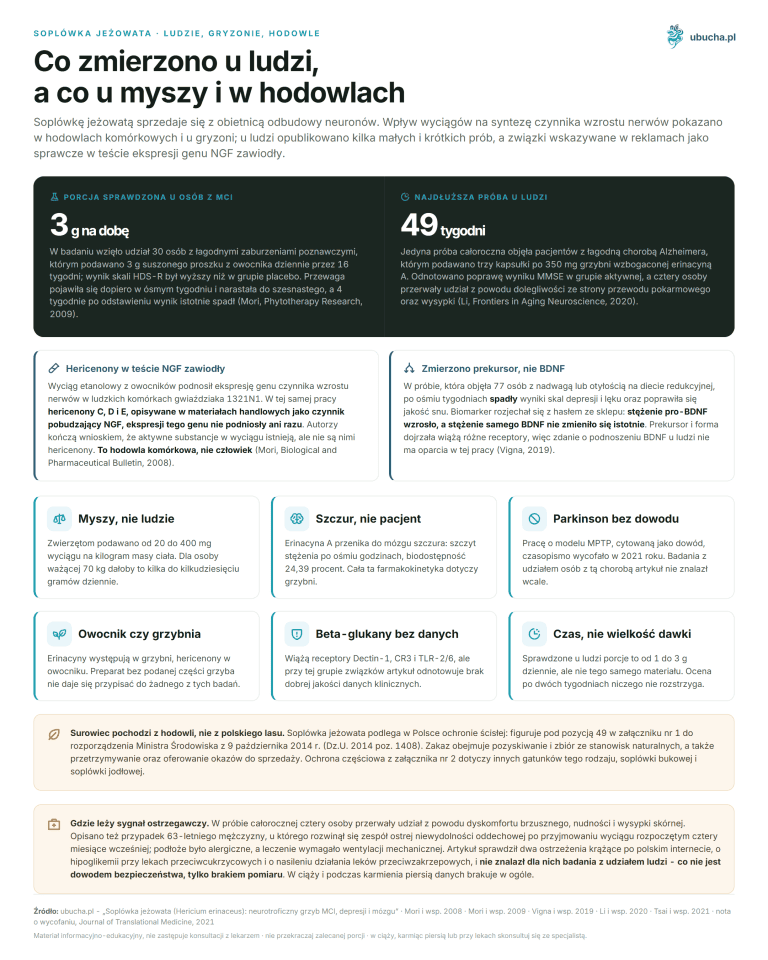
• Hericenones C, D, and E did not stimulate NGF gene expression (Mori et al., 2008).
• Other described benefits are based on rodents and cell cultures.
What is lion’s mane and how did it gain its reputation?
Lion’s mane is the fruiting body of the fungus Hericium erinaceus, a saprophyte growing on dead hardwood. Its brain-related reputation comes from Japanese lab work in the 1990s, where extracts stimulated cells to produce nerve growth factor. Since then, the hypothesis has developed faster than human evidence.
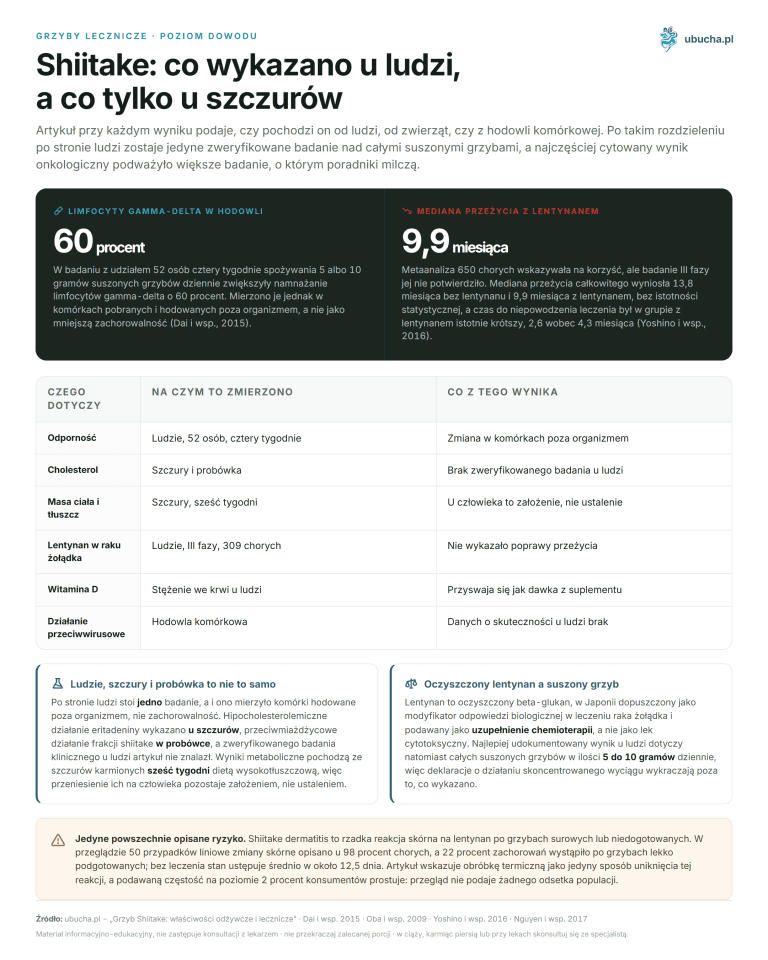
Polish names are soplówka jeżowata and lwia grzywa; Japanese yamabushitake; Chinese hou tou gu. The fruiting body is white, almost spherical, covered with hanging spines 1-5 cm long. In Polish forests, the species is rare and listed in Annex 1, position 49, of the Ministry of Environment regulation from October 9, 2014, on species protection of fungi, thus strictly protected (Dz.U. 2014 item 1408, current act). Partial protection covers beech and fir Hericium species. All commercial supply comes from controlled cultivation.
Chemistry of this mushroom divides into two parts, a division recurring throughout the article. The fruiting body contains hericenones and beta-glucan polysaccharides. Mycelium grown in fermenters produces erinacines, cyathane diterpenoids practically absent in fresh fruiting bodies. Erinacine A crosses the blood-brain barrier in rats by passive diffusion, with oral bioavailability estimated at 24.4% (Tsai et al., Molecules, 2021). No analogous pharmacokinetic study exists for hericenones.
This difference has practical consequences. A fruiting body preparation and a mycelium preparation are two products with different compositions, and clinical trials were conducted separately on each. A manufacturer advertising fruiting body while citing a study on erinacine A mycelium mixes two categories.
Where did the idea that the mushroom acts on the brain come from? From nerve growth factor, a protein that sustains neurons and supports synapse formation. When Japanese chemists showed extracts from Hericium increased its production in cultures, the hypothesis wrote itself. In a rat pharmacokinetic study, erinacine A appeared in the brain one hour after oral administration, peaking at eight hours. The main excretion route was feces. These are animal data but show that at least one compound reaches the target site.
What exactly have human studies shown?
There are several human trials, all small, the largest with 77 participants. The table below summarizes what was actually measured instead of marketing benefit lists. The results column shows effects as reported by authors, including tests with no difference.
| Study | Participants | Dosage and Duration | Outcome | Adverse Effects |
|---|---|---|---|---|
| Mori et al., 2009 | 30 Japanese aged 50-80 with mild cognitive impairment | 12 tablets of 250 mg dried fruiting body daily, 16 weeks | Higher HDS-R scores than placebo at weeks 8, 12, and 16. Four weeks after stopping, scores significantly dropped | Abdominal discomfort and mild diarrhea in some, no lab abnormalities |
| Nagano et al., 2010 | 30 perimenopausal women | Cookies with dried mushroom, 4 weeks | Lower CES-D and ICI scores than before study. Two ICI subscales significant vs placebo; anxiety and irritability showed trends | None reported |
| Saitsu et al., 2019 | Adults, fruiting body supplement | 12 weeks | Improved MMSE score. Benton and paired associate tests showed no difference | Not reported |
| Vigna et al., 2019 | 77 overweight/obese with mood or sleep disorders | 8 weeks supplementation with low-calorie diet | Reduced depression, anxiety, and sleep disorder symptoms. Increased circulating pro-BDNF without BDNF change | Not reported |
| Li et al., 2020 | Mild Alzheimer’s patients, pilot study | 3 capsules of 350 mg erinacine A mycelium daily, 49 weeks | Better MMSE, CASI, complex function scale, and contrast sensitivity. Four dropped out due to adverse effects | Not reported |
| Docherty et al., 2023 | 41 healthy aged 18-45 | 1.8 g daily, measured after 60 minutes and 28 days | Faster Stroop test one hour post-dose. Subjective stress reduction borderline significant after 28 days | Not reported |
| Surendran et al., 2025 | 18 healthy aged 18-35 | Single 3 g 10:1 fruiting body extract dose | No effect on complex cognition and mood measures. Improvement only in manual peg test | Not reported |
Several points emerge only in comparison. No trial exceeded 100 participants. Most were conducted in Japan or Taiwan. Positive results usually concern one test from the battery; others show no difference.
Does lion’s mane improve memory in healthy people?
Science does not yet provide a definitive answer. Two trials in healthy young adults gave mixed results based on single tasks from test batteries, with 41 and 18 participants. Authors recommend caution in interpretation.
In Docherty et al.’s pilot, 41 people aged 18-45 took 1.8 g. One hour after a single dose, participants performed the Stroop test faster; after 28 days, subjective stress was borderline significant. Authors note zero results and some negative changes, stating conclusions require caution (Docherty et al., Nutrients, 2023).
Surendran et al. tested a single 3 g 10:1 extract dose in 18 people crossover design. After 90 minutes, complex cognitive and mood indices did not differ from placebo. Improvement was only in a psychomotor peg test, not memory (Surendran et al., Frontiers in Nutrition, 2025).
Saitsu et al. 2019 is often cited as evidence for memory improvement, but only MMSE improved. Benton and paired associate tests, direct memory measures, showed no difference. MMSE is a dementia screening scale, insensitive in healthy people, so a single MMSE result does not promise better memory in thirty-year-olds.
A pattern spoils interpretation: small samples measure many parameters simultaneously - reaction time, attention, working memory, mood, stress, manual dexterity. With many comparisons, one statistically significant result often appears by chance. Until replicated in larger trials, it remains a hypothesis, not a confirmed benefit. A 2025 systematic review collected five randomized and three pilot trials in diverse populations, summarizing MMSE results from two: weighted mean was 1.17 points higher on a 30-point scale (Menon et al., Frontiers in Nutrition, 2025). This small change comes from cognitively impaired, not healthy young adults.
Do hericenones really stimulate nerve growth factor production?
Not the three most cited. Mori et al. 2008 showed ethanol extract of Hericium erinaceus increased NGF gene expression, but hericenones C, D, and E did not. Authors concluded active compounds are not hericenones.
The experiment compared ethanol extracts from four edible mushrooms in human astrocytoma 1321N1 cells. Only Hericium extract increased NGF expression dose-dependently. NGF protein secretion increased, and conditioned medium stimulated neurite growth in PC12 cells. JNK kinase inhibition abolished this effect; the extract induced JNK and c-Jun phosphorylation. Mice fed 5% dried mushroom for 7 days had higher hippocampal NGF expression (Mori et al., Biological and Pharmaceutical Bulletin, 2008).
We checked this paper because in Polish discourse it is cited as evidence for the opposite of its abstract. The statement about hericenones stimulating NGF is repeated in product descriptions and articles, but reading the last abstract sentence reveals the difference. How many such sentences were copied without source verification?
Erinacines are a separate story and appear to carry neurotrophic activity. A systematic preclinical review shows erinacines A and C activate Nrf2 transcription factor, act anti-inflammatory, and improve rodent behavioral outcomes (Spangenberg et al., Frontiers in Pharmacology, 2025). All data come from cells and animals; benefits were dose-dependent.
Computational studies are similarly misunderstood. Diling’s team described 3-hydroxyhericenone F as a possible beta-secretase inhibitor, an enzyme involved in amyloid plaque formation, based on molecular docking and biochemical tests (Diling et al., Frontiers in Pharmacology, 2017). This is an early lead discovery stage, where most candidates fail. The phrase “inhibits enzyme responsible for Alzheimer’s” correctly describes the study but misleads by implying a health effect no one measured.
Does lion’s mane help mood, anxiety, and sleep?
A signal exists but is weaker than marketing claims. Two human trials showed mood improvement, but some results were not significant vs placebo, and one involved participants on a calorie-restricted diet, which itself affects well-being.
Nagano et al. divided 30 women into a group eating cookies with dried Hericium and placebo for 4 weeks. Participants completed four questionnaires: menopausal KMI, depressive CES-D, sleep PSQI, and ICI for unspecified symptoms. Post-intervention, CES-D and ICI scores were lower than before. Compared to placebo, two ICI subscales were significantly lower; anxiety and irritability showed downward trends, as did concentration. Authors suggest a mechanism other than NGF stimulation (Nagano et al., Biomedical Research, 2010).
A larger, newer trial included 77 overweight or obese people with mood or sleep disorders or binge eating. After eight weeks, depression, anxiety, and sleep disturbance severity decreased, and circulating pro-BDNF increased without BDNF change (Vigna et al., ECAM, 2019). All participants were on a low-calorie diet, so separating mushroom from weight loss effects is impossible.
These data do not show Hericium treats depression or anxiety disorders. They show small group questionnaire improvements in mildly low mood. Moderate or severe depressive episodes require psychiatric treatment; supplements remain adjuncts agreed with a doctor.
These tools are self-report scales: CES-D for depressive symptoms in the past week, PSQI for sleep quality, ICI for nonspecific symptoms. They respond to treatment, expectations, and researcher attention. Four-week cookie trials lack full taste blinding, weakening placebo control. Pro-BDNF increase without BDNF change is not a straightforward improvement signal, as both act oppositely in the brain.
What is known about effects on stomach, intestines, and immunity?
Only what rats and cell cultures show. No human trials on gastric mucosa, inflammatory bowel disease, or immunity exist. Animal results are consistent and interesting but do not automatically translate to humans or capsule doses.
In an acetic acid-induced ulcer rat model, fruiting body polysaccharide alleviated mucosal damage. Interleukin 6, tumor necrosis factor alpha, malondialdehyde, and myeloperoxidase activity decreased; nitric oxide, prostaglandin E2, and epithelial repair growth factors increased (Wang et al., International Journal of Biological Macromolecules, 2022). This chemical model does not correspond to Helicobacter pylori-related human ulcers; comparisons to proton pump inhibitors are inappropriate.
Another direction is intestines. In rats with trinitrobenzene sulfonic acid-induced colitis, two-week extract administration reduced mucosal damage indices, lowered myeloperoxidase activity, shifted cytokine profiles, and altered microbiota composition (Diling et al., Oncotarget, 2017). Polysaccharide fraction acted as a prebiotic; alcohol fraction was immunomodulatory.
Immunological aspects are described in these studies via the gut-immune axis, not direct human immunity measurement. The same team isolated a protein from the mushroom that altered microbiota and immune response in animals (Diling et al., Frontiers in Immunology, 2017). A 2025 systematic review notes increased short-chain fatty acid-producing bacteria, fuel for intestinal epithelial cells.
A separate thread is cancer cells. Erinacine A isolated from mycelium inhibited invasiveness of gastric cancer cell lines MKN28 and TSGH 9201 and activated caspase pathways, inducing programmed cell death. These in vitro experiments, described in the same review, say nothing about patient disease course. Claims of phagocytosis increase by several dozen percent circulating in Polish texts lack a supporting study and are omitted here.
What are lion’s mane side effects?
Mild and mostly gastrointestinal. A 2025 systematic review found no serious adverse events attributed to Hericium; reported effects were bloating, gas, and loose stools, usually dose-dependent and transient. Mori’s 2009 study described abdominal discomfort and mild diarrhea in some participants, without lab abnormalities.
A rarer group is skin reactions: itching and mild rash, likely allergic rather than direct effects. Those with confirmed mushroom allergy should avoid. Caution is advised combining with anticoagulant and antidiabetic drugs, as both groups are sensitive to additives affecting coagulation and glycemia.
Note that the English name lion’s mane refers to the same species, Hericium erinaceus, and all above applies equally. The greatest practical risk is not side effects but that the product contains mycelium grown on grain instead of fruiting body, thus not matching studied material.
Does lion’s mane regenerate nerves and protect the aging brain?
In rats with crushed peroneal nerve, function returned earlier than controls; in mice, recognition memory improved. No such human study exists. This difference is crucial, as diabetic or drug-induced neuropathy differs from controlled mechanical injury in healthy animals.
Wong et al. gave rats oral aqueous extract of fresh fruiting bodies after peroneal nerve injury. Gait analysis showed earlier limb function return than controls, comparable to mecobalamin group. Histology showed better axon regeneration and neuromuscular junction restoration (Wong et al., ECAM, 2011). Authors related results to early recovery phase, without conclusions on chronic neuropathies.
An important correction concerns Brandalise et al. 2017, described in Polish discourse as an Alzheimer’s mouse model study. It was on wild-type healthy mice. Supplementation improved recognition memory and increased excitatory transmission in mossy fiber synapses with CA3 hippocampal cells (Brandalise et al., ECAM, 2017). Authors concluded effects appear outside disease states.
Scale should be compared to human physiology. About 700 new neurons are added daily in adult human hippocampus (Spalding et al., Cell, 2013). Neurite growth in cell culture, described by Lai et al. (2013), measures a different phenomenon. A 2023 review ends with a call for larger clinical trials, as current ones are few and small (Brandalise et al., Journal of Fungi, 2023).
The number 700 neurons daily impresses only in context. Spalding’s team, using 14C from nuclear tests, showed about one-third of hippocampal neurons turnover, with renewal rate about 1.75% annually, moderately declining with age. The rest of the brain lacks this renewal. Even if supplementation accelerated this in humans, it would modify a narrow hippocampal fragment, not rebuild the brain. This conclusion is unavoidable, as no human neurogenesis measurement after Hericium exists.
What doses and durations were used in studies?
Clinical trial doses range from 1.8 g to 3 g daily, durations from 4 to 49 weeks. No established effective dose exists, as each trial used different raw material. Below is a summary of what was actually given.
| Study Context | Raw Material and Daily Dose | Duration | Effect Measurement |
|---|---|---|---|
| Mild cognitive impairment in seniors | Dried fruiting body, 3 g (12 tablets of 250 mg) | 16 weeks | HDS-R scale |
| Mood in perimenopause | Dried mushroom in cookies, ~2 g | 4 weeks | CES-D, ICI, KMI, PSQI |
| Mood and sleep in overweight | Oral supplement with diet | 8 weeks | Questionnaires, pro-BDNF and BDNF |
| Mild Alzheimer’s disease | Erinacine A mycelium, 3 capsules of 350 mg | 49 weeks | MMSE, CASI, complex function scale |
| Healthy adults, chronic use | 1.8 g mushroom product | 28 days | Cognitive tests and stress scale |
| Healthy adults, single dose | 3 g 10:1 fruiting body extract | 90 minutes | Cognitive and mood tests |
Three grams dried fruiting body is not the same as three grams 8:1 extract. Labels stating “3000 mg” without specifying dry or extract and ratio are uninformative. To replicate Mori et al., look for dried fruiting body, not strong extract.
Duration matters more than dose. In seniors, difference vs placebo appeared only at week 8 and grew to week 16; four weeks after stopping, scores dropped. This reflects a preparation acting only while taken, with no lasting effect.
What is missing? Dose-dependence. No trial compared two doses of the same preparation, so it is unknown if more is better or where a threshold lies. No studies on cyclic use, breaks, or tolerance exist, though regimens like “eight weeks on, two weeks off” are repeated in guides as established knowledge. Popular advice to take with fat lacks human bioavailability studies.
What adverse effects were reported and who should be cautious?
Reports are few and mild but not zero. In a one-year pilot in mild Alzheimer’s patients, four dropped out due to abdominal discomfort, nausea, and skin rash. In the 16-week senior trial, lab tests showed no abnormalities.
Safety profile is described in a 2025 systematic review collecting five randomized trials, three pilot studies, one cohort study, and one case report (Menon et al., Frontiers in Nutrition, 2025). With such a small total number, events rarer than one per several hundred remain undetected. Lack of reports is not proof of no risk.
The list below gathers situations where supplementation should not start without doctor consultation. The first four are due to lack of data, not proven harm.
- Pregnancy and breastfeeding - no trials included these groups, so safety is unknown.
- Children and adolescents - pediatric studies on Hericium are practically absent.
- Anticoagulant and antidiabetic drugs - warnings are precautionary; no human interaction studies.
- Immunosuppressive treatment and autoimmune diseases - extracts alter cytokine profiles in animals; human effects unknown.
- Mushroom allergy, including molds and yeasts - contraindicated by raw material nature.
- Planned surgery - stop supplement like other botanicals and inform anesthesiologist.
Reported symptoms mostly concern the digestive tract and appear with higher doses on an empty stomach. Splitting doses and taking with food usually suffices. Rash or itching after initial doses signals to stop, not to wait it out.
There is also risk unrelated to the mushroom itself. Dietary supplements do not undergo drug registration; oversight relies on market controls and reports. Reaction after a capsule may result from heavy metal contamination, cultivation substrate residues, or other mixture components, not Hericium. Adverse effects should be reported to the manufacturer and Chief Sanitary Inspectorate; such reports build the safety profile of untested products.
How to read a lion’s mane supplement label?
Start with the raw material, as it determines which clinical trial you try to replicate. Fruiting body contains hericenones and beta-glucans; fermenter-grown mycelium contains erinacines. A label not clarifying this difference prevents comparison with any published study; other claims lose reference.
Second is units. Milligram declarations without specifying dry or extract and ratio are uninformative. An 8:1 extract means eight grams raw gave one gram product; 500 mg extract equals 4 g dry. Producers rarely state this clearly, making package comparison guesswork.
Third is standardization and batch testing. Beta-glucan content stated separately, not as “total polysaccharides,” indicates better analytics. This matters: mycelium is often grown on grain and milled with substrate; starch from grain is alpha-glucan, inflating polysaccharide totals without mushroom contribution. Beta-glucan-only declaration excludes this. Independent lab certificates should cover heavy metals, as mushrooms accumulate them, plus pesticide residues and microbiology.
Fourth is date and batch. A certificate from three years ago describes raw material likely absent in the package, as suppliers change more often than labels. Batch number on packaging should be traceable in documents provided by seller. If the producer publishes no analyses, only their declaration informs capsule content.
Finally, legal aspects. Hericium products are sold as dietary supplements after individual notification to the Chief Sanitary Inspectorate; no health claims are approved in the EU register for this species. Packaging promising dementia treatment or neuron regeneration violates the ban on attributing disease treatment properties to food, regardless of how convincing it sounds. More on the raw material is in our complete guide to Hericium erinaceus.
Who might benefit from lion’s mane and who might not?
The strongest evidence concerns two groups: older adults with mild cognitive impairment and people with mildly low mood. Both involve single small trials, not settled matters. Outside these groups, evidence quickly thins to rodents.
If you are healthy and seek sharper thinking this week, Hericium is not the answer. The only single-dose result concerned attention speed; another trial found no effect. If you have eight or sixteen weeks’ patience and accept that effect may not occur, risk seems low and cost known upfront.
We noticed that the longer the benefit list in product descriptions, the weaker the supporting data. Nine or twelve points appear only when human trials are mixed with cell cultures and rodents without separation. An honest list fits three items, each with a caveat.
A good example is the cardiovascular thread, usually near the bottom. It is based on one study: mice on a high-fat diet received aqueous or ethanol Hericium extract for 28 days, gained less weight, had less fat tissue and lower triacylglycerol levels in serum and liver; ethanol extract acted as a PPAR alpha receptor agonist (Hiwatashi et al., Bioscience, Biotechnology, and Biochemistry, 2010). The study did not measure LDL cholesterol, did not involve humans, and did not address blood pressure. All atherosclerosis prevention claims in Polish texts come from those authors, not researchers.
Frequently Asked Questions
Does lion’s mane regenerate neurons?
No human study shows this. Growth and branching of nerve processes were observed in cell cultures and rodents, including Lai et al. (2013). In humans, cognitive test results were measured, not brain structure.
How long does it take to see effects and do they last?
In Mori et al. (2009), difference vs placebo appeared at week 8 and increased to week 16. Four weeks after stopping, active group scores significantly dropped. Effect depends on continuous intake and does not persist after treatment ends.
Will lion’s mane help with Alzheimer’s disease?
One pilot double-blind trial, 49 weeks, erinacine A mycelium, in mild disease patients (Li et al., 2020). Results were better than placebo but this is a single small study. Not a treatment and does not replace neurologist care.
Does Hericium work in healthy young people?
Two trials in healthy adults gave mixed results. In 41 people, a single dose shortened Stroop test time; after 28 days stress reduction was borderline significant (Docherty et al., 2023). In 18 people, complex cognitive measures did not change.
Does lion’s mane calm and improve sleep?
In 77 overweight or obese people, eight weeks supplementation reduced depression, anxiety, and sleep disorder symptoms (Vigna et al., 2019). Participants were also on a calorie-restricted diet, so some improvement may come from that. Hericium does not cause drowsiness or act like a sleeping pill.
Fruit body or mycelium: which to choose?
Depends on which study you want to replicate. The trial in seniors with mild cognitive impairment used dried fruit body; the mild Alzheimer’s trial used erinacine A mycelium. Ingredients differ, so not interchangeable. Form comparison is discussed in the adaptogenic mushrooms article.
Does lion’s mane interact with medications?
No human interaction studies. Warnings on anticoagulant, antidiabetic, and immunosuppressive drugs are precautionary, not based on measured cases. No data on Hericium effects on liver enzymes metabolizing drugs. If you take prescriptions, consult doctor or pharmacist before supplementing.
Can you collect Hericium erinaceus in Polish forests?
No. It is strictly protected in Poland under the Ministry of Environment regulation from October 9, 2014. Collecting fruit bodies from natural sites is prohibited; such sites are few. Available raw material comes only from controlled cultivation.
If after reading you still want to try, choose products with clear raw material and extract ratio descriptions. Available forms are listed in the supplements category, and broader context of plant nootropics in the supplements for concentration and memory article.
This article is informational and educational and does not replace medical consultation. If pregnant, breastfeeding, taking medications, or with chronic conditions, consult a specialist before using supplements or herbs.
Author: Michał Waluk · Published: 2026-05-11 · Updated: 2026-08-24