
Cannabis edibles with CBD and THC relieve pain and improve cognitive functions in oncology patients
What did the study of edible cannabis in 25 oncology patients really show, what do the ASCO guidelines from 2024 recommend, and what is the access to cannabis in Poland.
Edible cannabis products have entered oncology through the back door. In 2023, a team from the University of Colorado Boulder described in the journal Exploration of Medicine an observation of 25 oncology patients who purchased and used edibles from the legal retail market in Colorado for two weeks. The study showed a decrease in pain severity and an improvement in sleep, but also a sharp deterioration in Stroop test results immediately after dosing. These are two different things and can easily be confused. Below, we break down the study: what exactly was measured, on what sample, what was not shown, and how these results relate to the American Society of Clinical Oncology guidelines from 2024 and to the Polish realities of access.
KEY INFORMATION
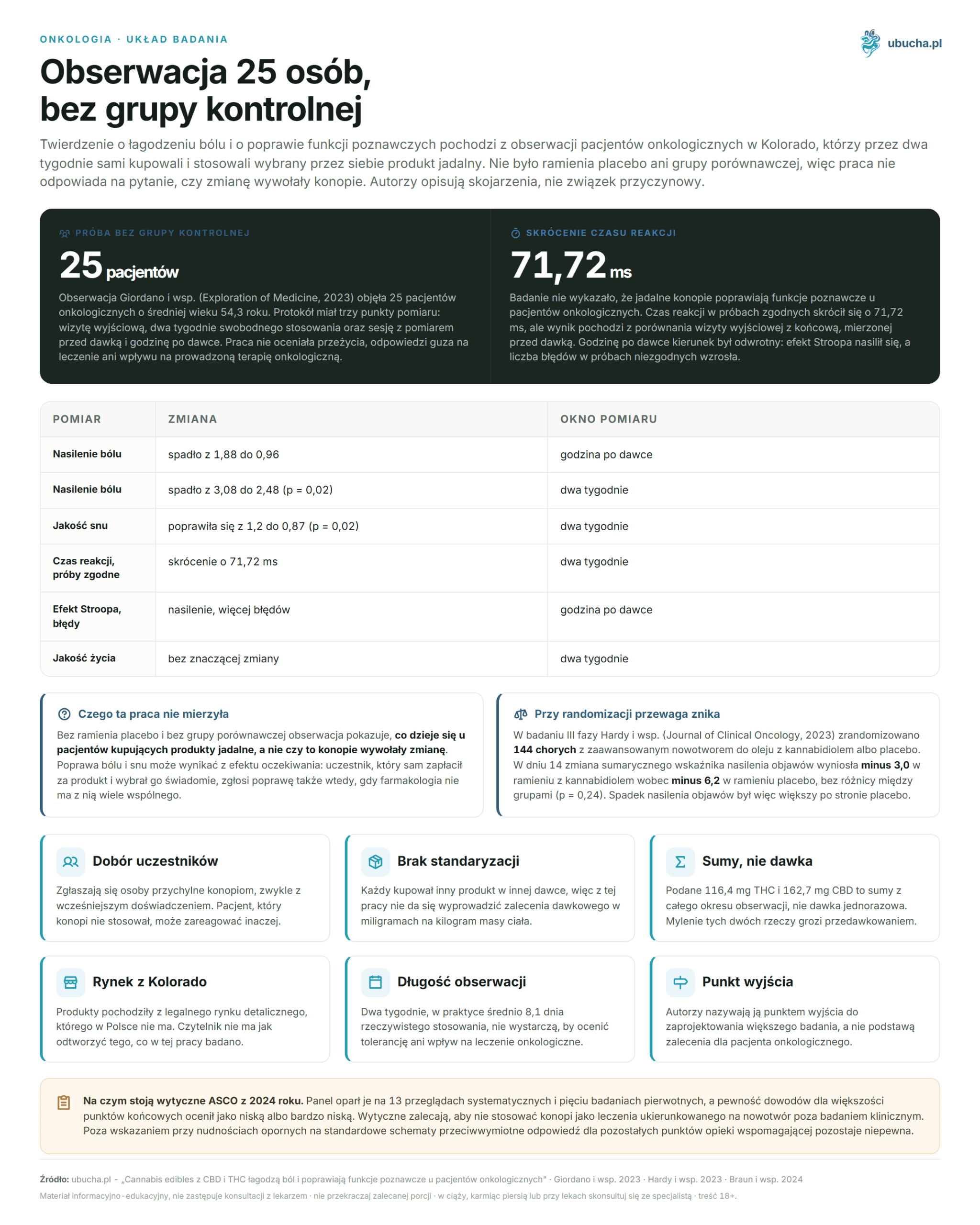
• In the observation by Giordano et al. (Exploration of Medicine, 2023), in 25 oncology patients, pain severity decreased from 1.88 to 0.96 one hour after dosing, and after two weeks from 3.08 to 2.48 (p = 0.02).
• The same work noted an acute increase in the Stroop effect and more errors immediately after dosing. Improvement in reaction time concerned the comparison after two weeks, not the moment after ingestion.
• The ASCO guidelines from 2024 recommend not using cannabis as an anticancer treatment outside of clinical trials. The certainty of evidence for most endpoints was rated as low or very low.
• The phase III study by Hardy et al. (2023) did not show an advantage of CBD oil over placebo in reducing symptom severity in patients with advanced cancer.
• CBD and THC affect CYP3A4, CYP2C19, and P-glycoprotein, which means they influence the metabolism of many oncology drugs. Any inclusion requires the oncologist’s consent and a review of the medication list.
What did the study of edible cannabis in oncology patients show?
The work by Giordano et al. (Exploration of Medicine, 2023) included 25 oncology patients with a mean age of 54.3 years. After two weeks of freely using edible cannabis products, pain severity decreased from 3.08 to 2.48, and sleep quality improved from 1.2 to 0.87. Both results reached a threshold of p = 0.02.
The protocol had three measurement points. First, a baseline visit in the laboratory. Then two weeks during which participants purchased their chosen product from a legal recreational pharmacy and used it without a prescribed schedule. Finally, a session with measurements before dosing and one hour after. On average, patients used edibles for 8.1 days and consumed a total of 116.4 mg of THC and 162.7 mg of CBD during this time.
The acute effect and the two-week effect diverged in opposite directions. One hour after dosing, pain severity decreased from 1.88 to 0.96, nearly by half, while the subjective feeling of intoxication increased. At the same time, the Stroop effect intensified, and the number of errors in incongruent trials increased. Only the comparison of the baseline visit with the final one, before dosing, showed a shortening of reaction time in congruent trials by 71.72 ms.
The authors also noted that the improvement in pain and sleep was more strongly associated with CBD consumption than with THC, and the overall quality of life did not change significantly. The title of this entry in its original form promised more than the work states.
What the study did not measure is equally important. There was no placebo arm or comparison group, so the work does not answer the question of whether the change was caused by cannabis. Survival, tumor response to treatment, or impact on ongoing oncology therapy were not assessed. The authors describe associations, not causal relationships, and they formulate conclusions accordingly.
| Measurement | Baseline Value | Post-Intervention | Measurement Window |
|---|---|---|---|
| Pain Severity | 1.88 | 0.96 | one hour after dosing |
| Pain Severity | 3.08 | 2.48 (p = 0.02) | two weeks |
| Sleep Quality | 1.2 | 0.87 (p = 0.02) | two weeks |
| Reaction Time, Congruent Trials | reference value | shortening by 71.72 ms | two weeks |
| Stroop Effect, Errors | reference value | intensification, more errors | one hour after dosing |
Why do edibles work differently than vaporization?
The digestive route shifts the entire action timeline. In the study by Vandreya et al. (PMC, 2017), healthy adults consumed cookies with 10, 25, or 50 mg of THC. Subjective and cognitive effects peaked between 1.5 and 3 hours after ingestion and lasted 6 to 8 hours. This is a completely different distribution than after inhalation.
The same work noted another thing that is rarely written about. Cannabinoid concentrations in the blood after oral administration were low compared to inhalation, with peak THC concentrations ranging from 1 to 3.5 ng/ml. The concentration of the metabolite 11-hydroxy-THC was similar to that of THC itself, with a similar time to peak. In comparison, Abrams et al. (PubMed, 2007) showed that vaporization yields peak THC concentrations comparable to smoking, with lower carbon monoxide levels in exhaled air.
For a patient in palliative care, this leads to a simple practical conclusion. An edible product is suitable for covering a long window, such as overnight, and not for breaking through acute pain. Vaporization works in the opposite way. The most common mistake is taking a second dose after 45 minutes when the first has not yet started to work.
One number from the Vandreya study deserves special attention. Doses of 25 mg and 50 mg of THC produced nearly identical peak blood concentrations, 3.5 and 3.3 ng/ml, respectively. Doubling the portion did not double the exposure. For the patient, this means that increasing the amount of the consumed product does not translate linearly into effect, but prolongs the action and increases the risk of adverse symptoms.
The authors also point out a conclusion for interpreting toxicological results. After oral administration, blood concentrations were low compared to inhalation, and the detection window for THC reached 22 hours. A low blood test result does not prove that the patient did not take a dose.
The mechanism of this difference is detailed in our entry about why edible CBD hits harder and later than dry herb.
What do earlier clinical studies in oncology say?
The oldest reference remains the review by Tramer et al. (BMJ, 2001), which included 30 randomized comparisons and 1366 patients. Oral nabilone, oral dronabinol, and intramuscular levonantradol were more effective than older antiemetic drugs, with a relative risk of 1.38 and an NNT of 6 for complete control of nausea.
This same review, however, calculated the cost of this advantage. Dizziness, dysphoria, hallucinations, paranoia, and drops in blood pressure occurred more frequently than in the comparison groups, and discontinuation of treatment due to adverse effects was nearly five times more common. It is worth adding something that the corpus of texts about cannabis regularly distorts: in these studies, cannabinoids were not compared with setrons, as such arms simply did not exist.
A newer and stronger piece of evidence came from the study by Hardy et al. (Journal of Clinical Oncology, 2023). 144 patients with advanced cancer were randomized to CBD oil or placebo. On day 14, the change in the total symptom severity score was minus 3.0 in the CBD arm versus minus 6.2 in the placebo arm, with no difference between groups (p = 0.24). The median dose chosen by patients was 400 mg of CBD per day. No impact on quality of life, depression, or anxiety was detected.
Three further numbers from this study complete the picture. The percentage of patients whose symptom severity decreased by at least six points was 44.8% in the CBD arm versus 58.7% in the placebo arm (p = 0.13). The only adverse symptom differing between groups was dyspnea, more frequent with CBD. On day 28, 70% of patients in the CBD arm and 64% in the placebo arm reported improvement, meaning that in both groups, the majority experienced benefits.
This distribution shows why observation without a control group can be misleading. If Hardy’s study were described solely from the perspective of the CBD arm, it would appear to be a success. However, the authors’ conclusion is unequivocal: CBD oil did not add anything to the reduction of symptoms provided by specialized palliative care alone.
What limitations does the naturalistic protocol from Colorado have?
The observation from Colorado is not a randomized study, and the authors do not present it as such. There is no control group or placebo, the sample consists of 25 individuals, and each participant used a different product at a different dose. This setup allows for describing what happens to patients buying edibles, but does not allow for concluding that cannabis caused the change.
The first limitation concerns participant selection. Recreational marijuana has been legal in Colorado for years, so individuals who volunteer for such a study are usually already favorably inclined towards cannabis and often have prior experience. A patient who has never used cannabis may react differently, especially to the psychoactive aspect.
The second limitation is the lack of product standardization. Since everyone bought something different, no dosing recommendation in milligrams per kilogram of body weight can be derived from this work. The 116.4 mg of THC and 162.7 mg of CBD reported by the authors are totals from the entire observation period, not a single dose, and confusing these two things leads directly to overdose.
The third limitation is methodological. The improvement in pain and sleep may result from the placebo effect. A participant who paid for the product themselves and consciously chose it may report improvement even when pharmacology has little to do with it. In Hardy’s study, the placebo arm improved more than the CBD arm, and this is the best possible illustration of this phenomenon.
The fourth limitation concerns the transfer of results to the Polish context. Participants purchased products from the legal retail market in Colorado, which simply does not exist in Poland. The reader has no way to replicate what was studied, so the work describes a reality unavailable to Polish patients and is therefore not a guideline for action.
The fifth limitation is the length of observation. Two weeks, and in practice an average of 8.1 days of actual use, is not enough to assess tolerance, accumulation in fatty tissue, or impact on the course of oncology treatment. The authors call their work a starting point for designing a larger study, and that is an honest description of its value.
What do the ASCO guidelines from 2024 recommend?
The guidelines by Braun et al. (ASCO Guideline, Journal of Clinical Oncology, 2024) are based on 13 systematic reviews and five additional primary studies. The expert panel rated the certainty of evidence for most endpoints as low or very low and formulated three clear recommendations.
First, physicians should discourage the use of cannabis and cannabinoids as targeted cancer treatment, outside the context of clinical trials. Second, cannabis may improve control of nausea and vomiting resistant to standard antiemetic regimens when added to treatment in accordance with guidelines. Third, for other supportive care points, the response remains uncertain.
It is worth seeing what this document stands on. A search of PubMed and the Cochrane Library covered the period up to January 27, 2023, and the found evidence base consists of 13 systematic reviews and five primary studies: four randomized and one cohort. For a topic present in the debate for decades, this is surprisingly little, and the panel states this condition outright.
The guidelines cover four areas: anticancer action, toxicity of oncology treatment, symptoms, and quality of life. Aside from the indication for resistant nausea, no evidence was found that would allow recommending cannabinoids in any of them. The panel emphasizes that the lack of evidence is not evidence of lack of action, but a reason to conduct research. The document is signed by Donald Abrams, among others, the author of the cited works on vaporization and the combination of cannabinoids with opioids.
The panel dedicated a separate part of the document to the conversation with the patient. Access to cannabis and its use have outpaced the science that would justify this use, so the guidelines describe how to conduct an open and non-judgmental conversation instead of pretending that the patient does not bring up the topic. This is a procedural recommendation, not a pharmacological one, and in Polish practice, it can be the most difficult to implement.
A full discussion of this document along with its implications for practice can be found in our entry about the new guidelines of the American Society of Clinical Oncology.
What is the access to cannabis for oncology patients in Poland?
A Polish oncology patient has two separate paths, and they must not be confused. The first is flower or extract from a pharmacy, dispensed on a RPW prescription issued by a doctor. The second is legal preparations from industrial hemp, available without a prescription. Edible products with high THC content, such as those from the study in Colorado, are not available in retail sales in Poland.
The boundary between these paths is defined by statutory definition. Industrial hemp refers to plants of the species Cannabis sativa L., in which the total content of delta-9-THC and tetrahydrocannabinolic acid (THCA) in flowering or fruiting tops, from which the resin has not been removed, does not exceed 0.3% when calculated on a dry weight basis, rounded to one decimal place. The basis is art. 4 point 5 of the Act of July 29, 2005 on Counteracting Drug Addiction (t.j. Dz.U. 2023 poz. 1939), as amended by the Act of March 24, 2022 (Dz.U. 2022 poz. 763).
Two clarifications that change the outcome of the laboratory test. The threshold is counted as the sum of delta-9-THC and THCA, not as delta-9-THC alone. The national threshold corresponds to the EU threshold from regulation (EU) 2021/2115, but it does not follow from it: these are two separate regulations with the same numerical value.
For the record, two dates. Until May 6, 2022, the national threshold was 0.20%, and from May 7, 2022, it is 0.3%. On the EU side, the value of 0.2% was established by regulation (EU) 1307/2013, repealed on January 1, 2023, by regulation 2021/2115, which introduced 0.3%.
A separate regulation concerns the permissible levels of THC in food from hemp seeds, expressed not in percentages but in milligrams per kilogram: 3.0 mg/kg for seeds and seed products and 7.5 mg/kg for seed oil, according to Annex I of Commission Regulation (EU) 2023/915. Confusing these limits with the 0.3% threshold occurs frequently in texts about cannabis and leads to conclusions that no regulation contains.
The procedure for obtaining a prescription and what the doctor requires is described in a separate guide on becoming a medical marijuana patient in Poland. A prescription-free preparation remains a supplement or cosmetic and does not replace oncology treatment.
What risks do edible cannabis pose for oncology patients?
The greatest risk does not lie in the molecule itself, but in interactions. Brown and Winterstein (PMC, 2019) gathered data from the characteristics of medicinal products containing CBD and described that adverse effects occurred in nearly half of users, with a clear dose-dependent relationship. Among the common ones, they mention increased transaminase activity, sedation, sleep disturbances, and anemia.
The mechanism of interactions is well described. CBD interacts with CYP3A4 and CYP2C19, which are enzymes that metabolize a large portion of drugs, and with P-glycoprotein responsible for their excretion. The authors call CBD both a victim and a perpetrator of interactions and recommend three things: reducing the substrate dose, monitoring for adverse effects, and considering alternative therapy for patients burdened with multiple medications.
The safety review by Iffland and Grotenhermen (PMC, 2017) confirms the favorable profile of CBD compared to drugs used for the same indications, but directly points out a gap: there is a lack of studies on the impact of CBD on liver enzymes and drug transporters. This is not a neutral statement when a patient is taking a cytostatic with a narrow therapeutic window.
Combining with opioids requires separate discussion, as this is a typical situation in oncology. Abrams et al. (PubMed, 2011) administered vaporized cannabis to 21 patients with chronic pain, treated with morphine or extended-release oxycodone, for five days. Opioid concentrations in plasma did not change significantly, and pain severity decreased by an average of 27% (95% confidence interval from 9 to 46).
Two things that this work does not say. The edible product was not studied, only vaporization. The reduction of the opioid dose was not measured; the authors merely suggested it as a hypothesis to be tested. Numbers about reducing the opioid dose by several dozen percent, circulating in Polish texts, do not come from this study and have no backing in it.
Additionally, there is a risk of falls. Since the effects after an edible dose last 6 to 8 hours, and an oncology patient may be weakened after chemotherapy or have steroid-induced osteopenia, a nighttime visit to the bathroom becomes a real fracture risk. The practical recommendation is to take the first doses when you do not plan to get up and not to drive vehicles.
Do CBG and other cannabinoids have a place here?
Besides CBD and THC, cannabigerol is most often mentioned. Nachnani et al. (PubMed, 2021) gathered pharmacological arguments for studying this molecule, but the title of their work speaks of premises, not evidence of effectiveness in humans. This distinction is crucial here.
The most promising result concerns neuropathy after cytostatic treatment and comes from an animal model. In a 2023 study (PMC), mice with cisplatin-induced neuropathy received CBG daily for 7 and 14 days. Mechanical hypersensitivity decreased in both males and females, and pain sensitivity returned to 60-70% of baseline values measured one day after the last injection (p below 0.001). No development of tolerance or weight loss was observed.
This is a good result and also a result in mice, after intraperitoneal administration. Translating it to patients after chemotherapy would require a study with randomization, standardized preparation, and oral administration route, and such a study does not exist. Anyone describing this work as evidence that CBG alleviates neuropathy in humans is overinterpreting it by several levels.
For reference, it is worth knowing where a cannabinoid has actually gone through the full registration process. Epidyolex, a solution containing 100 mg of cannabidiol per milliliter, is approved in the European Union as an adjunct therapy for seizures in Lennox-Gastaut syndrome and Dravet syndrome, in combination with clobazam, as well as in tuberous sclerosis. No oncological indication has been registered for it.
How to plan symptomatic support with the oncologist’s consent?
The starting point is the conversation, not the product. The ASCO guidelines place open communication with the patient first precisely because most patients reach for cannabis regardless of whether the doctor knows about it. Documentation protects both parties and allows the clinical pharmacist to review the medication list before anything begins.
The second step is contraindications. Pregnancy and breastfeeding, severe liver failure, unstable psychiatric illness, and recent cardiovascular incidents close the topic. The third step is to choose the route of administration suited to the problem: a long-acting form for the night, an inhaled form for breakthrough pain.
The fourth step is to slowly increase the dose with a record of effects. For reference, in Hardy’s study, the median dose chosen by patients was 400 mg of CBD per day, and at this dose, no advantage over placebo was found. This is a good argument to establish in advance how long and under what lack of effect the trial will be terminated.
The fifth step is monitoring. A pain severity diary, sleep assessment, body weight, list of adverse effects, and monitoring of aminotransferase activity with prolonged use of higher doses. Withdrawal is indicated in the absence of effect after the established trial period, in the case of a serious adverse event, and with disease progression requiring a change in first-line treatment.
Two notes about the diary itself, as its quality determines whether the trial can be evaluated at all. The record should include the hour and size of the dose, not just “in the evening,” and the severity of the symptom before and after the dose. Without these two columns, it is impossible to distinguish the effect of the preparation from natural daily fluctuations, and this distinction is precisely what the decision to continue is based on.
The termination criterion is established before the start, not during. Practice shows that a trial without a predetermined date and threshold drags on for months, as every better day can be read as an effect of the preparation. A previously recorded date and condition close this mechanism.
How to distinguish reliable data from marketing narratives?
In Polish internet, cannabis is often presented as a breakthrough in oncology. The National Cancer Institute in its PDQ review on cannabis and cannabinoids shows a completely different picture: data on tumor growth inhibition come from studies on cell and animal models, not from studies in humans. The statement “CBD cures cancer” is a fabrication regardless of who utters it.
A reliable source can be recognized by four characteristics. It refers to peer-reviewed publications, not to videos and social media posts. It provides doses in milligrams and measurement points instead of “a few drops.” It separates symptomatic support from causal treatment. It does not promise a cure and directs to the attending physician.
Separately, it is worth distinguishing two questions that constantly blend in conversations. Do cannabis cure cancer is a question about anticancer action, and the answer is: there is no evidence for that in humans. Do cannabis help oncology patients is a question about symptoms, and the answer is: perhaps, in selected situations, with low certainty of evidence.
We discuss this distinction more broadly in our entry about whether cannabis can support cancer treatment. A cannabis shop is not a medical entity and does not make diagnoses. Its role ends with a product of known composition and indicating sources where the patient can check the rest themselves.
What else is unknown about cannabis in oncology?
The ASCO guidelines conclude with a call for research, and this is not a courtesy formula. With 13 systematic reviews and five primary studies, the panel could do nothing but describe uncertainty. The biggest gap concerns not whether cannabinoids work, but which preparation and at what dose they would work.
The problem of standardization is well illustrated by the analysis of CBD extract labels sold online (Bonn-Miller et al., PMC, 2017). 84 products from 31 companies were examined. Correctly labeled were 30.95%, 26.19% had inflated declarations, and 42.85% had reduced ones. THC was detected in 18 of 84 samples, or 21.43%, at concentrations up to 6.43 mg/ml.
Transfer these numbers to a clinical study, and you will see why the results of market observations are so difficult to replicate. If two-thirds of products contain something different than declared on the label, then every study based on participant purchases essentially measures an unknown intervention. This is precisely why Hardy’s study used one preparation with a confirmed concentration, and this is why its negative result weighs more than the positive observation from Colorado.
So what is missing? Randomized studies with placebo, on a preparation with confirmed composition, with a predetermined dose, with an appropriate number of participants, and with endpoints agreed upon before the start. Until such works are created, every statement about the effectiveness of cannabis in oncology remains a hypothesis.
What do these studies mean for oncology patients?
The observation from Colorado is interesting and weak at the same time. It shows in 25 individuals that edible cannabis is associated with lower pain severity and better sleep after two weeks, with the improvement being more strongly associated with CBD than with THC. It also shows what titles in the media usually do not repeat: one hour after dosing, attention test results were worse, not better.
Comparing this work with the study by Hardy et al. gives a cautious picture. When CBD enters a study with randomization and placebo, the advantage disappears. This does not mean that cannabinoids are useless in palliative care, only that the evidence of their effectiveness is today weaker than the market suggests. The ASCO guidelines call this certainty low or very low, and it is difficult to circumvent this statement.
For the Polish patient, the practical conclusion boils down to order. First, oncology treatment conducted according to guidelines. Then, a conversation with the oncologist or palliative care team about symptoms that standard treatment does not fully address. Only at the end, a possible trial with cannabinoids, with written documentation, a review of interactions, and an established termination criterion.
Reversing this order is the most dangerous scenario we know from conversations in palliative care. Discontinuing or postponing chemotherapy, radiotherapy, or surgery in favor of a cannabis preparation has no support in any of the discussed studies and costs time that cannot be regained in cancer disease.
Finally, a sentence about the title of this entry. The study from Colorado did not show that edible cannabis improves cognitive functions in oncology patients. It showed that after two weeks, the reaction time in one of the tasks was shorter than at the start, while at the same time, results worsened one hour after dosing. These are two different statements, and only the second one is consistent with the data.
Frequently Asked Questions
Do cannabis edibles with CBD and THC cure cancer?
No. The ASCO guidelines from 2024 recommend against cannabis and cannabinoids as targeted cancer treatment outside of clinical trials. The National Cancer Institute indicates that data on tumor growth inhibition comes from cell and animal models. Edible cannabis is considered only as symptomatic support.
When does a cannabis edible start to work?
In the study by Vandreya et al. from 2017, the effects of cookies with 10, 25, or 50 mg of THC peaked between 1.5 and 3 hours after consumption and lasted from 6 to 8 hours. This is significantly later and longer than after vaporization. Do not dose again until the full waiting window has passed.
What dose of CBD did patients choose in palliative studies?
In the phase III study by Hardy et al. from 2023, the median dose chosen by the patients themselves was 400 mg of CBD oil per day. At this dose, no advantage over placebo was found in reducing symptom severity. The dose for a specific patient is determined by the oncologist or the palliative care team.
Can I use cannabis together with chemotherapy?
Only with the oncologist’s consent and after a review of the medication list by a clinical pharmacist. Brown and Winterstein described the effect of CBD on CYP3A4, CYP2C19, and P-glycoprotein, which affects the metabolism and excretion of many drugs. Recommendations from this work include reducing the substrate dose and monitoring for adverse effects.
Are THC edibles legal in Poland?
Not in retail sales. Hemp plants are those in which the total delta-9-THC and THCA does not exceed 0.3% dry weight, rounded to one decimal place (art. 4 point 5 of the Act on Counteracting Drug Addiction). Material with a higher content is available only by prescription from a pharmacy.
Does CBD help with nausea after chemotherapy?
The evidence is weak. ASCO allows cannabinoids as an adjunct for nausea resistant to standard antiemetic regimens. Tramer’s review from 2001 concerned oral nabilone and dronabinol, not CBD itself, and did not include a comparison with setrons, as such arms were not present in those studies.
Can edible cannabis be used in hospice care?
The decision is up to the palliative care team. The study by Hardy et al. did not show an advantage of CBD oil over placebo in reducing symptom severity in patients with advanced cancer. If the team allows a trial, documentation, a review of interactions, and a pre-established withdrawal criterion are needed.
If after talking to your oncologist you are looking for a product for symptomatic trial, the current assortment can be found in the cannabis oils category. Confirm stock levels and composition on the product page.
This article is for informational and educational purposes and does not constitute medical advice. Before starting to use cannabis or CBD for therapeutic purposes, consult your doctor, especially if you are taking other medications, are pregnant, or breastfeeding. In cancer disease, the standard of treatment remains chemotherapy, radiotherapy, oncological surgery, and immunotherapy.
Author: Michał Waluk · Published: 2026-05-04 · Updated: 2026-08-10