
Ashwagandha and CBD together: can they be combined and what effects does the combination give
Ashwagandha and CBD together: what studies have really shown for each separately, why no one has studied the combination, and with which medications it is better to ask a doctor.
Ashwagandha and CBD are two of the most commonly purchased supplements for stress in Poland, so the question of their combination inevitably arises. The answers circulating online are surprisingly confident: ready hourly schemes, specific milligrams, percentages of sleep improvement. When checked at the source, it turns out that they describe studies that no one has conducted or attribute numbers to works that those works do not contain. The most frequently repeated result of sleep improvement with ashwagandha comes from a study that did not measure sleep at all, and the attributed preparation and duration do not match either. This article shows what each of these ingredients really has documented, why the combination itself has not been studied, and where the real risks lie that are worth knowing before combining them.
KEY INFORMATION
• In a placebo-controlled study of 64 individuals with chronic stress, ashwagandha reduced serum cortisol by 27.9% compared to 7.9% in the placebo group (Chandrasekhar et al., Indian Journal of Psychological Medicine, 2012).
• There is not a single clinical study evaluating ashwagandha and CBD administered together; everything known pertains to each of them separately.
• CBD inhibits CYP2D6, and according to a safety review, there is evidence that it also inhibits CYP2C9, slowing the metabolism of warfarin and diclofenac.
• EFSA stated in 2026 that the safety of CBD cannot be established in individuals taking medications simultaneously.
How does ashwagandha affect stress and cortisol?
Ashwagandha (Withania somnifera) lowers cortisol levels, and this is its best-documented effect. It has been confirmed by two independent randomized placebo-controlled studies, both conducted on healthy individuals reporting elevated stress.
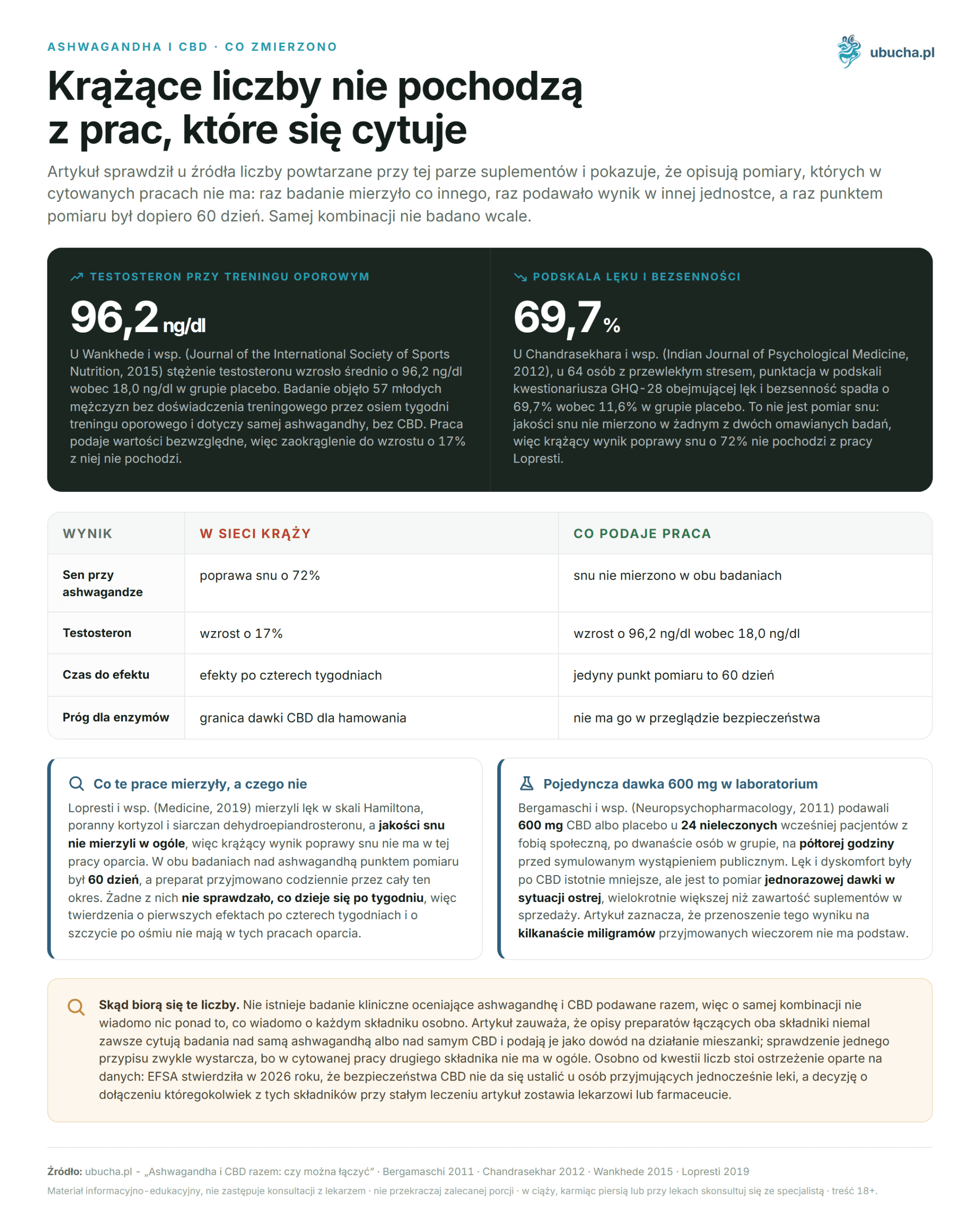
Chandrasekhar et al. (Indian Journal of Psychological Medicine, 2012) included 64 individuals with a history of chronic stress and administered them capsules twice daily for 60 days, in the study group with a high-content root extract of withanolides. After two months, serum cortisol decreased in the ashwagandha group by 27.9% compared to 7.9% in the placebo group, and scores on all applied stress scales significantly decreased. In the anxiety and insomnia subscale of the GHQ-28 questionnaire, the decrease was 69.7%, compared to 11.6% in the placebo group.
The full text of this work also indicates exactly which preparation was studied, which is often lost in texts about ashwagandha. The authors state directly that they used the KSM-66 extract provided by Ixoreal Biomed, obtained exclusively from the root, without alcohol and synthetic solvents, standardized by HPLC for a content of at least 5% withanolides. This is important because the results of the study refer to this specific extract, not to any root powder on the shelf.
Lopresti et al. (Medicine, 2019) repeated the observation on another preparation: 60 stressed adults received either Shoden extract or placebo for 60 days. The Hamilton anxiety scale significantly decreased, as did morning cortisol and dehydroepiandrosterone sulfate. It is worth noting what is not present in this work: the authors did not measure sleep quality, so the circulating result of a 72% improvement in sleep with ashwagandha does not come from this study.
What is known about CBD and anxiety?
The strongest single evidence concerns public speaking anxiety and comes from a double-blind study. However, this is not evidence of the action of CBD in supplemental doses or its effectiveness in daily stress.
Bergamaschi et al. (Neuropsychopharmacology, 2011) included 24 previously untreated patients with social phobia and randomly assigned them to CBD at a dose of 600 mg or placebo, with twelve people in each group, one and a half hours before a simulated public speaking event. Separately, the same trial was conducted with twelve healthy volunteers without any preparation. After CBD, anxiety, discomfort, and cognitive disturbances related to the performance were significantly lower, and in the negative self-assessment scale, the CBD group did not differ from healthy volunteers.
This work describes a single dose of 600 mg, which is a multiple of what is contained in available supplements. Transferring its result to several milligrams taken in the evening has no basis, and the authors themselves do not do this. The result also pertains to an acute situation, a specific stressor in laboratory conditions, not chronic tension.
The reference point for the amount remains the regulator’s position. The EFSA panel derived a provisional safe dose of CBD in 2026 at 0.0275 mg per kilogram of body weight per day, which is about 2 mg daily for a person weighing 70 kg, with an uncertainty factor of 400. This value applies only to supplements with a purity of at least 98% and without nanoparticles.
Has the combination of ashwagandha and CBD been studied at all?
No, it has not. This is the most important answer in the entire text and also the one you will not find in descriptions of products combining both ingredients. There is no clinical study evaluating ashwagandha and CBD administered together, so nothing is known about the combination itself beyond what is known about each ingredient separately.
Everything circulating about the synergy of these two substances is reasoning based on mechanisms, not observation. The reasoning sounds sensible: ashwagandha lowers cortisol over weeks, CBD acts on anxiety acutely, so together they should cover two different time horizons of stress. However, the sensibility of the hypothesis is not its confirmation, and the history of supplementation knows many combinations that looked logical and yielded nothing beyond the sum of the ingredients.
There is, however, a certain asymmetry: while there are no studies on the combination, its potential disadvantages are known. Both substances pass through the same enzymatic system in the liver, as discussed below, so the only well-justified predicted interaction is an adverse interaction. This is the opposite of the situation where marketing promises synergy.
We have noticed that descriptions of preparations combining both ingredients almost always cite studies on ashwagandha alone or on CBD alone, presenting them as evidence of the mixture’s action. Checking one citation usually suffices to see this: the cited work does not include the second ingredient at all. A broader comparison of adaptogens has been described in our post Adaptogens for stress: ashwagandha, rhodiola, and reishi.
How does CBD affect liver enzymes?
This is an area that cannot be overlooked when combining supplements. CBD interacts with cytochrome P450 enzymes, which is the same system that metabolizes most prescription medications, and the scale of this interaction is not well established.
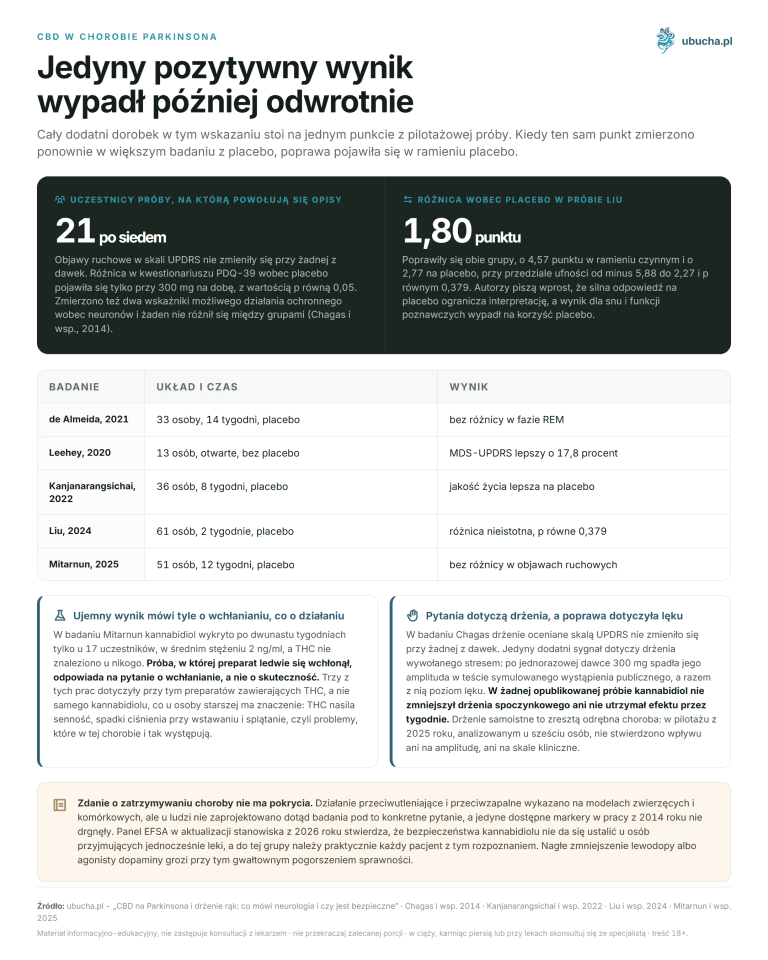
Iffland and Grotenhermen (Cannabis and Cannabinoid Research, 2017) gathered clinical data on this topic in a safety review of cannabidiol. CBD is metabolized, among other things, by CYP3A4, and about 60% of prescribed medications pass through this enzyme. The direction of action works both ways: ketoconazole, which inhibits CYP3A4, nearly doubles the peak concentration of CBD in the blood, while rifampicin, which stimulates this enzyme, lowers CBD concentration.
In the other direction, the authors state that CBD inhibits CYP2D6, and there is evidence that it also inhibits hepatic CYP2C9, slowing the metabolism of warfarin and diclofenac. The review also cites a clinical study involving thirteen children treated for epilepsy, in which the interaction of CBD with CYP3A4 and CYP2C19 increased the availability of clobazam enough to allow a reduction in the dose of the anticonvulsant.
However, the authors make a clear reservation, and it must be repeated: the in vitro studies on which the cytochrome inhibition tables are based were conducted at supraphysiological concentrations of CBD, and more clinical studies are needed to determine whether the interaction requires dose adjustments for concurrently administered medications. The circulating online boundary above which CBD would exhibit clinically significant inhibition of these enzymes does not appear in this work.
With which medications does this combination require a discussion with a doctor?
With any medication taken permanently, especially those with a narrow therapeutic window. The regulator’s position here is more assertive than a typical product description: EFSA stated in 2026 that the safety of CBD cannot be established in individuals taking medications simultaneously.
The panel also indicated a specific mechanism of risk. In animal studies, liver toxicity recurred, and liver mass and histopathological changes proved to be sensitive endpoints. In humans, potential hepatotoxicity has been noted, with the panel emphasizing that it manifests especially when CBD is used in conjunction with other medications. This is the same group for which safety has not been established.
A similar note comes from the World Health Organization’s 2018 review of cannabidiol. WHO describes CBD as a substance usually well tolerated, with a good safety profile, and adds that reported adverse effects may result from interactions between CBD and medications the patient is already taking. The warning thus concerns not the substance itself, but its company.
Practically, this means one thing: if you are taking anything on prescription, make the decision to add CBD or ashwagandha with your doctor or pharmacist, not based on the product description. This especially applies to anticoagulants, anticonvulsants, and immunosuppressants, where changes in blood concentration have a direct impact on treatment effectiveness.
Does ashwagandha help athletes?
There is one well-designed study on this, but it concerns ashwagandha alone during resistance training, not its combination with CBD. The results are clear, and it is worth knowing them in their original wording, as summaries often circulate distorted.
Wankhede et al. (Journal of the International Society of Sports Nutrition, 2015) randomly assigned 57 young men with little training experience to ashwagandha root extract or starch placebo for eight weeks of resistance training. In the ashwagandha group, the increase in load in bench press was 46.0 kg compared to 26.4 kg in the placebo group, and in leg extension, it was 14.5 kg compared to 9.8 kg. Arm and chest circumference increased faster, and body fat percentage decreased by 3.5% compared to 1.5%.
The work also measured two things important for recovery. Testosterone levels increased by an average of 96.2 ng/dl compared to 18.0 ng/dl in the placebo group, and creatine kinase, used as a marker of muscle damage after exercise, stabilized more clearly in the ashwagandha group. The popular rounding of this result to a 17% increase in testosterone does not come from this work, which provides absolute values, not percentages.
For whom is this combination not suitable?
The list of contraindications here is longer than the list of confirmed benefits, and that in itself is information. Some positions result from EFSA findings, while others stem from the properties of ashwagandha itself.
People under 25 years of age, pregnant and breastfeeding women, and those taking medications permanently should not use CBD, as for these three groups, the EFSA panel could not establish safety. The panel also noted that CBD crosses the placenta and accumulates in the body, and after prenatal exposure, long-term sex-dependent neurodevelopmental effects have been observed.
A separate reservation concerns the thyroid. Ashwagandha is sometimes described as a plant that affects thyroid hormones, so in the case of thyroid disease, especially when treated pharmacologically, adding it without the knowledge of the attending physician is a risk that cannot be self-assessed. The same applies to liver diseases, given the hepatotoxicity signals described above.
Ready-made adaptogenic preparations can be found in the adaptogens category. If you are interested in ashwagandha alone without the cannabis context, we have detailed its effects in the post Ashwagandha for sleep and stress, and a broader overview of ways to lower cortisol in the post Supplements for stress and cortisol.
How long does it take to see an effect?
Both ingredients act on completely different time scales, and this is the only thing that can be said about their combination with any certainty. Ashwagandha requires weeks, while CBD acted in studies on anxiety after a single dose.
In both studies on ashwagandha, by Chandrasekhar and Lopresti, the measurement point was day 60, and the preparation was taken daily throughout this period. Neither checked what happens after a week, so claims of initial effects after four weeks and a peak after eight have no basis in these works. What is known is that after two months of regular intake, the difference compared to placebo was significant.
On the CBD side, the situation looks different: in Bergamaschi’s study, the preparation was administered one and a half hours before the stressor, and the effect was measured the same day. However, this is a study on a single, high dose in an acute situation and does not say anything about how cannabidiol behaves when taken daily for weeks in supplemental amounts. The practical conclusion from comparing both time horizons is that assessment after a week resolves nothing because the ingredient with the slower action has not yet had time to show what it can do.
Frequently asked questions
Can ashwagandha and CBD be combined?
There is no clinical study evaluating this combination, so the answer is based solely on data about each ingredient separately. However, a known adverse interaction is that both pass through the liver cytochrome P450 system. For any permanent medication, make the decision with your doctor.
By how much does ashwagandha lower cortisol?
In the study by Chandrasekhara et al. (Indian Journal of Psychological Medicine, 2012), in 64 individuals with chronic stress, serum cortisol decreased by 27.9% after 60 days, compared to 7.9% in the placebo group. The extract was administered twice daily, and the difference between groups was statistically significant.
Does ashwagandha improve sleep?
This was not directly measured in either of the two discussed studies. However, Chandrasekhar et al. noted a 69.7% decrease in the anxiety and insomnia subscale of the GHQ-28 questionnaire. The circulating result of a 72% improvement in sleep with ashwagandha does not come from the work of Lopresti, which did not study sleep at all.
Does CBD interact with medications?
Yes. Iffland and Grotenhermen (Cannabis and Cannabinoid Research, 2017) state that CBD inhibits CYP2D6, and according to evidence, also CYP2C9, slowing the metabolism of warfarin and diclofenac. EFSA stated in 2026 that the safety of CBD cannot be established in individuals taking medications simultaneously.
What doses of ashwagandha and CBD should be used together?
This article will not and should not suggest that. There is no study on this combination, and the doses from scientific works describe specific research protocols, not recommendations for the reader. The amount should be determined individually with a doctor or pharmacist, especially with any parallel treatment.
Who should not use this combination?
Individuals under 25 years of age, pregnant and breastfeeding women, and those taking medications permanently should avoid it, as EFSA has not established the safety of CBD for these groups. Caution is also required for liver diseases and thyroid diseases, which ashwagandha may affect.
Does ashwagandha help with post-workout recovery?
Wankhede et al. (JISSN, 2015) demonstrated in 57 men training with resistance for eight weeks greater strength gains, higher testosterone increases, and stabilization of creatine kinase compared to placebo. However, the study concerns ashwagandha alone, without CBD, and men without training experience.
This article is for informational and educational purposes and does not constitute medical advice. Before starting to use cannabis or CBD for therapeutic purposes, consult your doctor, especially if you are taking other medications, are pregnant, or breastfeeding.
Author: Michał Waluk · Published: 2026-06-22 · Updated: 2026-08-11