
Reishi (lingzhi): the mushroom of immortality for immunity and stress 2026
Reishi (Ganoderma lucidum) – properties, effects on immunity and stress, dosing 1–3 g of extract, interactions with warfarin, and a complete guide 2026.
Reishi is perhaps the oldest and most symbolic medicinal mushroom in the world. In traditional Chinese culture, lingzhi (literally "divine mushroom") has been synonymous with health, longevity, and harmony for 2000 years. Emperors and dignitaries paid fortunes for it. Today, Ganoderma lucidum is available in every supplement store and has been studied in hundreds of scientific studies. But what actually works? Which of its hundreds of bioactive compounds have confirmed clinical effects? And what do you need to know about drug interactions before reaching for a capsule? This article answers these questions based on the monograph by Wachtel-Galor et al. (2011) and current clinical research.
KEY INFORMATION
• Reishi contains over 400 identified bioactive compounds - the main groups are triterpenes (ganoderic acids, β-lactone ganodermanondiol) and polysaccharides β-glucans (BN3C, BN3B, GLF) described in the monograph by Wachtel-Galor et al. (CRC Press Herbal Medicine, 2011).
• The study by Gao et al. (Journal of Medicinal Food, 2004) showed a 51.2% increase in NK cell activity after 12 weeks of using 1800 mg/day of reishi in cancer patients.
• Skuteczne dawkowanie ekstraktu 10:1: 1-3 g/d (1000-3000 mg) - odpowiednik 10-30 g surowego owocnika.
• Reishi may enhance the effect of warfarin - absolute necessity for medical consultation when using anticoagulant medications.
What is reishi and how does it differ from other medicinal mushrooms?
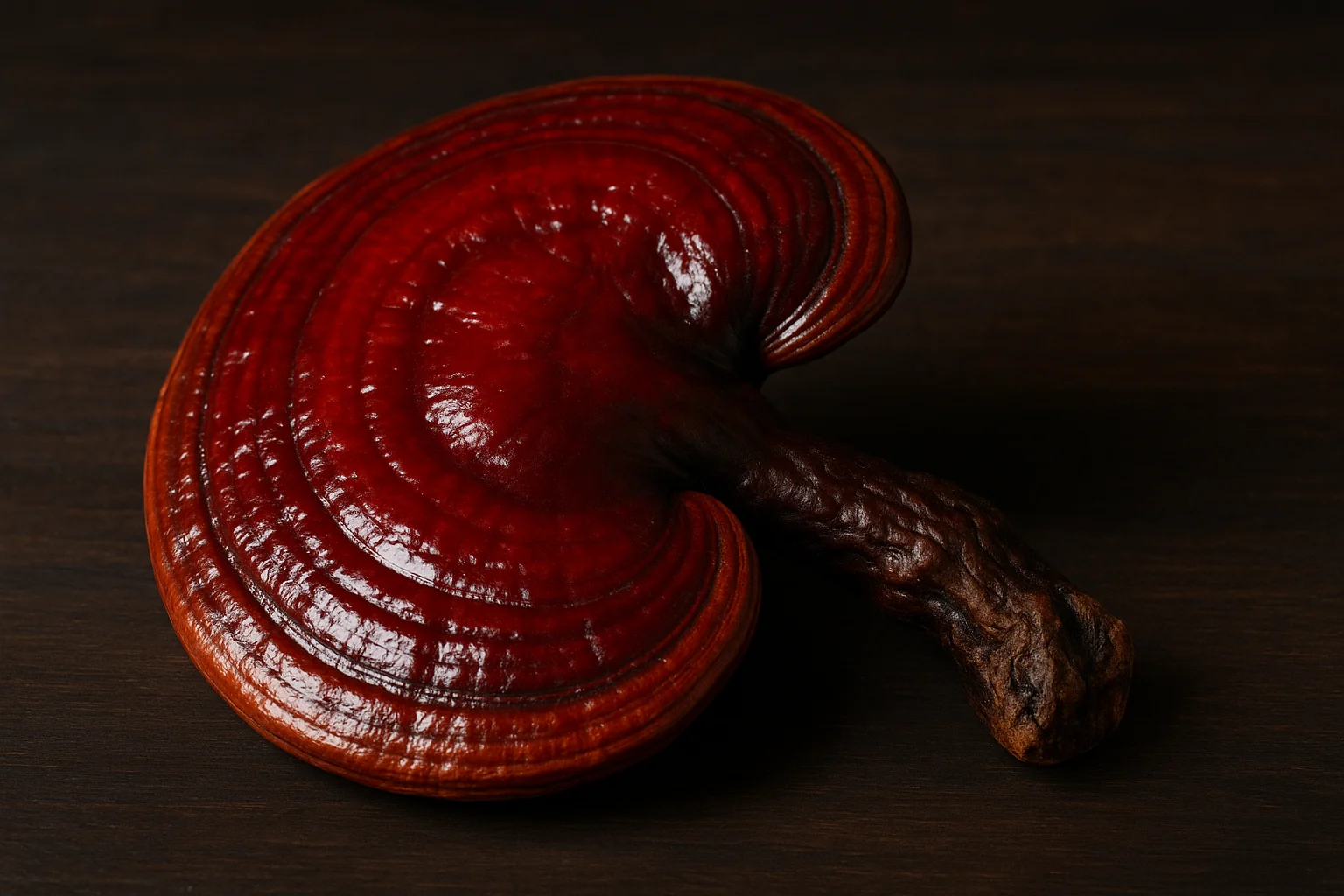
Ganoderma lucidum (lingzhi in Chinese, reishi in Japanese) is a polypore mushroom that grows on dead or living oak wood and other hardwoods. Its fruiting body has a characteristic shiny cap ranging from reddish-brown to dark brown - resembling a lacquered letter D. It is rare in nature; currently commercially cultivated mainly in China, Japan, and Korea on oak chips.
How does reishi differ from lion's mane or chaga? Lion's mane is the "brain mushroom" - it stimulates NGF and has neuroprotective effects. Chaga is the "antioxidant mushroom" with the highest ORAC. Reishi is the "adaptogenic and immunomodulating mushroom" with the broadest clinical documentation and the richest composition of triterpenes. It addresses the immune system, stress axis, and sleep quality simultaneously. This makes it a "base" mushroom in many health protocols - it can be combined with all other medicinal mushrooms without interference.
Triterpenes and β-glucans - the two pillars of reishi's action
The active biology of reishi is based on two groups of compounds acting through different mechanisms.
Triterpeny (kwasy ganodermowe): Over 140 triterpenes have been identified in reishi, with ganoderic acids A, B, C, D, and G being the most important. Triterpenes modulate the HPA axis, inhibit ACE (angiotensin-converting enzyme) affecting blood pressure, exhibit anti-inflammatory effects by inhibiting histamine and PAF (platelet activating factor), and have hepatoprotective effects by inhibiting toxin-induced damage to hepatocytes.
Polisacharydy β-glukany: Fractions BN3C, BN3B, GLF - high molecular weight polysaccharides activating immune cells. Wachtel-Galor et al. (CRC Press Herbal Medicine, 2011) describe reishi's β-glucans as immunomodulators activating macrophages, dendritic cells, and NK through TLR2 and TLR4. The GLF fraction exhibits the strongest immunostimulatory activity in vitro - increasing TNF-α and IL-1β by 300-500% in macrophage cultures.
Key technical point: raw reishi powder contains both types of compounds, but the water extract is richer in polysaccharides, while the ethanol extract (70% ethanol) is richer in triterpenes. "Dual extraction" products optimize the content of both groups. For adaptogenic effects (stress, sleep), triterpenes are more important. For immunological effects - β-glucans.
Reishi for immunity - what do clinical studies say?
Clinical studies on reishi and immunity vary in quality, but a few stand out with solid methodology. Gao et al. (Journal of Medicinal Food, 2004) In a study with 34 patients suffering from advanced colorectal cancer, it was shown that reishi 1800 mg/d for 12 weeks significantly increased NK (natural killer) cell activity by 51.2%, CD56+ population by 62.7%, and interferon-γ production. This is an important study conducted on a population with severely compromised immunity.
Another significant study: Wachtel-Galor et al. (Journal of Nutritional Science and Vitaminology, 2004) demonstrated that reishi in standard doses enhances immunoglobulin production and increases the number of T cells CD4+ and CD8+ after 4 weeks in healthy volunteers. In cases of recurrent upper respiratory infections, reishi shows preventive effects in several smaller studies - reducing the duration and frequency of colds by 25-35% in intervention groups. These are preliminary data but consistent with the mechanism of immunostimulation.
Reishi for stress and sleep - adaptogenic effects
The effects of reishi on stress and sleep are less clinically studied than its immunological effects, but the mechanisms are well described. Reishi triterpenes modulate GABA-A receptor reactivity - similar to L. rhamnosus JB-1 (psychobiotic), but through a different pathway. The GABAergic action explains the effects reported by users: reduction of mental tension, easier falling asleep, and fewer 'spinning thoughts' before sleep.
Badanie Tang et al. (Pharmacology Biochemistry and Behavior, 2012) In mouse models, it was shown that reishi extract prolonged non-REM sleep time, increased serotonin production in the raphe nuclei, and reduced sleep latency. The authors identified triterpenes as the active fraction responsible for the effects on sleep. Adaptogenically: reishi may reduce HPA axis reactivity during chronic stress by acting on corticosteroid receptors in the hippocampus.
Practically: reishi is best taken in the evening or afternoon for effects on sleep and stress. In the morning, it also works for immunological effects, but may cause slight lethargy in some individuals. Try both timings for 2 weeks and assess which yields better results.
Our observations: Reishi has one characteristic effect that is rarely mentioned: the subjective 'taming' of chronic stress. It’s not that stress disappears, but after 4-6 weeks of reishi, many people describe the same stressful situations as less emotionally engaging. The mechanism is likely related to the normalization of adrenal reactivity - a smaller amplitude of cortisol fluctuations means a milder emotional response to stressors. This is a subtle, gradual effect that is fully appreciated only after some time when looking back at the previous month.
Dawkowanie reishi - ekstrakt vs proszek vs herbata
The three forms of reishi available on the market differ significantly in the effectiveness and bioavailability of active ingredients.
Standaryzowany ekstrakt 10:1: The most effective form. 1 g of 10:1 extract corresponds to 10 g of raw fruiting body. The dual extraction (water + ethanol) ensures optimal content of both β-glucans and triterpenes. Recommended dosage: 1-3 g/d of 10:1 extract (1000-3000 mg), which corresponds to 10-30 g of raw fruiting body. This is the range used in clinical studies.
Surowy proszek owocnika: Requires higher doses (5-10 g/d) due to lower bioavailability and the presence of chitinous cell walls that hinder digestion. To avoid bloating and stomach issues with the powder, it is advisable to start with 2-3 g/d and gradually increase.
Herbata reishi (plasterki suszone): Traditional method of use - boiled slices of the fruiting body for 20-30 minutes. The tea mainly contains polysaccharides (well soluble in water), but loses some triterpenes during cooking. A good form for immunological effects, weaker for adaptogenic/sleep effects of triterpenes.
Reishi and the liver and hepatoprotective effects
One of the historical uses of reishi in Chinese medicine was liver protection. Modern science has confirmed part of this action. Reishi triterpenes - particularly ganoderic acid B and ganodermanondiol - exhibit hepatoprotective effects in models of chemical toxicity. Mechanism: inhibition of cytochrome P450 (CYP) that activates xenobiotics into reactive metabolites, reduction of lipid peroxidation in hepatocytes, and stimulation of antioxidant enzymes (SOD, CAT, GPx) in the liver.
Badanie Lin et al. (Life Sciences, 2003) In a model of fatty liver in mice, it was shown that reishi extract significantly reduced levels of ALT, AST, and liver triglycerides. In the human context, studies on non-alcoholic steatohepatitis (NASH) are interesting: preliminary data suggest that β-glucans from reishi, by modulating the gut microbiome and reducing LPS penetrating through 'leaky gut', may reduce liver inflammation. However, there are no clinical RCTs confirming hepatoprotection in humans.
Important disclaimer: although reishi protects the liver in toxicity models, it is not a cure for liver diseases and should not replace diagnostic and hepatological treatment. In the presence of liver disease, the use of reishi requires hepatological consultation - the metabolism of fungal triterpenes by the affected liver may be altered.
Reishi and cancer - what does science really say?
Reishi is being intensively studied as a supplement supporting cancer therapy. Important: it is not a cancer cure and does not treat tumors on its own. Its role is immunomodulation in patients undergoing chemotherapy or radiotherapy, whose immune system is severely weakened.
Cochrane Review (Jin et al., 2016) analyzed 5 RCTs with a total of 373 cancer patients using reishi as adjuvant therapy. Results: patients taking reishi showed a 24% higher response rate to chemotherapy and better quality of life (less fatigue, better immunity). The Cochrane authors rated the quality of evidence as moderate and stated that reishi may be a valuable complement to cancer therapy, but not a standalone therapeutic intervention.
Antiproliferative mechanisms in vitro: β-glucans from reishi induce apoptosis in cancer cells, inhibit angiogenesis by blocking VEGF, and stimulate NF-κB-dependent cytotoxic immune responses. This is a promising area of research that requires confirmation in larger clinical trials with high methodological quality.
How to combine reishi with other adaptogens?
Reishi combines well with other adaptogens and functional mushrooms - there is no documented negative interaction between these supplements. A few popular combinations:
Reishi + lion’s mane: Reishi provides immunomodulation and stress reduction (for background), lion’s mane supports NGF and concentration (for cognitive functions). This is a classic 'shield + brain' stack popular in biohacking circles.
Reishi + ashwagandha: Both act adaptogenically by modulating the HPA axis, but through different mechanisms (reishi - triterpenes, ashwagandha - withanolides). The effects may be additive in cases of chronic stress with an immunological component.
Reishi + chaga: Both are immunomodulating mushrooms, but with different profiles - reishi has more triterpenes and adaptogenic effects, while chaga has a higher ORAC and antioxidants. The combination provides a broad spectrum of immunological and antioxidant protection.
When combining reishi with other supplements, always start with lower doses of each ingredient to assess tolerance. In combinations containing reishi, it is particularly important to check if you are simultaneously taking anticoagulant medications - this is an absolute boundary line.
Reishi interactions with medications - what you need to know
Reishi has documented interactions with several classes of medications and should not be used without medical consultation in individuals taking medications regularly.
Warfarin and anticoagulants: This is the most important interaction. The triterpenes in reishi inhibit platelet aggregation and may enhance the anticoagulant effect of warfarin, heparin, and NOAC, increasing the risk of bleeding. Wachtel-Galor et al. (2011) They describe documented cases of increased warfarin activity in patients using reishi. In anticoagulant treatment, reishi is absolutely contraindicated without consulting a doctor and monitoring INR.
Immunosuppressive drugs: Immunological stimulation with β-glucans may interfere with immunosuppression in patients after organ transplantation or with autoimmune diseases treated with immunosuppressants (methotrexate, cyclosporine). A conversation with a specialist is essential before using reishi.
Leki hipotensyjne: Reishi may slightly lower blood pressure by inhibiting ACE and the vasodilatory effect of triterpenes. When combined with ACE inhibitors or sartans, slight hypotension is possible. Monitoring blood pressure during the first weeks of supplementation is advisable.
More about functional mushrooms as a group - a comparison of reishi, chaga, cordyceps, and lion's mane - can be found in the article Adaptogenic mushrooms - which one to choose.
For those interested in using reishi in evening cocoa or tea, it's worth knowing that tea made from reishi prepared by boiling slices for 20-30 minutes is a traditional form and a completely acceptable method for extracting polysaccharides. The boiling temperature (100°C) does not destroy β-glucans - they are thermally stable. The bitterness of the tea can be softened with orange peel or cinnamon. Such an evening tea is a simple way to regularly supplement reishi without the need to buy capsules.
Frequently Asked Questions
What is reishi and why is it called the mushroom of immortality?
Ganoderma lucidum (lingzhi/reishi) is a medicinal mushroom with a 2000-year tradition in Chinese medicine, containing over 400 bioactive compounds. It symbolized longevity and health in court culture. Wachtel-Galor et al. (2011) It is described as one of the most widely studied medicinal mushrooms with documented immunomodulatory and adaptogenic effects.
What effect does reishi have on immunity?
β-glucans from reishi activate NK cells, macrophages, and T lymphocytes through Dectin-1 and TLR receptors. Gao et al. (Journal of Medicinal Food, 2004) They demonstrated a 51.2% increase in NK activity after 12 weeks of using 1800 mg/d in oncology patients. It enhances the nonspecific immune response.
How does reishi affect stress?
Triterpenes (ganoderic acids) modulate the reactivity of the HPA axis and act GABA-ergically, reducing mental tension. Tang et al. (2012) showed in an animal model an extension of non-REM sleep and an increase in serotonin with reishi extract. The adaptogenic effect normalizes cortisol reactivity without blocking the physiological response to stress.
Jakie dawkowanie reishi jest skuteczne?
Extract 10:1: 1-3 g/d. Raw fruiting body powder: 5-10 g/d. Effects visible after 4-8 weeks of regular use. Cycles of 8-12 weeks with a 4-week break. Use in the morning or evening - timing is not significant for immune effects, evening is better for sleep effects.
Czy reishi ma interakcje z lekami?
Yes - the most important interaction is the enhancement of the effects of warfarin and anticoagulants with a risk of bleeding. Secondary: possible interference with immunosuppressants and antihypertensive medications. Individuals taking these medications must consult a doctor before incorporating reishi.
How long should reishi be taken?
Cycles of 8-12 weeks with a one-month break. Immunomodulatory and adaptogenic effects visible after 4-8 weeks. Clinical studies up to 12 weeks showed a good safety profile. There is no data from RCT studies beyond 6 months - long-term use without breaks is not well studied.
This article is for informational and educational purposes and does not replace consultation with a doctor. If you are pregnant, breastfeeding, taking medications, or have chronic conditions, consult the use of supplements or herbs with a specialist.
Author: Michał Waluk · Published: 2026-05-04 · Updated: 2026-05-04