
CBD for allergies: does cannabidiol alleviate allergic symptoms and how to use it
There is not a single clinical study of CBD in allergies. However, an IgE-dependent allergy to cannabis and cross-reactions with fruits have been described. Check what this means.
The question in the title has a short answer, just not the one most readers expect. There is not a single clinical study in the Europe PMC database that has tested cannabidiol in allergic rhinitis, urticaria, or food allergy. Not one. Instead, the allergy literature describes something opposite: IgE-dependent allergy to Cannabis sativa, reactions after contact with the fresh plant, after inhaling pollen, and after eating hemp seeds, along with a cross-allergy syndrome with fruits and vegetables. For some people, a cannabis product is therefore not a hope, but an additional allergen. Below you will find what can be documented: the state of evidence regarding cannabidiol, described reactions to cannabis itself, symptoms of anaphylaxis, and what allergies are really treated with.
KEY INFORMATION
• No clinical trials of cannabidiol in allergic rhinitis, urticaria, and food allergy (search of Europe PMC, August 2026).
• An IgE-dependent allergy to Cannabis sativa has been described, from contact urticaria to anaphylaxis (Ebo et al., Curr Allergy Asthma Rep, 2024).
• The Can s 3 protein cross-reacts with peach, cherry, mandarin, tomato, hazelnut, and latex (Jackson et al., Allergy Asthma Clin Immunol, 2020).
• Anaphylaxis has been described after eating yogurt with hemp seeds (Wąsik et al., Medicina, 2024).
• Allergy is treated by avoiding the allergen, antihistamines, nasal glucocorticoids, and specific immunotherapy.
Is there a clinical trial of CBD in allergies?
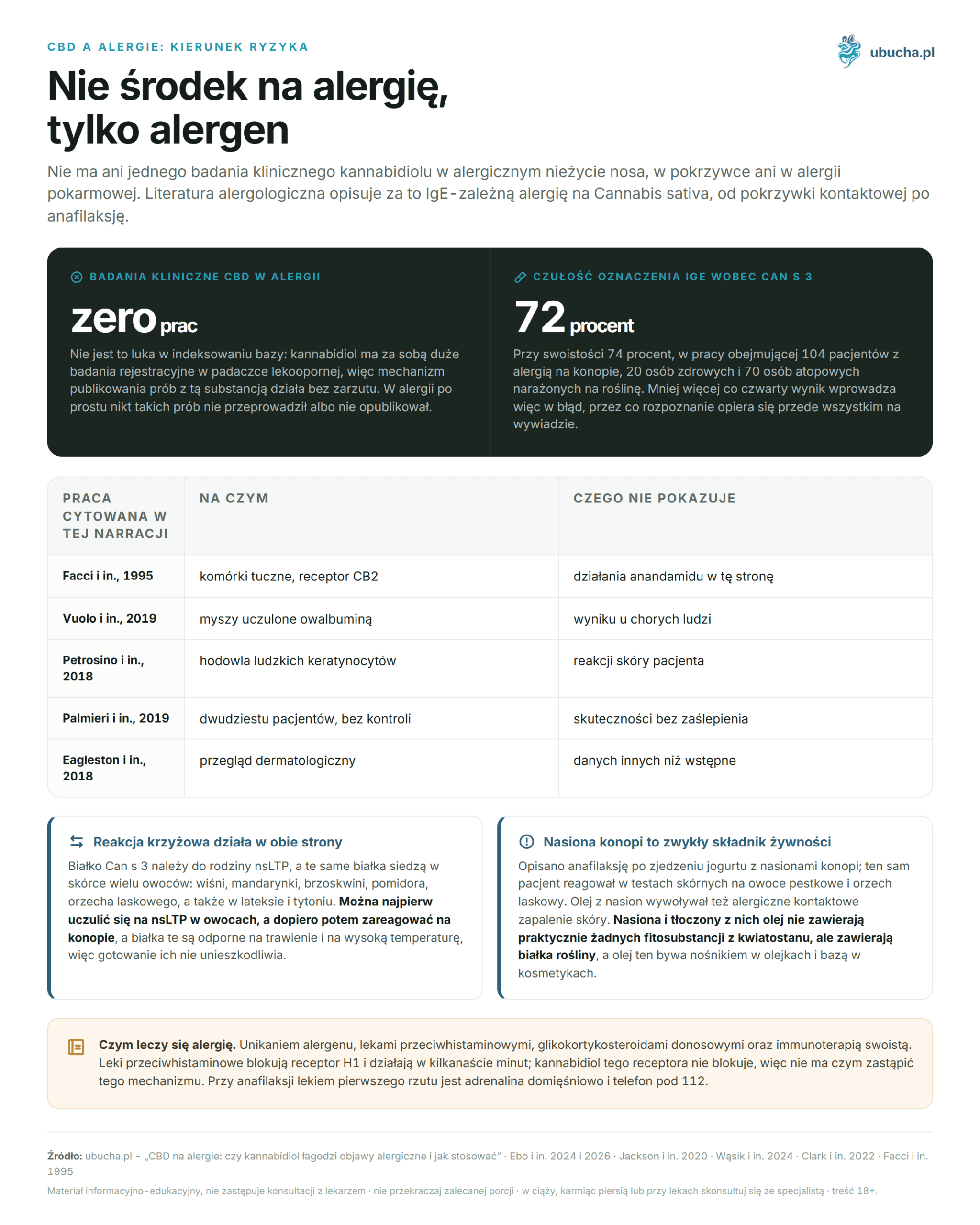
There is no such study. A search of Europe PMC for clinical trials of cannabidiol in allergic rhinitis, urticaria, and food allergy returns zero works. There is also not a single entry whose title would connect cannabidiol with rhinitis or urticaria.
This is not a gap in the indexing of the database. Cannabidiol has undergone large registration studies in drug-resistant epilepsy, so the mechanism for publishing clinical trials with this substance works flawlessly. In allergy, simply no one has conducted or published such trials. Everything circulating in texts about CBD for hay fever comes from three other sources: cell cultures, mouse models, and single series of dermatological studies without a control group.
The difference is practical, not academic. A mouse model with ovalbumin tells us what happens to the lungs of a mouse sensitized in the lab. It does not tell us whether a person allergic to grass pollen will sneeze less in May. Pharmacology is full of substances that performed excellently in rodents and failed in the second phase of human studies.
Therefore, in this article, you will not find dosages or usage schemes. There is nothing to dose for an indication that no one has studied, and a number pulled from thin air would look like knowledge that it is not.
What do the studies cited in texts about CBD and allergies really show?
The same five works keep coming back, and none says exactly what is attributed to it. It is worth reading them in the original, as the conclusions circulating on the internet can be reversed. The very mechanisms that this narrative refers to, namely mast cells, histamine, and IgE antibodies, we have outlined separately in the entry can CBD alleviate allergy symptoms.
Facci et al. (PNAS, 1995) showed that mast cells have the gene and active protein of the CB2 receptor, and stimulation of this receptor suppresses their activation. Activation was suppressed by palmitoylethanolamide. Anandamide, although it also binds to CB2, did not provide this effect and rather effectively counteracted the action of palmitoylethanolamide. The popular version of this story, in which cannabidiol raises the level of anandamide and thereby calms mast cells, turns the authors’ conclusion 180 degrees.
Vuolo et al. (Eur J Pharmacol, 2019) administered cannabidiol to Balb/c mice sensitized with ovalbumin and observed reduced bronchial hyperreactivity, fewer collagen fibers in the airways and in the septa of the alveoli, and lower inflammation rates. This is an animal model of allergic asthma, not a study on sick humans. Similarly, Petrosino et al. (J Pharmacol Exp Ther, 2018): the experiment was conducted on cultures of human HaCaT keratinocytes, stimulated with synthetic nucleic acid as a laboratory model of allergic contact dermatitis. A slide with cells does not tell us what will happen to a patient’s skin.
Palmieri et al. (Clin Ter, 2019) is a retrospective, descriptive series of twenty patients: five with psoriasis, five with atopic dermatitis, and ten with scars. Without randomization, without a control group, without blinding. Five people with atopic dermatitis is not evidence of effectiveness, and atopic dermatitis is not the same as IgE-dependent immediate allergy.
Eagleston et al. (Dermatol Online J, 2018) summarized cannabinoids in dermatology in a review and themselves called the available data preliminary. Eight years later, they are still such.
Can cannabis itself cause allergies?
Yes, and this is the best-documented part of this topic. Allergy to Cannabis sativa is IgE-dependent, first described in the 1970s, and the number of reports is increasing along with the legalization and industrial cultivation of the plant.
A review by Ebo et al. (Curr Allergy Asthma Rep, 2024) states that the dominant symptoms are conjunctivitis and rhinitis, as well as contact urticaria with angioedema, but the reaction can be life-threatening. You can become sensitized in several ways: by touching the fresh plant, inhaling pollen, smoke, and eating food with cannabis. The WHO and IUIS allergen database contains five proteins from Cannabis sativa: Can s 2 (profilin), Can s 3 (nonspecific lipid transport protein), Can s 4, Can s 5 (homolog of Bet v 1), and Can s 7 (thaumatin-like protein).
Diagnostics is lacking. Extracts for skin tests are not standardized, and molecular reagents remain difficult to access. In the work Ebo et al. (Clin Exp Allergy, 2026), which included 104 patients with cannabis allergy, 20 healthy individuals, and 70 atopic individuals exposed to the plant, the determination of IgE specific to recombinant Can s 3 had a sensitivity of 72% and specificity of 74%. About one in four results is therefore misleading, which means that diagnosis relies primarily on the interview and what the patient reports. The authors summarize directly that determining the optimal decision threshold for this determination remains difficult.
The practical conclusion is inconvenient for advertising. If you have ever had urticaria, rhinitis, or swelling after contact with cannabis, hemp oil is not a candidate for an anti-allergic agent.
What is the basis of the cross-allergy between cannabis and fruits?
It is based on the similarity of proteins. Can s 3 belongs to the nsLTP family, i.e., nonspecific lipid transport proteins, and these same proteins are found in the skin of many fruits. The result is a syndrome described in the literature as cannabis-fruit/vegetable syndrome.
A review by Jackson et al. (Allergy Asthma Clin Immunol, 2020) lists cross-reacting products: cherry, mandarin, peach, tomato, hazelnut, latex, and tobacco. Two things distinguish this syndrome from the well-known oral allergy syndrome after birch. First, symptoms can be more severe, and anaphylaxis has been described after a fruit that was previously well tolerated. Second, sensitization works both ways: one can first become sensitized to nsLTP in fruits and only then react to cannabis.
nsLTP proteins are resistant to digestion and high temperatures, so cooking does not neutralize them. A series of cases Bennici et al. (Eur Ann Allergy Clin Immunol, 2024) describes three anaphylaxes with primary sensitization to cannabis, including after eating food with cannabis and after occupational exposure.
For the reader, this means a specific question to ask the allergist. If you have a diagnosed allergy to peach, cherry, or other fruits from the nsLTP group, mention this before reaching for any cannabis product: oil, supplement, cosmetic, or food. The direction of risk here is the opposite of what marketing promises.
Can hemp seeds cause anaphylactic shock?
Yes. Hemp seeds are a common food ingredient, rich in protein, and reactions of full-blown anaphylaxis have been described after consuming them. This is not an exotic exception, but a product found in every health food store.
A review of six cases Wąsik et al. (Medicina, 2024) cites anaphylaxis after eating yogurt with hemp seeds. The same patient reacted in skin tests to stone fruits, namely cherry, nectarine, and peach, as well as to hazelnut, indicating a cross-reactive mechanism through nsLTP. This same work describes contact urticaria after exposure to hemp leaves and conjunctivitis with rhinitis after exposure to smoke.
Hemp seed oil can be a problem not only after ingestion. Clark et al. (Contact Dermatitis, 2022) described allergic contact dermatitis caused by this oil. This has direct implications for the store shelf: hemp seed oil is a common carrier in oils and a base in cosmetics, so it ends up on the skin and under the tongue of people who do not think about it at all.
Seeds and the oil pressed from them contain virtually no phytosubstances from the inflorescence, but they do contain proteins from the plant. Therefore, a product that, from the point of view of the description on the label, is “just oil” can cause sensitization.
How to recognize anaphylaxis and what to do then?
Anaphylaxis is a rapid systemic reaction that usually develops within minutes to two hours after contact with the allergen. It is a direct life-threatening condition and does not resolve on its own.
Symptoms that must trigger an alarm:
- swelling of the larynx, tongue, or throat, hoarseness, and change of voice
- shortness of breath, wheezing, feeling of tightness in the throat
- generalized urticaria and itching all over the body
- drop in blood pressure with dizziness, pallor, or loss of consciousness
- violent vomiting and crampy abdominal pain
Involvement of two systems at once, for example, skin and respiratory, is sufficient for diagnosis. The guidelines describe the procedure EAACI (Muraro et al., Allergy, 2022). The first-line drug is adrenaline administered intramuscularly in the anterolateral thigh, without waiting for improvement from anything else. At the same time, help is called at 112. The person with the reaction should lie down with their legs elevated, not sit or stand. Antihistamines or steroids do not replace adrenaline.
Anyone who has experienced anaphylaxis should carry an adrenaline autoinjector and know how to use it. If the reaction occurred after consuming a cannabis product, take the packaging with you to the hospital, and then report to an allergist. Without determining what caused the allergy, the risk returns with every subsequent contact.
What really treats allergies?
Four things, none of which is cannabidiol: avoiding the allergen, antihistamines, nasal glucocorticoids, and specific immunotherapy. The order is not accidental, as the effectiveness of the remaining ones depends on the first position.
Avoidance is fundamental, and in the case of cannabis allergy, it means giving up the entire plant, including food and cosmetics containing it. Second-generation antihistamines block the H1 receptor and work within minutes, which in an acute attack determines everything. Cannabidiol does not block the H1 receptor, so it cannot replace this mechanism. Nasal glucocorticoids remain the most effective single group of drugs in allergic rhinitis and act on the inflammation of the mucous membrane, not just on itching and sneezing.
Specific immunotherapy, commonly known as desensitization, is the only method that changes the natural course of the disease instead of suppressing symptoms. It usually lasts from three to five years and requires supervision by an allergist. Even in cannabis allergy, it is considered, although it is at an early stage of research.
Replacing any of these four things with hemp oil is a bad deal, and in the case of allergic asthma and after experiencing anaphylaxis, it is simply dangerous. If you still want to reach for a cannabis product for another reason, treat it as an addition outside of treatment and inform your attending physician about it, especially during desensitization.
Why is smoke and inhalation a bad route for allergies?
Because in respiratory diseases, you deliver the substance exactly where the inflammation is occurring, along with combustion products. Cannabis smoke contains the same irritating tar compounds as tobacco smoke and in itself exacerbates coughing and bronchospasm.
In inhalant allergies, there is a second problem: smoke carries the plant’s allergens. Cabrera-Freitag et al. (J Investig Allergol Clin Immunol, 2019) described anaphylaxis in teenagers after passive exposure to cannabis cigarette smoke. None of them smoked themselves.
We made the same conclusion in the text about CBD and asthma and the respiratory system: inhalation and smoking are the worst possible routes of administration for someone with hyperreactive bronchi. Vaporization lowers the temperature and reduces some combustion products, but it does not remove plant proteins or irritation from hot aerosol.
If someone advertises inhaling cannabis as a way to treat hay fever or shortness of breath, they are selling you exactly what your respiratory tract needs the least. It is also worth remembering that the pollen of the plant itself is one of the described routes of sensitization, and with legalization and field cultivation, contact with it is increasing (Jackson et al., 2020). Seasonal symptoms from the nose and conjunctiva are discussed more broadly in the text CBD and allergic rhinitis and seasonal allergies.
Frequently asked questions
Does CBD help with allergies?
It is unknown, as no one has tested it in a clinical trial. A search of Europe PMC returns not a single trial of cannabidiol in allergic rhinitis, urticaria, or food allergy. All cited data comes from cell cultures, mouse models, or small series of dermatological studies without a control group.
Can CBD replace antihistamines?
No. Antihistamines block the H1 receptor and work within minutes. Cannabidiol does not block this receptor, so it cannot replace this mechanism in an acute attack. The same applies to nasal glucocorticoids and specific immunotherapy: none of these methods are replaced by hemp oil.
Can you be allergic to hemp oil?
Yes. An IgE-dependent allergy to Cannabis sativa has been described, and hemp seed oil, a common carrier in oils, has caused allergic contact dermatitis (Clark et al., Contact Dermatitis, 2022). Terpenes and other components of full-spectrum extracts and the carrier oil itself can also cause sensitization.
Which fruits and vegetables cross-react with cannabis?
Cherry, mandarin, peach, tomato, hazelnut, latex, and tobacco (Jackson et al., Allergy Asthma Clin Immunol, 2020). The common denominator is the nsLTP protein, marked in cannabis as Can s 3. Sensitization works both ways, and the reaction can be more severe than in classic oral allergy syndrome.
How to recognize anaphylaxis after consuming a cannabis product?
By symptoms from two systems at once: swelling of the larynx or tongue, shortness of breath and wheezing, generalized urticaria, drop in blood pressure with dizziness or loss of consciousness. This is a life-threatening condition. Administer adrenaline intramuscularly in the thigh and call 112, without waiting for improvement from other medications.
Does CBD help with atopic dermatitis?
The data is weak. In the series by Palmieri et al. (Clin Ter, 2019), there were five patients with atopic dermatitis in a retrospective, uncontrolled observation of a cream with cannabidiol. This is too little to conclude effectiveness. Atopic dermatitis is not the same as IgE-dependent immediate allergy.
If you are considering a cannabis product for reasons other than allergies, check the composition and type of carrier in the hemp oils section, and consult your choice with an allergist.
This article is for informational and educational purposes and does not constitute medical advice. Before starting to use cannabis or CBD for therapeutic purposes, consult your doctor, especially if you are taking other medications, are pregnant, or breastfeeding.
Author: Michał Waluk · Published: 2026-05-22 · Updated: 2026-08-15