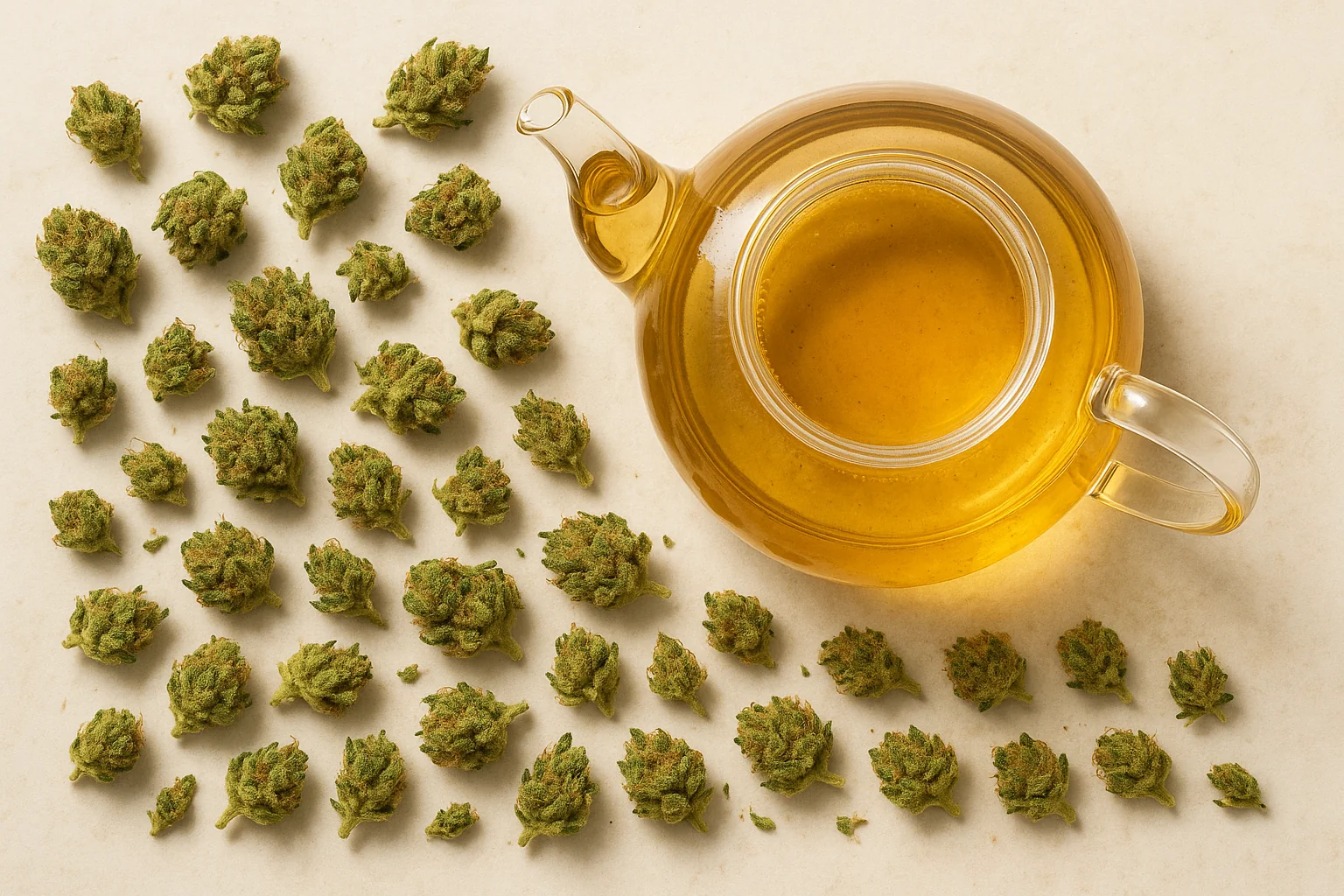

CBD Flower for Tea: How to Brew, What Concentration to Choose, and What It Helps With
How to brew CBD flower tea, what concentration makes sense, and what is really known about the infusion's effects. Without invented conversions to milligrams.
Hemp flower as an ingredient in evening tea has one advantage that is rarely mentioned: it is a cheap way to check if the ritual of brewing suits you at all. It also has one disadvantage, which is even less often discussed: no one knows exactly how much cannabidiol ends up in the cup. The converters circulating online that derive milligrams in the blood from the percentage in the flower are arithmetic based on coefficients that have not been measured. Below, I show what can be said honestly about this, how to brew to extract as much as possible from the raw material, what concentration makes sense when purchasing, and what research on cannabidiol really proves and what it does not.
KEY INFORMATION
• The absolute bioavailability of cannabidiol has only been measured in humans for the inhalation route and was 31%; no study has established it for oral administration (Millar et al., Frontiers in Pharmacology, 2018).
• Cannabidiol is lipophilic, so without fat in the cup, most remains in the plant material.
• In a series of cases, Shannon et al. (The Permanente Journal, 2019) reported that sleep improved in 66.7% of patients, but the result did not last for three months of observation.
• EFSA provides a temporary safe dose of 0.0275 mg/kg body weight per day, which is about 2 mg for a person weighing 70 kg.
How much cannabidiol does tea from flower provide?
Less than the percentage on the package suggests, and no one will give you an exact number for a specific cup. This consists of two stages that guides usually merge into one: how much substance passes from the flower to the water and how much of that reaches the bloodstream. Both are poorly measured, but not equally poorly.
The first stage is limited by chemistry. Cannabidiol dissolves in fats, not in water, so without fat in the cup, most remains in the plant material discarded with the strainer. The composition of the hemp infusion was quantitatively measured by Hazekamp et al. (Journal of Ethnopharmacology, 2007), systematically checking the influence of brewing conditions and subsequent storage. However, the results pertain to a specific raw material studied in that work and do not directly transfer to any flower from the shelf.
The second stage was measured better, although the result is surprising. A review by Millar et al. (Frontiers in Pharmacology, 2018) gathered 24 works with pharmacokinetic data in humans and found that the absolute bioavailability of cannabidiol was established only for the inhalation route, where it was 31%. No study has determined it for oral administration. The peak concentration occurs within 0-4 hours and increases after a meal and with fatty forms.
The practical conclusion is this: converters like “from 1 g of flower you will get this many milligrams in the blood” look precise, but they multiply coefficients that no one has established. It is more sensible to control what can be controlled, namely fat, temperature, and time.
What concentration of flower should I choose for tea?
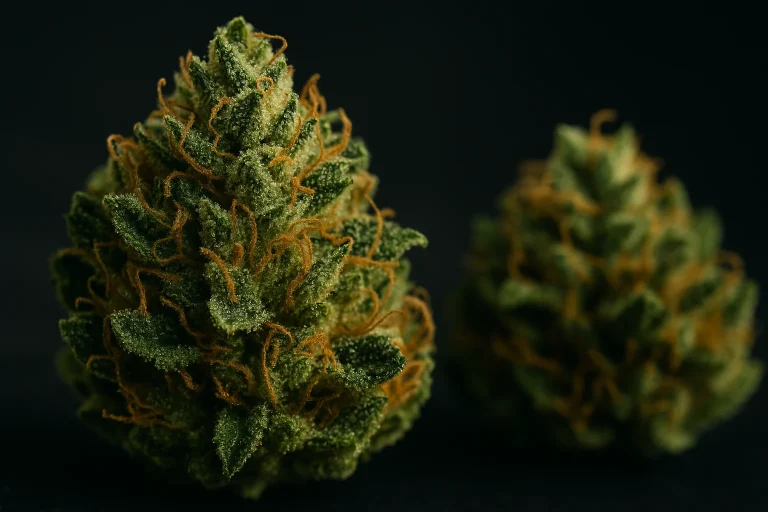
For the infusion, flower from the mid-range is sufficient, and a higher percentage does not provide stronger effects with the same amount of raw material. It only changes the fact that the same amount of substance will be transferred by less plant material. This distinction determines whether you will pay for something that you will actually receive.
Flowers with low cannabidiol content require a larger amount of material per cup, which can be a practical problem: more flower means a stronger herbal taste and a larger strainer. High-content flowers allow you to use less and are useful when you want to combine hemp with other herbs without dominating the composition with aroma.
We have noticed that the most common disappointment arises precisely from overlooking this difference. Someone buys the most expensive flower with the highest percentage, brews it with a pinch because “it is stronger,” and ends up with a weaker infusion than with a cheaper raw material used normally. The product of concentration and mass matters, not just the number on the label.
When purchasing, more important than the percentage is whether the producer provides the test result for a specific batch. Flower is an agricultural product, so the content of cannabidiol varies between harvests of the same strain, and a declaration without a certificate remains a declaration.
Is it allowed to brew hemp flower at home?
Yes, if it is flower from industrial hemp, and no, if it comes from a pharmacy. The difference is not a formality, as it concerns two raw materials that cannot be distinguished from each other after brewing, and the regulations treat them completely differently.
Industrial hemp refers to plants in which the sum of delta-9-THC and tetrahydrocannabinolic acid does not exceed 0.3% when calculated on a dry mass basis. The basis is Article 4 point 5 of the Act of July 29, 2005 on Counteracting Drug Addiction (Journal of Laws 2023, item 1939), as amended by the Act of March 24, 2022 (Journal of Laws 2022, item 763). It is worth knowing that the threshold is counted as the sum of both compounds, not just delta-9-THC, and is rounded to one decimal place.
Pharmaceutical flower, or hemp other than industrial, is subject to regulations on narcotic substances. The law defines processing as giving such a substance a new form (Article 4 point 20), and liability arises from Article 53. Brewing an infusion from it meets this definition just like making butter or cookies.
A prescription does not change this, and this is the most common misunderstanding in culinary guides. Article 33a of the Act allows hemp flower as a raw material for compounded medications, i.e., prepared in a pharmacy by a pharmacist. There is no regulation exempting the patient from liability for independently giving the raw material a new form at home.
How to brew CBD flower for tea?
Four things change the result: fat, temperature, covering, and time. An infusion prepared like black tea, that is, boiling water for three minutes without any addition, uses the raw material the worst and is also the most common way of brewing hemp.
Add fat to the empty cup before pouring to work during brewing. A teaspoon of hemp oil, coconut oil, clarified butter, or a few tablespoons of whole milk works well. Cold-pressed hemp oil has a flavor advantage here, as it does not overpower the aroma of the raw material.
Use water below boiling. The terpenes responsible for the aroma are volatile, and boiling water drives them away the fastest, and they are what distinguishes the infusion from a solution of isolate. Without a kettle with regulation, it is enough to boil water and wait a few minutes before pouring.
Brew covered and longer than black tea. A saucer or plate retains steam with aroma, which otherwise escapes. A few minutes is a reasonable compromise: further extending does not extract noticeably more but brings out bitterness from chlorophyll. Choose a metal strainer, as a paper filter absorbs the fat you just added. A broader protocol is described in the text about how to brew CBD tea from hemp.
How long does it take for CBD flower tea to take effect?
Slower than oil taken sublingually and slower than vaporization, because the infusion passes through the entire digestive tract along with the liver. No specific values for the infusion have been published, but a review by Millar et al. (2018) states that the peak concentration of cannabidiol occurs in humans between zero and four hours after administration.
This wide range is not the researchers’ negligence but a reliable description of the situation: the pace depends on the form of the preparation and what is in the stomach. Therefore, it is better to drink the evening cup with some time to spare, not just before going to bed, and not to assess the effect after fifteen minutes.
Regularity probably has more significance here than a single dose. A repeated action at the same time becomes a signal for the nervous system that the day is ending, and this mechanism works regardless of the cannabinoid content. People who stick to the evening infusion usually describe a gradual habituation, not the effect of the first cup.
If you are looking for a comparison with other evening herbs, we have gathered them in the text about sleep teas.
What does CBD flower tea help with?
Here, a distinction is needed that is lacking in most texts about hemp infusions. Cannabidiol has documented effects in several areas, but studies have been conducted on doses that a cup does not provide. The properties of the substance are not the same as the effectiveness of the infusion.
The best illustration is the study most often referenced in this context. Shannon et al. (The Permanente Journal, 2019) described 72 adult patients from a psychiatric clinic observed over three months. The doses ranged from 25 to 175 mg per day, with almost everyone receiving 25 mg in a capsule. Anxiety scores improved in the first month for 57 people, or 79.2%, and were maintained. Sleep scores improved for 48 people, or 66.7%, but varied, and in the three-month observation, the improvement was not sustained. This is a series of cases without a control group, and the lowest dose used still exceeds what the infusion delivers.
For anxiolytic effects, the evidence is stronger, but comes from the same level of doses. A review by Blessing et al. (Neurotherapeutics, 2015) included 49 studies: preclinical data strongly support the anxiolytic effects of cannabidiol, while human evidence is limited to single administration, and chronic use has been studied the least.
The third area referenced is anti-inflammatory effects. The anti-inflammatory and antioxidant properties of cannabidiol at the cellular level are discussed in a review by Atalay et al. (Antioxidants, 2019). This is a work on mechanisms and therapeutic potential, not on the effectiveness of infusions, so no conclusions should be drawn about specific ailments.
What to pay attention to when buying flower?
The hemp flower market in Poland is highly varied in quality, and the difference is not visible through the packaging. The document decides, not the appearance: an analysis certificate for a specific batch issued by an independent laboratory.
| What to look for | Good signal | Warning signal |
|---|---|---|
| Analysis certificate | report from an independent laboratory for the batch number | certificate issued by the producer itself |
| THC content | given as the sum of delta-9-THC and THCA | given only as delta-9-THC |
| Strain and origin | strain name and country of cultivation | no information about origin |
| Smell and consistency | intense aroma, resilient raw material | hay smell, material crumbling in fingers |
| Flavoring | no added flavorings | artificial aroma masking the raw material |
Pay attention to the second row of the table, as it is often overlooked. The regulation requires the sum of delta-9-THC and tetrahydrocannabinolic acid, so a certificate stating only delta-9-THC does not answer the question of whether the raw material is within the threshold. Store the flower in a sealed glass jar, in a dark and cool place, as light and heat degrade cannabinoids and evaporate terpenes. More about the raw material itself is discussed in the text about CBD flower.
Frequently Asked Questions
How much cannabidiol does a cup of tea from flower provide?
No one knows the exact number. Cannabidiol is lipophilic, so it poorly transfers to water, and the result depends on the raw material, the amount of flower, the presence of fat, and the time and temperature of brewing. The converters circulating online that derive milligrams in the blood from the percentage in the flower are arithmetic based on coefficients that have not been measured.
What concentration of CBD flower should I choose for tea?
A higher percentage does not provide stronger effects with the same amount of raw material; it only allows you to use less material. The product of concentration and mass matters. When choosing, the analysis certificate for a specific batch is more important than the percentage, as the content varies between harvests of the same strain.
How long does it take for CBD flower tea to take effect?
Slower than oil taken sublingually, because the infusion passes through the entire digestive tract. No one has measured this for the infusion itself, but a review by Millar et al. (2018) states that the peak concentration of cannabidiol occurs in humans between zero and four hours after administration.
Does CBD flower tea help with sleep?
The evidence is weaker than it is presented. In a series of cases, Shannon et al. (2019) reported that sleep improved in the first month for 66.7% of patients, but the result varied and did not last for three months. The doses in this study significantly exceeded what the infusion delivers.
Can I add CBD flower to regular tea?
Yes, and it pairs well with calming herbs, such as lemon balm, linden, or chamomile. With green and black tea, remember about caffeine, which works against evening relaxation. Fat in the cup is necessary regardless of what you combine the flower with.
How to store CBD flower for tea?
In a sealed glass jar, in a dark and cool place, away from moisture. Light and heat degrade cannabinoids and evaporate terpenes, so a ziplock bag on the counter is a bad idea. A fading smell is a practical indicator of deteriorating quality.
Flowers with a batch certificate can be found in the hemp flower category.
This article is for informational and educational purposes and does not replace consultation with a doctor. If you are pregnant, breastfeeding, taking medications, or have chronic conditions, consult the use of supplements or herbs with a specialist.
Author: Michał Waluk · Published: 2026-06-08 · Updated: 2026-08-11