
CBD and Bipolar Disorder: What You Should Know (FAQ)
Two clinical studies of cannabidiol in bipolar disorder yielded negative results. A case of mania after CBD was also described. We check the evidence and risk of interactions.
Bipolar affective disorder is a diagnosis where mood stability is more important than immediate relief, and any psychoactive substance added to treatment can disrupt that stability. Cannabidiol has been studied in this diagnosis twice, and both studies yielded negative results at the endpoint. A separate case of a manic episode was described that occurred after cannabidiol alone. This text collects what has been measured and names the risk that consumer guides usually remain silent about: the possibility of phase change. We also show where warnings about interactions come from in vitro and where from studies involving humans, as these are two different findings. For medications used in this diagnosis, we provide direction separately.
KEY INFORMATION
• Cannabidiol is not a mood stabilizer and does not replace mood stabilizers.
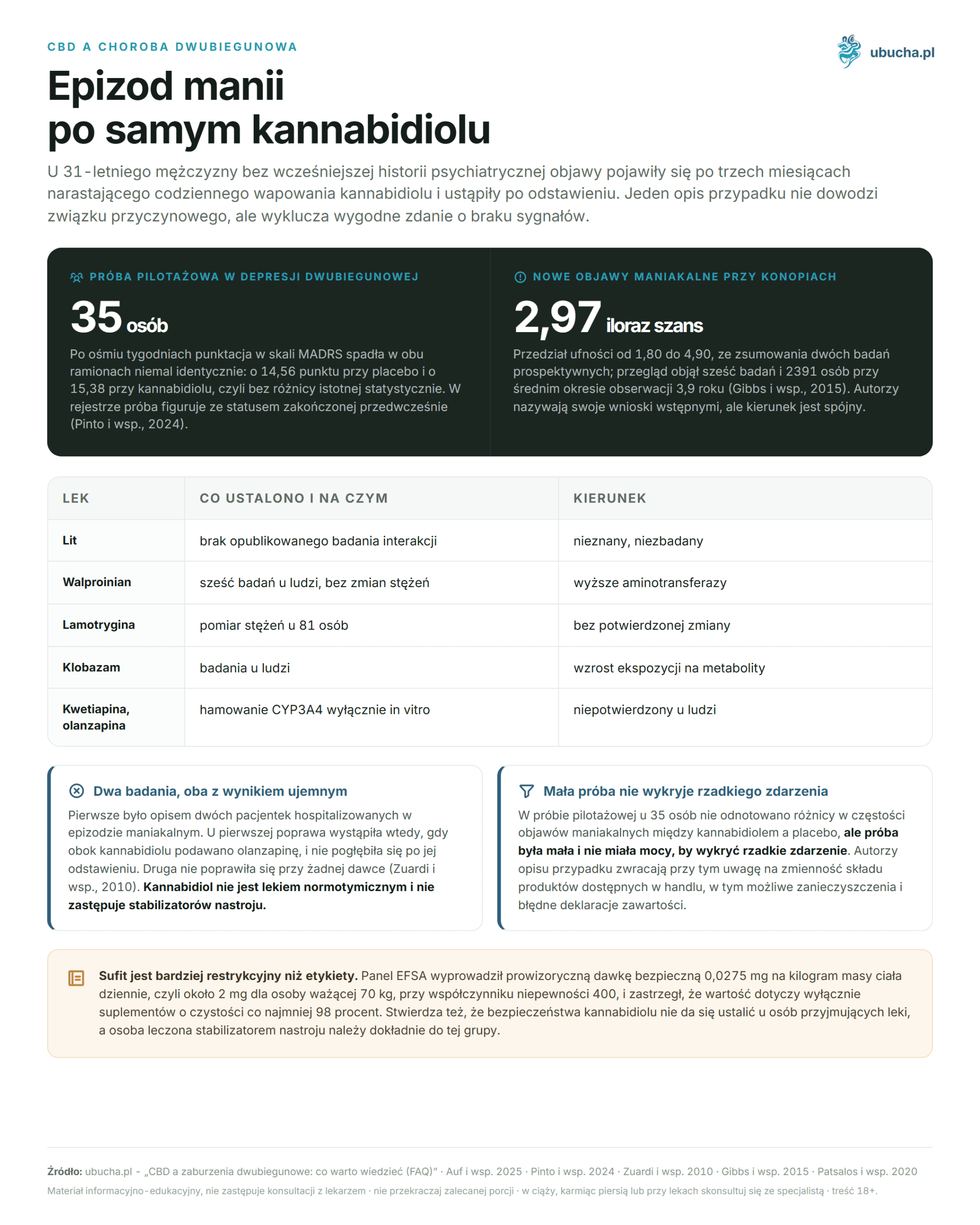
• In a study of two patients in a manic episode, cannabidiol did not bring improvement (Zuardi et al., Journal of Psychopharmacology, 2010).
• In a randomized pilot trial involving 35 people with bipolar depression, cannabidiol did not differ from placebo at the endpoint (Pinto et al., Canadian Journal of Psychiatry, 2024).
• A manic episode was described in a 31-year-old man with no prior psychiatric history after three months of increasing cannabidiol vaping (Auf et al., Psychopharmacology Bulletin, 2025).
• Cannabis use is associated with approximately three times the risk of new manic symptoms, odds ratio of 2.97 with a confidence interval of 1.80-4.90 (Gibbs et al., Journal of Affective Disorders, 2015).
What Did Clinical Studies of Cannabidiol in Bipolar Disorder Show?
Two studies, both with negative results at the endpoint. The first was a description of two patients hospitalized in a manic episode due to bipolar disorder type I. For the first five days, they received placebo, and from the sixth to the thirtieth day, cannabidiol at a dose increasing from 600 to 1200 mg per day. The first patient improved when olanzapine was given alongside cannabidiol, and did not worsen after its discontinuation. The second did not improve at any dose. Both tolerated the preparation well (Zuardi et al., Journal of Psychopharmacology, 2010).
The second study was a randomized, double-blind pilot trial with placebo involving 35 people with bipolar depression, in which cannabidiol was added to existing treatment. After eight weeks, the MADRS score decreased in both arms almost identically, by 14.56 points with placebo and by 15.38 with cannabidiol, indicating no statistically significant difference. An exploratory analysis indicated an effect in the subgroup with a higher dose, but the authors treat this as a premise for further research, not as a result (Pinto et al., Canadian Journal of Psychiatry, 2024). In the ClinicalTrials.gov registry, this trial is listed as having been prematurely terminated, and of the ten entries returned for cannabidiol and bipolar disorder, one was withdrawn before it started (as of August 16, 2026).
Can Cannabidiol Trigger Mania or Phase Change?
Such a case cannot be ruled out today, and this is the most important gap in consumer descriptions of this substance. In 2025, a description of a manic episode in a 31-year-old man with no prior psychiatric history was published. Symptoms, including irritability, decreased need for sleep, excessive activity, and aggression, appeared after three months of increasing daily cannabidiol vaping, during a period of taking high doses. Toxicological tests did not reveal other substances, and the condition improved after discontinuing cannabidiol and initiating mood stabilizers and antipsychotic medications (Auf et al., Psychopharmacology Bulletin, 2025).
This is one case report and does not prove a causal relationship. However, it carries weight because it stands in contrast to the convenient statement of a lack of evidence. A fair summary would therefore sound different: in a pilot trial involving 35 people, no difference in the frequency of manic symptoms was recorded between cannabidiol and placebo, but the trial was small and lacked the power to detect rare events. The authors of the case report also point out the variability in the composition of commercially available products, including possible contaminants and incorrect content declarations. The EFSA panel states directly that data on the neurological and psychiatric safety of cannabidiol remain insufficient (EFSA, EFSA Journal, 2026).
Why is THC Contraindicated in Bipolar Disorder?
Because the risk is calculated here, not hypothetical. A systematic review with meta-analysis included six prospective studies and 2391 individuals who experienced manic symptoms, with an average follow-up period of 3.9 years. The summary of two studies yielded an odds ratio of 2.97 with a confidence interval of 1.80 to 4.90 for the occurrence of new manic symptoms in individuals using cannabis. The studies included in the review also support a relationship between cannabis use and the severity of manic symptoms in individuals already diagnosed with bipolar disorder (Gibbs et al., Journal of Affective Disorders, 2015).
The authors themselves call their conclusions preliminary, as there were few studies and they had variable quality. The direction is, however, consistent and sufficient to treat products containing THC as contraindicated in this diagnosis. Practically, this means avoiding full-spectrum preparations and checking in a laboratory test batch what exactly a given product contains. A declaration on the label does not replace this, as the composition of hemp products in retail can differ from the description. We discuss this group of studies more broadly in the post about the impact of marijuana on mental health.
Does Cannabidiol Interact with Lithium, Valproate, and Lamotrigine?
The direction must be resolved separately for each drug, as two different findings are mixed here. In vitro, cannabidiol inhibits CYP3A4 and CYP2D6: the inhibitory concentration at half-maximal was 11.7 micromolar for CYP3A4 (Yamaori et al., Life Sciences, 2011) and from 4.01 to 24.9 micromolar for CYP2D6 on recombinant enzyme and human liver microsomes (Yamaori et al., Drug Metabolism and Disposition, 2011). In humans, a review of six interaction studies found that cannabidiol did not alter the activity of CYP3A4, and the only clinically significant interaction was with clobazam, a benzodiazepine (Patsalos et al., Epilepsia, 2020).
For valproate, the same review found no significant pharmacokinetic changes in either direction. The signal lies elsewhere: in a study of 81 individuals, the activity of aminotransferases was significantly higher in those taking valproate together with cannabidiol (Gaston et al., Epilepsia, 2017). Lamotrigine is not among the drugs for which this study reported a significant change in concentration. For lithium, we found no published study of interactions; it is excreted by the kidneys, so an interaction through cytochrome P450 is unlikely, which is not the same as being ruled out.
| Drug | What was established and on what basis | Direction |
|---|---|---|
| Lithium | No published interaction study; renal excretion | Unknown, unstudied |
| Valproate | Six studies in humans, no significant changes in concentrations | No changes, but higher aminotransferases |
| Lamotrigine | Measurement of concentrations in 81 individuals, no reported significant change | No confirmed change |
| Clobazam, benzodiazepines | Studies in humans, the only clinically significant interaction | Increased exposure to metabolites |
| Quetiapine, olanzapine | Inhibition of CYP3A4 demonstrated only in vitro | Unconfirmed in humans |
Does Cannabidiol Help with Sleep in Bipolar Disorder?
This has not been measured in individuals with this diagnosis, and the data that is usually cited in this context is weaker than its popularity suggests. The most frequently cited work is a retrospective review of psychiatric outpatient records. Of the 103 described adults, 72 individuals reporting mainly anxiety or poor sleep were included in the analysis. Anxiety scores decreased in the first month in 57 individuals, or 79.2 percent, and remained at a lower level. Sleep scores improved in the first month in 48 individuals, or 66.7 percent, but fluctuated in the following months (Shannon et al., The Permanente Journal, 2019).
This is not a randomized study, there was no control group, and sleep was assessed by questionnaire, not by polysomnographic study. Therefore, this work does not provide any information about sleep onset time or sleep architecture, although such statements circulate online citing it. The problem itself is real, as sleep deprivation is one of the best-documented triggers for a manic episode. This is an argument for treating sleep disorders with a psychiatrist, rather than alongside them. We discuss the evidence base for sleep more broadly in the post about cannabidiol in insomnia.
What Does This Mean for a Person Treated for Bipolar Disorder?
That talking to the treating psychiatrist should be the first step, not the last. The reason is specific: a manic episode has been described after cannabidiol alone, and that in a person with no prior psychiatric history, and commercially available products can be contaminated or incorrectly labeled. The psychiatrist also knows the full list of medications you are taking and knows which of them require monitoring of liver parameters. They also have a reference point in your previous course of the illness, so they will recognize a phase change earlier than you will.
The safety ceiling here is more restrictive than would be suggested by the labels. The EFSA panel derived a provisional safe dose of 0.0275 mg per kilogram of body weight per day, or about 2 mg for a person weighing 70 kg, with an uncertainty factor of 400, and noted that this value applies only to supplements with at least 98 percent purity without nanoparticles. The panel also states that the safety of cannabidiol cannot be established in individuals taking medications, and a person treated with a mood stabilizer falls precisely into that group. The anxiety accompanying the illness is discussed in the post about cannabidiol and THC in anxiety disorders.
Frequently Asked Questions
Does cannabidiol treat bipolar disorder?
No. Two clinical studies conducted on this diagnosis yielded negative results at the endpoint: a description of two patients in mania showed no improvement, and a randomized trial involving 35 people with bipolar depression showed no difference compared to placebo (Pinto et al., 2024).
Can cannabidiol trigger a manic episode?
Such a case has been described. A 31-year-old man with no prior psychiatric history experienced a manic episode after three months of increasing cannabidiol vaping and resolved after discontinuation and initiation of treatment (Auf et al., 2025). One case does not prove causality, but it excludes the statement of a lack of signals.
Does cannabidiol increase the levels of quetiapine or olanzapine?
This has not been demonstrated in humans. CYP3A4 inhibition has been described in vitro, and a review of six studies involving humans found that cannabidiol did not alter the activity of this enzyme (Patsalos et al., 2020). No studies with antipsychotic medications have been conducted.
Does cannabidiol interact with lithium?
We found no published study of such an interaction as of August 16, 2026. Lithium is excreted by the kidneys and is not metabolized by cytochrome P450, so an interaction through this pathway is unlikely. However, the absence of a study means a lack of knowledge.
Are THC products safe with this diagnosis?
No. A meta-analysis of two prospective studies reports an odds ratio of 2.97 with a confidence interval of 1.80 to 4.90 for the occurrence of new manic symptoms in individuals using cannabis (Gibbs et al., 2015). Full-spectrum preparations containing THC are contraindicated in bipolar disorder.
This article is for informational and educational purposes only and does not constitute medical advice. Before starting to use cannabis or CBD for therapeutic purposes, consult with a doctor, especially if you are taking other medications, are pregnant, or breastfeeding.
Author: Michał Waluk · Published: 2026-08-09 · Updated: 2026-08-16