
CBD and trigeminal neuralgia - does it relieve pain (FAQ)
CBD and trigeminal neuralgia: answers to the most common questions and what studies say. u Bucha.
Trigeminal neuralgia (trigeminal neuralgia) is described by patients as one of the most intense pains a person can experience - sudden, electric shocks on one side of the face, triggered by touch, eating, or a gust of wind. The guidelines of the European Academy of Neurology classify it as a serious neuropathic pain requiring specialized neurological care, not self-treatment (Cruccu et al., EAN guidelines, 2016). Nevertheless, many people with TN, exhausted by the side effects of carbamazepine or awaiting neurosurgical procedures, inquire about CBD. This article provides a thorough response: what the research says, where the limits of knowledge lie, and what the real risks are when combining CBD with medications used in TN.
KEY INFORMATION
• Trigeminal neuralgia affects about 4-5 people per 100,000 annually and is one of the most severe neurological pains (Cruccu et al., EAN guidelines, 2016).
• There are no randomized clinical trials for CBD specifically in trigeminal neuralgia - only data from neuropathic pain in general is available.
• Carbamazepine (the first-line drug in TN) strongly affects the metabolism of CBD through CYP3A4 - combining it without the supervision of a neurologist is dangerous.
• CBD may only be considered as a supplement to neurological therapy, not as a replacement.
What is trigeminal nerve pain?
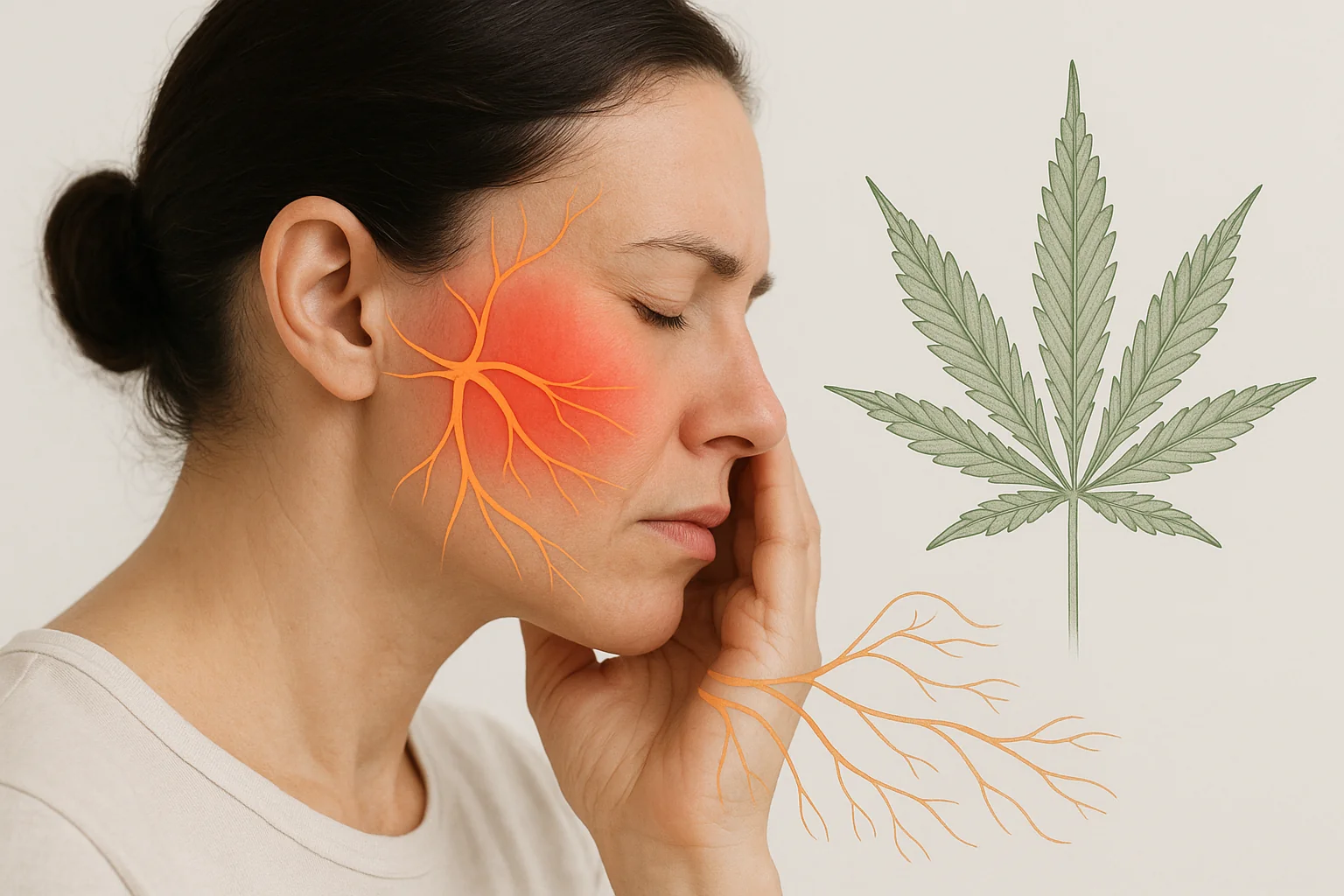
The trigeminal nerve (V cranial nerve) is the largest of the cranial nerves, responsible for sensation from most of the facial surface. It has three branches: ophthalmic (V1), maxillary (V2), and mandibular (V3). Trigeminal neuralgia is pain in the area of one or more branches, most often the maxillary and mandibular, on one side of the face. Classic TN is characterized by sudden, short-lived (seconds to two minutes) attacks of pain that are electric or stabbing in nature, with completely pain-free intervals between attacks.
The most common cause of classic TN is compression of the trigeminal nerve root by a nearby blood vessel - an artery or vein - leading to demyelination of nerve fibers and their pathological discharges. Less commonly, TN is a symptom of multiple sclerosis or a tumor at the cerebellopontine angle. It is important: facial pain, especially unilateral and paroxysmal, always requires neurological diagnostics - CBD is not the answer to unexplained facial pain.
What does research say about CBD for neuropathic pain?
There are no direct randomized clinical trials for CBD in trigeminal neuralgia. The available evidence base pertains to neuropathic pain as a broader category, and the data is ambiguous. A review by Aviram and Samuelly-Leichtag published in Journal of Pain Research in 2017 analyzed the evidence for cannabinoids in neuropathic pain and found a moderate reduction in pain intensity, but with low to moderate quality of evidence (Aviram & Samuelly-Leichtag, Journal of Pain Research, 2017).
The mechanism by which CBD could alleviate neuropathic pain involves several pathways. CBD activates the TRPV1 receptor - the so-called capsaicin receptor, which is involved in pain conduction. Activation of TRPV1 by CBD may initially increase the sensation of pain, but with prolonged exposure, it leads to receptor desensitization, which reduces pain conduction. CBD also modulates the serotonin receptor 5-HT1A, the TRPA1 receptor, and the sodium channels Nav1.7 and Nav1.8, which are important for neuropathic pain conduction. Russo summarizes these mechanisms in a 2008 review as a basis for CBD research in neuropathic pain (Russo, Expert Opinion on Pharmacotherapy, 2008).
Medications used in TN and interactions with CBD
Carbamazepine - the first-line drug for TN - is a strong inducer of the CYP3A4 enzyme. CBD is both a substrate of this enzyme (it is broken down by it) and an inhibitor (it slows down its action). When both drugs are taken simultaneously, carbamazepine accelerates the metabolism of CBD, significantly lowering its concentration in the blood. At the same time, CBD may affect the concentration of carbamazepine. The interaction is bidirectional and unpredictable without monitoring drug levels (Bruni et al., Molecules, 2018).
Oxcarbazepine (Trileptal), used as an alternative to carbamazepine with better tolerance, is a weaker inducer of CYP3A4 - the interaction with CBD is likely less significant, but still exists. Gabapentin and pregabalin, used in some cases of TN, are not metabolized by CYP and have a lower risk of pharmacokinetic interactions with CBD.
| Drug in TN | Metabolic pathway | Risk of interaction with CBD |
|---|---|---|
| Carbamazepine | CYP3A4 (inducer) | High - bidirectional concentration disorder |
| Oxcarbazepine | CYP3A4 (weaker inducer) | Umiarkowane - monitorowanie zalecane |
| Gabapentin | Not metabolized by CYP | Niskie - brak interakcji farmakokinetycznej |
| Pregabalin | Not metabolized by CYP | Niskie - brak interakcji farmakokinetycznej |
| Baclofen | Renal excretion | Niskie - brak znanych interakcji |
What can CBD realistically offer to people with TN?
Given the current state of knowledge, CBD is not a treatment for trigeminal neuralgia. It may be considered as a supplement to therapy for individuals whose pharmacological treatment is insufficient and who are awaiting neurosurgical intervention or using low-dose medications with minimal risk of interactions (e.g., gabapentin) between episodes. In these cases, potential benefits could arise from reducing overall anxiety and tension (which can lower pain thresholds), supporting sleep (sleep deprivation increases pain sensitivity), or from its general anti-inflammatory effects.
We have noticed that individuals with TN seeking information about CBD are often in a very difficult situation - classic trigeminal neuralgia is resistant to many methods, and the path to surgery can be long. Understanding this frustration does not change the fact that CBD with carbamazepine is potentially dangerous without the supervision of a neurologist, and self-experimenting with CBD as a "substitute" for treatment may delay proper diagnosis or neurosurgical therapy.
Practical tips for individuals with TN considering CBD
If you have trigeminal neuralgia and want to discuss CBD with a neurologist, prepare specific information: what form of CBD you are considering (oil, capsule, patch), what concentration of CBD in mg, how often you plan to use it, and for what purpose - to support sleep, reduce anxiety between attacks, or for pain relief. The neurologist needs to know about all substances you are taking concurrently to assess the risk of interactions.
Individuals taking gabapentin or pregabalin have a more favorable interaction profile with CBD than those on carbamazepine - inhibition of CYP3A4 by CBD does not apply to drugs excreted by the kidneys without hepatic metabolism. If the neurologist intends to change the treatment or you are between therapies (e.g., after discontinuing carbamazepine due to side effects, before a planned procedure), there may be a time window in which CBD is relatively safer to try. Never discontinue carbamazepine or any other antiepileptic drug on your own to "make room" for CBD - sudden withdrawal can trigger pain attacks or seizures, depending on the drug and indication.
Frequently Asked Questions
What is trigeminal nerve pain?
Trigeminal neuralgia is a chronic neuropathic pain characterized by sudden, very intense, short-lived pain attacks in the area innervated by the trigeminal nerve - usually on one side of the face. The pain is electric or stabbing in nature. TN affects about 4-5 people per 100,000 annually and is considered one of the most severe neurological pains (Cruccu et al., EAN guidelines, 2016).
Can CBD alleviate trigeminal nerve pain?
There are no randomized clinical trials for CBD in trigeminal neuralgia. General data on CBD in neuropathic pain suggest moderate analgesic effects through TRPV1, TRPA1, and 5-HT1A receptors, but the quality of evidence is low to moderate. CBD does not replace carbamazepine or neurosurgical treatment for TN (Russo, Expert Opinion on Pharmacotherapy, 2008).
What standard treatment is used for trigeminal neuralgia?
The first-line medication is carbamazepine (effective in about 70% of patients initially). An alternative is oxcarbazepine. If there is no response, neurosurgical treatment is employed: microvascular decompression, Gasserian ganglion thermoablation, or stereotactic radiosurgery. Diagnosis and treatment of TN require specialized neurological care (Cruccu et al., EAN guidelines, 2016).
Does CBD interact with carbamazepine?
Yes - and it's a serious issue. Carbamazepine is a strong inducer of CYP3A4 and significantly accelerates the metabolism of CBD, lowering its concentration. At the same time, CBD may affect the concentration of carbamazepine. Combining without the supervision of a neurologist is dangerous and may destabilize antiepileptic treatment (Bruni et al., Molecules, 2018).
Is medical marijuana used for trigeminal neuralgia?
Anecdotal reports from patients and small observational studies describe the use of medical cannabis in refractory neuropathic pain, including TN. However, there are no randomized clinical trials specifically regarding cannabis or CBD in TN. Products containing THC may also cause unwanted psychoactive effects and increase anxiety.
In what type of neuropathic pain does CBD have the best evidence?
The best evidence for cannabinoids in neuropathic pain pertains to diabetic neuropathy and pain in multiple sclerosis. The review by Aviram & Samuelly-Leichtag states a moderate reduction in neuropathic pain with low to moderate quality evidence - trigeminal neuralgia as a separate entity has not been the subject of any RCT with CBD (Aviram & Samuelly-Leichtag, Journal of Pain Research, 2017).
This article is for informational and educational purposes and does not constitute medical advice. Before starting to use cannabis or CBD for therapeutic purposes, consult a doctor, especially if you are taking other medications, are pregnant, or breastfeeding.
Author: Michał Waluk · Published: 2026-05-04 · Updated: 2026-05-04