
Live resin and live rosin: extracts from frozen flowers (table)
Live resin and live rosin: how they are made, what they really differ in, what studies confirm about terpenes, and why they are not legally sold in Poland.
Extracts described as “live” promise one thing: the aroma of fresh plants instead of dried herb. The material goes into the freezer within a few hours of harvest, so volatile compounds do not have time to escape. This part of the story is supported by literature: in an annual study of cannabis storage, terpene concentrations dropped rapidly in all tested temperatures (Milay et al., Frontiers in Plant Science, 2020). The rest of what you read about live resin and live rosin is usually numbers without sources. This text separates one from the other: it shows how both extracts are made, what scientific works really confirm, where the reported percentages come from, and what the status of these products is in Polish law.
KEY INFORMATION
• Terpene concentrations in cannabis dropped rapidly in all studied storage conditions (Milay et al., Frontiers in Plant Science, 2020).
• Live resin is made using butane, while live rosin is made without a solvent: using water, heat, and pressure.
• The entourage effect remains a hypothesis, not a determination: Russo writes about synergy conditionally.
• The THC and terpene percentages circulating on the internet have no basis in any found peer-reviewed work.
• In Poland, such concentrates are not available in legal retail.
What does “live” mean in the name of the extract?
“Live” describes the state of the raw material at the time of extraction: the plant has not undergone drying or curing. The standard path of the material is harvest, drying, curing, and then extraction, and each of these stages costs a portion of the volatile terpenoids. The “live” technology shortens this path to one step: freezing within a few hours of cutting.
The basis of this idea is measured. Milay and colleagues stored flowers and extracts for a year at four temperatures and checked the metabolite profile every six months. The conclusion regarding terpenoids was clear and uncomfortable for producers: their concentrations dropped rapidly in every tested variant, and grinding the raw material further accelerated this. For cannabinoids, the worst temperature was 25 degrees Celsius, and the best solution turned out to be storing whole flowers at 4 degrees.
This logic of freezing follows. If losses begin immediately after harvest, then the only moment when the aromatic profile is still full occurs in the first hours. However, it is worth noting what this work does not say: it does not compare extracts from frozen material with extracts from dried material and does not state how many percent richer the “live” product is. The number “60% of lost terpenes” that the industry repeats has no basis in this study and has not been found in any other work.
How is live resin made and what varieties does it have?
Live resin is a butane extract (BHO) from frozen flowers. The process resembles classic BHO with two changes: the raw material has never been dried, and the entire extraction is done at low temperatures. Cold butane is more selective, so it takes less water and pigments, and terpenoids do not evaporate during the procedure itself.
The consistency of the final product depends on the post-extraction processing, not on the raw material. Terp sauce, also described by the acronym HTFSE, is produced when the extract separates into two phases: crystalline THCA settles at the bottom and a thick layer rich in terpenoids forms above. Both can be combined in any proportions or used separately. Sugar wax is a partially crystallized variant, with a grainy texture resembling wet sugar. Budder is made by whipping the extract during the evaporation of residual solvent, which aerates the mass and gives it an opaque, buttery texture.
All these names describe appearance and processing methods, not composition. On the labels of American producers, they are accompanied by percentages of THC and terpenes, but these values come from commercial laboratories serving individual batches, not from scientific publications. A comparison of the methods of obtaining concentrates, along with solvents, is described in a separate text about cannabis extraction methods CO2, ethanol, rosin, and BHO, and a map of the consistencies themselves can be found in the guide to shatter, wax, budder, and crumble.
How is live rosin made without a solvent?
Live rosin removes butane from the equation. Instead of a chemical solvent, it uses ice water, filter bags, and heated press plates. The process has two stages, and each of them sifts out part of the material, which is why the yield is lower than with BHO.
The first stage produces bubble hash, also known as ice hash. The frozen material is washed with ice-cold water, which causes the brittle trichomes to detach from the leaves and break less frequently than when mixed dry. The suspension passes through a set of screens with increasingly finer mesh, and on each of them, a fraction of different sizes of gland heads remains. The second stage is pressing: the dried bubble hash is placed between two heated plates, which squeeze the resin from the trichomes onto collection paper.
This method has one property worth knowing before comparing prices. The press cannot compensate for poor raw material because it does not dissolve or purify anything, it only squeezes out what it finds in the heads. Butane extraction can pull cannabinoids from average material as well. Therefore, live rosin can be more expensive not because of the technology itself, but because it requires raw material that cannot be substituted with cheaper material without immediately degrading the result.
Live resin or live rosin: what can be compared and what cannot?
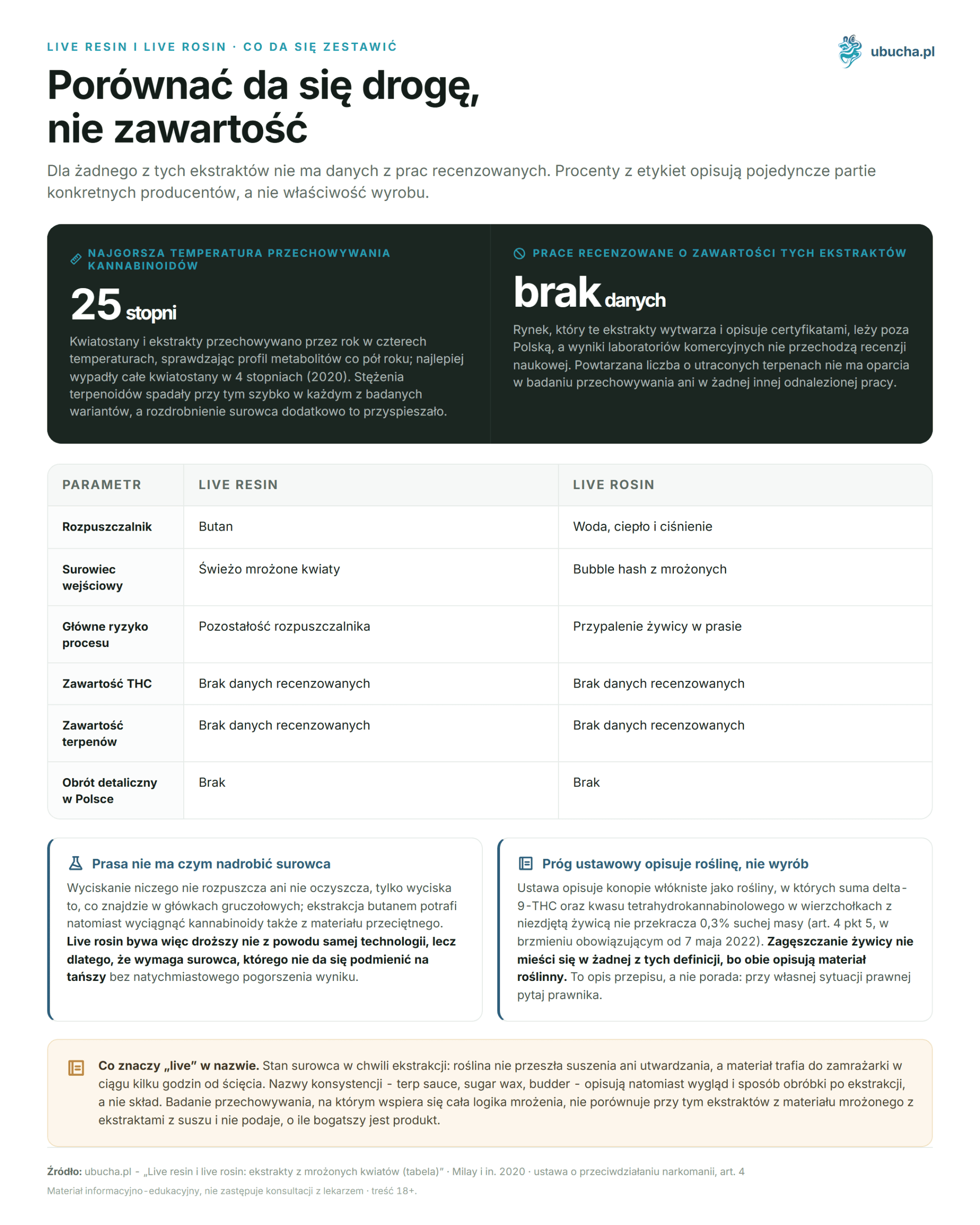
The technological path, equipment, and process risks can be compared. The THC or terpene content cannot be compared because there are no data from peer-reviewed works for either of these extracts, and the values provided in foreign stores describe individual batches from specific producers. The table below separates these two layers.
| Parameter | Live resin | Live rosin |
|---|---|---|
| Solvent | Butane (BHO) | None, only water and pressure |
| Input raw material | Freshly frozen flowers | Bubble hash from frozen flowers |
| Main process risk | Residual solvent with incomplete evaporation | Burning the resin with too hot a press |
| THC content | No data from peer-reviewed works | No data from peer-reviewed works |
| Terpene content | No data from peer-reviewed works | No data from peer-reviewed works |
| Yield from one kilogram of raw material | No data from peer-reviewed works | No data from peer-reviewed works |
| Typical consistencies | Sauce, sugar wax, budder, shatter | Budder, jam, caviar |
| Required equipment | Closed loop butane system, industrial setup | Press and filter bags, handheld equipment |
| Status in Polish retail | None | None |
The last row of the table explains why the three previous ones say “no data.” The market that produces these extracts and describes them with certificates lies outside Poland, and the results of commercial laboratories do not undergo scientific review. Therefore, the Polish reader has nothing to verify, even if the number looks precise.
Are live resin and live rosin legal in Poland?
They are not available in legal retail, and this results from the structure of the regulations, not from a loophole. The law describes industrial hemp as plants in which the total delta-9-THC and tetrahydrocannabinolic acid in the tops with unremoved resin does not exceed 0.3% dry weight, rounded to one decimal place. The threshold therefore applies to the plant, not the product, and cannot describe a concentrate.
The basis is Article 4 point 5 of the Act of July 29, 2005 on Counteracting Drug Addiction (Journal of Laws 2023, item 1939), as amended by the Act of March 24, 2022 (Journal of Laws 2022, item 763), effective from May 7, 2022. Article 4 point 37 of the same law names the herb of cannabis other than industrial hemp as any above-ground part of the plant, excluding seeds, with a content above this threshold. Concentrating resin does not fit into any of these definitions, as both describe plant material.
The second issue concerns self-production. Article 4 point 20 defines processing as giving a narcotic a new form, and Article 53 describes responsibility for producing, processing, and altering. Pressing rosin from herb issued on prescription is precisely giving it a new form, so the availability of presses for sale does not legalize anything here. This is a description of the regulation, not advice: for your own legal situation, consult a lawyer, not an article.
What do studies say about terpenes and the entourage effect?
They say that the hypothesis is serious and still unproven. The most frequently cited work is Russo’s review from 2011 (Russo, British Journal of Pharmacology, 2011), which gathered data on eight cannabis terpenoids:
- limonene
- myrcene
- alpha-pinene
- linalool
- beta-caryophyllene
- caryophyllene oxide
- nerolidol
- phytol
Two findings from this review are strong. First, terpenoids act in very small concentrations: effects on the behavior of animals, and even humans, have been described at serum levels of single nanograms per milliliter, when inhaled from surrounding air. Second, all these compounds are ordinary flavoring ingredients in food with an established safety status, so their presence in an extract is not new in itself.
However, what is more important is how Russo formulates the conclusion. He writes about cannabinoid-terpenoid synergy conditionally, “if proven,” and ends the review with a proposal for methods that should be used to study it. The statement that live rosin “allows experiencing the full entourage effect” has no basis in the source that sellers refer to. The significance of terpenes for the perception of the herb itself is described in a separate text about how to assess the quality of CBD herb.
How to tell if “live” on the label means something?
By the document, not by the smell. In markets where these extracts are allowed for sale, they are usually accompanied by a certificate of analysis of the batch with results for cannabinoids, terpenes, and residual solvents. Without such a document, the word “live” is merely a trade name, as the freezing process is not visible in the finished product.
Sensory hints have auxiliary value, and it is worth knowing their limits. Extracts from frozen material can be more aromatic than classic BHO, but the intensity of the smell also depends on the strain, freshness of the batch, and storage method, so the nose alone does not decide. A very dark color of rosin indicates rather overheating of the press than quality of the raw material. Loss of aroma after a few days at room temperature is consistent with what Milay and colleagues measured: terpenoids decrease rapidly everywhere, even in premium products.
The third hint is commercial. If a “live” extract is offered by a retail store in Poland, that fact alone is a warning signal, regardless of the description. There are no such concentrates in the offer of ubucha.pl; the herb category includes CBD and CBG hemp herb and ready-made joints from such herb.
Frequently Asked Questions
What is the difference between live resin and live rosin?
The difference is the solvent. Live resin is produced by butane extraction conducted at low temperatures, while live rosin is made without any solvent: frozen material is first turned into bubble hash in ice-cold water, and then the resin is pressed out between heated plates of a press. Both start from the same raw material frozen immediately after harvest.
How much THC does live resin and live rosin contain?
It is unknown, and that is an honest answer. The percentages circulating on the internet come from certificates of individual batches issued by commercial laboratories outside Poland, not from peer-reviewed studies. No scientific work has been found that provides the range of THC or terpenes for these two classes of extracts, so comparing them numerically has no basis.
Does live rosin provide a stronger entourage effect than live resin?
This cannot be determined. The entourage effect remains a hypothesis: Russo’s review from 2011 (British Journal of Pharmacology) describes the synergy of cannabinoids and terpenoids conditionally and only proposes methods for studying it. There is no work comparing the perception of live rosin with that of live resin in humans.
Are live resin and live rosin legal in Poland?
They are not available in legal retail. The threshold of 0.3% total delta-9-THC and THCA from Article 4 point 5 of the Act on Counteracting Drug Addiction (Journal of Laws 2023, item 1939) describes the plant, not the product, and the self-pressing of rosin from the herb is processing in the sense of Article 4 point 20 in connection with Article 53. Leave the assessment of your own situation to a lawyer.
Does freezing the raw material really protect terpenes?
The direction is supported by measurement, but the scale is not. In an annual study of cannabis storage, terpene concentrations dropped rapidly in all tested temperatures, and grinding the raw material accelerated this (Milay et al., Frontiers in Plant Science, 2020). However, the work does not compare extracts from frozen material with extracts from dried material, so you cannot derive any numbers from it.
How to store concentrates so they do not lose aroma?
In coolness, darkness, and airtight packaging. In Milay’s study, the worst temperature for cannabinoids was 25 degrees Celsius, and the best option was storing whole flowers at 4 degrees. No variant protected terpenoids, so packaging and coolness slow down losses but do not stop them.
This article is for informational and educational purposes only and does not constitute legal advice. The legal status described in the article is valid as of the date of publication: regulations regarding cannabis may change. Before making decisions, consult a lawyer or current legal acts.
Author: Michał Waluk · Published: 2026-08-09 · Updated: 2026-08-15