
CBD in the Treatment of Insomnia and Other Sleep Disorders: What Sleep Medicine Says in 2026
CBD for insomnia, sleep apnea, and restless legs syndrome: what randomized studies showed, what AASM discourages, and why this text does not provide a dose.
Sleep disorders are not a single disease but seven groups and dozens of entities with different pathophysiology. Psychogenic insomnia, obstructive sleep apnea, restless legs syndrome, parasomnias, and narcolepsy respond to completely different treatments, yet cannabidiol is advertised as a solution for all at once. In Poland, 50.5% of adults report sleep complaints (Psychiatria Polska, 2016), so the audience for such a promise is huge. This guide breaks down the evidence separately for each category of disorders, relying on positions of the American Academy of Sleep Medicine, meta-analyses of randomized studies, and the EFSA opinion from 2026. You will learn where a signal exists, where it does not, and when supplementation delays diagnosis instead of helping.
KEY INFORMATION
• For chronic insomnia, cognitive-behavioral therapy has the strongest recommendation, not pharmacotherapy (American Academy of Sleep Medicine, 2021).
• In a randomized trial with cannabidiol alone in people with insomnia, symptom severity did not differ from placebo (Journal of Clinical Sleep Medicine, 2024).
• In obstructive sleep apnea, AASM discourages medical cannabis and their synthetic extracts (AASM Position Statement, 2018).
• A meta-analysis of 39 randomized studies on 5100 people showed a small improvement in sleep quality with a higher risk of dizziness (Sleep, 2022).
• EFSA could not establish cannabidiol safety in people taking medications, i.e., typical patients with diagnosed sleep disorders (EFSA Journal, 2026).
Why are sleep disorders not a single disease?
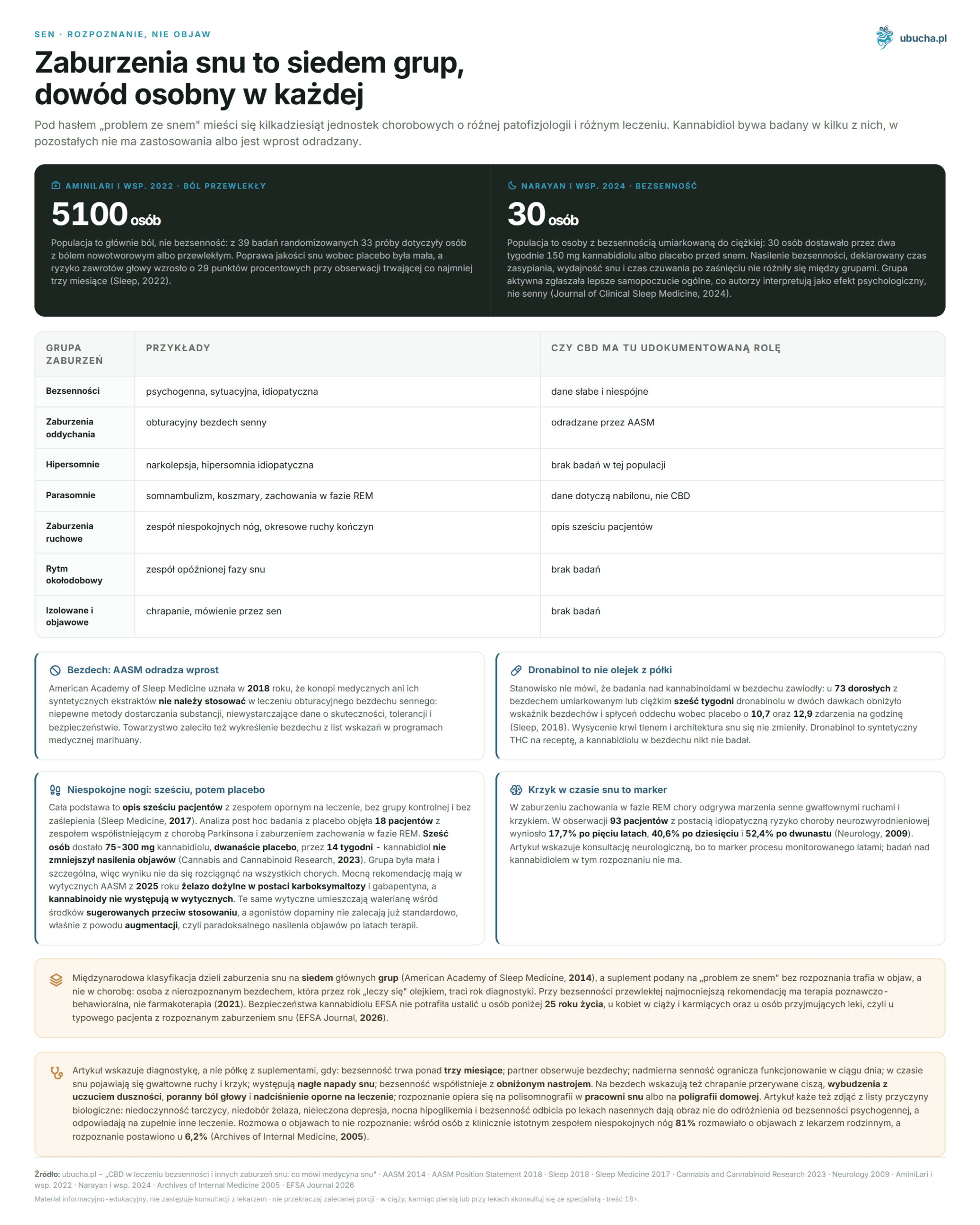
Because under the term “sleep problem” there are dozens of distinct disease entities with different pathophysiology and treatments. The International Classification of Sleep Disorders divides them into seven main groups (American Academy of Sleep Medicine, 2014). Cannabidiol is studied in some of them, while in others it has no application or is explicitly discouraged.
The distinction is not academic. A person waking up tired after eight hours in bed may have psychogenic insomnia, undiagnosed apnea, iron deficiency with restless legs syndrome, or circadian rhythm disorder. Each case requires different management, and in some, supplementation delays proper diagnosis.
| disorder group | examples | does CBD have documented role here |
|---|---|---|
| insomnias | psychogenic, situational, idiopathic insomnia | weak and inconsistent data |
| sleep-related breathing disorders | obstructive sleep apnea | discouraged by AASM |
| hypersomnias | narcolepsy, idiopathic hypersomnia | no studies in this population |
| parasomnias | sleepwalking, nightmares, REM behavior disorder | data concern nabilone, not CBD |
| movement disorders | restless legs syndrome, periodic limb movements | case series of six patients |
| circadian rhythm disorders | delayed sleep phase syndrome | no studies |
| isolated and symptomatic disorders | snoring, sleep talking | no studies |
Diagnosis of a specific entity is based on history, sleep diary, and questionnaires, and in suspected breathing or movement disorders, on polysomnography. Only after that does it make sense to discuss whether any supplement has a place. The reverse order, i.e., supplement first, is the most common mistake described in this text.
How common are sleep problems in Poland?
Half of adult Poles report sleep complaints. The NATPOL study, conducted on a representative sample of 2413 people aged 18-79, found that 50.5% reported sleep-related complaints: 58.9% of women and 41.4% of men (Psychiatria Polska, 2016). The most commonly reported problem was difficulty falling asleep.
Age and sex distribution has practical significance. Among women aged 60-79, 74.8% reported subjective insomnia, i.e., three quarters of the group. This is also the group in which hypnotics carry the greatest risk, and interactions with chronic medications are most likely.
It is important to distinguish complaint from diagnosis. The 50.5% figure describes people who reported a sleep problem in history, not those meeting criteria for chronic insomnia. Some have situational insomnia that resolves spontaneously, some have breathing or movement disorders not yet diagnosed. Supplementation given for a “sleep problem” without this distinction targets a symptom, not a disease, and that is why the rest of this text breaks down disorders into categories.
Does CBD cure primary insomnia?
It does not cure and is not intended for that. The American Academy of Sleep Medicine guidelines from 2021 give cognitive-behavioral therapy for insomnia the highest strength recommendation, described as “we recommend” (American Academy of Sleep Medicine, 2021). All other behavioral methods received conditional recommendations. Pharmacotherapy or supplementation is not first-line according to these guidelines.
The same document contains a statement often reversed in consumer content: the authors suggest not to use sleep hygiene alone as the sole treatment for chronic insomnia. Sleep hygiene is part of cognitive-behavioral therapy but alone is insufficient. This does not exempt from its use but removes its role as a standalone solution.
Cognitive-behavioral therapy works on mechanisms that maintain insomnia: time in bed restriction, stimulus control, and beliefs about sleep. Supplements do not teach any of these, so after discontinuation, the problem returns in the same form. In Poland, availability of this therapy is limited, which is a real reason patients turn to supplements. This is not evidence that supplements work.
What do clinical studies of CBD on sleep show?
They show a signal that weakens as study design improves. The most cited is a retrospective case series from a psychiatric clinic: among 72 adults, sleep improved in the first month in 48 (66.7%), and anxiety improved in 57 (79.2%) (The Permanente Journal, 2019). The authors note that sleep improvement fluctuated over time, unlike anxiety improvement, which persisted. The abstract does not provide dose.
A controlled study gives a different picture. In a pilot randomized trial, 30 people with moderate to severe insomnia received 150 mg cannabidiol or placebo before sleep for two weeks. Insomnia severity, reported sleep latency, sleep efficiency, and wake after sleep onset did not differ between groups (Journal of Clinical Sleep Medicine, 2024). The active group reported better overall well-being, interpreted by authors as a psychological, not sleep, effect.
| study | what it was | result |
|---|---|---|
| Shannon 2019 | series of 72 cases, no control group | sleep improved in 66.7% in first month, then fluctuations |
| Ranum 2023 | systematic review of 34 studies | only 2 of 34 studies involved patients with insomnia |
| AminiLari 2022 | meta-analysis of 39 randomized studies, 5100 people | small sleep quality improvement in chronic pain patients, higher risk of dizziness |
| Narayan 2024 | randomized trial, 30 people, 150 mg, two weeks | no difference from placebo in insomnia severity |
Read the table from the right column. The stronger the study design, the less remains of the promise. These studies are discussed in more detail in the review of CBD and sleep quality studies.
How to interpret the review of 34 studies cited by the market?
Cautiously, because the number of studies is not a measure of evidence strength. A 2023 systematic review included 34 works on cannabidiol in insomnia and reported symptom improvement in at least some participants in each. However, the same abstract states that only two of these 34 studies involved patients with insomnia, and one of those was a single case report (Cannabis and Cannabinoid Research, 2023).
The rest of the material comes from studies where sleep was a secondary measure in people treated for other reasons. Moreover, in 21 of 34 studies, preparations with nearly equal CBD to THC ratios were used, so results cannot be attributed to CBD alone. Authors state that some studies used subjective measures without validation and omitted objective measurement.
The largest meta-analysis of randomized trials included 39 trials and 5100 patients, of which 33 trials involved people with cancer pain or other chronic pain. Sleep quality improvement versus placebo was small, and dizziness risk increased by 29 percentage points over at least three months of observation (Sleep, 2022). The authors conclude the benefit is probably small. This is currently the strongest honest statement about cannabinoids and sleep.
Does CBD help with sleep apnea?
No, and the scientific society’s position is unequivocal. The American Academy of Sleep Medicine in 2018 stated that medical cannabis or their synthetic extracts should not be used to treat obstructive sleep apnea, citing uncertain delivery methods and insufficient data on efficacy, tolerance, and safety (AASM Position Statement, 2018). The society also recommended removing apnea from indications in medical marijuana programs.
It is worth noting what this position does not say. It does not say cannabinoid research in apnea ended in failure. In a phase 2 study, 73 adults with moderate or severe apnea received placebo or dronabinol in two doses for six weeks. Apnea-hypopnea index decreased by 10.7 and 12.9 events per hour versus placebo, and daytime sleepiness decreased at the higher dose (Sleep, 2018). Oxygen saturation and sleep architecture did not change.
The difference between these paragraphs is key. Dronabinol is synthetic prescription THC studied under controlled conditions, not over-the-counter cannabidiol oil. Cannabidiol has not been studied in apnea, and the disease mechanism is mechanical: upper airway patency, which CBD cannot affect. The 2018 position refers to dronabinol itself and states its long-term tolerance is unknown.
How to recognize apnea instead of ordinary insomnia?
By symptoms reported more often by a partner than the patient. Loud snoring interrupted by silence, observed apneas, awakenings with choking sensation, morning headache, excessive daytime sleepiness, and treatment-resistant hypertension form a picture requiring examination, not supplements. The more of these elements present, the less sense there is in reaching for anything off the shelf.
This distinction has a cost. A person with undiagnosed apnea “treating” with oil for a year loses a year of diagnosis, and the disease progresses. Subjective sleep improvement after supplementation proves nothing because apnea is measured by respiratory events per hour, not by feeling rested.
Diagnosis is based on polysomnography in a sleep lab or home polygraphy. After confirmation, first-line treatment is a device providing positive airway pressure, and in selected cases, an oral appliance or surgery. Supplementation does not replace any of these and no studies suggest it does. When insomnia coexists, both are treated in parallel, but apnea is addressed first.
Does CBD work for restless legs syndrome?
Evidence is the weakest possible. The entire basis is a case series of six patients with treatment-resistant restless legs syndrome published in 2017 (Sleep Medicine, 2017). Case series lack control groups and blinding and cannot distinguish substance effect from natural disease course. Europe PMC does not provide the abstract, so protocol details cannot be read from this source.
It is important to know the scale of the problem. In a population study based on 15,391 completed questionnaires, 7.2% of adults reported symptoms of any frequency, 5.0% at least weekly, and 2.7% clinically significant symptoms. Among the latter, diagnosis was made in only 6.2%, although 81% discussed symptoms with a family doctor (Archives of Internal Medicine, 2005).
| treatment | AASM 2025 recommendation strength |
|---|---|
| gabapentin enacarbil, gabapentin, pregabalin | recommended, strong recommendation |
| intravenous iron as carboxymaltose | recommended, strong recommendation |
| oral iron sulfate with ferritin up to 75 ng/ml | suggested, conditional recommendation |
| pramipexole, ropinirole, rotigotine, levodopa | suggested against standard use |
| valerian, clonazepam, bupropion | suggested against use |
| cannabinoids | not included in guidelines |
Current guidelines have overturned the image perpetuated in consumer content: dopamine agonists are no longer recommended routinely due to augmentation, i.e., paradoxical symptom worsening after years of therapy (Journal of Clinical Sleep Medicine, 2025). The topic is expanded in a separate post on CBD and restless legs syndrome.
What happened when CBD was tested in a placebo-controlled study?
The signal from case reports disappeared. A post hoc analysis of a phase 2 and 3 double-blind placebo-controlled trial included 18 patients with restless legs syndrome coexisting with Parkinson’s disease and REM behavior disorder. Six received cannabidiol doses of 75-300 mg, twelve placebo, observed for 14 weeks (Cannabis and Cannabinoid Research, 2023).
The result was unequivocal in a direction marketing does not cite. On the International Restless Legs Syndrome Study Group severity scale, cannabidiol did not differ from placebo in primary or secondary endpoints. Authors state plainly: cannabidiol did not reduce symptom severity in this group.
The group was small and special, so results cannot be generalized to all patients. However, this does not favor the supplement but shows how narrow the evidence base is: six patients in a case series and six in the active arm of a randomized trial, the latter showing no effect. Publication order matters practically because older, weaker evidence is cited more often than newer, stronger evidence.
What is known about CBD in narcolepsy and excessive sleepiness?
Almost nothing, and that alone is the answer. Narcolepsy is a rare disorder with sudden daytime sleep attacks, loss of muscle tone with emotions, and fragmented nighttime sleep, caused by hypocretin deficiency in the hypothalamus. It is a neurological diagnosis with established prescription treatment, in which cannabinoids have not been studied in controlled trials.
A review on cannabinoids in sleep disorders covers narcolepsy and parasomnias alongside insomnia, breathing disorders, and restless legs syndrome, but its conclusion is cautious: data come from small, biased studies with lack of allocation concealment in clinical trials (Neurotherapeutics, 2021). Authors mention a potential role, not an established one.
A 2017 literature review lists excessive daytime sleepiness among areas where cannabidiol is described as promising (Current Psychiatry Reports, 2017). This is a hypothesis from a review, not a study result, and has not been tested clinically in nine years. A person suspected of narcolepsy needs sleep lab testing because diagnosis determines access to reimbursed treatment.
What do cannabinoids do for nightmares after trauma and parasomnias?
The strongest data in this group concern nabilone, a synthetic THC analogue available by prescription, not cannabidiol. An open-label study reviewed records of 47 patients with post-traumatic stress disorder whose nightmares persisted despite antidepressants and hypnotics. In 72%, nightmares ceased or markedly decreased after adding nabilone (CNS Neuroscience and Therapeutics, 2009). A 2017 literature review confirms this direction and notes that data on cannabidiol alone are preliminary (Current Psychiatry Reports, 2017).
Separately is REM behavior disorder, where patients act out dreams with violent movements and shouting. This is not a cosmetic problem: in a cohort of 93 patients with idiopathic form, risk of neurodegenerative disease was 17.7% after five years, 40.6% after ten, and 52.4% after twelve (Neurology, 2009). Parkinson’s disease and Lewy body dementia were most common.
The practical conclusion for readers is one and unrelated to product choice. Violent behaviors during sleep require neurological consultation because they mark a process that can be monitored for years. Symptom suppression by supplement removes this information value, and no studies on cannabidiol in this diagnosis exist.
Do CBN and melatonin work better than CBD?
Cannabinol is marketed as “the strongest cannabinoid for sleep,” but this claim lacks support. A 2021 review searched literature, screened 99 human study abstracts, and included eight for full analysis. It found no clinical trial assessing cannabinol’s effect on sleep by polysomnography or validated questionnaire (Cannabis and Cannabinoid Research, 2021). Available studies date from the 1970s and 1980s with small groups.
Melatonin has numerical data but modest. A meta-analysis of 19 studies on 1683 participants showed shortening sleep latency by 7.06 minutes and increasing sleep duration by 8.25 minutes versus placebo (PLOS ONE, 2013). Authors state the effect is moderate and less than classic hypnotics, but side effect profile is milder.
A separate topic is the entourage effect, i.e., the hypothesis that full extract acts stronger than a single component. The paper popularizing this term formulates synergy conditionally and proposes methods to study it rather than declaring it proven (British Journal of Pharmacology, 2011). Fifteen years later, no study confirms it in sleep disorders. Until then, comparing flower to isolate by sleep effect strength is speculation.
Why does this article not provide a CBD dose?
Because it concerns diagnosed diseases, not general well-being. EFSA in 2026 opinion derived a provisional safe dose by benchmark dose method of 0.0275 mg per kilogram body weight per day, about 2 mg daily for a 70 kg person, with an uncertainty factor of 400 (EFSA Journal, 2026). This is a safety ceiling, not a therapeutic recommendation.
This value applies only to supplements with cannabidiol purity of at least 98%, without nanoparticles. More importantly for readers, the panel stated that cannabidiol safety cannot be established in people under 25 years old, pregnant and breastfeeding women, and people taking medications. Patients with chronic insomnia, apnea, or restless legs syndrome usually take medications.
Market numbers have another problem. The most repeated safety threshold attributed to WHO now refers to a document not available at the given address and differs five hundredfold from EFSA’s value. If you consider cannabidiol for a diagnosed sleep disorder, dose is set by your doctor who knows your medication list and what can be discontinued.
What are CBD interactions with hypnotics?
Real and poorly predictable. A review of registration data and literature indicates cannabidiol affects CYP3A4 and CYP2C19 enzymes and P-glycoprotein, i.e., metabolism and excretion pathways used by most chronic medications (Journal of Clinical Medicine, 2019). Authors report adverse effects in nearly half of cannabidiol users, dose-dependent.
Most common are elevated aminotransferase activity, sedation, sleep disturbances, infections, and anemia. Sleep disturbances here are not a mistake: the drug studied in refractory epilepsy caused them in some patients. For drugs with narrow therapeutic index, authors recommend dose reduction, adverse effect monitoring, or treatment change.
A second problem is pharmacokinetic. A review of 24 human cannabidiol pharmacokinetic studies showed absolute bioavailability was measured only for inhalation, at 31%. No study established it for oral or sublingual routes, and maximum blood concentration increases after meals and with fatty preparations (Frontiers in Pharmacology, 2018). Bioavailability percentages circulating in product descriptions thus lack source, and without known bioavailability, dose from studies cannot be converted to bottle drops.
What to do before trying CBD?
Organize sleep behaviorally and exclude causes that supplements do not address. Fixed wake-up time, limiting screens in the evening, a cool and dark bedroom, caffeine only in the first half of the day, and no alcohol before sleep are components that cost nothing. 2021 guidelines caution not to treat sleep hygiene as sole treatment for chronic insomnia (American Academy of Sleep Medicine, 2021).
It is also worth ruling out biological causes. Hypothyroidism, iron deficiency, untreated depression, nocturnal hypoglycemia, and rebound insomnia from hypnotics produce a picture indistinguishable from psychogenic insomnia but respond to different treatments. Blood tests and a two-week sleep diary cost less than a quarter of supplementation.
Evening alcohol deserves a separate mention as a common silent cause. It shortens sleep latency but fragments the second half of the night, so a person drinking a glass of wine with dinner later reports “waking at three” as insomnia symptom. Practical solutions are collected in a separate post on natural ways to sleep without pills.
How does CBD compare to classic hypnotics?
Comparison is harder than marketing suggests because of lack of head-to-head studies. What is known concerns risks of classic drugs. A prospective study of 3434 people over 65 showed a dose-response relationship between cumulative use of strong anticholinergic drugs and dementia risk: the highest exposure group had hazard ratio 1.54 (JAMA Internal Medicine, 2015). This group includes older over-the-counter antihistamines used for sleep.
Herbs have weaker data than commonly believed, as shown by two reviews from the same year. The first included 16 studies on 1093 patients and found valerian increased chance of sleep quality improvement but noted publication bias (The American Journal of Medicine, 2006). The second reviewed 592 articles and analyzed 37 studies: most found no difference from placebo, and none of the newest and methodologically best showed effect (Sleep Medicine Reviews, 2007). The title summarizes: safe but ineffective. Valerian is listed among agents suggested against use in restless legs syndrome guidelines (Journal of Clinical Sleep Medicine, 2025).
CBD cannot be honestly placed in this comparison. No study compares it to hypnotics in insomnia, and the only randomized trial with cannabidiol alone showed no difference from placebo. This does not mean it does not work for anyone. It means no one measured it, so “milder than benzodiazepines” describes side effect profile, not efficacy.
When to see a doctor instead of trying CBD?
Always when any sign of organic disease appears. Insomnia lasting over three months, partner-observed apneas, excessive daytime sleepiness limiting function, violent movements and shouting during sleep, sudden sleep attacks, and insomnia with low mood require diagnosis, not supplement shelves.
Consultation in a sleep medicine clinic is predictable. The doctor takes detailed history, requests a two-week sleep diary, uses questionnaires assessing insomnia severity and daytime sleepiness, and if breathing disorders are suspected, refers for polysomnography or home polygraphy. Only diagnosis determines treatment.
Remember the scale of underdiagnosis. In the cited population study, among people with clinically significant restless legs syndrome, 81% discussed symptoms with a family doctor, but diagnosis was made in 6.2% (Archives of Internal Medicine, 2005). Talking about symptoms is not the same as diagnosis, so if symptoms persist, ask for referral to a sleep medicine clinic and bring a diary.
Is CBD safe for children and during pregnancy?
There is no basis to claim so, and this is a regulatory authority position, not a precautionary convention. EFSA in 2026 opinion stated cannabidiol safety cannot be established in people under 25, pregnant and breastfeeding women, and people taking medications (EFSA Journal, 2026). The panel also describes the substance’s ability to cross the placenta and accumulate in the body.
Pediatric data are symbolic. The most cited publication on cannabidiol in a child’s insomnia is a single case report: a ten-year-old girl with post-traumatic stress disorder whose anxiety decreased and sleep quality and duration gradually improved (The Permanente Journal, 2016). A single case report cannot distinguish drug effect from natural course or changes in child care.
| group | what data say | management |
|---|---|---|
| children and adolescents | single case report, no controlled studies | behavior modification and age-appropriate sleep hygiene, decision by doctor |
| people under 25 years | EFSA: safety cannot be established | no self-supplementation |
| pregnant and breastfeeding women | EFSA: safety cannot be established, cannabidiol crosses placenta | gynecological consultation, no supplementation |
| people taking medications | EFSA: safety cannot be established | decision and supervision by treating physician |
In practice, this means insomnia in children, adolescents, and pregnancy is managed without cannabidiol. In these groups, first-line treatment is behavioral, and pharmacotherapy, if needed, is managed by the treating physician.
What has not been measured yet?
Almost everything a reader would want to know before purchase. No study compares cannabidiol to hypnotics in insomnia. No study establishes an effective dose for a specific diagnosis. No absolute bioavailability measurement exists for oral or sublingual routes, so doses from studies cannot be converted to bottle drops.
Studies measuring these are underway. A published crossover placebo-controlled trial protocol planned to give 20 people with chronic insomnia a single oral dose containing 10 mg THC and 200 mg cannabidiol, assessing total sleep and wake time by polysomnography and next-day performance (BMJ Open, 2020). This is a plan description, not a result, and should be read as such.
A review from the same period summarizes knowledge with a statement worth remembering: rigorous, large multicenter studies are needed to assess dose, efficacy, and safety of various cannabinoids in sleep disorders (Neurotherapeutics, 2021). Until then, any dose tables in consumer content fill a gap, not summarize evidence.
Summary: what is known today about CBD and sleep
Less than the market suggests, and this is known quite precisely. For chronic insomnia, cognitive-behavioral therapy remains the most strongly recommended treatment (American Academy of Sleep Medicine, 2021). The only randomized trial with cannabidiol alone in insomnia showed no difference from placebo in symptom severity (Journal of Clinical Sleep Medicine, 2024). For sleep apnea, the scientific society explicitly discourages cannabinoids (AASM Position Statement, 2018).
Where a signal exists, it is weak and indirect. A meta-analysis of 39 randomized studies showed a small sleep quality improvement mainly in people treated for chronic pain and with increased dizziness risk (Sleep, 2022). For restless legs syndrome, the basis is a case series of six patients, and for post-traumatic nightmares, data concern prescription nabilone, not cannabidiol.
Practically, this means three things. Identify your disorder instead of treating the vague “sleep problem.” Exclude organic causes before adding anything. And if considering cannabidiol for a diagnosed disorder, coordinate with a doctor familiar with your medications, as EFSA could not establish safety in this group (EFSA Journal, 2026).
Frequently Asked Questions
Does CBD cure insomnia or just relieve symptoms?
CBD does not causally cure insomnia. The American Academy of Sleep Medicine guidelines from 2021 give cognitive-behavioral therapy for insomnia the highest strength recommendation (American Academy of Sleep Medicine, 2021). In the only published controlled study where cannabidiol was given alone to people with insomnia, symptom severity did not differ from placebo (Journal of Clinical Sleep Medicine, 2024).
Does CBD help with sleep apnea?
No. The American Academy of Sleep Medicine in its 2018 position states that medical cannabis or their synthetic extracts should not be used to treat obstructive sleep apnea due to uncertain delivery methods and insufficient data on efficacy and safety (AASM Position Statement, 2018). The basis of treatment remains positive airway pressure.
Does CBD work for restless legs syndrome?
Evidence is limited to a case series of six patients helped by cannabis (Sleep Medicine, 2017). This is the lowest level of evidence available. The American Academy of Sleep Medicine guidelines from 2025 do not mention cannabinoids at all, and strong recommendations were given to gabapentin, pregabalin, and intravenous iron (Journal of Clinical Sleep Medicine, 2025).
Does CBN help sleep more than CBD?
There is no evidence for this. A 2021 review searched the literature and found no clinical trial assessing the effect of cannabinol on sleep by polysomnography or validated questionnaire (Cannabis and Cannabinoid Research, 2021). The author states plainly that manufacturers’ claims are not supported by published data.
How much CBD to take for sleep?
This article does not provide a dose because it concerns diagnosed disorders. EFSA in 2026 derived a provisional safe dose of 0.0275 mg per kilogram of body weight per day, about 2 mg for a 70 kg person, and noted that safety cannot be established for people taking medications (EFSA Journal, 2026). Dose is determined by a physician.
When to see a doctor for insomnia?
When the problem lasts longer than three months, when a partner observes apneas, when daytime sleepiness impairs functioning, or when violent movements and shouting occur at night. Sleep disorders are often undiagnosed: in a population study, restless legs syndrome was diagnosed in only 6.2% of people with clinically significant symptoms (Archives of Internal Medicine, 2005).
This article is for informational and educational purposes and does not constitute medical advice. Before starting cannabis or CBD for therapeutic purposes, consult a doctor, especially if you take other medications, are pregnant, or breastfeeding.
Author: Michał Waluk · Published: 2026-05-04 · Updated: 2026-08-10