
Choline for the liver, brain, and memory: how much is needed (FAQ)
Choline without marketing: EFSA's adequate intake is 400 mg per day, the form of the supplement did not change plasma concentration, and the unabsorbed remainder produces TMAO.
Choline is a nutrient that is talked about less frequently than vitamins, yet the body uses it in three separate roles: it builds phospholipids of cell membranes, produces acetylcholine, and packages fats exported from the liver. Humans synthesize some choline themselves, but not all, so the rest must come from food. Around this simple fact, a layer of promises about forms, bioavailability, and memory support has grown, which has little to do with the data. Below is what can be read at the source: the official value and what it is, the result of a study with intentional deficiency, the result of a comparison of four forms, and a signal that advertisements remain silent about. Each number is provided along with who measured it, on how many people, and for how long, because without this context, it is impossible to assess whether it pertains to the reader at all.
KEY INFORMATION
• EFSA has established an adequate intake of choline at 400 mg per day for all adults and deemed it unnecessary to provide separate values for women and men.
• For pregnancy, the value is 480 mg per day, and for breastfeeding, 520 mg per day.
• EFSA has not established an upper limit for choline intake; the figure of 3500 mg comes from the American list, not the European one.
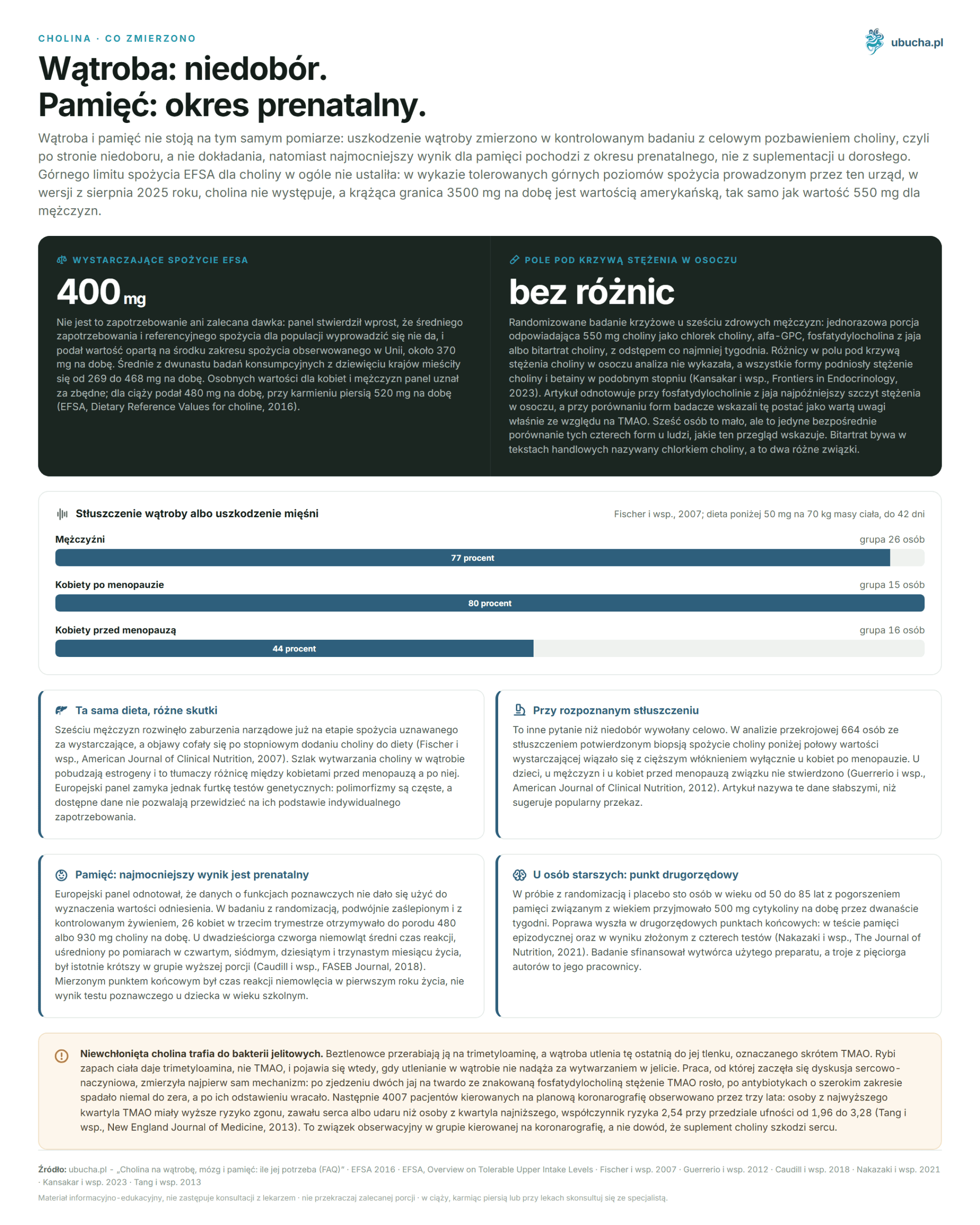
• In a study with intentional choline deprivation, fatty liver or muscle damage developed in 77 percent of men and 80 percent of postmenopausal women, but only 44 percent of premenopausal women.
• A comparison of four forms of the supplement in six healthy volunteers showed no difference in the area under the curve of choline concentration in plasma.
How much choline is considered sufficient and what is this number?
The European Food Safety Authority has established an adequate intake of choline at 400 mg per day for all adults. This is not a recommended dose or a requirement calculated from measurements: the panel stated directly that average requirements and reference intake for the population cannot be derived, so it provided a value based on the midpoint of observed intake in the Union, which is about 370 mg per day.
The panel also considered whether to provide separate numbers for women and men and deemed it unnecessary. For pregnancy, the value is 480 mg per day, calculated by scaling to body weight, and for breastfeeding, 520 mg per day, accounting for what is lost in milk (EFSA, Dietary Reference Values for choline, 2016).
It is worth correcting two numbers that circulate around this topic. The value of 550 mg for men comes from the American list, not from the European opinion. EFSA has not established an upper limit for choline intake at all: in the list of tolerated upper intake levels maintained by this authority, as of August 2025, choline does not appear (EFSA, Overview on Tolerable Upper Intake Levels). The sometimes cited limit of 3500 mg per day is an American value, and attributing it to the European authority is a mistake.
Separately regarding the scale of deficiency: the average choline intake calculated from twelve consumption studies from nine EU countries ranged from 269 to 468 mg per day, with lower values pertaining to women. The adequate intake thus lies within this range, not far above it.
What happens with choline deficiency and who is most affected?
The effects of deficiency were measured in one carefully controlled nutritional study, and the result is more surprising than the number itself. Damage affects the liver and muscles, and the risk is unevenly distributed between genders and depends on menopausal status.
Fifty-seven adults, including 26 men, 16 premenopausal women, and 15 postmenopausal women, first received a diet with 550 mg of choline per 70 kg of body weight, and then a diet containing less than 50 mg per 70 kg, for a period of up to 42 days. Fatty liver or muscle damage developed in 77 percent of men and 80 percent of postmenopausal women, but only 44 percent of premenopausal women. Symptoms reversed after gradually adding choline back to the diet. Six men developed organ dysfunction even at the intake considered sufficient (Fischer et al., American Journal of Clinical Nutrition, 2007).
The difference between premenopausal and postmenopausal women has a biochemical explanation: the pathway for choline production in the liver is stimulated by estrogens. It is tempting to transfer this to genetic testing, but the European panel closes this door: polymorphisms of genes responsible for choline metabolism are common in the population and affect requirements, but available data do not allow predicting individual needs based on them.
Regarding fatty liver, the data is weaker than popular narratives suggest. In a cross-sectional analysis of 664 individuals with biopsy-confirmed fatty liver, choline intake below half of the adequate value was associated with more severe fibrosis only in postmenopausal women. No association was found in children, men, or premenopausal women (Guerrerio et al., American Journal of Clinical Nutrition, 2012). More about what has evidence regarding fatty liver and what does not can be found in the text about liver supplements.
Does choline improve memory in humans?
The answer depends on whom you ask and when. The strongest result comes from the prenatal period, not from supplementation in adults. The European panel noted that data on the health effects of choline, including cognitive functions, could not be used to set reference values.
In a randomized, double-blind, controlled nutrition study, twenty-six women in their third trimester received either 480 or 930 mg of choline per day until delivery. In twenty-four infants, information processing speed and visual-spatial memory were measured at four, seven, ten, and thirteen months of age. The average reaction time averaged across these four measurements was significantly shorter in the higher dose group (Caudill et al., FASEB Journal, 2018). It is important to immediately name the limits of this result: the study involved 26 women, and the measured endpoint was the infant’s reaction time in the first year of life, not the cognitive test result of the child in school age.
In older individuals, citicoline was tested. In a randomized, placebo-controlled trial, one hundred individuals aged 50 to 85 with age-related memory decline took 500 mg of citicoline per day for twelve weeks. Improvement was observed in secondary endpoints: in episodic memory tests and in a composite score from four tests (Nakazaki et al., The Journal of Nutrition, 2021). The study was funded by the manufacturer of the product used, and three of the five authors are its employees. This does not invalidate the result but requires reading it more cautiously.
Does the form of the supplement determine absorption?
The most frequently repeated thesis on this topic states that alpha-GPC absorbs better than all other forms. The only study that directly compared forms in humans does not confirm this. However, before we move on to the result, it is worth organizing the names, as they can be confused in a way that changes the substance.
| Form | Formula and molecular weight | Note |
|---|---|---|
| Alpha-GPC (alpha-glycerophosphorylcholine) | C8H20NO6P, 257.22 g/mol | 41 percent choline by weight |
| Choline bitartrate | C9H19NO7, 253.25 g/mol | salt with tartaric acid, it is not choline chloride |
| Citicoline (CDP-choline) | C14H26N4O11P2, 488.32 g/mol | also provides cytidine |
| Egg phosphatidylcholine | lipid form | latest peak concentration in plasma |
A review of choline forms reports a randomized crossover study in which six healthy men received a single dose corresponding to 550 mg of choline in four forms: as choline chloride, alpha-GPC, egg phosphatidylcholine, and choline bitartrate, in random order, with at least a week apart. The analysis showed no difference in the area under the curve of choline concentration in plasma between these forms, and all raised choline and betaine levels to a similar extent (Kansakar et al., Frontiers in Endocrinology, 2023). Six people is a small sample, but it is the only direct comparison of these four forms in humans that this review indicates. The authors of the review declare no conflict of interest.
Choline bitartrate is sometimes referred to in commercial texts as choline chloride. These are two different compounds: bitartrate is a salt of tartaric acid with the formula C9H19NO7, while chloride has a different formula and mass. A mistake in the name of the salt changes what is actually in the capsule.
Where does TMAO come from and why do advertisements remain silent about it?
Unabsorbed choline is processed in the intestine by anaerobic bacteria into trimethylamine, which is then oxidized in the liver to its oxide, abbreviated as TMAO. The mechanism itself is described in the European opinion on reference values. Trimethylamine is responsible for the fishy body odor; TMAO, on the other hand, is a marker around which a separate cardiovascular discussion revolves.
The work that started this discussion first measured the mechanism itself: after eating two hard-boiled eggs along with labeled phosphatidylcholine, TMAO levels rose, after administering broad-spectrum antibiotics, it dropped almost to zero, and after stopping them, it returned. Then, 4007 patients referred for elective coronary angiography were studied and followed for three years. Individuals in the highest quartile of TMAO had a higher risk of death, heart attack, or stroke than those in the lowest quartile: a risk ratio of 2.54 with a confidence interval from 1.96 to 3.28 (Tang et al., New England Journal of Medicine, 2013).
This is an observational association in a group referred for coronary angiography, not evidence that choline supplementation harms the heart. But it is also exactly that layer of information that is not on the packaging, which explains why researchers pointed to egg phosphatidylcholine as a form worth noting precisely because of TMAO. Betaine, into which choline is converted, has been described separately in the text about TMG betaine.
Frequently Asked Questions
How much choline does an adult need?
The European authority states that the adequate intake is 400 mg per day for all adults, regardless of gender, and 480 mg during pregnancy and 520 mg while breastfeeding. This is a reference value based on observed intake in the Union, not calculated requirements or recommended supplement doses.
Has EFSA established an upper limit for choline?
No, it has not. In the list of tolerated upper intake levels maintained by this authority, as of August 2025, choline does not appear at all, neither among vitamins nor among minerals. The circulating figure of 3500 mg per day comes from the American list, and attributing it to the European authority is a misunderstanding.
Which products have the most choline?
According to the United States Department of Agriculture food composition database, raw chicken egg contains 294 mg of choline per 100 g, which is about 147 mg in a fifty-gram egg, raw beef liver 333 mg per 100 g, soybeans 116 mg per 100 g, and raw peanuts 52.5 mg per 100 g.
Does alpha-GPC absorb better than other forms?
A crossover study in six healthy men showed no difference in the area under the curve of choline concentration in plasma between choline chloride, alpha-GPC, egg phosphatidylcholine, and choline bitartrate given in a dose corresponding to 550 mg of choline. The superiority of one form over the others was not confirmed in this measurement, although the sample was small.
Does choline deficiency lead to fatty liver?
In a study with intentional choline deprivation, fatty liver or muscle damage developed in 77 percent of men and 80 percent of postmenopausal women. In the analysis of individuals with diagnosed fatty liver, low intake was associated with more severe fibrosis only in postmenopausal women, and no association was found in men and premenopausal women.
Does a plant-based diet increase the risk of choline deficiency?
The richest sources are of animal origin, so covering the reference value without eggs and dairy requires planning. However, European consumption data show that the average for adults ranges from 269 to 468 mg per day, thus around the value of 400 mg, not far below it.
Where does the fishy smell come from with large doses of choline?
It is caused by trimethylamine, which gut bacteria produce from unabsorbed choline, not its oxide abbreviated as TMAO, as this has no smell. The smell appears when the oxidation of trimethylamine in the liver does not keep up with its production in the intestine.
This article is for informational and educational purposes only and does not constitute medical advice. Before starting supplementation, consult your doctor, especially if you are taking medications regularly, are pregnant or breastfeeding, or have a chronic illness.
Author: Michał Waluk · Published: 2026-08-09 · Updated: 2026-08-16