
Integration After a Psychedelic Experience: Step by Step Practices
What is integration after a psychedelic experience, how many sessions do clinical research protocols anticipate, and which practices have real support in data.
In clinical studies on psychedelics, a session with the substance never stands alone. In the third phase of the MDMA study in post-traumatic stress disorder, each participant underwent three preparatory meetings and nine integration sessions, and the same was true for the placebo arm. Therefore, the conversation after the experience is not an addition to the protocol, but a part of it. This text explains what integration is, what is really known about its biological basis, which practices are supported by data, and which are mainly traditions of the environment, as well as what signals indicate that professional help is needed. It pertains to the context of therapy conducted by qualified personnel, not self-administration.
KEY INFORMATION
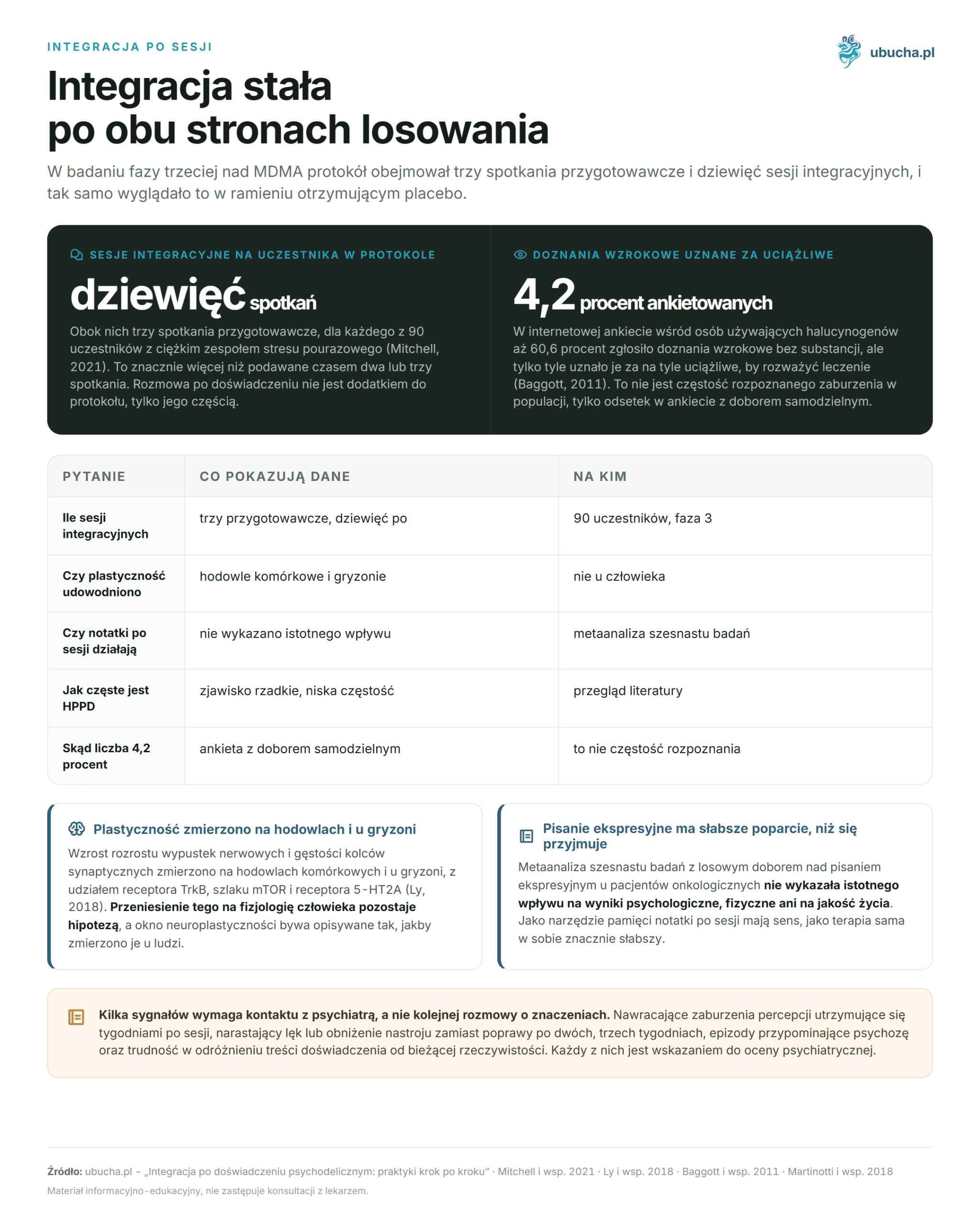
• In the phase 3 study of MDMA in PTSD, the protocol included three preparatory sessions and nine integration sessions for each of the 90 participants (Mitchell et al., Nature Medicine, 2021).
• The increase in plasticity after psychedelics has so far been documented in cell cultures and in rodents, not in humans (Ly et al., Cell Reports, 2018).
• Integration is an element of the protocol in both arms of the studies, so its separate contribution cannot be read from these results.
• Persistent perceptual disturbances after hallucinogens are a rare phenomenon but require psychiatric assessment.
What is integration and why do studies treat it as part of therapy?
Integration is the work on what remains after the session: giving meaning to the content that appeared and translating it into changes in everyday life. In clinical studies, it takes the form of meetings with a therapist, conducted according to a manual, at a set rhythm after each session with the substance.
The scale of these meetings is often downplayed in popular texts. In the phase 3 study published in Nature Medicine, ninety participants with severe PTSD were randomly assigned to therapy with MDMA or placebo, and the protocol in both arms included three preparatory sessions and nine integration sessions (Mitchell et al., Nature Medicine, 2021). This is more than twice the hours of conversation compared to hours under the influence of the substance.
This also leads to a limitation that must be stated plainly. Since integration is part of the protocol in both arms, the study does not measure it separately. It is impossible to read from such a setup how much the conversation contributes on its own and how much the substance does, because no one separated these two things by randomization. The theoretical framework for this work was described by the authors of the psychological flexibility model drawn from acceptance and commitment therapy (Watts and Luoma, J Contextual Behav Sci, 2020).
What happens in the brain in the weeks after the session?
The concept of the neuroplasticity window is based on preclinical studies, and it is worth knowing where their reach ends. Psychedelics increase the growth of nerve processes and the density of synaptic spines, and this effect depends on the TrkB receptor, the mTOR pathway, and the 5-HT2A receptor. This has been measured in cell cultures and in animals (Ly et al., Cell Reports, 2018).
Translating this to humans is a hypothesis, not a measurement. The cited work counted dendritic spines in culture and in animals, so the statement about a window that opens for two weeks and closes is a conclusion from the animal model transferred to the reader. It sounds convincing and may be confirmed, but it should not be presented as an established fact from its own physiology.
Nonetheless, the practical conclusion remains sensible, only it is based on something else. Study participants describe a several-day period of increased openness after an intense experience, referred to in this environment as afterglow. This is a sufficient reason to use this time for conversation and organizing conclusions, regardless of what happens at the synaptic level. What imaging studies show about this period is described in the text about the default mode network and afterglow.
What to do in the first days and weeks?
In the first day, the priority is rest, not working on meaning. Sleep, light food, a calm environment, and abstaining from alcohol for a few days. This is also a bad time to make decisions about breakups, quitting jobs, or moving, as the sense of certainty can be stronger than the foundations on which it stands.
From the second day, the real work begins. Keeping notes is a basic tool here, as writing down an image, thought, or emotion preserves it in a form that can be returned to in a month. Regular mindfulness practice keeps attention on what is happening, rather than on interpretations. Talking to someone who understands the context protects against two traps at once: recognizing the experience as meaningless and attributing it the status of a revelation.
| Time After Session | What to Focus On | What to Avoid |
|---|---|---|
| First Day | Sleep, light food, silence, walking | Alcohol, important decisions, intense stimuli |
| Days 2-7 | Notes, first conversation with a therapist, contact with a trusted person | Next session, pressure for quick interpretation |
| Weeks 2-4 | Mindfulness, psychotherapy, small habit changes | Isolation, abandoning practice when mood drops |
| Months 1-6 | Consolidating changes, returning to notes, follow-up meetings | Considering the matter closed after the first week |
It is also worth honestly separating practices described in protocols from those that have solid evidence. Expressive writing is often presented as a technique with strong support, but a meta-analysis of sixteen randomized studies in cancer patients did not show a significant impact on psychological, physical outcomes, or quality of life (Zachariae and O’Toole, Psycho-Oncology, 2015). Notes after the session make sense as a memory tool, not as therapy in itself.
How does integrative psychotherapy differ from regular psychotherapy?
Primarily in the therapist’s knowledge of what is typical in such an experience. A sense of unity, temporary loss of a sense of separateness, strong emotions without an identifiable cause, vivid images: without familiarity with this phenomenology, it is easy to mistake them for a symptom, even though they fit within the described course. A therapist who does not know this may start treating something that would have resolved on its own.
The second difference concerns the way the conversation is conducted. The model based on psychological flexibility emphasizes accompanying and accepting content, rather than imposing interpretations by the therapist (Watts and Luoma, J Contextual Behav Sci, 2020). This is particularly important after a psychedelic, as the person returns with material they do not yet understand, and someone else’s ready interpretation usually closes it off rather than opens it up.
The third aspect is organizational. In clinical studies, sessions have a set rhythm and schedule, and outside of the study, no one monitors this rhythm. If a meeting is not scheduled before the session, it usually does not take place. Separately, it is worth knowing how to behave towards someone who is having a difficult transition at that moment, which we discuss in the text about psychological first aid.
In organizing this literature, we noted an asymmetry in what is being studied. The conditions preceding the session, such as mindset and environment, have received separate analyses, and integration is described in detail in the protocols, but in the cited phase 3 study, it stood on both sides of the randomization, so its own contribution is not visible. Therefore, we know less about its impact than the certainty with which the environment speaks about it suggests. This does not mean it does not work. It means that its role today is based on the construction of the protocol and the relationships of participants, not on a comparison with a group that did not receive integration. We discuss mindset and environment in the text about set and setting.
When is integration not enough and help should be sought?
Several signals require contact with a psychiatrist, not another conversation about meanings. Recurring perceptual disturbances lasting for weeks after the session, increasing anxiety or mood decline instead of improvement after two to three weeks, episodes resembling psychosis, and difficulty distinguishing the content of the experience from current reality.
Persistent perceptual disturbances after hallucinogens (HPPD) have been described in a review as a rare phenomenon, with a low frequency, more often recognized in individuals with previous mental health issues or substance abuse (Martinotti et al., Brain Sciences, 2018). The figure of 4.2 percent circulates in this context, and it is worth knowing where it comes from. In an online survey among individuals using hallucinogens, as many as 60.6 percent reported visual experiences without substances, but only 4.2 percent found them bothersome enough to consider treatment (Baggott et al., Drug Alcohol Depend, 2011). This is not the frequency of a recognized disorder in the population, but the percentage in a self-selected survey.
In Poland, access to therapists working with this material is limited, but not zero. The Polish Society for Psychedelic Integration, a registered association, conducts free support groups in several cities and publishes a list of verified specialists. Before scheduling a meeting, ask about education, experience in working with such reports, and how the therapist understands their role. More about the period immediately after the session can be found in the text about afterglow and the neuroplasticity window.
Frequently Asked Questions
What is integration after a psychedelic experience?
It is the work of giving meaning to the content from the session and translating it into changes in everyday life. In clinical studies, it takes the form of meetings with a therapist according to a manual. In the phase 3 study of MDMA in PTSD, there were nine sessions per participant, alongside three preparatory meetings.
How many integration sessions do research protocols anticipate?
In a phase 3 study published in Nature Medicine involving 90 people with severe PTSD, the protocol included three preparatory sessions and nine integration sessions in both arms of the study. This is significantly more than the sometimes mentioned two or three meetings.
Is the neuroplasticity window after psychedelics proven in humans?
Not in that form. The increase in the growth of nerve processes and the density of synaptic spines has been measured in cell cultures and in rodents, involving the TrkB receptor, the mTOR pathway, and the 5-HT2A receptor. Translating this to human physiology remains a hypothesis.
Is there research support for taking notes after a session?
As a memory tool, yes, as therapy in itself significantly weaker than assumed. A meta-analysis of sixteen randomized studies on expressive writing in cancer patients did not show a significant impact on psychological, physical outcomes, or quality of life.
How common is HPPD after psychedelics?
A literature review describes it as a rare phenomenon, with a low frequency. The repeated figure of 4.2 percent comes from an online survey and represents the percentage of individuals who found visual experiences without substances bothersome enough to consider treatment, not the frequency of diagnosis.
How to know when professional help is needed?
After perceptual disturbances lasting for weeks, after increasing anxiety or mood decline instead of improvement within two to three weeks, after episodes resembling psychosis, and after difficulty distinguishing the content of the experience from reality. Each of these signals indicates the need for psychiatric assessment.
The article is for informational and educational purposes. It describes clinical studies in which the substance is administered under medical supervision after participant qualification; self-administration of these conditions does not replicate. These substances are controlled in Poland under the Act on Counteracting Drug Addiction. If you have suicidal thoughts, call the free, 24-hour numbers 116 123 or 800 70 2222. In case of life-threatening situations: 112.
Author: Michał Waluk · Published: 2026-08-09 · Updated: 2026-08-16