
Adaptogens for Weight Loss: Do They Really Help You Lose Weight
Adaptogens for weight loss: a meta-analysis of 20 studies and 1249 participants found no effect of ashwagandha on body weight. We check what the numbers say and for whom they make sense.
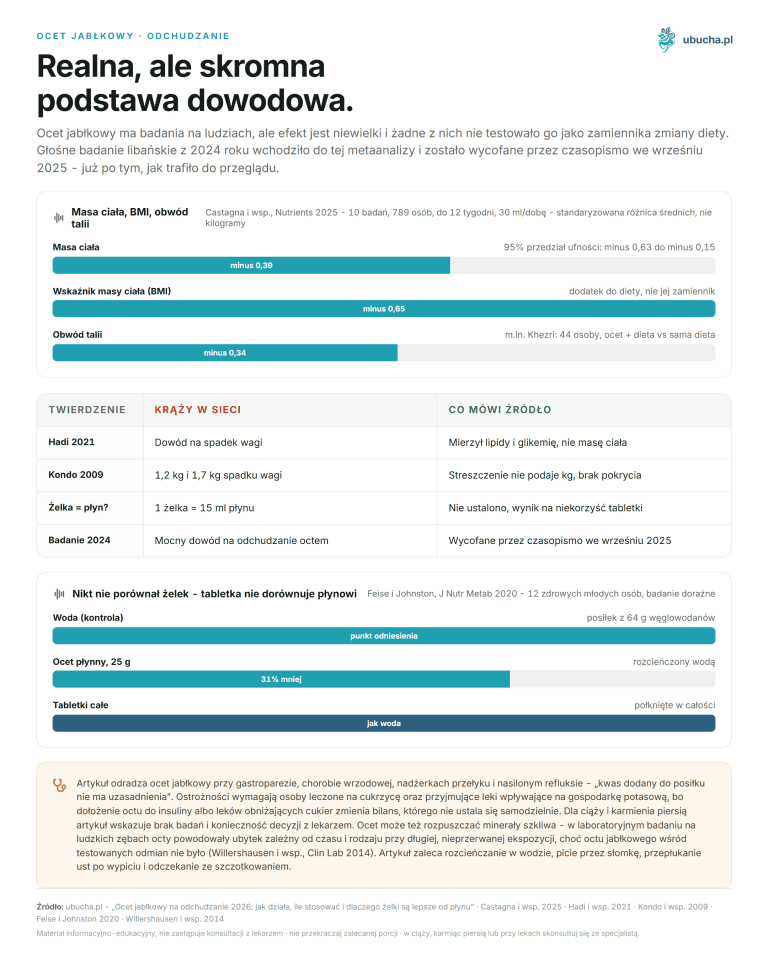
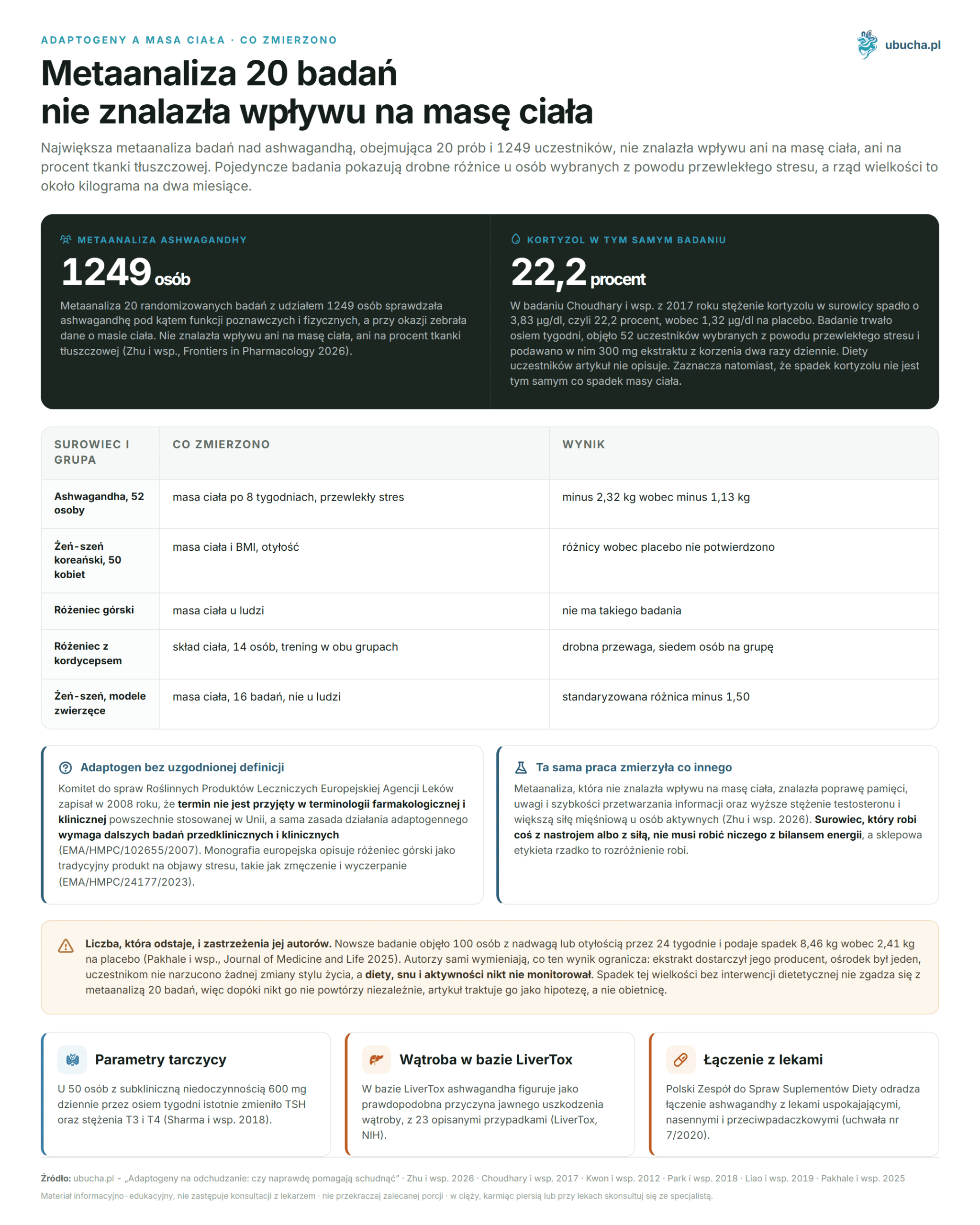
No, adaptogens do not promote weight loss in the way the label suggests. The largest meta-analysis of studies on ashwagandha, involving 20 trials and 1249 participants, found no effect on body weight or percentage of body fat (Zhu et al., Frontiers in Pharmacology 2026). Individual studies show minor differences in people selected due to chronic stress, but the order of magnitude is about a kilogram over two months, not kilograms weekly as the packaging slogan suggests. Below we break it down: what was actually measured for ashwagandha and ginseng, for which raw materials there are no data in humans, how much the numbers from animal studies are worth, and why a capsule does not replace a negative energy balance, as we have already discussed regarding apple cider vinegar.
KEY INFORMATION
• Meta-analysis of 20 studies and 1249 participants: ashwagandha did not change body weight or body fat percentage (Zhu et al. 2026).
• Most cited study: 52 people under chronic stress, 8 weeks, weight loss of 2.32 kg versus 1.13 kg on placebo (Choudhary et al. 2017).
• Cortisol dropped by 22.2 percent there, which is not the same as weight loss.
• Korean ginseng in 50 women with obesity: no difference compared to placebo was confirmed (Kwon et al. 2012).
• For rhodiola, there is not a single study in humans with body weight as an endpoint.
• European Medicines Agency: the term adaptogen is not accepted in the pharmacological and clinical terminology used in the EU (EMA/HMPC/102655/2007).
Do adaptogens help with weight loss?
Not to a degree that would be visible on the scale. A meta-analysis of 20 randomized studies involving 1249 participants examined ashwagandha for cognitive and physical functions, and in the process collected data on body weight. It found no effect on body weight or percentage of body fat (Zhu et al. 2026).
This same work found something else: improvement in memory, attention, and processing speed, as well as higher testosterone levels and greater muscle strength in active individuals. The distinction is important because store labels rarely make it. A raw material that does something for mood or strength does not have to do anything for energy balance.
The second thing not visible in advertising: an adaptogen is not a category with an agreed pharmacological definition. The Committee on Herbal Medicinal Products of the European Medicines Agency noted in 2008 that the term is not accepted in the pharmacological and clinical terminology commonly used in the EU, and the very principle of adaptogenic action requires further preclinical and clinical research (EMA/HMPC/102655/2007).
None of this invalidates the energy deficit, and nothing replaces it. An adaptogen can at most stand alongside working on diet.
How many kilograms did the most cited study on ashwagandha show?
About a kilogram difference compared to placebo in eight weeks, in individuals selected due to chronic stress. In the study by Choudhary et al. from 2017, 52 participants took 300 mg of root extract twice daily or placebo. Body weight decreased on average by 2.32 kg versus 1.13 kg in the placebo group, with p equal to 0.0148 (Choudhary et al. 2017).
The body mass index decreased by 0.79 versus 0.38, and serum cortisol by 3.83 µg/dl, or 22.2 percent, versus 1.32 µg/dl on placebo. The researchers also measured the intensity of food cravings, and it also favored the extract. The scale is, however, what it is: one kilogram advantage in two months, in a group of fifty-some individuals, in one center.
A newer study provides numbers an order of magnitude larger: 100 people with overweight or obesity, 24 weeks, weight loss of 8.46 kg versus 2.41 kg on placebo (Pakhale et al., Journal of Medicine and Life 2025). Before you repeat this number, read the disclaimers from the authors themselves. The extract was provided by its manufacturer, there was one center, participants were not imposed any lifestyle changes, and no one monitored diet, sleep, and activity. A decrease of this magnitude without dietary intervention does not agree with the meta-analysis of 20 studies, so until someone independently replicates it, it is a hypothesis, not a promise.
What do studies show for rhodiola and other adaptogens?
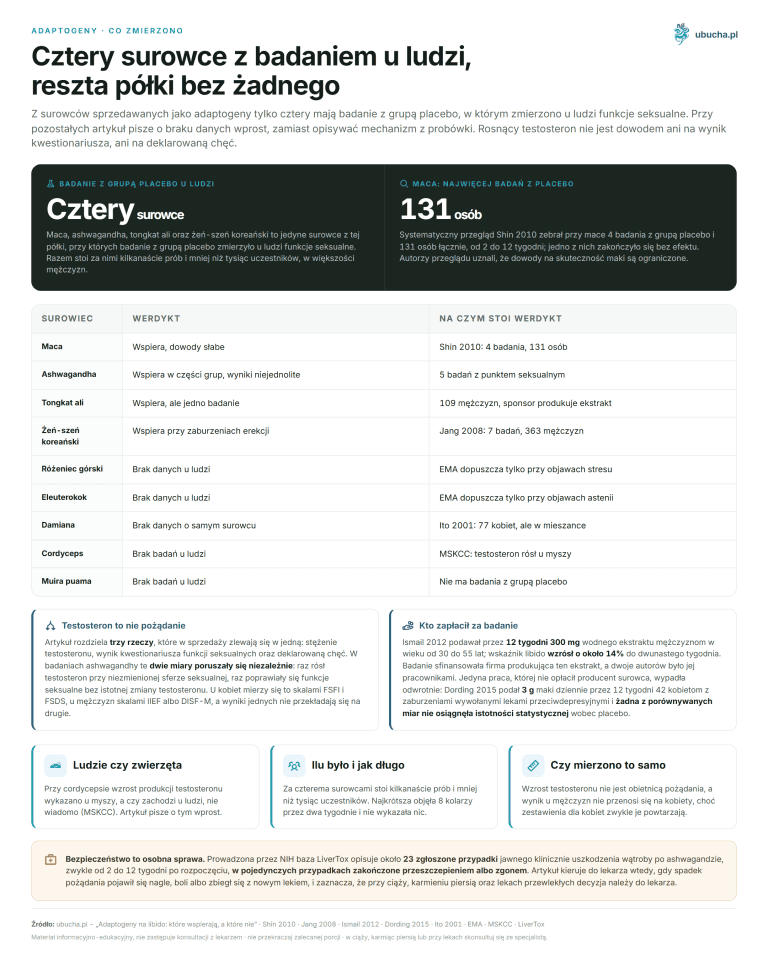
For rhodiola, there is not a single study in humans where body weight was an endpoint; the European monograph describes it as a traditional product for stress symptoms such as fatigue and exhaustion (EMA/HMPC/24177/2023). For Korean ginseng, such a study exists and it came out neutral: in 50 women with obesity, improvement appeared within the group, but the difference compared to placebo was not confirmed (Kwon et al. 2012).
The closest topic is a small study combining rhodiola with cordyceps: 14 sedentary individuals, eight weeks of endurance training in both groups. The supplement added a slight advantage in body composition, but that is seven people per group and the effect of training, not the extract itself (Liao et al., Nutrients 2019). More about the raw material itself can be found in our post about rhodiola.
So where do the strong slogans come from? From animal models. A meta-analysis of 16 studies on obese animals showed a standardized mean difference of minus 1.50 for ginseng, indicating a large effect (Park et al. 2018). No one has replicated this in humans.
| Raw Material | What Was Measured | Result | Source |
|---|---|---|---|
| Ashwagandha | body weight and body fat, 20 studies, 1249 people | no effect | Zhu et al. 2026 |
| Ashwagandha | body weight after 8 weeks, 52 stressed individuals | minus 2.32 kg versus minus 1.13 kg on placebo | Choudhary et al. 2017 |
| Korean ginseng | body weight and BMI, 50 women with obesity | no difference compared to placebo was confirmed | Kwon et al. 2012 |
| Ginseng, animal models | body weight, 16 studies on animals | standardized difference of minus 1.50 | Park et al. 2018 |
| Rhodiola | body weight in humans | there is no such study | none |
| Rhodiola with cordyceps | body composition, 14 people with training | slight advantage over placebo | Liao et al. 2019 |
Why does lower cortisol not mean less body weight?
Because between cortisol and weight stands food. Ashwagandha does indeed lower cortisol levels, and that is measured, but the same plant in a meta-analysis of 1249 people did not affect body weight. Less stress may reduce the desire to eat, but only fewer calories consumed changes the energy balance.
The practical conclusion is this: if you reach for an adaptogen due to tension or poor sleep during reduction, you have some data for that. If you reach for it instead of changing your diet, you have no data at all. The same conclusion we made regarding CBD for weight loss, because the marketing mechanism is the same in both cases.
It is also worth remembering the costs. Ashwagandha changes thyroid parameters: in 50 individuals with subclinical hypothyroidism, 600 mg daily for eight weeks significantly changed TSH and levels of T3 and T4 (Sharma et al. 2018). For someone taking levothyroxine, this is not a neutral addition. In the LiverTox database of the American health institutes, ashwagandha is listed as a probable cause of apparent liver damage, with 23 reported cases (LiverTox, NIH), and the Polish Dietary Supplements Team advises against combining it with sedatives, sleeping pills, and anticonvulsants (resolution no. 7/2020). If you are still looking for a raw material for stress or sleep, you can find an overview in the adaptogens category, and a comparison of the raw materials themselves in the post about adaptogens for stress.
Frequently Asked Questions
Does ashwagandha help with weight loss?
A meta-analysis of 20 randomized studies involving 1249 participants found no effect of ashwagandha on body weight or percentage of body fat (Zhu et al., Frontiers in Pharmacology 2026). A single study in stressed individuals showed about a kilogram advantage over placebo in eight weeks, and that is the real scale of this effect.
How many kilograms can you lose with adaptogens?
The best-documented difference is 2.32 kg versus 1.13 kg on placebo over eight weeks, which is about a kilogram advantage (Choudhary et al. 2017). Participants were selected due to chronic stress, so this is not a number that can be transferred to any person wanting to lose weight.
Does rhodiola accelerate metabolism?
I found no study in humans where body weight or metabolism rate after rhodiola was an endpoint. The European Medicines Agency monograph describes rhodiola as a traditional product for stress symptoms such as fatigue and exhaustion, not for body weight.
Do adaptogens reduce appetite?
In the 2017 study by Choudhary, the intensity of food cravings decreased after ashwagandha more than after placebo, but it was measured by a questionnaire, not by the number of calories consumed. A lower desire to eat and lower energy intake are two different things, and only the latter changes body weight.
Do adaptogens work on belly fat?
Animal studies on obesity show a large effect for ginseng on body weight, a standardized difference of minus 1.50 in 16 studies (Park et al. 2018). No one has replicated this in humans, and I found no separate data on visceral tissue after adaptogens.
Do adaptogens replace a calorie deficit?
No. A negative energy balance is the mechanism through which every effective weight loss method works, and adaptogens for body weight have one study on a few dozen people and a meta-analysis with no effect. A supplement can stand alongside working on diet, never in its place, and none of the described studies tested it otherwise.
When does an adaptogen make sense for weight loss?
When the problem is stress or sleep, not just weight. Ashwagandha reduced cortisol levels by 22.2 percent in the Choudhary 2017 study, and that is a measured effect. Treat it as support for well-being during reduction, not as a way to lose weight.
Are adaptogens for weight loss safe?
Ashwagandha is listed in the LiverTox database of the American health institutes as a probable cause of apparent liver damage, with 23 reported cases. The Polish Dietary Supplements Team advises against combining it with sedatives, sleeping pills, and anticonvulsants. It is not a neutral addition to the diet.
This article is for informational and educational purposes and does not replace consultation with a doctor. If you are pregnant, breastfeeding, taking medications, or have chronic conditions, consult the use of supplements or herbs with a specialist.
Author: Michał Waluk · Published: 2026-08-24 · Updated: 2026-08-24