
Collagen and its properties: A comprehensive guide to natural support for skin, joints, and health in 2026
Collagen in clinical studies: what doses worked on skin, joints, and bones, how long to wait for results, and how hydrolysate differs from UC-II.
Collagen is the most abundant protein in animals, holding together skin, cartilage, bone, and tendon. However, so much marketing has grown around supplementation that it is difficult to distinguish research results from label slogans. The good news is that collagen is one of the few products in the beauty sector that has undergone randomized trials with placebo, and their results can be read in abstracts. This guide collects what has actually been measured in these studies: what dose was administered, for how long, to whom, and with what effect, as well as the size of the study group. It also shows where popular numbers circulating on the internet have no basis in any of the cited works or their abstracts.
KEY INFORMATION
• Collagen hydrolysate at a dose of 2.5 or 5 g daily for 8 weeks significantly improved skin elasticity in 69 women aged 35-55 (Proksch et al., Skin Pharmacology and Physiology 2014).
• The collagen family consists of 28 members, with type I accounting for over 90% of all collagen in the human body (Ricard-Blum 2011; StatPearls 2026).
• Undenatured type II collagen works in a microdose of 40 mg daily and performed better than glucosamine with chondroitin in two trials.
• After menopause, collagen content in the skin decreases by 1-2% per year (Brincat et al. 1987).
• Vitamin C is a cofactor for the hydroxylation of proline and lysine, without which new collagen chains do not form properly.
What is collagen and why does it serve as the framework for the entire body?
Collagen is a family of structural proteins built from a triple helix. According to the review by Shoulders and Raines (Annual Review of Biochemistry 78: 929-958, 2009), it is the most abundant protein in animals, and its molecule is a right-handed bundle of three left-handed polyproline type II helices. This structure gives the fiber tensile strength while also allowing it to bear loads in tissue.
The family is larger than marketing suggests. The review by Ricard-Blum (Cold Spring Harbor Perspectives in Biology 3: a004978, 2011) states that it includes 28 members containing at least one triple helix domain. The StatPearls on collagen synthesis adds that the most common types are I to IV, with type I accounting for over 90% of all collagen in the human body. Dietary supplements are practically based on types I, II, and III, and the differences between them are broken down in detail in our text on collagen types.
Synthesis requires vitamin C. The residues of proline and lysine undergo hydroxylation with the help of prolyl and lysyl hydroxylase, and these enzymes require ascorbic acid as a cofactor. A historical consequence of its deficiency was scurvy, which is the breakdown of connective tissue while maintaining protein intake.
What forms of collagen will you find in stores?
Five categories practically exhaust the entire market, differing not so much in the quality of the raw material but in whether they have been clinically studied at all. The most trials have been conducted on hydrolysate and undenatured type II collagen, and all the numbers mentioned later in this text refer to them.
| Form | What it is | Dose used in studies | Notes |
|---|---|---|---|
| hydrolysate, i.e., collagen peptides | collagen enzymatically broken down into short fragments | 2.5-10 g daily | the form on which most clinical trials are based |
| gelatin | denatured collagen, but not broken down into peptides | no trials of this kind | this category includes homemade bone broth |
| undenatured type II collagen (UC-II) | intact protein from cartilage, acting through oral tolerance | 40 mg daily | the only form studied in such a small dose |
| so-called plant collagen | a mixture of amino acids, vitamin C, and plant extracts | not applicable | does not contain collagen, as it is an animal protein |
| marine, beef, or poultry collagen | division by raw material, not by molecular structure | as for hydrolysate or UC-II | poultry cartilage is a typical source of type II |
The name of the form is often confused with the name of the raw material, which are two separate things. Hydrolysate can come from fish, cattle, or poultry and will remain a hydrolysate, while UC-II is always a protein from cartilage and is always administered in a microdose. The differences arising from the source of raw material are discussed separately in the comparison of grass-fed and marine collagen.
What do clinical studies say about collagen and skin?
The most frequently cited trial is Proksch et al. (Skin Pharmacology and Physiology 27: 47-55, 2014). Sixty-nine women aged 35-55 took either 2.5 g or 5 g of collagen hydrolysate or placebo for eight weeks, with twenty-three people in each group. At the end of the study, skin elasticity significantly improved in both groups receiving collagen. Four weeks after discontinuation, older participants maintained higher elasticity.
It is worth noting what this work did not show. The effect on skin hydration and transepidermal water loss was beneficial in subgroup analysis but did not reach statistical significance. No adverse effects were reported.
A broader picture is provided by the systematic review Choi et al. (Journal of Drugs in Dermatology 18: 9-16, 2019), which included eleven randomized trials and 805 patients. Eight of them used hydrolysate at doses from 2.5 to 10 g daily for 8 to 24 weeks, with indications ranging from pressure ulcers to skin aging. Two other trials in this set studied not hydrolysate but collagen tripeptide at a dose of 3 g daily for 4 to 12 weeks and also noted a noticeable improvement in elasticity and hydration. The authors’ conclusion states an improvement in elasticity, hydration, and collagen density in the dermis, and they assess supplementation as generally safe, with no reported adverse events. A mechanistic review Barati et al. (Journal of Cosmetic Dermatology 19: 2820-2829, 2020) indicates three possible mechanisms of action: the effect of peptides on fibroblasts, on M2 macrophages, and mechanisms related to oral tolerance.
Does collagen really reduce joint pain?
Three trials provide a consistent affirmative answer, although they involve different subjects and different preparations. Two of them compared collagen not with placebo but with glucosamine and chondroitin, the most popular alternative in the same category.
| Study | Group | Scheme | Result |
|---|---|---|---|
| Clark et al. 2008 | 147 athletes with joint pain during activity, 97 people in analysis | 10 g hydrolysate daily for 24 weeks | significantly less pain when walking, standing, at rest, when carrying and lifting |
| Crowley et al. 2009 | people with knee osteoarthritis | UC-II 40 mg versus glucosamine with chondroitin, 90 days | decrease in WOMAC score by 33% versus 14%; decrease in VAS scale by 40% versus 15.4% |
| Lugo et al. 2016 | 191 people with knee osteoarthritis | UC-II 40 mg versus glucosamine with chondroitin and versus placebo, 180 days | significant advantage of UC-II over placebo (p = 0.002) and over the comparative preparation (p = 0.04) |
In Lugo’s trial, not only the total score was significant, but all three WOMAC subscales: pain, stiffness, and physical function. The frequency of adverse events did not differ between groups, which is significant information about the tolerance of the preparation over a six-month period.
Crowley’s work is sometimes described in Polish internet as a study on dogs. This is a mistake: the participants were people with knee osteoarthritis, and the observation period was ninety days. A separate topic is the combination of collagen with other joint preparations, which is developed in our supplement comparison for joints.
Does collagen strengthen bones and nails?
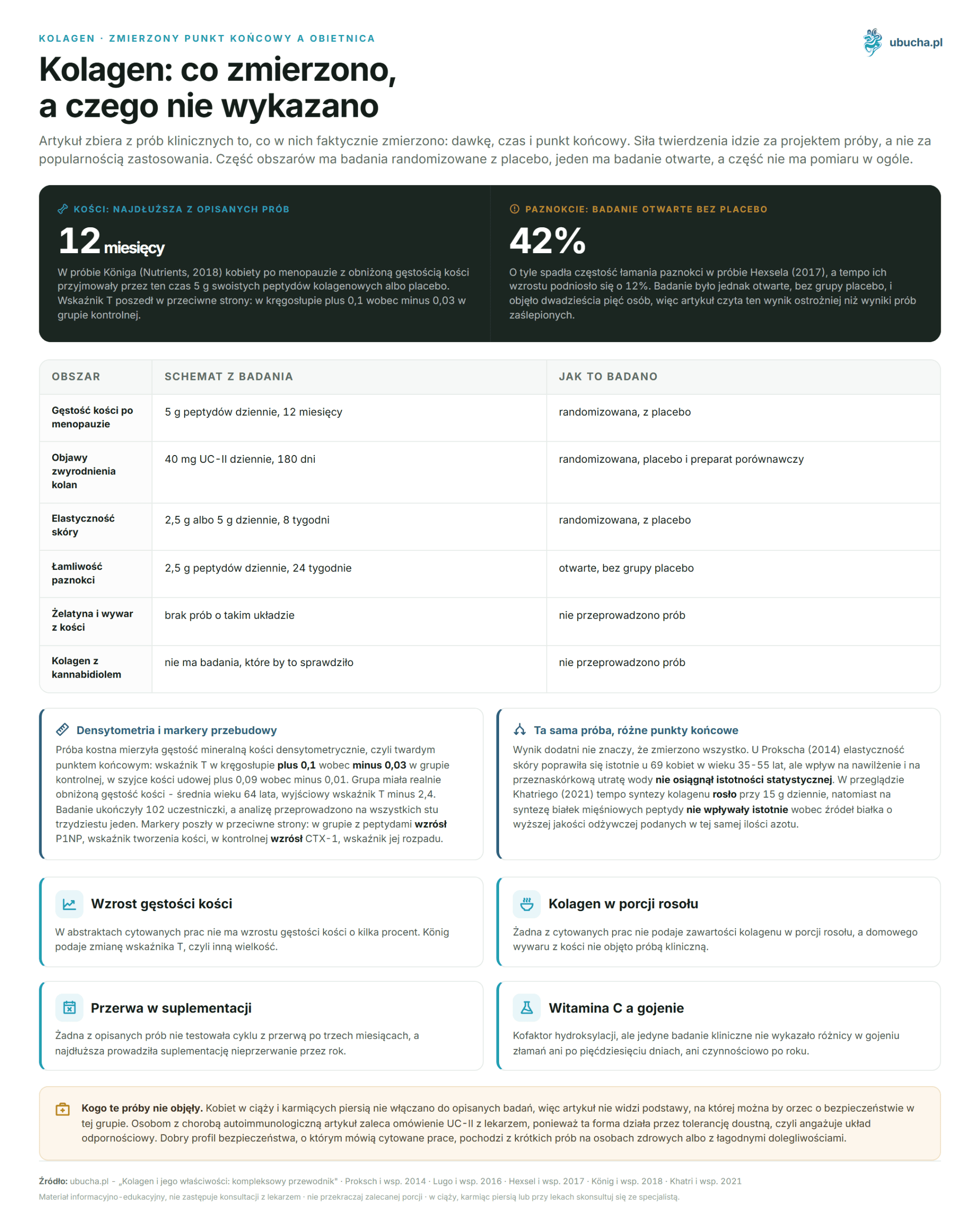
In the case of bones, evidence comes from a one-year trial König et al. (Nutrients 10: E97, 2018). One hundred thirty-one postmenopausal women with age-related reduced bone mineral density took 5 g of specific collagen peptides or placebo for twelve months. The result was reported as a change in the T-score: in the spine plus 0.1 versus minus 0.03 in the control group, in the femoral neck plus 0.09 versus minus 0.01. The study was completed by 102 participants, but the analysis was conducted according to the planned treatment, i.e., on all one hundred thirty-one. The average age was 64 years, and the baseline T-score in the spine was minus 2.4, so this was a group with realistically reduced bone density, not healthy volunteers.
Bone remodeling markers also changed. In the group receiving peptides, P1NP, the bone formation marker, increased, while in the control group, CTX-1, the bone resorption marker, increased. These are two opposing directions, and they give this result biological meaning.
Nails have been studied less extensively. In the trial Hexsel et al. (Journal of Cosmetic Dermatology 16: 520-526, 2017), twenty-five people took 2.5 g of bioactive collagen peptides for 24 weeks. The rate of nail growth increased by 12%, the frequency of breakage decreased by 42%, and improvement was noted in 64% of participants. However, the study was open-label, without a placebo group, so its result should be read more cautiously than the results of blinded trials.
How much collagen should you take and for how long to see results?
The dose depends on the goal and the form, and the difference can reach three orders of magnitude: from forty milligrams with UC-II to ten grams with hydrolysate. The following table provides only the schemes that were actually applied in the studies described above, along with the time after which the effect was measured.
| Goal | Dose from study | Observation time | Source |
|---|---|---|---|
| skin elasticity | 2.5 g or 5 g of hydrolysate daily | 8 weeks | Proksch 2014 |
| hydration and density of the dermis | 2.5-10 g of hydrolysate daily | 8-24 weeks | Choi 2019 |
| joint pain during physical activity | 10 g of hydrolysate daily | 24 weeks | Clark 2008 |
| symptoms of knee osteoarthritis | 40 mg of UC-II daily | 90-180 days | Crowley 2009, Lugo 2016 |
| bone mineral density after menopause | 5 g of specific peptides daily | 12 months | König 2018 |
| nail brittleness | 2.5 g of peptides daily | 24 weeks | Hexsel 2017 |
The table lacks two things that readers often ask about. There is no scheme for gelatin or homemade bone broth, as no clinical trials of this kind have been conducted, and transferring doses from studies on hydrolysate would be an abuse. There is also no basis for the popular recommendation to take a month off after three months. None of the described trials tested such a cycle, and the longest of them conducted supplementation continuously for a year.
Does collagen support recovery after exercise and muscle building?
Partially, but not where most buyers expect it. The systematic review Khatri et al. (Amino Acids 53: 1493-1506, 2021) reviewed 856 articles and included fifteen randomized trials combining collagen peptides with physical exercise. Twelve of them concerned recreationally training individuals, two older individuals, and one untrained women before menopause.
The authors grouped the results into four areas: joint pain and return to function after injury, body composition, muscle soreness, and muscle and collagen protein synthesis. The most apparent benefit concerned joint function and reduction of joint pain. Improvements also appeared in body composition, strength, and muscle recovery, but less consistently.
The most significant caveat concerns the muscles themselves. The rate of collagen synthesis increased with a dose of 15 g daily, while collagen peptides did not significantly affect muscle protein synthesis compared to higher quality protein sources provided in the same amount of nitrogen. Therefore, collagen will not replace whey or meat in a diet aimed at muscle gain. The authors of the review also point out what is lacking in this literature: larger groups, elite athletes, a greater proportion of women, and more robust measurement methods, such as muscle biopsy.
Which accompanying ingredients have documented roles?
The best-documented is vitamin C, and not because it appears on labels, but because without it the biochemical reaction does not complete. Prolyl and lysyl hydroxylase require ascorbic acid as a cofactor, and without hydroxylation of proline and lysine residues, the triple helix does not achieve proper stability.
This role does not mean, however, that supplementation of vitamin C alone accelerates healing in humans. The systematic review DePhillipo et al. (Orthopaedic Journal of Sports Medicine 6: 2325967118804544, 2018) included ten studies on musculoskeletal injuries. Preclinical studies indicated accelerated healing of fractures and increased amounts of type I collagen, but the only clinical study assessing fracture healing did not show a significant difference either after fifty days or in functional outcomes after a year. The authors did not report adverse events and state directly that there is insufficient clinical evidence.
Copper participates in the cross-linking of fibers through lysyl oxidase, zinc is part of the enzymes remodeling the matrix, and hyaluronic acid binds water in the skin. However, none of these ingredients have evidence in the context of collagen supplementation comparable to that collected for the peptides themselves.
For whom does collagen supplementation make the most sense?
The strongest evidence concerns postmenopausal women and individuals with joint pain. In both groups, there are trials with hard endpoints: bone mineral density measured densitometrically and the WOMAC score, which is a standard scale for the severity of osteoarthritis symptoms.
The decline after menopause has been documented for a long time. The work of Brincat et al. (1987) showed that collagen content in the skin, skin thickness, metacarpal index, and mineral content in the forearm bone decrease after menopause at a similar rate of 1 to 2% per year, and these declines are correlated. The authors concluded that a common mechanism in connective tissue is responsible for the loss of bone mass and skin thinning.
Athletes with overload pain are the second group with a clear rationale, as Clark’s trial included active individuals without a diagnosed joint disease. Individuals recovering from surgery and injuries, as well as those seeking to improve the appearance of hair and nails, have weaker bases: for nails, there is an open study on twenty-five individuals, and for postoperative recovery, there is a lack of trials with clinically significant endpoints.
Do collagen and CBD work synergistically?
There is no study that has verified this, and it is worth stating this clearly before the temptation arises to combine two trendy ingredients into one promise. However, there is a common point of reference in the form of chronic inflammation that accompanies osteoarthritis.
The review Atalay et al. (Antioxidants 9: E21, 2019) summarizes the anti-inflammatory and antioxidant properties of cannabidiol and its interaction with cannabinoid receptors and other elements of the endocannabinoid system. This is a review of preclinical and clinical data concerning CBD itself, not its combination with collagen.
UC-II works through oral tolerance, i.e., an immunological mechanism, not by providing building blocks. Theoretically, both ingredients could affect inflammation through different pathways, but this is a hypothesis, not a measured result. The difference is significant because the hypothesis of a common mechanism is often presented in product descriptions as if it had already been verified in a clinical trial. In practice, the simplest way is to separate both preparations throughout the day and observe your own reaction, without expecting an effect that no one has measured so far. Individuals with autoimmune diseases should additionally discuss UC-II with a doctor, as this form deliberately engages the immune system.
How to recognize a good collagen product?
The most reliable filter is to compare the label with the dose from studies. If the manufacturer claims hydrolysate, the daily serving should reach several grams, as such amounts were administered in clinical trials. If it claims UC-II, the appropriate size is forty milligrams, and here more does not mean better, as the mechanism of oral tolerance is based on a small dose.
The second thing is the source of raw material. A reliable manufacturer states whether the collagen comes from cattle, fish, or poultry, as this determines the profile of types and is also important information for individuals with allergies. A production facility certificate and declaration of the source of raw material say more than a slogan about an innovative formula.
The third thing is the composition beyond collagen itself. Vitamin C has a biochemical justification described above. A long list of fillers, colorings, and sweeteners with low peptide content usually means that savings were made on the most expensive element of the product. It is also worth paying attention to the form of administration: powder allows for measuring a portion consistent with studies, while capsules and gummies usually contain so few peptides that reaching the dose from clinical trials requires many pieces daily.
What is the legal status of collagen in Poland and who should exercise caution?
Collagen is a dietary supplement in Poland, not a medicinal product. This means that it cannot be attributed therapeutic effects or suggested that it prevents or treats diseases. The manufacturer can only use health claims permitted in the European Union, and for collagen itself, the list of such claims is very short. That is why descriptions on packaging talk about support and care, not about rebuilding cartilage.
The safety profile is good. The review by Choi et al. did not report any adverse events in the eleven analyzed trials, and the Prokschy study did not report any side effects over eight weeks. However, these are data from short trials on healthy individuals or those with mild ailments.
Caution is advised in several situations. Marine collagen may cause allergic reactions in individuals with fish allergies, and beef collagen may affect those with beef protein allergies. Pregnant and breastfeeding women do not have studies in this group on which to base their decisions. Individuals on long-term medication, especially those with autoimmune diseases considering UC-II, should discuss supplementation with a doctor, as this form works through the immune system.
Summary: what do these studies imply in practice
Collagen performs better in the literature than most products in the beauty sector, but worse than advertisements suggest. Hydrolysate at a dose of 2.5 to 10 g daily improves skin elasticity, reduces joint pain in active individuals, and increases bone mineral density in postmenopausal women. Undenatured type II collagen at a dose of 40 mg daily performed better than glucosamine with chondroitin in two trials.
All these results have a common denominator in terms of time. The shortest trial lasted eight weeks, and the bone trial lasted twelve months. A preparation taken for two weeks cannot replicate any of these results, and this is the most common cause of disappointment.
Numbers circulating on the internet without support in the cited works are worth avoiding. The abstracts of the studies described above do not mention an increase in bone density by several percent, nor data on the superiority of marine collagen’s bioavailability over beef collagen, nor the collagen content in a serving of broth. When choosing a product, compare the dose and time with the table above, not with promises on the label.
Frequently asked questions
Is pharmacy collagen better than supplement store collagen?
The sales channel does not change the status of the product. In both places, collagen remains a dietary supplement subject to the same food regulations. The value of the preparation is determined by the serving size, form of collagen, and source of raw material, and this information can be found on the label regardless of where you buy it.
How long should you take collagen before seeing results?
In the Prokschy study from 2014, skin elasticity was assessed after eight weeks, in Clark’s study joint pain after twenty-four weeks, and in König’s study bone mineral density increased over twelve months. Shorter use does not replicate the conditions of any of these trials, so two weeks is definitely too short.
Does collagen help with cellulite?
One trial suggests so. Schunck et al. in 2015 administered 2.5 g of bioactive peptides or placebo for six months to 105 women aged 24-50 with moderate cellulite. The severity of cellulite and skin waviness significantly decreased in women of normal weight, while the effect was weaker in overweight women.
Is marine collagen better than beef collagen?
There is no comparison in the cited studies that resolves this. The repeated number of several times higher bioavailability of marine collagen is not confirmed in any of these works. The choice should be based on allergies, dietary preferences, and the declared profile of collagen types.
Can collagen be combined with medications?
Collagen hydrolysate is a regular dietary protein and no significant drug interactions have been reported for it. Caution is primarily advised for individuals with autoimmune diseases considering UC-II, as this form works through the mechanism of oral tolerance, i.e., through the immune system. It is advisable to discuss the decision with a doctor when on continuous pharmacotherapy.
Is collagen safe during pregnancy?
There is a lack of studies to verify this. Pregnant and breastfeeding women were not included in the trials described above, so there is no basis to determine safety. The amino acids that build collagen are provided by a regular protein-rich diet, so a break in supplementation does not cause a deficiency.
Is there vegan collagen?
Not in the literal sense, as collagen is an animal protein and does not occur in plants. Products described as vegan collagen contain a mixture of amino acids, vitamin C, and plant extracts that are supposed to support the body’s own synthesis. This is a different category of product and should not be compared to hydrolysate.
You can find the current assortment in the collagen category in our store.
This article is for informational and educational purposes and does not constitute medical advice. Before starting supplementation, consult your doctor, especially if you are on long-term medication, are pregnant or breastfeeding, or have a chronic illness.
Author: Michał Waluk · Published: 2026-05-11 · Updated: 2026-08-10