
Rhodiola rosea (roseroot): properties for stress and fatigue 2026
Roseroot has studies on humans, but they say less than the advertising claims. We check the results of trials on fatigue, mood, and burnout.
Roseroot has what most plants on the adaptogen shelf lack: several randomized studies with a placebo group, a systematic review that gathered them, and one trial comparing it directly with an antidepressant. It also has something else that advertisements are silent about: a review assessing this body of evidence concluded with a much more cautious statement than product descriptions suggest. Below you will find exactly what was measured in each of these trials, how many participants there were, how long they lasted, and what the outcomes were. You will also see where popular summaries attribute results to the plant that are not present in the cited works, and where they reverse them one hundred and eighty degrees. At the end, there is a table summarizing all four studies in one place.
KEY INFORMATION
• Olsson et al. (Planta Medica, 2009) administered the SHR-5 extract to 60 people with fatigue syndrome for 28 days: superiority over placebo occurred on the Pines burnout scale and in some attention indicators.
• The systematic review by Hung, Perry, and Ernst (Phytomedicine, 2011) included 11 randomized studies and concluded with a lack of independent replications.
• In the study by Mao et al. (Phytomedicine, 2015), roseroot performed worse than sertraline but caused fewer side effects (30 versus 63.2 percent).
• WHO classifies burnout as an occupational phenomenon, not a disease.
What is roseroot and where did its popularity come from?
Roseroot (Rhodiola rosea L.) is a plant from the Crassulaceae family, whose medicinal raw material is a thick, fleshy root. In folk medicine of Eastern Europe and Asia, it was used to stimulate the nervous system and in cases of fatigue, mental stress, and low mood.
A review by Ivanova Stoycheva and Quintely (Molecules, 2022) organizes this body of work. The authors list traditional uses: stimulation of the nervous system, treatment of stress-induced fatigue and depression, improvement of physical performance and work efficiency, as well as gastrointestinal complaints. They note that most newer clinical publications concern cognitive functions and mental performance, including symptoms of life stress, fatigue, and burnout.
Roseroot’s popularity in Poland is therefore due to two things at once. Firstly, it is one of the few adaptogenic plants with a real clinical background, not just tradition. Secondly, this background can be summarized in a way that is much more enthusiastic than would be suggested by reading the studies themselves. The difference between the two is the subject of this text. A broader comparison of adaptogenic plants has been gathered in our post about adaptogens for beginners.
What did the most important study on fatigue show?
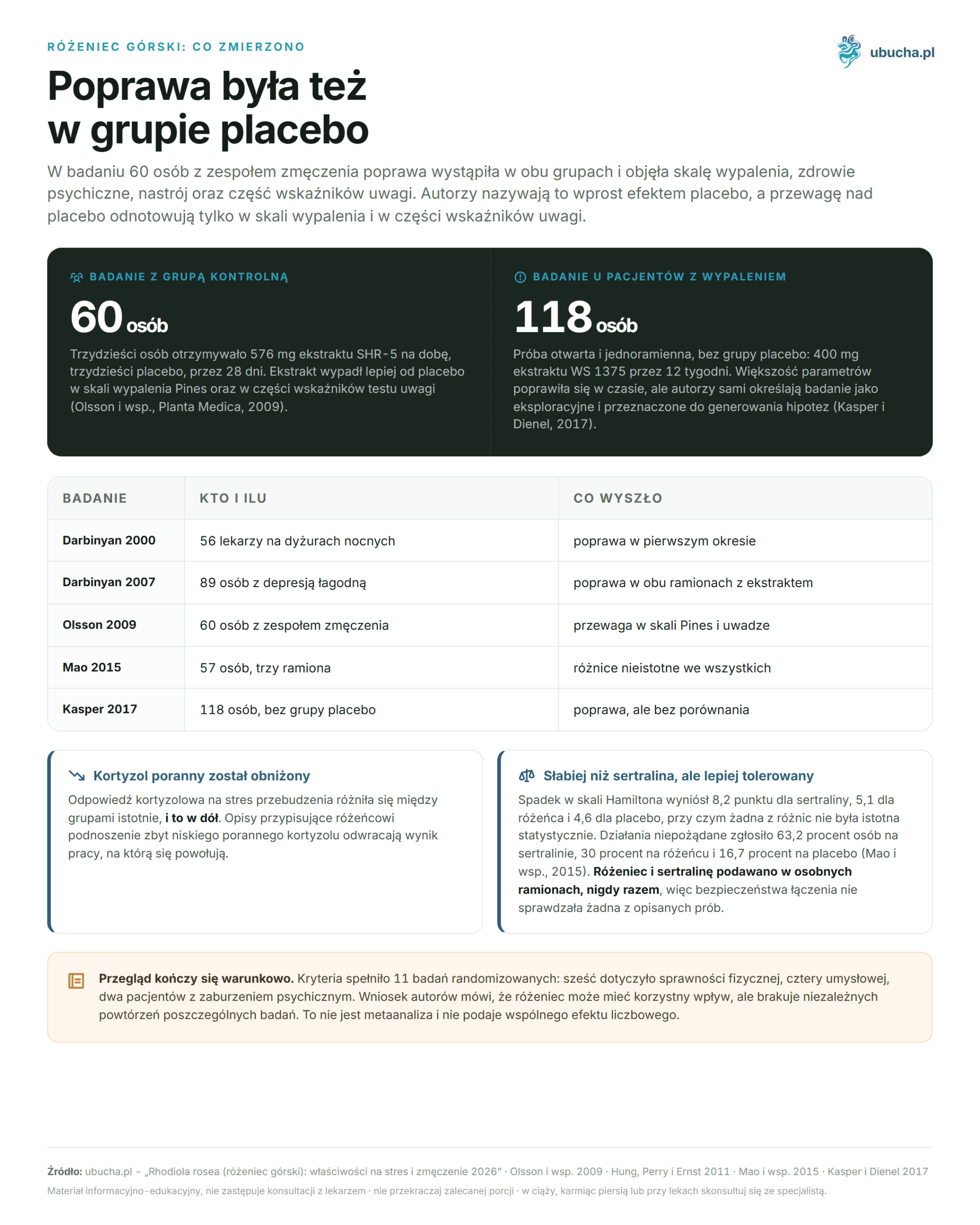
The most frequently cited trial is the phase three study published in Planta Medica. Olsson, von Schéele, and Panossian (2009) recruited 60 women and men aged 20 to 55, selected according to the criteria of the fatigue syndrome of the Swedish health authority. Thirty people received four tablets of the SHR-5 extract daily, which amounted to 576 mg of extract per day, and thirty received placebo; the observation lasted 28 days.
Quality of life was measured using the SF-36 questionnaire, fatigue symptoms using the Pines burnout scale, mood using the MADRS scale, attention using the CCPT II computer test, and the cortisol response in saliva to awakening. The result has two layers, and only the second is interesting.
Layer one: improvement occurred in both groups, including the placebo, and included the Pines scale, mental health in SF-36, the MADRS score, and several attention indicators. The authors call this a placebo effect. Layer two, which is the comparison of groups with each other: the extract performed better than placebo on the Pines burnout scale and in some indicators of the attention test. The cortisol response to awakening stress differed significantly between the groups.
The authors’ conclusion is: repeated administration of the SHR-5 extract provides an anti-fatigue effect, improves mental performance, especially concentration ability, and lowers the cortisol response to awakening stress in patients with burnout and fatigue syndrome. Note the direction of the last result: morning cortisol was lowered, not raised. Popular descriptions attributing to roseroot the “raising of too low morning cortisol” reverse the result of this very work.
What does the review of all clinical studies say?
More cautiously than the market suggests. Hung, Perry, and Ernst (Phytomedicine, 2011) searched six databases without language restrictions, also reaching out to authors and manufacturers for unpublished works. Eleven randomized studies met the criteria, all with a placebo group. Six concerned physical performance, four mental performance, and two patients with diagnosed mental disorders.
The methodological quality of most studies was rated as moderate or good, and reported side effects were few and mild. The authors’ conclusion is, however, clearly conditional: roseroot may have a beneficial effect on physical performance, mental performance, and some mental health conditions, but there is a lack of independent replications of individual studies, so further work is needed.
This is not a meta-analysis and does not provide a common numerical effect. If you encounter a statement that “all 11 studies showed a positive effect on fatigue and stress,” it is a summary narrowing three different areas into one and omitting the caveat that the authors placed in the conclusion.
This review also includes the first Western clinical trial. Darbinyan et al. (Phytomedicine, 2000) studied 56 young, healthy doctors on night shifts in an alternating schedule with a washout period. The endpoint was a fatigue index calculated from five tests of associative thinking, short-term memory, counting, and visual-auditory perception speed. A significant improvement was noted in the treated group during the first two-week period. The study measured mental performance, not physical endurance.
Does roseroot help with low mood?
Two trials give two different answers, and only together do they form a fair picture. Darbinyan et al. (Nordic Journal of Psychiatry, 2007) included 89 patients with mild to moderate depression episodes according to DSM-IV criteria, with a baseline Hamilton scale score of 21 to 31 points. Three groups received 340 mg of SHR-5 extract daily, 680 mg daily, or placebo, for six weeks.
In both groups receiving the extract, overall depression severity, insomnia, emotional instability, and somatization improved. Self-assessment did not improve in either group. The placebo group showed no improvement. No serious side effects were reported.
A newer and more cautious American trial. Mao et al. (Phytomedicine, 2015) randomly assigned 57 people with mild to moderate depression to three arms for 12 weeks: standardized roseroot extract, sertraline, or placebo. Decreases in Hamilton and Beck scales were moderate and statistically insignificant in all arms, with no significant difference between them. The decrease on the Hamilton scale was 8.2 points for sertraline, 5.1 for roseroot, and 4.6 for placebo.
However, the difference in tolerance was clear: side effects were reported by 63.2 percent of those on sertraline, 30 percent on roseroot, and 16.7 percent on placebo. The authors summarize that roseroot had a weaker antidepressant effect than sertraline, but with significantly fewer side effects, it may have a more favorable risk-benefit ratio in mild to moderate depression. This is a preliminary study, with a small group.
Does roseroot work for burnout?
The first and most frequently cited study in this group of patients must be read together with its limitations. Let’s start with the concept itself: WHO in the ICD-11 classification does not classify burnout as a disease. It places it among factors affecting health and describes it in three dimensions: a sense of energy depletion, increasing psychological distance from work with a negative or cynical attitude, and reduced professional efficacy.
Kasper and Dienel (Neuropsychiatric Disease and Treatment, 2017) conducted the first clinical study of roseroot in patients with burnout symptoms. The multicenter open trial included 118 outpatients who took 400 mg of WS 1375 extract daily for 12 weeks. Various parameters were assessed, including the German version of the Maslach burnout questionnaire, burnout screening scales, the Sheehan disability scale, and the perceived stress questionnaire.
Most measured parameters improved over time, some already after the first week, and the frequency of adverse events was low. However, the authors themselves describe the study as exploratory and intended to generate hypotheses for future randomized trials.
Why is this caveat so important: the study was single-arm and open, without a placebo group. In Olsson’s study, improvement in the placebo group included several different scales, so without a control arm, it is impossible to separate the effect of the preparation from the passage of time and the mere participation in the study. It is also worth noting that the second author is associated with the manufacturer of the tested extract, Dr Willmar Schwabe.
How does roseroot work at the biochemical level?
The best-documented mechanism is the inhibition of monoamine oxidases, enzymes that break down serotonin, dopamine, and norepinephrine. The data comes from laboratory studies, not from the human body, and this distinction is practically significant in terms of interactions.
Van Diermen et al. (Journal of Ethnopharmacology, 2009) examined three extracts from roseroot in a plate test against monoamine oxidase A and B. The strongest effects were shown by the methanol and water extracts: MAO A inhibition at 92.5 and 84.3 percent, and MAO B at 81.8 and 88.9 percent, at a concentration of 100 micrograms per milliliter.
The authors then isolated twelve compounds using bioassay-guided fractionation. The most active was rosiridin, inhibiting MAO B by over 80 percent. This is an important detail because popular texts attribute this action to salidroside, while in this work, the leading compound is another molecule.
The authors conclude that the roseroot has strong antidepressant effects by inhibiting MAO A. However, it is important to remember the distance between the petri dish and the human: the concentrations in the test are chosen by the researcher, while absorption and metabolism determine them in the body.
What should roseroot not be combined with?
Caution arises directly from the mechanism described above. Since extracts from the root inhibit monoamine oxidase in laboratory conditions, combining them with drugs acting on the same neurotransmitters requires a conversation with a doctor, not a self-decision.
This primarily concerns antidepressants from the SSRI and SNRI groups, as well as psychostimulant medications. Note that in Mao’s study, roseroot and sertraline were administered in separate arms, never together, so none of the described trials tested the safety of combining the two. The lack of reported events is not evidence of safety here, as such a combination simply has not been studied.
The second situation requiring caution is pregnancy and breastfeeding. None of the described studies were conducted in this population, so there is simply no safety data for it. The third is the treatment of hypertension; if you are taking blood pressure-lowering medications, inform your doctor about any herbal preparations you intend to use.
Adverse events in the studies were few and mild. In Hung et al., only a few events of mild severity were noted, in Darbinyan’s 2007 study no serious events were reported, and in Kasper’s study, the frequency was low. However, this concerns taking the preparation itself, at the doses and for the time described in these works.
How to read the label of a roseroot preparation?
The study result pertains to a specific extract, not the plant in general. This is the most practical takeaway from this literature: two trials that are usually cited together used preparations with different names and compositions, and the manufacturer of raw powder from the root has no basis to refer to either of them.
The table below summarizes what exactly was studied in the four works described above. Treat it as a description of the results, not as a recommendation for yourself; whether and how much to use is decided by a doctor or pharmacist who knows your medications.
| Study | Preparation and dose | Who and how many | Time | What came out |
|---|---|---|---|---|
| Darbinyan 2000, Phytomedicine | SHR-5, one tablet daily | 56 healthy doctors on night shifts | 3 periods of 2 weeks | significant improvement in mental fatigue index in the first period |
| Darbinyan 2007, Nord. J. Psychiatry | SHR-5, 340 or 680 mg daily | 89 patients with mild to moderate depression | 6 weeks | improvement in both arms with extract, no improvement on placebo; self-assessment unchanged |
| Olsson 2009, Planta Medica | SHR-5, 576 mg daily | 60 people with fatigue syndrome | 28 days | superiority over placebo on the Pines scale and some attention indicators; lower cortisol response to awakening |
| Kasper 2017, Neuropsychiatr. Dis. Treat. | WS 1375, 400 mg daily | 118 outpatients with burnout symptoms | 12 weeks | improvement in most parameters, but without a placebo group |
The practical conclusion from this table: look for the species name Rhodiola rosea and the designation of the standardized extract on the packaging. A product described only as “roseroot” or “Rhodiola sp.” does not allow relating to any of these trials. A comparison of roseroot with other plants has been gathered in our post about adaptogens for stress, and the context of exhaustion and stress axis in our post about so-called adrenal fatigue.
Frequently asked questions
Does roseroot really work for fatigue?
In Olsson’s 2009 study, the SHR-5 extract performed better than placebo on the Pines burnout scale and some attention indicators in 60 people with fatigue syndrome after 28 days. However, improvement also occurred in the placebo group, which the authors note directly.
How many clinical studies are there on roseroot?
A systematic review from 2011 qualified 11 randomized studies with a placebo group: six concerned physical performance, four mental performance, and two patients with mental disorders. The authors rated the quality of most studies as moderate or good, but noted a lack of independent replications.
Is roseroot as effective as antidepressants?
No. In Mao’s 2015 study, the decrease on the Hamilton scale was 8.2 points for sertraline compared to 5.1 for roseroot and 4.6 for placebo, with none of the differences being statistically significant. However, roseroot caused fewer side effects.
Can roseroot be combined with depression medications?
Not without consulting a doctor. Extracts from the root inhibit monoamine oxidase A and B in laboratory conditions, and none of the described studies tested the combination of roseroot with an antidepressant. In Mao’s study, the plant and sertraline were administered in separate arms.
Does roseroot raise morning cortisol?
No, the measured direction was the opposite. In Olsson’s 2009 study, the extract lowered the cortisol response to awakening stress compared to placebo. Descriptions attributing to roseroot the raising of too low morning cortisol reverse the result of the work they refer to.
What should be written on the packaging?
The species name Rhodiola rosea and the designation of the standardized extract, for example, the one used in the cited studies. A product described generally as roseroot or as Rhodiola sp. does not allow relating the results of these trials to the contents of the package.
Adaptogenic preparations in the store ubucha.pl are gathered in the category adaptogens.
This article is for informational and educational purposes and does not constitute medical advice. Before starting supplementation, consult your doctor, especially if you are taking medications regularly, are pregnant or breastfeeding, or have a chronic illness.
Author: Michał Waluk · Published: 2026-06-22 · Updated: 2026-08-16