
Cannabis Withdrawal: How Long It Lasts and Duration of Insomnia
Cannabis withdrawal symptoms start 24-48 hours after cessation. Learn how long insomnia lasts, the day-by-day course, and where to seek help.
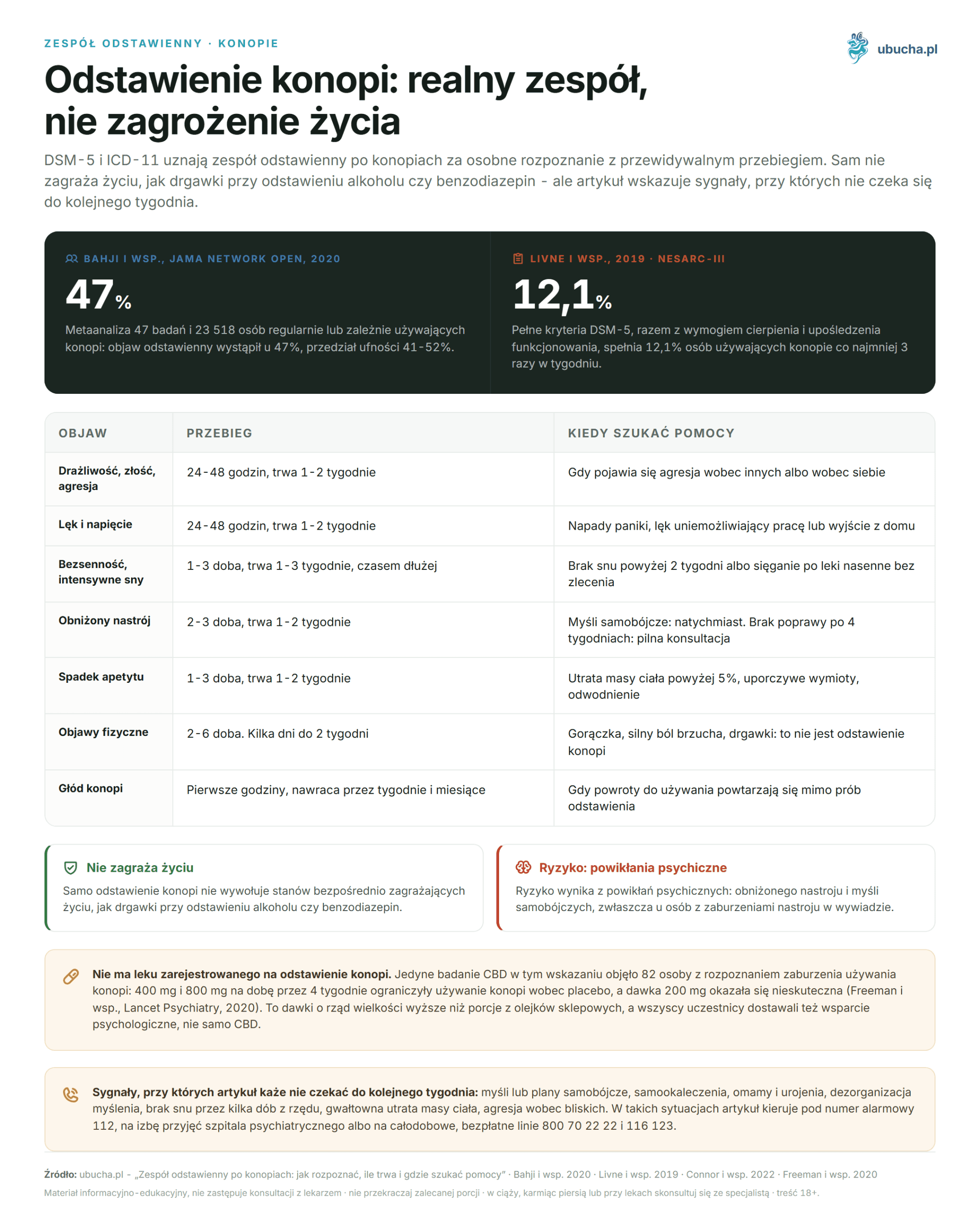
Withdrawal symptoms from cannabis begin 24 to 48 hours after cessation, peak between days two and six, and sleep disturbances can last up to three weeks. The brain does not rebalance overnight. A meta-analysis of 47 studies including 23,518 regular cannabis users found withdrawal symptoms in 47% (Bahji et al., JAMA Network Open, 2020). This is not a matter of character or willpower. DSM-5 and ICD-11 describe this as a distinct diagnosis with specific criteria and a predictable course. The problem is that anxiety, irritability, and insomnia look exactly like depression or anxiety disorders, so they are easily confused and often underestimated. This article explains which symptoms count formally, when they appear, how long they last, what has proven effectiveness, and which numbers to call in Poland when it becomes unsafe.
KEY INFORMATION
• Withdrawal symptoms occur in 47% of regular cannabis users (Bahji et al., JAMA Network Open, 2020).
• Full DSM-5 criteria are met by 12.1% of those using at least 3 times a week.
• Onset 24-48 hours after cessation, peak days 2-6, up to 3 weeks with heavy use.
• No registered medication for cannabis withdrawal.
• In crisis call: 800 70 22 22, 116 123, 112.
What is cannabis withdrawal syndrome in DSM-5 and ICD-11?
This is a formal diagnosis in both current classifications. DSM-5 requires at least three of seven symptoms appearing after stopping intensive, long-term use. ICD-11 lists it under code 6C41.4 for dependent or heavy long-term users.
Until 2013, psychiatry did not officially recognize this condition. DSM-IV lacked cannabis withdrawal diagnosis, considering the substance insufficient to cause clear somatic symptoms. However, lab studies showed a reproducible, predictable withdrawal pattern, so DSM-5 introduced a separate category, followed by ICD-11.
| DSM-5 Criterion Symptom | Practical Presentation |
|---|---|
| Irritability, anger, or aggression | Disproportionate reactions, conflicts at home and work |
| Nervousness or anxiety | Tension without clear cause, sometimes panic symptoms |
| Sleep disturbances | Difficulty falling asleep, awakenings, very vivid dreams |
| Decreased appetite or weight loss | Lack of hunger, skipping meals, weight loss |
| Psychomotor agitation | Feeling unable to sit still |
| Depressed mood | Sadness, loss of pleasure in usual activities |
| At least one physical symptom | Abdominal pain, tremors, sweating, chills, headache |
A side-by-side comparison of criteria from both classifications is provided by Connor et al. (Addiction, 2022), source of the above list. DSM-5 adds two conditions often overlooked: symptoms must cause real distress or functional impairment and cannot be explained by another mental disorder or medical condition. ICD-11 does not specify a symptom count but explicitly lists chills, sweating, headaches, abdominal cramps, and muscle pain alongside psychological symptoms. The practical conclusion is the same: diagnosis is made by a doctor, not an online test.
Also important is what the criteria mean by intensive and long-term use. DSM-5 means daily or almost daily use for at least several months. ICD-11 requires dependence or long-term or heavy use. For someone who smoked only on weekends, worse feelings after a break are possible but usually do not meet formal criteria. This does not invalidate the discomfort but changes what to look for and discuss in the clinic.
How many users experience withdrawal syndrome?
It depends on what exactly is counted. Withdrawal symptoms affect 47% of regular or dependent cannabis users, with a confidence interval of 41-52% (Bahji et al., JAMA Network Open, 2020). Full DSM-5 criteria are met by far fewer: 12.1% of those using cannabis at least 3 times weekly.
This discrepancy is easily explained and shows why online statistics vary widely. Bahji’s meta-analysis counted symptom occurrence, while the NESARC-III population study counted full syndrome meeting all DSM-5 criteria including distress and impairment (Livne et al., Drug and Alcohol Dependence, 2019). Who is studied also matters: population samples showed 17%, outpatient care 54%, hospitalized patients 87%.
In NESARC-III, the most common symptoms in full syndrome cases were nervousness and anxiety (76.3%), hostility (71.9%), sleep disturbances (68.2%), and depressed mood (58.9%). The picture is clearly mainly psychological, not somatic.
Broader context: cannabis use disorder develops in about 10% of the 193 million cannabis users worldwide (Connor et al., Nature Reviews Disease Primers, 2021). Risk increases with frequency and age of initiation. Among those who started in adolescence, about 17% develop dependence, and among daily users 25-50% (Volkow et al., New England Journal of Medicine, 2014).
Another less cited figure: NESARC-III found 2.5% annual and 6.3% lifetime prevalence of cannabis use disorder, but only 13.2% of those ever meeting criteria received any treatment or support (Hasin et al., American Journal of Psychiatry, 2016). The vast majority go through it alone. This gap is more practically important than the debate over 12% or 47%, as it shows how many people never reach help.
When do symptoms appear and how long do they last?
Symptoms typically start 24-48 hours after the last dose, most peak between days 2 and 6, and with heavy, long-term use some persist 3 weeks or longer (Connor et al., Addiction, 2022). Sleep disturbances and low mood last longest.
The table below compares typical course with signals when help should be sought immediately rather than waiting for the “wave” to end.
| Symptom | Onset | Duration | Typical Resolution Day | When to Seek Help |
|---|---|---|---|---|
| Irritability, anger, aggression | 24-48 hours | 1-2 weeks | Days 10-14 | If aggression toward others or self appears |
| Anxiety and tension | 24-48 hours | 1-2 weeks | Days 10-14 | Panic attacks, anxiety preventing work or leaving home |
| Insomnia, vivid dreams | Days 1-3 | 1-3 weeks, sometimes longer | Days 14-21, longer in some | No sleep over 2 weeks or unsupervised sleeping pill use |
| Low mood, anhedonia | Days 2-3 | 1-2 weeks | Days 10-14 | Suicidal thoughts: immediate. No improvement after 4 weeks: urgent consultation |
| Appetite loss, weight loss | Days 1-3 | 1-2 weeks | Days 10-14 | Weight loss over 5%, persistent vomiting, dehydration |
| Physical symptoms: chills, sweating, headaches, abdominal pain | Days 2-6 | Several days to 2 weeks | Days 8-14 | Fever, severe abdominal pain, seizures: not cannabis withdrawal |
| Cannabis craving | First hours | Recurring for weeks and months | No fixed end, recurs | Repeated relapses despite quitting attempts |
It is important to separate two often confused things. Duration of withdrawal symptoms is not the same as the presence of THC and its metabolites in the body, which can be detected long after well-being returns to normal. Pharmacokinetics and detection times are detailed separately in the post how long marijuana stays in the body, and the withdrawal timeline in marijuana withdrawal duration.
This distribution leads to a simple organizational tip. Since the hardest days are from the second to the sixth, set your quit date so this week does not coincide with peak work demands or exam sessions. Another tip concerns lapses: a single use during withdrawal resets the clock and the course starts over. If symptoms fall outside these time frames, e.g., appear only after two weeks of abstinence or worsen instead of improving, it signals something else is happening and medical evaluation is needed.
How long does insomnia last after quitting marijuana?
From one to three weeks, sometimes longer. Sleep difficulties usually start on day one or three, along with intense, vivid dreams, and are the longest-lasting symptom. This is why insomnia is the most common single reason for relapse in the first month.
Sleep returns gradually, not suddenly. The REM sleep phase suppressed by daily THC use rebounds after quitting, causing vivid dreams. If lack of sleep lasts over two weeks or prevents work, it is time to see a doctor, not just wait it out.
Why does the brain react so strongly to THC withdrawal?
Because months of regular THC exposure reduce availability of its own receptors. A positron emission tomography study showed reversible, selective reduction of cannabinoid CB1 receptor density in daily cannabis users (Hirvonen et al., Molecular Psychiatry, 2012). After about 4 weeks of monitored abstinence, receptor density returned to levels typical of non-users.
The scale of this decrease correlated with years of smoking, explaining differences between individuals. Someone who smoked for six months and someone who smoked for ten years start withdrawal from very different baselines.
Focus on the word reversible, the most important takeaway for those quitting. The receptor density change is not permanent brain damage. After a month of abstinence, brain scans no longer differed from non-users. Symptom timing matches this: the worst symptoms occur when receptors are still low and THC is gone, so the system receives no signal. As receptors recover, symptoms ease, explaining why weeks three and four are often easier than the first.
Later reviews confirm this mechanism. Reduced CB1 receptor density associates with stronger early withdrawal symptoms and reverses with longer abstinence (Schlienz et al., Current Addiction Reports, 2017). The same review notes women report some withdrawal symptoms more frequently and intensely than men.
The endocannabinoid system regulates sleep, appetite, mood, pain, and stress response, so its temporary reduced sensitivity causes exactly the symptom set described in diagnostic criteria. This is not a random symptom collection but a consequence of one regulatory disorder. How this system works daily is explained in our introduction to the endocannabinoid system.
Who is more at risk for severe withdrawal?
Primarily people with psychiatric disorders in history. NESARC-III found full withdrawal syndrome associated with mood disorders, anxiety disorders, personality disorders, and family depression, with odds ratios from 1.7 to 2.6 (Livne et al., 2019). It also linked to measurable functional impairment.
The second measurable factor is addiction severity before quitting. Participants with more severe addiction reported stronger disruption of daily activities during abstinence, and this predicted cannabis use one month later (Allsop et al., PLoS One, 2012).
Common risk factors in studies:
- daily or almost daily use for months
- initiation during adolescence
- treated or untreated mood and anxiety disorders
- concurrent use of alcohol, nicotine, or other substances
- previous failed quit attempts ending in relapse
- lack of social support and no plan for first two weeks
With psychiatric comorbidities and polysubstance use, hospital withdrawal is considered to avoid complications (Connor et al., 2022). This is not a decision to make alone at home based on an article. If you identify more than two points above, schedule a consultation before quitting.
Modern product potency is also noted. High-THC flower and concentrates deliver doses incomparable to those studied decades ago, and addiction risk rises with frequency and amount (Volkow et al., 2014). Gender differences exist: women report some withdrawal symptoms more often and intensely than men (Schlienz et al., 2017).
The risk factor list is not to scare but to tailor support level. Occasional users without psychiatric burdens usually manage with a home plan and close support. Daily alcohol drinkers and long-term cannabis smokers need someone to guide the process, preferably arranged before day one without cannabis, not on day five when symptoms peak.
How to distinguish withdrawal from depression and anxiety disorders?
You cannot do this alone, and that is the honest answer. Cannabis withdrawal symptoms overlap with depressive and anxiety disorder symptoms so much that NESARC-III authors conclude clinicians must be vigilant about this syndrome and its accompanying factors (Livne et al., 2019).
A clue is symptom course: withdrawal symptoms appear within days of stopping use and weaken with abstinence, while primary mood or anxiety disorders persist despite abstinence. This is a clue, not a diagnosis. Diagnosis is made by a doctor who sees the full history, psychiatric exam, and possible other medical causes.
Instead of self-testing online, prepare concrete data for your visit:
- date of last use and amount/frequency in recent months
- day each symptom appeared and whether it has lessened or worsened since
- whether similar symptoms occurred before starting use
- medications and supplements taken, including OTC
- episodes of depression or psychiatric treatment in family
From our reader conversations, the most often omitted info is point three. Cannabis is sometimes a coping method for pre-existing anxiety or low mood. After quitting, not only withdrawal but also the suppressed problem returns, requiring different treatment. More on this in the post about CBD and THC in anxiety states.
From the clinic side, psychiatrists assess symptom course over time, not a single moment, sometimes recommending observation over weeks of abstinence instead of immediate diagnosis. Starting antidepressants is not forbidden but decided individually, considering some symptoms resolve spontaneously. If you already take psychiatric meds, do not stop them on your own when quitting cannabis. Changing two things at once prevents knowing what affects your well-being, and stopping some meds carries health risks.
What really helps in the first weeks?
First choice is psychological support and psychoeducation, not pharmacotherapy. No drug is registered for cannabis withdrawal, though some are used off-label for anxiety, insomnia, or nausea, always prescribed by a doctor (Connor et al., Addiction, 2022).
Among non-pharmacological methods, exercise is best documented. A pilot study of 12 cannabis-dependent people underwent 10 supervised 30-minute treadmill sessions over 2 weeks at 60-70% heart rate reserve. Use dropped from 5.9 to 2.8 joints daily on average, and craving questionnaire scores decreased in all dimensions (Buchowski et al., PLoS One, 2011). The sample was small and needs confirmation, but the direction is consistent.
What you can do safely yourself:
- moderate aerobic exercise, e.g., brisk walking or running, 3-4 times weekly
- consistent sleep and wake times, including weekends
- limit caffeine after afternoon and alcohol during first weeks
- regular meals even with reduced appetite
- plan activities for times previously filled by use
- inform one close person that the next two weeks may be difficult
Gradual dose reduction instead of abrupt cessation is a popular advice. It sounds reasonable but lacks strong evidence for better outcomes with cannabis. Withdrawal symptoms also occur after significant use reduction, not only full cessation (Connor et al., 2022). Discuss pace with a doctor or addiction therapist rather than planning grams on paper.
Psychoeducation, simply knowledge of what is happening, deserves special mention. Awareness that low mood and broken nights have a predictable course and end reduces tendency to interpret them as permanent personal failure. Clinical reviews place it first alongside support, even if it sounds less impressive than a drug name. If symptoms prevent work, a doctor can issue sick leave for the hardest days, which is normal, not failure.
Does CBD help with THC withdrawal?
Evidence exists but concerns doses much higher than retail oil labels. In a phase 2a study, 82 people with cannabis use disorder took 200 mg, 400 mg, or 800 mg CBD daily for 4 weeks. The 200 mg dose was ineffective and dropped early; 400 mg and 800 mg reduced cannabis use versus placebo (Freeman et al., Lancet Psychiatry, 2020).
These doses are orders of magnitude higher than typical retail oil portions, so citing Freeman’s results for such doses is an overstatement. Safety is another limit: EFSA panel in 2026 set a temporary safe dose at 0.0275 mg/kg body weight daily, about 2 mg/day for a 70 kg person, and stated CBD safety cannot be established for under 25s, pregnant or breastfeeding women, or those on medications (EFSA NDA Panel, EFSA Journal, 2026).
Context matters: all participants, including placebo, received brief motivational intervention, so CBD was an add-on, not a substitute for psychological support. Anandamide levels were also measured: after 28 days they decreased in placebo, remained unchanged at 800 mg, no difference at 400 mg, and none of these changes correlated with clinical outcome (Hua et al., Translational Psychiatry, 2023).
The pure CBD profile is described: the WHO Expert Committee on Drug Dependence 2018 report states it does not cause effects indicating abuse or dependence potential. Safe does not mean effective for this indication, and prescription drugs may have interactions to discuss with a pharmacist.
Research is ongoing. Freeman’s work is phase 2a, dose-finding, not registration. Phase 3 trial planned in Australia with 250 moderate to severe cannabis use disorder patients, all receiving four cognitive-behavioral therapy sessions, will test longer-term efficacy (Bhardwaj et al., BMC Psychiatry, 2024). Until then, describing CBD as addiction treatment is premature.
The raw material at the start of this story is collected in the flower category; legal hemp flower contains THC below threshold and does not cause the described syndrome.
When to seek help and where to find it in Poland?
Immediately if suicidal thoughts or psychotic symptoms appear. Urgently if after 2 weeks of abstinence you cannot eat, sleep, or work normally; mood does not improve after a month; or if there is concurrent addiction to alcohol, sedatives, or other substances.
Signals not to wait for another week: suicidal thoughts or plans, self-harm, hallucinations and delusions, disorganized thinking, several days without sleep, rapid weight loss, aggression toward loved ones. In any of these, call emergency number 112 or go to a psychiatric hospital emergency room.
| Where | Contact | Hours | For Whom |
|---|---|---|---|
| Emergency Number | 112 | 24/7 | Immediate life or health threat |
| Support Center for People in Mental Crisis | 800 70 22 22 | 24/7, free | Mental crisis, suicidal thoughts, relatives of people in crisis |
| Adult Helpline | 116 123 | 24/7, free | Emotional crisis, psychological support |
| National Addiction Helpline (KCPU) | 800 199 990 | Daily 16:00-21:00, free | Substance users and families |
| Children and Youth Helpline | 116 111 | 24/7, free | Under 18 years old |
| NFZ Addiction Treatment Clinics | NFZ Search Engine | No referral, free | Outpatient and inpatient therapy |
| MONAR Association | monar.org | Depends on facility | Inpatient centers and clinics nationwide |
You can find NFZ addiction treatment facilities in the NFZ treatment appointment search, and the database of programs and institutions is maintained by the National Center for Addiction Prevention, which since 2022 has taken over tasks from the former National Bureau for Drug Prevention. Addiction treatment under NFZ is free and requires no referral.
What is the first visit like at an addiction treatment clinic? Usually a diagnostic interview with a therapist lasting about an hour, after which a plan is made: individual therapy, group therapy, or referral to an inpatient center. You do not need to come with a ready decision to abstain or any certificates. Relatives of users can also access help, as some clinics run separate family groups. Documentation is confidential under the same rules as any medical records.
Which therapies have documented effectiveness?
Three psychological interventions have the strongest evidence: cognitive-behavioral therapy, motivational enhancement therapy, and contingency management (reward system for confirmed abstinence). All three significantly reduce cannabis use and problem severity, though sustained abstinence is not typical (Connor et al., Nature Reviews Disease Primers, 2021).
A recent synthesis of European and international data clarifies conditions. Cognitive-behavioral and motivational therapies improve short-term outcomes, but effects usually do not last 9 months post-treatment. Programs longer than four sessions outperform shorter ones, and adding contingency management further improves results (Connor et al., European Archives of Psychiatry and Clinical Neuroscience, 2025).
Two practical consequences follow. First, no drug will solve the problem alone, as none is registered for this indication, and off-label substances show inconsistent results. Second, plans must span months, not just a difficult week, and include ongoing contact after the main cycle.
Group support can complement individual therapy. Twelve-step groups and those run by addiction clinics do not replace treatment but provide regular contact points that maintain motivation when initial determination fades.
What do these names mean? Cognitive-behavioral therapy identifies triggers and develops alternative responses, usually over a dozen sessions. Motivational enhancement therapy is shorter, focusing on resolving internal ambivalence about change rather than external persuasion. Contingency management is a system of measurable rewards for verified abstinence, often added to one of the first two methods.
How to reduce relapse risk?
Start with withdrawal symptoms, as they drive relapse. The more withdrawal disrupted daily functioning during abstinence attempts, the more cannabis was used a month later (Allsop et al., PLoS One, 2012). Reporting severe symptoms to a specialist is relapse prevention, not weakness.
The second layer is triggers. Four most common: same place and time of day, contact with people used with, strong stress, and states like boredom, loneliness, and fatigue.
Boredom is left for last intentionally, as it is the most frequent in reader conversations but least mentioned in guides. Daily use occupies a real time block every evening. After quitting, this block does not disappear but becomes an empty space to fill in advance. Planning specific activities for these hours works better than just resolving to “somehow endure.”
What helps maintain effect in the first six months:
- changing evening routine to engaging activities, not just watching
- a pre-prepared plan for strong craving moments, with one person to call
- limiting contact with obvious use situations for the first months
- regular contact with a therapist or group, even if it seems unnecessary
- talking with close ones about needed support instead of expecting them to guess
Relapses are not exceptions but common process elements, treated as such in addiction therapy. The difference is what you do with them. Viewing relapse as data - information about which trigger worked and in what circumstances - changes the next month’s plan. Viewing it as failure usually ends the process.
Another point is time horizon. The first two weeks are hardest physically, but change durability depends on months three to six, when initial motivation wanes and environment stops asking how it’s going. Planning regular contact with a specialist or support group for this period costs less effort than restarting the whole process.
Frequently Asked Questions
Is cannabis withdrawal syndrome life-threatening?
Cannabis withdrawal itself does not cause life-threatening states like seizures during alcohol or benzodiazepine withdrawal. Risk comes from psychological complications: low mood and suicidal thoughts, especially in people with mood disorder history. In such cases, call 800 70 22 22, 116 123, or 112.
How long does the hardest phase of cannabis withdrawal last?
Symptoms usually start 24-48 hours after the last dose, with most peaking between days 2 and 6 (Connor et al., Addiction, 2022). Then they gradually weaken. In heavy, long-term users, some symptoms, mainly sleep and mood disturbances, persist for 3 weeks or longer.
Does CBD ease THC withdrawal symptoms?
In a phase 2a study, doses of 400 mg and 800 mg CBD daily for 4 weeks reduced cannabis use, while 200 mg was ineffective (Freeman et al., Lancet Psychiatry, 2020). All participants also received psychological support. CBD is not a registered medication for cannabis addiction.
Can I quit cannabis without a doctor?
Usually yes, with occasional use and mild symptoms. Consultations are needed for daily use over a year, psychiatric treatment history, concurrent use of alcohol or other substances, and symptoms not easing after 2 weeks. Withdrawal in psychiatric comorbidities may require hospital settings.
Will insomnia after quitting cannabis go away?
For most, sleep normalizes within weeks, but sleep disturbances and vivid dreams are among the longest-lasting symptoms, especially in heavy users beyond 3 weeks (Connor et al., 2022). Do not self-prescribe sleeping pills; this is a doctor’s decision, usually for a few days.
Will a doctor report me to the police if I disclose cannabis use?
No. Doctors, psychiatrists, and therapists are bound by professional confidentiality, and substance use information is not grounds for reporting to law enforcement. Exceptions apply only in direct life or health threat situations. Addiction treatment under NFZ is free and requires no referral.
What to do after a one-time relapse?
Treat it as a trigger signal, not the end of the process. Note what preceded it: place, people, emotional state, time of day. Return to your previous plan and consider increasing support. Intensified withdrawal symptoms increase relapse risk, so report them to a specialist (Allsop et al., PLoS One, 2012).
Finally, a note on the legal status in Poland, as it affects available options. Possession of non-fiber cannabis remains prohibited under Article 62 of the Act of July 29, 2005 on Counteracting Drug Addiction (consolidated text Dz.U. 2023 item 1939), and pharmacy cannabis flower appears available only by prescription. Before issuing, regulations require personal patient examination, as non-fiber cannabis herb is listed among group I-N narcotics (§ 7 section 2a of the Minister of Health regulation, consolidated text Dz.U. 2025 item 1678). If you are quitting a doctor-prescribed preparation, the pace is decided by the treating physician, not an internet plan.
This article is for informational and educational purposes and does not constitute medical advice. Before starting cannabis or CBD for therapeutic purposes, consult a doctor, especially if you take other medications, are pregnant, or breastfeeding.
Author: Michał Waluk · Published: 2026-05-11 · Updated: 2026-08-24