
CBD and Stomach Ulcers and Hyperacidity: What You Should Know (FAQ)
Does CBD help with stomach ulcers and hyperacidity? We checked the research registry and the interaction with omeprazole. The drug-related aspect is more important here than efficacy.
Ulcers and hyperacidity are troublesome and recurrent ailments, where it is easy to reach for something natural in hopes of relief. Cannabidiol appears in this context regularly, usually referring to cannabinoid receptors present in the gastric mucosa. We checked these references at the sources, along with the public register of clinical studies. However, the most important finding does not concern efficacy, as no one has studied it, but safety: cannabidiol inhibits the liver enzyme that breaks down the medications most commonly taken for ulcers and hyperacidity. This is a thread that usually disappears without a trace in guides, and it concerns exactly the person reading such an article, namely someone already treated for the stomach.
KEY INFORMATION
• There are no registered clinical studies on cannabidiol in peptic ulcer disease, gastritis, or reflux (clinicaltrials.gov registry, as of August 16, 2026).
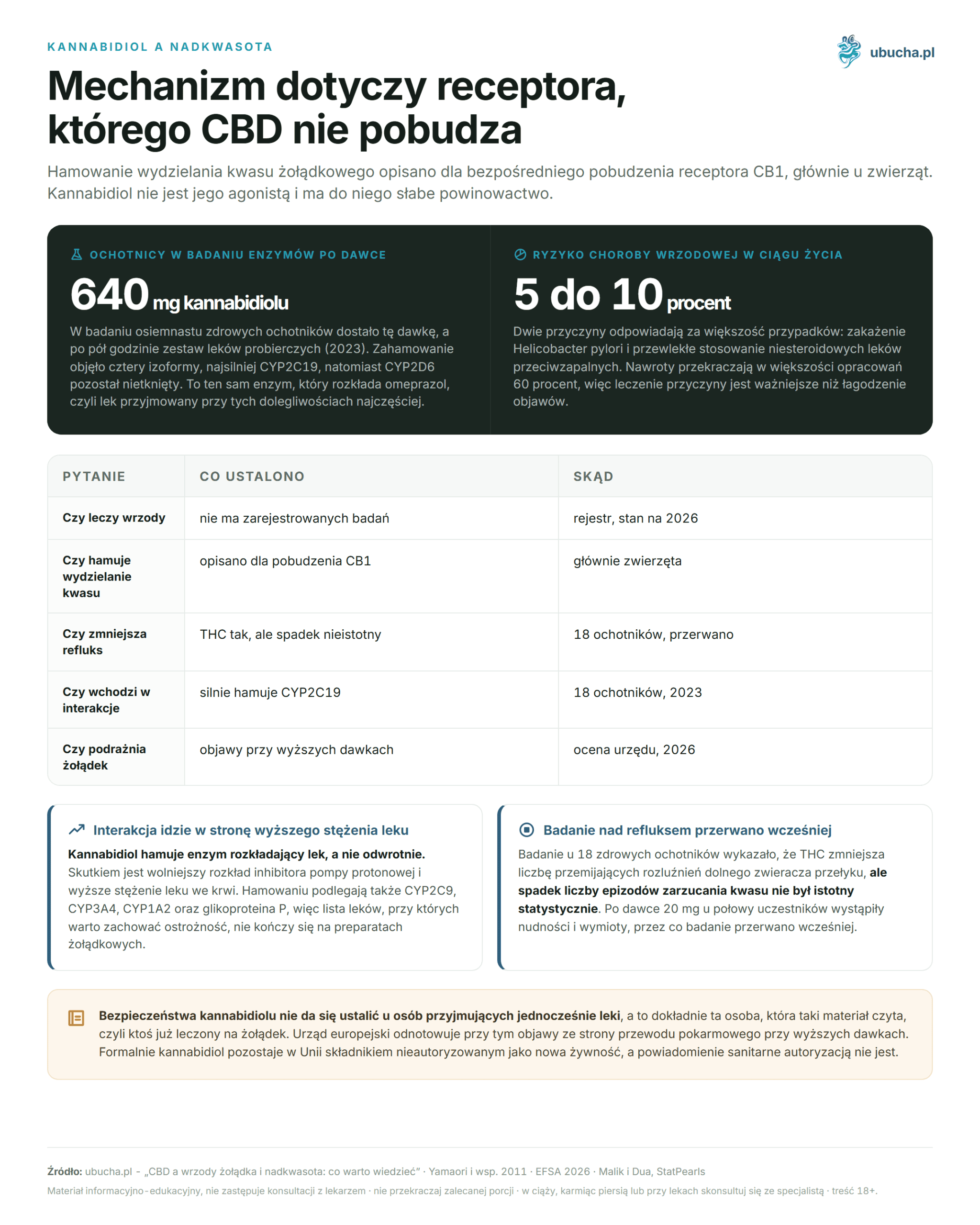
• Cannabidiol strongly inhibits the CYP2C19 enzyme that breaks down omeprazole, so it may raise the concentration of proton pump inhibitors in the blood.
• The European Food Safety Authority states that the safety of cannabidiol cannot be established in people taking medications and notes gastrointestinal symptoms at higher doses.
• Inhibition of acid secretion has been described for stimulation of the CB1 receptor, and cannabidiol is not its agonist, so the mechanism does not transfer directly.
• Helicobacter pylori infection requires antibiotic eradication, and no supplement can replace it.
What Really Causes Stomach Ulcers?
Two causes account for most cases: infection with the Helicobacter pylori bacterium and chronic use of non-steroidal anti-inflammatory drugs. The lifetime risk of developing ulcers ranges from 5 to 10 percent (Malik and Dua, StatPearls, review of ulcer disease).
It is worth organizing the numbers, as they are sometimes misrepresented in popular texts. Helicobacter pylori is responsible for about 90 percent of duodenal ulcers and 70 to 90 percent of stomach ulcers. Duodenal ulcers are four times more common than stomach ulcers. Anti-inflammatory drugs are the second most common cause: they block the synthesis of prostaglandins, thereby reducing mucus and bicarbonate secretion and impairing blood flow in the mucosa.
This arithmetic has a direct impact on what can be expected from a supplement. If the cause is a bacterium, the treatment is its eradication, typically with a three-drug regimen consisting of two antibiotics and a proton pump inhibitor. Without this, the ulcer recurs regardless of what else the patient takes. If the cause is anti-inflammatory drugs, the solution is to discontinue or change them under medical supervision. In both situations, cannabidiol does not address the cause.
Recurrences are common, exceeding 60 percent in most studies, which further supports the importance of causal treatment rather than symptomatic relief.
Does CBD Treat Ulcers or Hyperacidity?
There is no data to support this. Queries to the public register of clinical studies regarding cannabidiol in connection with ulcer disease, gastritis, and gastroesophageal reflux return zero results (as of August 16, 2026).
The theoretical background exists and is solid, but it pertains to something else. A review by Gyires and Zádori published in Current Neuropharmacology in 2016 describes that direct stimulation of CB1 receptors reduces gastric acid secretion and gastric motility and limits the formation of mucosal damage caused by stress, pyloric ligation, anti-inflammatory drugs, or alcohol (Gyires and Zádori, Current Neuropharmacology, 2016). The paper summarizes experimental data, mostly from animals.
Here lies the caveat that determines the whole matter. The described effect requires stimulation of the CB1 receptor, and cannabidiol is not its agonist and has a weak affinity for it. It acts indirectly, among other things, by raising the levels of endocannabinoids, as well as through other pathways. Therefore, the conclusion from studies on CB1 agonists does not automatically transfer to cannabidiol, although it is often presented that way in guides. The review does note that indirectly increasing endocannabinoid levels also protects the mucosa, but this occurs in a CB1 receptor-dependent manner and also in animal models.
Do Cannabis Help with Reflux?
There is a human study worth knowing in full, as it is usually only half of it that is cited. Beaumont and colleagues examined in British Journal of Pharmacology in 2009 the effect of THC, an agonist of CB1 and CB2 receptors, on transient relaxations of the lower esophageal sphincter, which is the main mechanism of reflux. The study involved dogs and then 18 healthy volunteers in a placebo-controlled setup, with doses of 10 and 20 mg (Beaumont et al., Br J Pharmacol, 2009).
The results are mixed. THC significantly reduced the number of transient relaxations of the sphincter, but the decrease in the number of acid reflux episodes in humans did not reach statistical significance. The resting pressure of the lower esophageal sphincter and the frequency of swallowing also decreased, which is not a desirable change in reflux.
However, the most important part is the one that most discussions omit. After taking 20 mg, half of the participants experienced nausea and vomiting, which led to the premature termination of the study. Drops in blood pressure, increased heart rate, and central symptoms were also noted. Omitting this in a text about stomach ailments is a misrepresentation of the result.
Two things need to be repeated here. The study concerned THC, not cannabidiol, and the participants were healthy volunteers, not patients with reflux. Therefore, this is not evidence of efficacy in sick individuals. If you are looking for a discussion of home remedies for heartburn, we have gathered them in a text about apple cider vinegar for reflux.
How Does CBD Interact with Stomach Medications?
This is the most practically significant finding in this topic. Proton pump inhibitors, such as omeprazole, pantoprazole, esomeprazole, and lansoprazole, are broken down by the liver enzyme CYP2C19. Cannabidiol strongly inhibits this enzyme.
Jiang and colleagues demonstrated in Drug Metabolism and Pharmacokinetics in 2013 that cannabidiol inhibits CYP2C19 activity in human liver microsomes and in the enzyme obtained by recombinant methods. The researchers tested this on the hydroxylation reaction of omeprazole, that is, directly on the drug in question, achieving inhibition in the micromolar concentration range (Jiang et al., Drug Metab Pharmacokinet, 2013).
The direction of this relationship can be confusing, so it is worth stating it directly. It is cannabidiol that inhibits the enzyme that breaks down the drug, not the other way around. The result is a slower breakdown of the proton pump inhibitor and a higher concentration of the drug in the blood, meaning an intensification of the drug’s action and its side effects. Cannabidiol also inhibits CYP3A4 and P-glycoprotein, and in studies on human liver microsomes, it turned out to be a strong inhibitor of CYP2D6, more effective in this regard than other main cannabinoids (Yamaori et al., Drug Metab Dispos, 2011). This particular signal was not confirmed in the body: eighteen healthy volunteers received 640 mg of cannabidiol, and after half an hour a set of test drugs, and the inhibition covered four other isoforms, most strongly CYP2C19, while CYP2D6 remained untouched (Clinical Pharmacology and Therapeutics, 2023). The difference between in vitro and in vivo is significant here, so in the case of ongoing treatment, the medical history is decisive, not self-assessment.
Jiang’s study was conducted outside the body, on enzymatic preparations, so it does not answer the question of the strength of this phenomenon in a specific patient. However, this is not a reason to ignore it, as the European Food Safety Authority notes the potential for liver damage in humans, especially when cannabidiol is combined with medications. Consulting a doctor or pharmacist before combining both substances is a reasonable course of action.
What Are the Safety Limits and Legal Status of CBD?
The European Food Safety Authority updated its safety assessment of cannabidiol in 2026. It established a temporary safe dose of 0.0275 mg per kilogram of body weight per day, which is about 2 mg daily for a person weighing 70 kilograms, with an uncertainty factor of 400. This is a ceiling that should not be exceeded, not a guideline on how much to take. It applies only to supplements with a purity of cannabidiol of at least 98 percent, without nanoparticles.
For the reader of this article, three further findings are significant. The authority states that the safety of cannabidiol cannot be established in people taking medications simultaneously, in pregnant and breastfeeding women, and in individuals under 25 years of age. It notes gastrointestinal symptoms at higher doses. It also indicates consistent liver toxicity in animal studies.
Formally, cannabidiol remains an unauthorized ingredient as a novel food in the European Union, and a sanitary notification of a product’s introduction to the market is not an authorization and does not change the status of the ingredient. A product with cannabidiol is not a medicinal product, so it cannot be attributed to treating ulcer disease or presented as a substitute for medications. Among herbal methods for alleviating stomach ailments, marshmallow, which acts mechanically through a layer of mucus, is better described.
Frequently Asked Questions
Does CBD treat stomach ulcers?
No. There are no registered clinical studies on cannabidiol in ulcer disease, and cannabidiol products are not medicinal products. Ulcers related to Helicobacter pylori infection require antibiotic eradication, and those caused by anti-inflammatory drugs resolve after discontinuation or change.
Can CBD be combined with omeprazole?
Without consulting a doctor or pharmacist, it is not advisable. Cannabidiol strongly inhibits the CYP2C19 enzyme that breaks down omeprazole, so it may raise the concentration of the drug in the blood and enhance its side effects. The European authority also states that the safety of cannabidiol in people taking medications cannot be established.
Which way does this interaction work?
Cannabidiol inhibits the enzyme that breaks down the drug, not the other way around. The result is a slower breakdown of the proton pump inhibitor and a higher concentration of the drug in the blood. Cannabidiol also inhibits CYP2C9, CYP3A4, CYP1A2, and P-glycoprotein, so the list of drugs for which caution is warranted does not end with stomach preparations.
Do cannabis reduce reflux?
A study in 18 healthy volunteers showed that THC reduces the number of transient relaxations of the lower esophageal sphincter, but the decrease in the number of acid reflux episodes was not statistically significant. After a dose of 20 mg, half of the participants experienced nausea and vomiting, leading to the premature termination of the study.
Does CBD inhibit gastric acid secretion?
This has been shown for direct stimulation of the CB1 receptor, mainly in animal studies. Cannabidiol is not an agonist of this receptor and has a weak affinity for it, so the conclusion does not directly transfer to it. No clinical study has tested this in patients with hyperacidity.
Can CBD oil irritate the stomach?
The European authority notes gastrointestinal symptoms at higher doses of cannabidiol. It also emphasizes that the absorption of cannabidiol is variable and depends on the form of the preparation and food intake. If stomach complaints worsen, it is advisable to discuss the matter with a doctor rather than increase the dose.
What helps with ulcers besides treatment?
The most important factor is the removal of irritants: alcohol, smoking, and unnecessary anti-inflammatory drugs. In the case of Helicobacter pylori infection, eradication remains the basis, typically with two antibiotics and a proton pump inhibitor. Recurrences exceed 60 percent in most studies, so treating the cause is more important than alleviating symptoms.
This article is for informational and educational purposes and does not constitute medical advice. Before starting to use cannabis or CBD for therapeutic purposes, consult a doctor, especially if you are taking other medications, are pregnant, or breastfeeding.
Author: Michał Waluk · Published: 2026-08-09 · Updated: 2026-08-16