
CLA for Fat Tissue Reduction: An Honest Look at the Scale of Effect
A meta-analysis of 18 randomized studies reports 0.09 kg of fat tissue per week over placebo. We examine the scale of this effect and safety signals.
Conjugated linoleic acid has been returning to the rankings of weight loss supplements for two decades, usually based on one study: a meta-analysis of eighteen randomized studies published in 2007 in the American Journal of Clinical Nutrition. It reports a number significantly more modest than advertisements suggest. After standardizing to a median dose of 3.2 g per day, the fat tissue loss was 0.09 kg per week over placebo (Whigham et al., AJCN, 2007). Below, we show exactly what was measured and with what uncertainty, why a simple extrapolation of this number over a year diverges from the authors’ own conclusion, how the two best-studied isomers differ, and what adverse metabolic changes researchers reported when administering the t10,c12 isomer alone. We also check what the EU health claims register says about this substance.
KEY INFORMATION
• A meta-analysis of eighteen randomized studies: 0.09 kg of fat tissue per week over placebo at a median dose of 3.2 g per day (Whigham et al., AJCN, 2007).
• The study reports this value with a variability of 0.09 +/- 0.08 kg per week, rather than a confidence interval, so the measurement uncertainty is nearly equal to the effect itself.
• The effect increased linearly with the dose and persisted for up to six months, after which it approached an asymptote; calculating annual loss from it contradicts what the authors wrote.
• The purified t10,c12 isomer increased insulin resistance by 19 percent and C-reactive protein by 110 percent compared to placebo (Risérus et al., 2002).
• The EU register of approved health claims does not contain any claim regarding conjugated linoleic acid.
What is CLA and what exactly was measured in the studies?
Conjugated linoleic acid is not a single substance but a group of isomers of linoleic acid differing in the position and geometry of double bonds. The two most commonly studied are c9,t11 and t10,c12. This distinction is not a chemical detail, as in clinical trials these two compounds behaved differently, and the results of one cannot be transferred to the other.
The supplements administered in the studies had two forms. Some trials used a mixture of purified isomers, while others used only the purified t10,c12. Whigham and colleagues collected eighteen studies with randomization, double-blinding, and a placebo group, in which body composition was measured using a method considered reliable. Three of them administered a single isomer, and the comparison between isomers was deemed inconclusive by the authors.
The endpoint was fat tissue mass, not body mass. This is an important difference, as bathroom scales cannot measure this, and a validated method for assessing body composition was a condition for including the study in the review. Therefore, the statement “the supplement changes body composition” only makes sense when it is known how this composition was measured. Weight fluctuations alone do not resolve anything.
How much fat tissue is lost according to the meta-analysis of 18 studies?
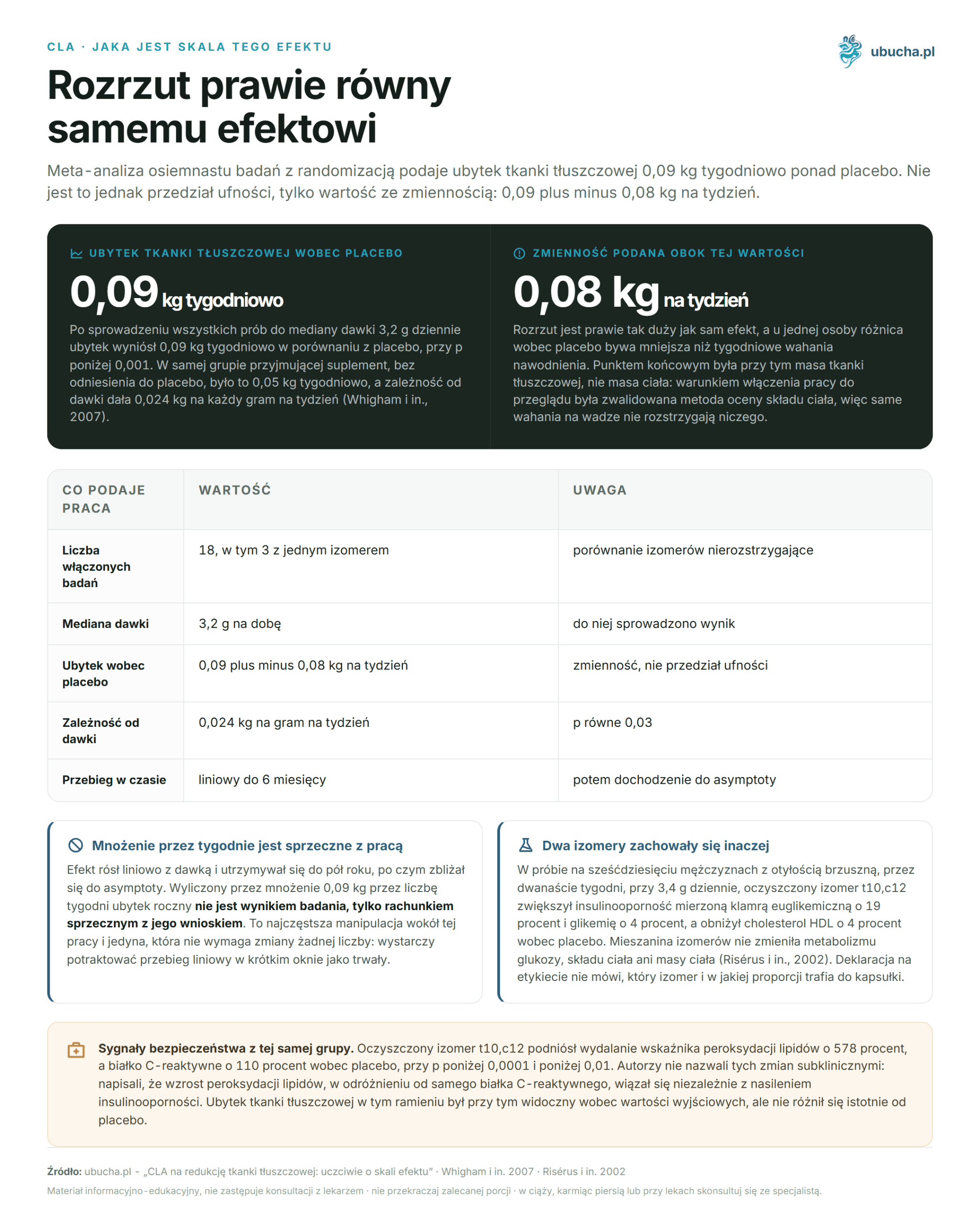
After standardizing all trials to a median dose of 3.2 g per day, the fat tissue loss was 0.09 kg per week compared to placebo, with p below 0.001. In the supplement group alone, without reference to placebo, it was 0.05 kg per week. The analysis of the dose-response relationship yielded 0.024 kg for each gram of conjugated linoleic acid per week, with p equal to 0.03.
It is also important how uncertainty was reported. It is not a confidence interval but a value with variability: 0.09 +/- 0.08 kg per week. The spread is almost as large as the effect itself, and for one person, the difference compared to placebo can be smaller than weekly fluctuations in hydration.
| What the study reports | Value |
|---|---|
| Number of included studies | 18, including 3 with a single isomer |
| Median dose to which the result was standardized | 3.2 g per day |
| Fat tissue loss compared to placebo | 0.09 +/- 0.08 kg per week (p below 0.001) |
| Dose-response relationship | 0.024 kg per 1 g per week (p = 0.03) |
| Time course | linear to 6 months, then slowly approaching an asymptote around 2 years |
The last line negates the most common manipulation surrounding this study: multiplying 0.09 kg by the number of weeks. The annual loss calculated this way is not a result of the study but a calculation that contradicts its conclusion. The same caution is maintained in our ranking of supplements by strength of evidence.
Do both CLA isomers work the same?
No. The best-described trial in this regard is that of Risérus and colleagues: sixty men with abdominal obesity and features of metabolic syndrome, randomization, double-blinding, twelve weeks, 3.4 g per day. Participants received purified t10,c12, a mixture of isomers, or placebo (Risérus et al., Diabetes Care, 2002).
The divergence of results was clear. Purified t10,c12 increased insulin resistance measured by the euglycemic clamp by 19 percent and glycemia by 4 percent, while lowering HDL cholesterol by 4 percent compared to placebo. The mixture of isomers did not change glucose metabolism, body composition, or body mass, but lowered HDL by 2 percent. Fat tissue loss in the t10,c12 arm was visible compared to baseline but did not differ significantly from placebo.
This is a practical conclusion for the label reader. The declaration “CLA” does not specify which isomer and in what proportion is in the capsule, and this determines both the expected benefit and the risk profile. Whigham and colleagues had too few trials with a single isomer to resolve this, and they themselves stated that the comparison of isomers was inconclusive.
What safety signals did researchers report?
The same group of men was described in a second study focused on oxidative stress and inflammatory markers. The results are stronger than the increase in insulin resistance alone. Purified t10,c12 raised the excretion of 8-iso-PGF2alpha, a lipid peroxidation index, by 578 percent and C-reactive protein by 110 percent compared to placebo, with p below 0.0001 and below 0.01 (Risérus et al., Circulation, 2002).
The authors did not label these changes as subclinical. They wrote that the increase in lipid peroxidation, unlike C-reactive protein itself, was independently associated with the severity of insulin resistance, and that the adverse effect of the t10,c12 isomer may have clinical significance in the context of cardiovascular diseases, considering the prevalence of supplements containing this fatty acid. This is a statement from the summary of a study published in a cardiology journal, not a precautionary note.
Therefore, the balance of benefits and risks is different here than with most supplements. On one side, we have fat tissue loss of tenths of a kilogram per week, burdened with variability almost equal to itself. On the other, documented deterioration in insulin sensitivity and an increase in two markers that are treated as warning signals in cardiology. A similar accounting is done in the text about fat burners under the microscope of research.
Is it allowed to advertise CLA as a weight loss agent in the EU?
No. The list of approved health claims other than those concerning disease risk reduction is a closed list and is governed by Commission Regulation (EU) No 432/2012. A claim not on this list cannot be used in commercial information. In the consolidated text of the regulation (PL version of May 17, 2021, read at EUR-Lex), there is not a single entry for conjugated linoleic acid.
It is worth comparing this with a substance from the same category. Glucomannan has two claims in the same annex with precisely described conditions of use. Conjugated linoleic acid has none, and the only claim regarding linoleic acid concerns regular LA and cholesterol, which is a different molecule. The names are misleading, but the regulation is not.
The absence of an entry in the register does not mean that the substance cannot be sold. It means that it cannot be attributed with effects on body mass on the packaging or in advertising. It is also important to separate two issues that marketing likes to mix: the approval of a claim is an administrative decision about the allowed wording of the label, not a judgment about the strength of effect in grams.
For whom does this supplement make sense, and who should be cautious?
The profile of a person for whom consideration makes any sense is narrow: physical activity and controlled caloric balance are already in place, and expectations concern marginal changes in body composition. Even then, it is worth remembering that at 3.2 g per day, we are talking about tenths of a kilogram per week, with variability comparable to the effect itself. The meta-analysis does not answer the question of whether the loss will be maintained after discontinuation, as the studies ended with the intervention.
Caution is particularly indicated for individuals with prediabetes, type 2 diabetes, or insulin resistance, as these parameters worsened in the cited trials. This also applies to individuals with cardiovascular diseases, for whom the increase in C-reactive protein is not negligible. For pregnant and breastfeeding women, data is lacking, and a lack of data is not evidence of safety. It is also worth checking the label for which isomer and in what proportion a given preparation contains. If you are looking for background for a decision about weight loss supported by a supplement, also check the text about CBD and weight loss.
Frequently Asked Questions
How much does CLA reduce fat tissue according to meta-analysis?
A meta-analysis of eighteen randomized studies reports 0.09 kg per week over placebo after standardizing to a median dose of 3.2 g per day, with p below 0.001 (Whigham et al., AJCN, 2007). The authors provided this value with a variability of 0.09 +/- 0.08 kg, rather than a confidence interval, so the uncertainty is nearly equal to the effect.
Can this number be used to calculate loss over a year?
No. The authors state that the effect increased linearly only for about six months, and then slowly approached an asymptote around two years. Multiplying 0.09 kg by fifty-two weeks gives a number that is not present in the study and contradicts its conclusion about the time course.
Which isomer is responsible for adverse effects?
The purified t10,c12. In a trial with sixty men with abdominal obesity, it increased insulin resistance by 19 percent, glycemia by 4 percent, and lowered HDL by 4 percent compared to placebo (Risérus et al., Diabetes Care, 2002). The mixture of isomers did not change glucose metabolism but also lowered HDL by 2 percent.
Are these metabolic changes subclinical?
The authors did not describe them as such. In the same group of men, purified t10,c12 raised the lipid peroxidation index by 578 percent and C-reactive protein by 110 percent compared to placebo (Risérus et al., Circulation, 2002). In the summary, they stated that these effects may have clinical significance for the cardiovascular system.
Does conjugated linoleic acid have an approved health claim in the EU?
No. The annex to Commission Regulation (EU) No 432/2012, in the consolidated text of May 17, 2021, does not contain an entry for conjugated linoleic acid. The only claim regarding linoleic acid concerns regular LA and cholesterol levels, which is a different molecule.
Who should skip this supplement?
Individuals with prediabetes, type 2 diabetes, or insulin resistance, as these parameters worsened in the cited trials. Caution is also required for individuals with cardiovascular diseases due to the increase in C-reactive protein. There is a lack of data for pregnancy and breastfeeding, and this is not the same as confirmed safety.
Supplements available in our store are gathered in the supplements category.
This article is for informational and educational purposes and does not constitute medical advice. Before starting supplementation, consult with a doctor, especially if you are taking medications regularly, are pregnant or breastfeeding, or have chronic illnesses.
Author: Michał Waluk · Published: 2026-08-09 · Updated: 2026-08-16