
How to Roll a Joint? Complete Guide 2026 (papers, filters, technique)
How to roll a joint step by step: choosing paper and filter, grinding herb, rolling technique, storage, and the legal status of hemp herb in Poland.
Rolling a joint seems like a simple task only when you watch someone who has been doing it for years. First attempts usually end with a joint that pulls like through a clogged straw or burns only on one side. This guide breaks the entire process down into eight repeatable moves and shows what really determines the outcome: the weight of the paper, the stiffness of the filter, the grind size, and the moisture of the herb. We write it with people in mind who reach for legal industrial hemp or herbal blends like chamomile, damiana, or lemon verbena. You will also find data on what smoking does to the respiratory system, why tobacco in a joint is a separate issue, and how to store herb so that the aroma does not disappear in a few weeks.
KEY INFORMATION
• To roll a joint, you only need paper, a filter about 6 mm in diameter, a grinder, and a flat surface.
• Tobacco in a joint is a separate risk. In the 2014 Global Drug Survey of 33,687 people, 65.6% of cannabis smokers reported using tobacco, and in Europe, the percentage ranged from 77.2% to 90.9% (Hindocha 2016, PMC4933835).
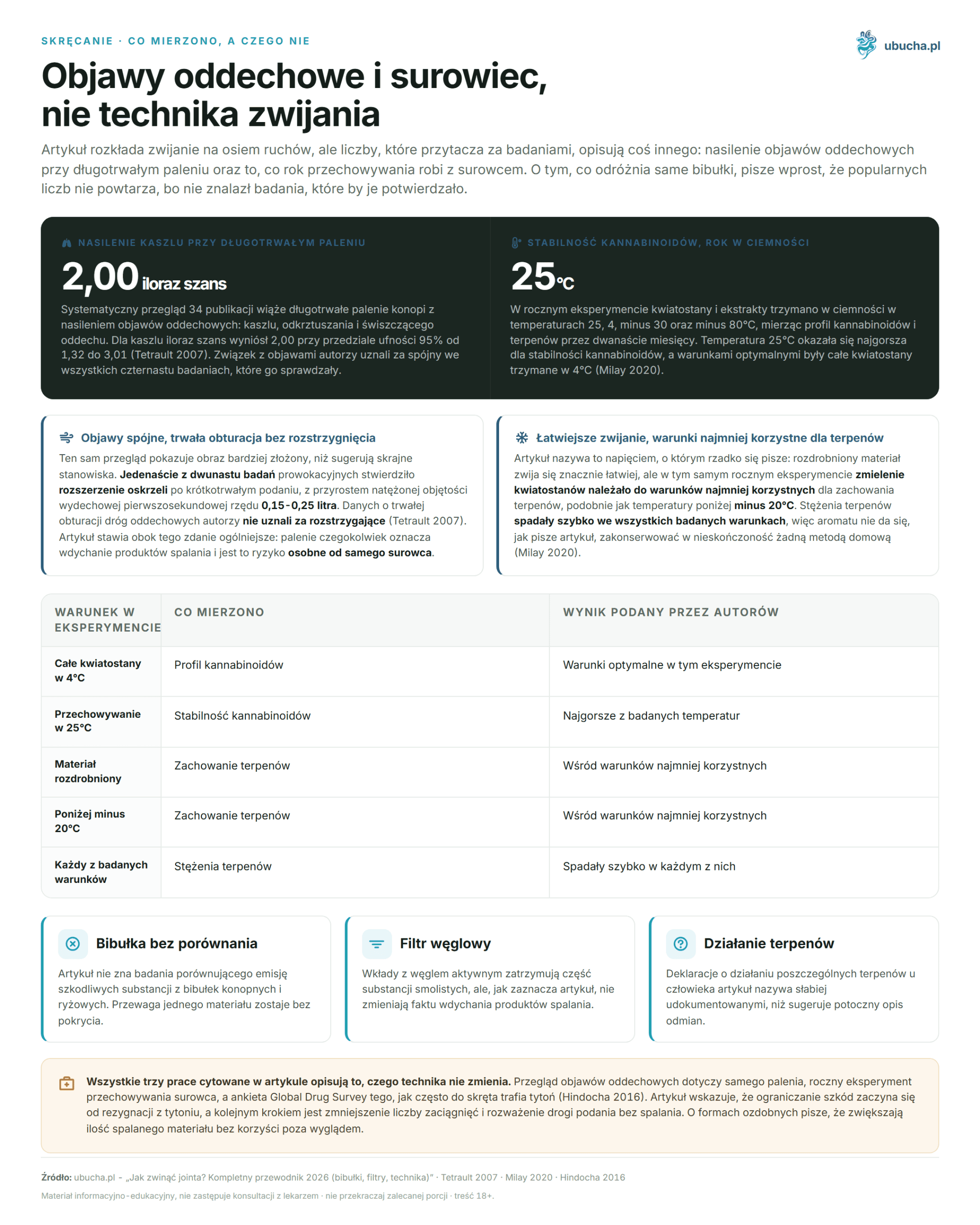
• A review of 34 publications links long-term smoking of cannabis with increased respiratory symptoms, including cough (odds ratio 2.00; 95% confidence interval from 1.32 to 3.01) (Tetrault 2007, PMC2720277).
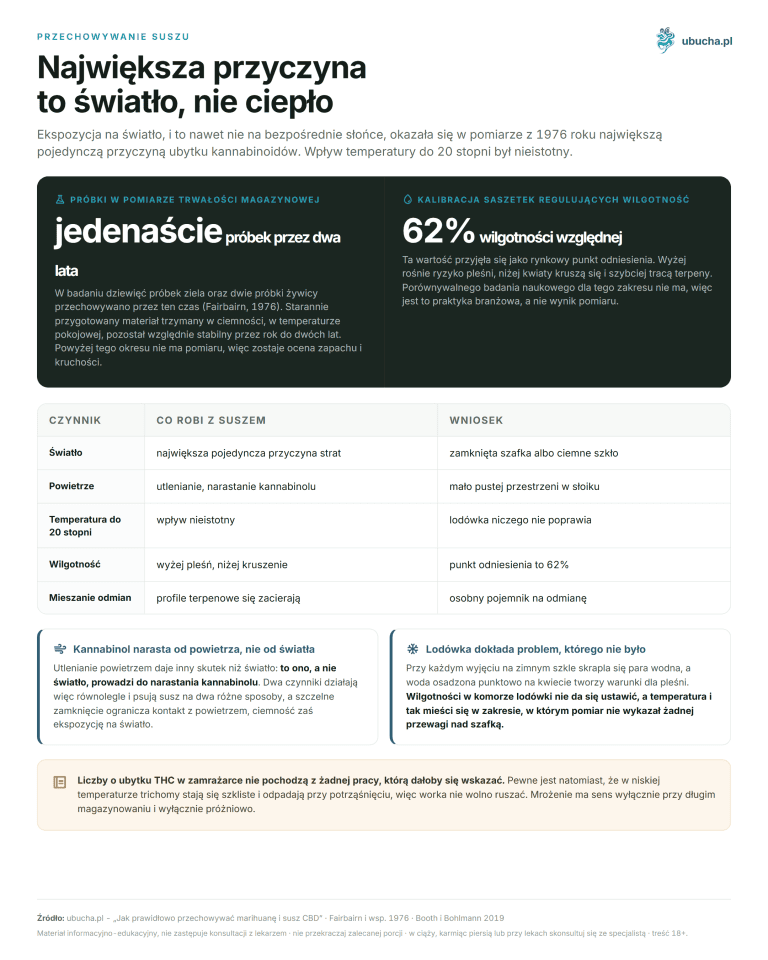
• Store herb in whole buds, in darkness and coolness. In a year-long experiment, a temperature of 25°C most significantly changed the cannabinoid profile (Milay 2020, PMC7593247).
• The Polish threshold of 0.3% is calculated as the sum of delta-9-THC and THCA, not just delta-9-THC.
What is a joint and how does it differ from a spliff?
A joint is a hand-rolled cigarette made of plant material in thin paper, usually finished with a stiff filter. A spliff additionally contains tobacco, a blunt wraps the herb in a tobacco leaf, and a cone describes the shape, not the content. The distinction is practically significant because the presence of tobacco changes both the smoking method and the risk profile.
| Name | What it means | Tobacco |
|---|---|---|
| joint | herb only in paper or hemp paper | no |
| spliff (spliff) | herb mixed with tobacco, historically a European variant | yes |
| blunt | herb wrapped in a cigarette leaf | yes, in a leaf |
| cone | a term for shape: wider tip, narrower side at the filter | depends on the filling |
| roll | Polish colloquial term, encompasses all of the above | depends on the filling |
English forums also use the terms jay and doobie, but these are synonyms for a joint without any technical meaning. In Polish circulation, the term simply used is roll, which does not clarify whether there is tobacco inside. Therefore, when ordering accessories or reading instructions, it is better to stick to precise names.
This seemingly dictionary difference translates into real decisions. International data shows that Europe mainly smokes with tobacco, while both Americas hardly do, and that the choice of method is associated with the willingness to reduce tobacco smoking (Hindocha 2016, PMC4933835). We return to this in a separate section.
What accessories are needed to roll a joint?
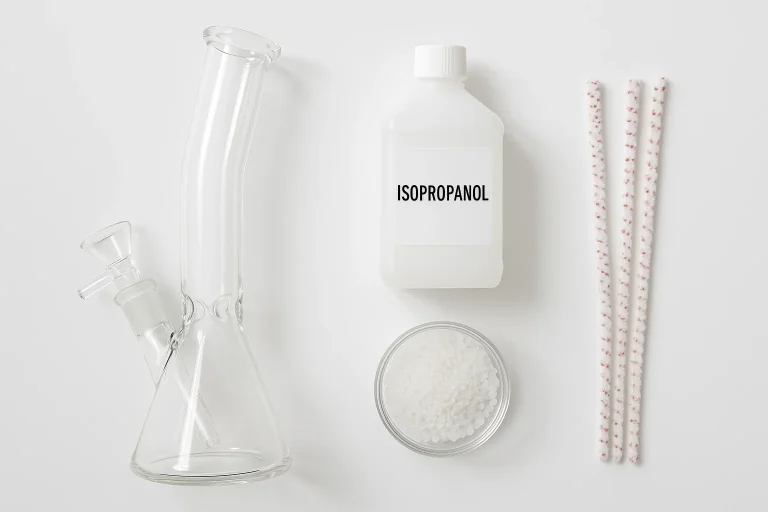
You need four things: paper, a cardboard or carbon filter, a grinder, and a flat surface. The rest is convenience. The biggest difference is made by the grinder, as an even herb texture directly translates to an even draw, and the most common fault of a finished joint comes from uneven grinding.
| Element | Typical parameter | Purpose |
|---|---|---|
| paper | weight from about 10 to 18 g/m², king size slim size | determines taste and burning rate |
| filter (tip) | diameter about 6 mm, length 15-20 mm | holds shape, catches particles |
| grinder | two or four-piece, aluminum or plastic | provides a uniform herb texture |
| tray | metal or plastic, raised edge | limits herb spillage |
Filters are divided into two groups. Cardboard ones are shaped by you from a strip of cardboard and mainly serve a structural function. Activated carbon filters are ready-made inserts of fixed diameter that catch some tar substances, although they do not change the fact that you are inhaling combustion products. If you are wondering how they differ from regular tips, we described it in the text about carbon filters and their actual functioning.
You do not need an expensive set to start. A two-piece plastic grinder and a pack of papers with tips will do the job. Four-piece models also have a screen that collects kief, which can be useful for larger amounts of herb, but does not improve the rolling technique itself.
Which papers to choose for rolling?
For a joint with a filter, the most convenient size is king size slim, which is about 110 by 44 mm. You choose the material based on how pronounced an aftertaste you accept: rice papers are the thinnest and most neutral, hemp papers are slightly thicker and more forgiving for beginners, and flax papers burn the most evenly.
| Size | Sheet dimension | Use |
|---|---|---|
| single wide | about 68-70 mm long | short rolls without a filter |
| 1 1/4 | about 78 mm long | small portion, single-person session |
| king size slim | about 110 by 44 mm | European standard with a filter |
| king size | about 110 by 55 mm | wide cones, larger portion |
Flavored and colored papers are a separate matter. The addition of flavor masks the terpene profile of the herb, so with good raw material, it loses its purpose, and dyes are an additional substance that burns. If you care about the taste of the herb itself, choose paper without additives in the thinnest version you can roll.
An alternative to sheets are ready-made cone tips with an inserted filter, to which you just need to add ground herb and press. We gathered a comparison of both approaches along with wraps in the text about papers, wraps, and ready-made cones. For someone just starting out, a cone can be a better first step than struggling with a sheet.
How to grind herb and why does the texture matter?
The grind size affects the draw more than any other parameter because it determines how much air passes through the filling. Material that is too fine clumps into a solid mass and chokes the flow. Too coarse leaves empty channels through which the fire travels faster than through the rest of the cross-section.
A practical point of reference is coarsely ground coffee. Put one portion into the grinder, make a few turns in both directions, and check the effect instead of grinding to the max. Grinding to the max turns part of the material into dust, which settles at the filter and clogs it after two or three puffs. Large, hard pieces of stem are better removed than trying to grind them down.
Here arises a tension that is rarely written about. Ground material rolls much easier, but in a year-long experiment on storage conditions, it was precisely grinding the buds that was among the least favorable conditions for preserving terpenes (Milay 2020, PMC7593247). The resolution is simple: grind just before rolling and only as much as you will use right away.
A two-piece grinder is sufficient. Four-piece versions have an additional chamber and screen through which kief passes, which can be useful for larger amounts, but does not change the quality of the grind itself. Breaking up with fingers or scissors gives uneven material, so if your rolls come out one-sided despite careful rolling, start your corrections from this stage.
How to roll a joint step by step?
The entire sequence consists of eight moves and takes less than three minutes after a few repetitions. The first attempts will take longer, and that is normal. The most important rule is: evenly distributing the herb before rolling saves more joints than any trick done later.
- Prepare a flat, clean surface and lay out the paper, filter, grinder, and herb. Wash and dry your hands, as grease from your fingers weakens the glue strip.
- Grind 0.4 to 0.6 g of herb, making a few turns of the grinder in both directions. The texture should resemble coarsely ground coffee, without fine dust.
- Shape the filter from a strip of cardboard: make three narrow accordion folds over a length of about 8 mm, and roll the rest of the strip around them into a cylinder about 6 mm in diameter.
- Lay the paper with the glue strip facing up, towards you, and fold it along to create a shallow trough. Insert the filter into one end so that it sticks out about 2 mm.
- Sprinkle the herb along the trough, starting just by the filter. Spread it evenly, with a slight bulge on the opposite side if you want to achieve a cone shape.
- Hold the paper under the herb with your thumbs and index fingers, shape the contents into a cylinder with a gentle up-and-down motion, and then fold the lower edge over the herb.
- Moisten the glue strip with one smooth motion from left to right, press it against the second layer of paper, and hold for three seconds. Excess moisture softens the paper.
- Pack the tip with a thin stick, and twist the protruding piece of paper into a small candle to keep the herb inside.
The most difficult step is the sixth, as it requires a feel that cannot be described in words. Practice it a few times on an empty paper, without herb. The movement is led by the side of the filter, and the other side simply follows it.
How does a cone differ from a simple roll?
A cone has a tip wider than the filter side, causing the channel cross-section to grow as it burns. A simple cylinder becomes tighter towards the end because tar substances accumulate near the filter. The geometry of the cone partially compensates for this, which is why ready-made cones are produced in this shape.
The rolling technique is almost identical. The difference lies in the distribution of the herb: in a cone, about two-thirds of the contents land in the first third of the length counting from the tip, while the filter side remains noticeably thinner. Rolling such a shape requires more skill, as the paper must wind unevenly.
Ready-made cone tips shorten the entire procedure to two actions, which are filling and pressing. The cost is a lack of control over packing density and the fact that you choose from sizes offered by the manufacturer. For someone learning the technique, a cone can be useful as a reference point: it shows how densely a well-rolled joint should be packed.
A cone also has two disadvantages worth knowing in advance. The wider tip ignites over a larger surface, so the first puffs can be harsher than with a cylinder, and with careless lighting, it is easier to get an uneven line of fire. The second disadvantage is greater material consumption: the same king size slim sheet rolled into a distinct cone will hold more herb than rolled into a simple cylinder, which in a single-person session simply means wasting material.
The choice between one shape or the other thus comes down to the situation. A simple cylinder works well for a small portion and when learning the technique, as it forgives more and shows faster whether the herb has been evenly distributed. A cone makes sense for a session for two people and when you want the last third to burn as comfortably as the first.
Is it worth rolling a cross-joint and decorative forms?
A cross-joint is three connected rolls in the shape of a cross, popularized by the film “Pineapple Express” from 2008. It looks impressive but burns unevenly because three channels of different lengths cannot draw equally. This is a show technique, not an everyday one.
The principle of execution is simple in description and difficult in practice. You roll a base joint and a second, thinner one, pierce the first with a toothpick about one-third of the way from the tip, thread the thinner joint through the hole, and seal the connections with a strip of paper. Losses of herb at the connections are noticeable.
Similar principles apply to decorative variants: a tulip ending with an expanded cup, a braid woven from three thin rolls, or a form with one side arm. All require two or three papers and all fall short of a regular cone in terms of draw equality. If you want to genuinely improve the quality of the session, you will gain more by refining the classic shape than by learning the cross-joint.
There is also an argument for restraint. Multi-ended forms are lit from several ends at once, so smoke is produced faster than you can consciously dose it, and the connections and seals mean that the material smolders even when no one is inhaling. From a harm reduction perspective, this is a step in the wrong direction, as it increases the amount of material burned without any benefit beyond appearance.
If you still want to try, do it with material you do not mind wasting, and treat the effect as a manual exercise. Real skills useful in everyday life can be found elsewhere: evenly distributing the herb, feeling the right pressure, and a single, confident sealing of the edge. These three things improve every joint, regardless of its shape.
What mistakes most often ruin a joint?
Almost all faults of a finished joint boil down to ten repeatable mistakes. Each has a simple correction, but you need to know what to look for, as the symptom can be the same: the joint draws poorly or burns unevenly. The table below matches the symptom with the cause.
| Error | Symptom | Correction |
|---|---|---|
| too strong packing of the herb | draws like through a clogged straw | density such that the joint slightly bends under your fingers |
| too loose cylinder | losing herb, burning unevenly | press with a stick from the tip side |
| uneven grinding | empty channel or clogged draw | texture like coarsely ground coffee |
| paper laid upside down | the joint does not stick | the glue strip is always on top, facing you |
| too short filter | bits in the mouth | length 15-20 mm |
| herb too dry or moist | crumbles or fails to ignite | store in an airtight container, see below |
| under-packed tip | burning unevenly | press with a stick before twisting |
| greasy or wet fingers | softened paper | wash and dry hands before working |
| soaked glue strip | unrolling during smoking | one short motion, without repeating |
| giving up the filter | burning fingers, uneven draw | treat the filter as a mandatory element |
If the joint is already burning unevenly, you do not have to throw it away. Extinguish the ember, moisten the paper on the side that is burning faster, and relight. Moisture will slow down the burning and even out the line of fire.
Should you add tobacco to a joint?
There is no reason why tobacco should improve a joint, and there is one serious reason to skip it: it adds an addictive substance to an activity that is burdensome to the respiratory system in itself. In European practice, tobacco still dominates, although this does not stem from any technical advantage.
The scale is well documented. In the 2014 Global Drug Survey, which included 33,687 cannabis smokers in the past year, 65.6% reported using tobacco. In Europe, the percentage ranged from 77.2% to 90.9%, in Australasia from 20.7% to 51.6%, and in both Americas only from 4.4% to 16.0% (Hindocha 2016, PMC4933835). This is a cultural difference, not a technological one.
This same work shows something else. People using methods without tobacco more often reported a desire to reduce tobacco smoking and a willingness to seek help in this regard. The authors conclude that interventions regarding both substances should encourage tobacco-free methods. We elaborated on this topic in the post about combining cannabis with tobacco.
If you care about the volume of the filling, herbs work instead of tobacco: chamomile, mullein, damiana, lemon verbena, mint, or lavender. They do not contain nicotine and do not change the rolling procedure. However, it should be remembered that burning any plant material produces smoke, so replacing tobacco with herbs reduces one risk but does not eliminate all.
How to store herb so that the joint burns evenly?
Keep herb in whole buds, in an airtight container, without light access, and in coolness. Grind only directly before rolling. Moisture determines whether the material can be rolled evenly: over-dried crumbles when squeezed, and too moist does not hold the ember.
The most specific data on storage comes from a year-long experiment in which buds and extracts were kept in darkness at temperatures of 25, 4, minus 30, and minus 80°C, measuring the cannabinoid and terpene profile over twelve months. A temperature of 25°C turned out to be the worst for cannabinoid stability, while optimal conditions were whole buds kept at 4°C (Milay 2020, PMC7593247).
This same work brings two less obvious conclusions. First, terpene concentrations dropped quickly in all studied conditions, so aroma cannot be preserved indefinitely by any home method. Second, grinding the material and temperatures below minus 20°C were among the least favorable conditions. Grinding a stash a few days in advance works against you.
In practice, this means a glass jar with a seal, stored in a dark and cool place, opened as rarely as possible. Humidity-regulating packets help maintain a steady level, but they cannot replace coolness and lack of light. Buy a stash in portions that you will use in a reasonable time, instead of keeping a large jar for a year.
How to choose herb or a blend for a session?
The choice of raw material depends on whether you want an aromatic effect or the action of phyto-compounds. Legal herb from industrial hemp provides a terpene profile and cannabidiol content with THC below the statutory threshold. Pure herbal blends do not contain cannabinoids at all and remain solely a taste experience.
Terpenes are responsible for the smell and partially for the perception of the session. Myrcene is associated with earthy and herbal notes, limonene with citrus, pinene with resinous, and linalool with floral. Claims about the specific effects of individual terpenes on humans are, however, less well documented than the common descriptions of strains, so treat them as aromatic hints, not a promise of effect.
When purchasing herb, pay attention to whether the seller provides a laboratory test result for a specific batch. The content of phyto-compounds in plant material varies between harvests even within the same strain, so a declaration on the label without reference to a batch number says little. You are primarily interested in confirmation that the sum of delta-9-THC and THCA is below the statutory threshold, as this determines the legality of the material.
A practical rule when choosing the portion size is simple: start with a smaller amount than you think you need. A king size slim joint usually holds between 0.4 to 0.6 g of herb and is enough for a session for one or two people. If you are smoking alone, a 1 1/4 sheet with a portion of about 0.3 g may be a more sensible choice than an unfinished cone, which loses aroma after an hour.
What does smoking do to the respiratory system?
Smoking anything means inhaling combustion products, and this is a separate risk from the raw material itself. A systematic review of 34 publications found that long-term smoking of cannabis is associated with increased respiratory symptoms: cough, expectoration, and wheezing. For cough, the odds ratio was 2.00 with a 95% confidence interval from 1.32 to 3.01 (Tetrault 2007, PMC2720277).
This same analysis shows a picture more complex than extreme positions suggest. Eleven out of twelve provocative studies found bronchodilation after short-term administration, with an increase in forced expiratory volume in one second of about 0.15-0.25 liters. The authors did not consider data on permanent obstruction of the airways as conclusive, while they recognized the association with symptoms as consistent across all fourteen studies that examined it.
The practical conclusion is simple. Harm reduction starts with giving up tobacco, and the next step is to reduce the number of puffs and consider a method of administration without combustion. We gathered a comparison of different methods of use in terms of respiratory system burden in the text on what harms the least.
What is the legal status of hemp herb in Poland?
Legal is herb from industrial hemp, i.e., plants of Cannabis sativa L., in which the sum of the content of delta-9-THC and tetrahydrocannabinolic acid in flowering or fruiting tops does not exceed 0.3% in relation to dry mass. The sum is rounded to one decimal place.
The basis is Article 4 point 5 of the Act of July 29, 2005 on counteracting drug addiction (consolidated text Journal of Laws 2023 item 1939), as amended by the Act of March 24, 2022 (Journal of Laws 2022 item 763), effective from May 7, 2022. Previously, the national threshold was 0.20%.
Two distinctions are often confused, and both have practical significance. First, the threshold refers to the sum of delta-9-THC and THCA, not just delta-9-THC, which changes the result of laboratory testing, as the acidic form predominates in raw material. Second, the national threshold corresponds to the EU threshold, but does not derive from it: the EU value of 0.3% for varieties covered by agricultural support comes from Article 4 paragraph 4 of Regulation 2021/2115, applicable from January 1, 2023, and is a separate regulation.
Plant material above this threshold is considered cannabis other than industrial hemp under Article 4 point 37 of the Act, and its possession is subject to criminal liability under Article 62. Separate regulations on health protection against the consequences of tobacco use prohibit smoking in enclosed public spaces. Do not drive after a session: police screening tests do not determine what exactly you smoked.
Summary
Rolling a joint is a manual skill that grows through repetition, not through equipment. Four things determine the outcome: even grind texture, a stiff filter of reasonable length, moderate packing, and the right moisture of the raw material. When these conditions are met, the shape and brand of the paper become a matter of taste.
The health layer is simpler than it seems. Tobacco adds a risk that you do not have to accept, and combustion itself is associated with increased respiratory symptoms. If you want to limit this, start by giving up tobacco and smaller portions, and only then consider changing the method of administration.
It is also worth clarifying what you will not find in this text. We do not provide a ranking of paper brands or prices of accessories, as the assortment and rates change faster than the article, and comparisons circulating on forums almost never indicate the measurement method. We also do not repeat popular numbers about the alleged superiority of one paper material over another, as we have not found a study that confirms them.
What remains is what can be verified and repeated: the procedure, dimensions of elements, storage conditions, and the legal status as of the date of the text update. If you want to go further, the best investment is not more expensive equipment, but a dozen conscious repetitions on cheap material, during which you observe what changes with each density correction.
Frequently Asked Questions
How much herb is needed for one joint?
A king size slim sheet usually holds between 0.4 to 0.6 g of herb, a smaller 1 1/4 size about 0.25-0.35 g, and a wide king size cone can hold up to 1 g. A portion of about 0.5 g is enough for a session for one or two people.
Is hemp paper healthier than rice paper?
We do not know of any study comparing the emission of harmful substances from hemp and rice papers, so claims about the health superiority of one material are unfounded. The differences you will actually feel relate to the thickness of the paper, aftertaste, and burning rate, not the safety of the session.
How long can a rolled joint be kept?
The shorter, the better. Ground herb loses aroma faster than whole buds, and in a year-long experiment, grinding the material was among the least favorable conditions for preserving terpenes (Milay 2020, PMC7593247). Roll just before the session instead of preparing a stash.
Can you roll a joint without a filter?
Technically yes, but every part of the session suffers. Without a filter, bits of herb get into your mouth, the last puffs burn your fingers, and a cylinder without a rigid support is easier to crush and burns unevenly. Treat the filter as a structural element, not an accessory.
Why does a joint only burn on one side?
There are three reasons: uneven distribution of herb, an under-packed tip, or too strong puffs. A quick fix is to extinguish the ember and moisten the paper on the side that is burning faster. A permanent solution is to distribute the herb more carefully before rolling.
Does smoking herb from industrial hemp harm the lungs?
Smoking means inhaling combustion products regardless of the raw material. A review of 34 publications linked long-term smoking of cannabis with increased respiratory symptoms, including cough (odds ratio 2.00; 95% confidence interval from 1.32 to 3.01) (Tetrault 2007, PMC2720277). Giving up tobacco reduces part of this burden.
Does a rolling machine make sense for beginners?
A rolling machine helps those who find manual technique difficult and when preparing several joints at once. It produces a consistent cylinder but takes away control over packing density and does not teach feel. Treat it as a transitional tool, not a final method.
Papers, filters, and rolling accessories can be found in the papers category in the u Bucha store.
This article is for informational and educational purposes and does not constitute legal advice. The legal status described in the article is valid as of the date of publication: regulations regarding cannabis may change. Before making a decision, consult a lawyer or current legal acts.
Author: Michał Waluk · Published: 2026-05-04 · Updated: 2026-08-10