
CBD Roll-on for Muscle and Joint Pain: How to Use (FAQ)
CBD roll-on for muscle and joint pain. What two studies in humans showed, why the Hammell study concerns rats, and how the roll-on differs from ointment.
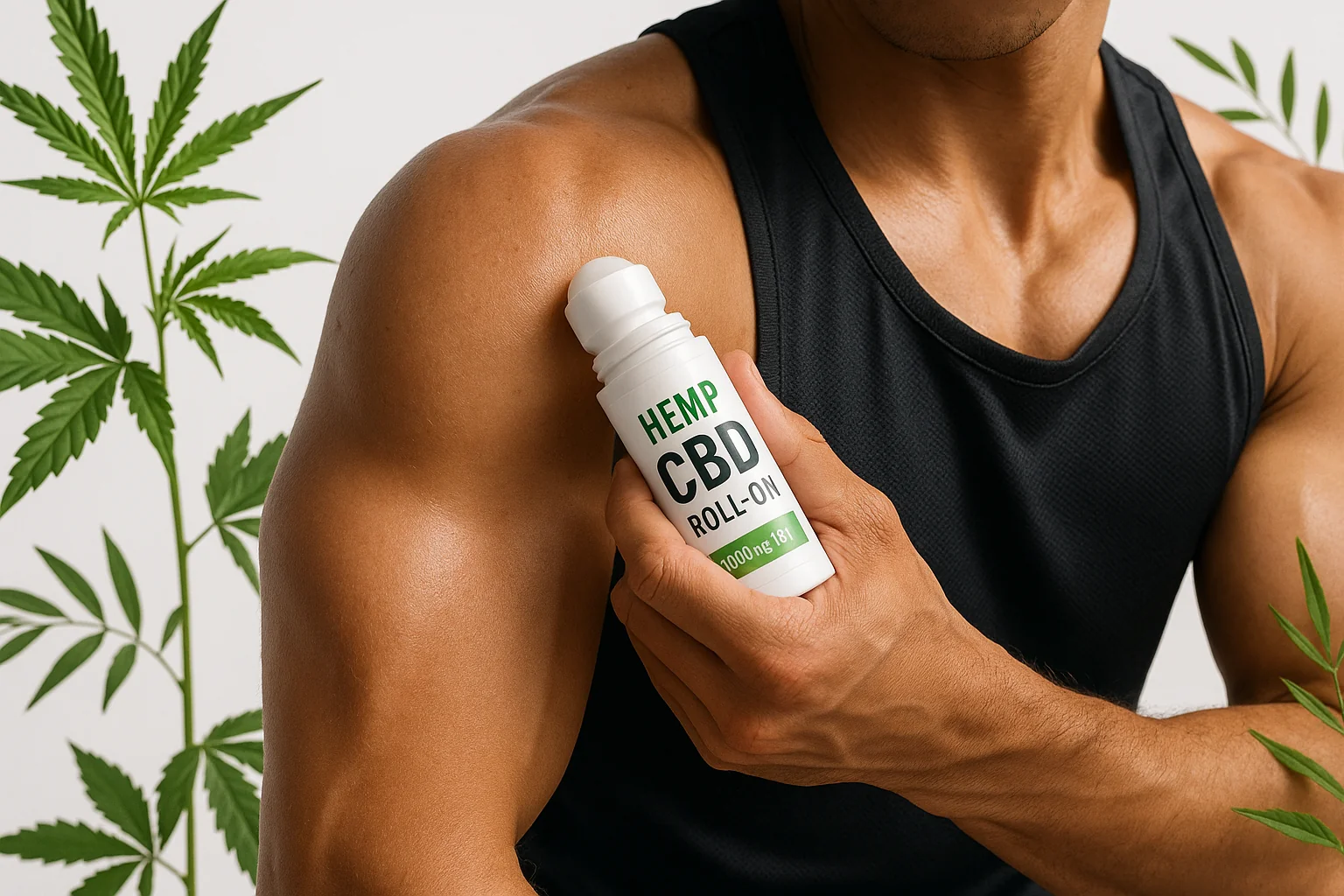
A CBD roll-on is one of the more convenient formats for topical cannabis application: the ball applicator allows you to apply the product to a painful knee or tense calf without hand contact with the product. The convenience is undeniable, and the question of effectiveness requires checking what has actually been measured. The answer is shorter than product descriptions suggest: there are two controlled studies of topical cannabidiol in humans for muscle and joint pain, and they yield opposing results. The most frequently cited work in this matter concerns rats, and its conclusion about absorption is often reversed. This text collects available measurements, separates what pertains to the skin from what pertains to the bloodstream, and states what is not available in the store.
KEY INFORMATION
• In a randomized study of 60 people with myofascial pain of the jaw, topical cannabidiol reduced the tension of the masseter muscle in electromyographic recording and pain on a visual analog scale.
• In a randomized study of 80 people after knee prosthesis implantation, topical cannabidiol did not reduce pain or opioid consumption.
• The Hammell study, cited as evidence of action without absorption, is a rat model, and the concentration of cannabidiol in plasma increased linearly with the dose.
• Cannabidiol was removed from the list of prohibited substances by the World Anti-Doping Agency with the release effective from 2018. Other cannabinoids still appear on it.
• The store ubucha.pl does not carry roll-ons with cannabidiol; catalog status as of August 16, 2026.
How can cannabidiol applied to the skin work topically?
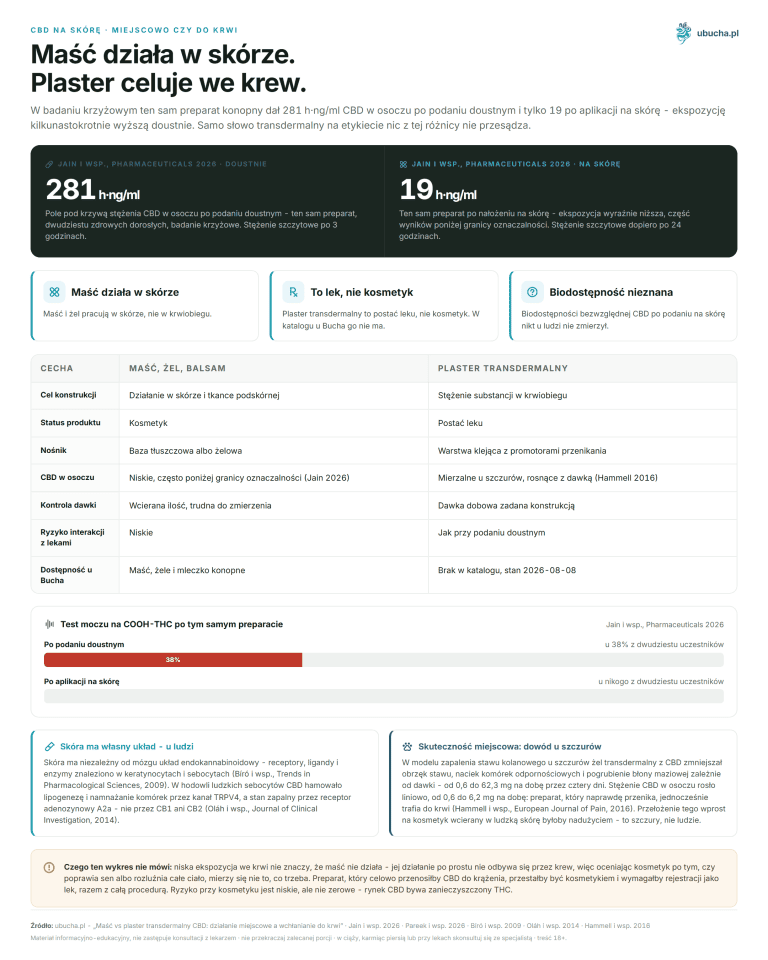
The skin has its own endocannabinoid system. A review of this field describes the presence of endocannabinoids, cannabinoid receptors coupled with G-proteins, and synthesis and degradation enzymes in epidermal cells and appendages, and recognizes its basic physiological function as maintaining the balance of proliferation, differentiation, and survival of skin cells. Disruption of this balance is associated with the development of skin diseases, including itching and pain (Bíró et al., Trends in Pharmacological Sciences, 2009). This is a description of the system that a topical product can affect, not a measurement of the effectiveness of a specific product.
The second issue is the penetration of substances through the stratum corneum. A study on human skin permeability in diffusion cells compared four solutions and two semi-solid forms and showed that the carrier determines the outcome: the optimal choice turned out to be a hydrophilic gel mainly composed of propylene glycol (Casiraghi et al., Pharmaceuticals, 2020). The practical conclusion is that the declared content of cannabidiol does not yet say anything about how much will reach the tissue, as the base of the product determines this.
Additionally, there is a purely mechanical effect. Rolling the ball over the skin and spreading the product with fingertips is a form of massage that itself relaxes soft tissues. This is not due to cannabidiol, and when assessing its own effect, it is worth remembering this.
Does the Hammell study prove action without absorption into the blood?
No, and this is the most frequently reversed statement in this entire topic. The work concerns rats with monoarticular knee inflammation induced by complete Freund’s adjuvant. Gels with cannabidiol in doses of 0.6, 3.1, 6.2, or 62.3 mg per day were applied for four consecutive days, after which the joint circumference, immune cell infiltration, and threshold response to thermal stimulus were measured. Swelling, infiltration, and thickening of the synovial membrane decreased depending on the dose, and effective doses were 6.2 and 62 mg per day (Hammell et al., European Journal of Pain, 2016).
The previous version of this article stated that the study showed local action “without visible systemic effects.” The work says something opposite in the pharmacokinetic layer: the measurement of cannabidiol concentration in plasma after absorption through the skin showed linearity in the dose range from 0.6 to 6.2 mg per day. The substance therefore passed into the bloodstream, and that proportionally to the dose. The sentence that the authors actually wrote is different: local application has therapeutic potential without visible side effects. The absence of side effects is not the same as the absence of absorption. In humans, we do not know the scale of this phenomenon: a systematic review of the pharmacokinetics of cannabidiol established absolute bioavailability only after smoking, and no study has done so for transdermal application (Millar et al., Frontiers in Pharmacology, 2018).
Additionally, there is the species issue. This was a rat model with a gel designed for transdermal penetration, not a shelf cosmetic. The difference between local action and absorption into the bloodstream has been separately outlined in our post about how ointment differs from a transdermal patch.
What have studies of topical cannabidiol in humans shown?
There are two controlled studies on muscles and joints, and they yield opposing results, so it is fair to present both. The first involved 60 patients with myofascial pain in the temporomandibular joint, randomly assigned to a cannabidiol preparation or placebo, in a parallel design with double blinding. The preparation was applied to the masseter muscle twice daily for fourteen days. In the cannabidiol group, muscle activity in the surface electromyographic recording decreased by 11% on the right side and 12.6% on the left, compared to 0.23% and 3.3% in the placebo group, and pain on the visual analog scale decreased by 70.2% versus 9.81% (Nitecka-Buchta et al., Journal of Clinical Medicine, 2019).
The second study involved 80 patients after primary unilateral knee arthroplasty, randomly assigned to four groups: cannabidiol, essential oil, both together, and placebo. The preparation was applied around the knee three times daily for two weeks post-surgery, as a supplement to standard multimodal analgesia. Cannabidiol did not reduce pain, cumulative opioid consumption, nor improve sleep scores, and on the second day post-surgery, the cannabidiol group reported higher pain than the essential oil group (Haffar et al., The Journal of Arthroplasty, 2022).
The difference between these works lies in the clinical situation. The first concerned chronic muscle tension in outpatients, while the second acute postoperative pain in individuals already receiving strong medications. The conclusion for the reader is cautious: there is a signal for muscle tension, but none for postoperative pain.
How does the roll-on differ from ointment and gel?
Primarily in the method of administration, not the mechanism. All these forms are supposed to act in the skin and in the tissue beneath it, but they differ in base and control of the amount applied. The following table organizes what can be said about them without fabricating action times that no one has measured.
| Form | Base | Amount Control | What has been measured |
|---|---|---|---|
| Roll-on | Usually water or water-alcohol | Difficult, dependent on the number of rolls | No studies for this form |
| Gel | Water or water-alcohol | Difficult, rubbed amount | Permeation through human skin in laboratory conditions |
| Ointment, cream, and other semi-solid preparations | Fatty, seals the skin more effectively | Difficult, rubbed amount | Two controlled studies in humans, opposing results |
| Transdermal patch | Adhesive layer with penetration enhancers | Daily dose set by design | Form of medication, not cosmetic |
The previous version of this text provided the time to effect and duration of action in hours for each form. None of these values had a source, and all have been removed. Practical tips regarding the base of the preparation and situations where a topical cannabis preparation is insufficient have been gathered in our post about hemp ointment for joints and muscles.
Is the CBD roll-on safe for athletes?
The World Anti-Doping Agency prohibits all natural and synthetic cannabinoids with one exception, which is cannabidiol. It was removed from the list of prohibited substances with the release effective from 2018. Tetrahydrocannabinol remains prohibited only in competitions and only above the threshold of 150 nanograms per milliliter of the metabolite 11-nor-9-carboxy-THC in urine; outside of competitions, it is not subject to control.
The risk for the athlete does not lie in cannabidiol itself, but in the contamination of the product. Full-spectrum products contain trace amounts of tetrahydrocannabinol, and quality testing of cannabis products regularly shows discrepancies between the label and actual content. For individuals subject to the anti-doping system, isolates or broad-spectrum products with a laboratory certificate indicating the absence of tetrahydrocannabinol are a safer choice.
It is also worth being careful in formulating this condition. The threshold of 0.3% is not a specification of the finished product, but a definition of the plant: it concerns the sum of delta-9-THC and tetrahydrocannabinolic acid in flowering or fruiting tops of cannabis, calculated on a dry weight basis, according to Article 4 point 5 of the Act on Counteracting Drug Addiction as amended by the Act of March 24, 2022. The certificate of the preparation should state the absolute content, not refer to the plant threshold.
Is the cannabis roll-on a cosmetic and what does it change?
Yes, and this determines two things at once. First, a cosmetic cannot promise treatment, so descriptions claiming to alleviate joint inflammation go beyond what such a product is allowed to declare. Second, it determines the composition of the raw material. Position 306 of Annex II to Regulation (EC) No 1223/2009 prohibits in cosmetics substances from the lists of the 1961 Single Convention, and these include cannabis tops with resin and their extracts. Raw materials derived from seeds are allowed.
Practically, this means that when purchasing, it is worth checking whether the cannabis in the composition is an extract from flowers or only seed oil, which practically does not contain cannabidiol. The trade name does not determine anything here, and the declared content in milligrams on the package without stating the volume does not allow for comparing two products.
Regarding the purchase: in the catalog of the store ubucha.pl, according to the status as of August 16, 2026, there are no roll-ons with cannabidiol in any category. However, hemp massage gels are available, which have the same water base and the same purpose for muscles and joints.
Frequently Asked Questions
Does the CBD roll-on work for muscle pain?
There are no studies for the roll-on itself. For topical cannabidiol, there are two controlled studies in humans with opposing results: in myofascial pain of the jaw, a decrease in muscle tension and pain was observed, while in pain after knee prosthesis implantation, no benefits were noted.
Does CBD from the roll-on absorb into the bloodstream?
Partially yes, contrary to popular belief. In a study on rats, the concentration of cannabidiol in plasma increased linearly with the dose after transdermal administration. Absolute bioavailability after transdermal application has not been measured in humans in any study, so we do not know the scale of this phenomenon in humans.
How does the roll-on differ from CBD ointment?
The mechanism is the same; they differ in base and method of application. Roll-ons usually have a water or water-alcohol base and do not dirty hands, while ointments have a fatty base, seal the skin more effectively, and allow for more intense massage of the product. Comparisons of action times circulating in product descriptions have no source.
Can the CBD roll-on give a positive result in a doping test?
Cannabidiol itself has not been on the list of prohibited substances since the release effective from 2018. The risk comes from contamination with tetrahydrocannabinol in full-spectrum products. The threshold for a positive result for its metabolite is 150 nanograms per milliliter in urine and applies only in competitions.
Where should the cannabis product not be applied?
It should not be applied to open wounds, burns, broken, infected, or irritated skin, nor on mucous membranes and around the eyes. During pregnancy and breastfeeding, the decision should be left to the doctor. When using topical pain medications simultaneously, do not combine both products in the same area.
Is the CBD roll-on available in the store ubucha.pl?
No. According to the catalog status as of August 16, 2026, the store does not carry roll-ons with cannabidiol in any category. Available are hemp massage gels with a similar purpose, including cooling and warming variants.
You can find hemp massage products in the hemp gels category.
This article is for informational and educational purposes only and does not constitute medical advice. Before starting to use cannabis or CBD for therapeutic purposes, consult your doctor, especially if you are taking other medications, are pregnant, or breastfeeding.
Author: Michał Waluk · Published: 2026-08-09 · Updated: 2026-08-16